Turning an AC stick welder into DC

   / Turning an AC stick welder into DC #1  

rhamer

Silver Member
Joined
Sep 5, 2008
Messages
117
Location
Melbourne, Australia
Are there add on rectifiers that can be bought to turn an AC welder into a DC one?

Is it that simple, or is there a catch?

Cheers

Rohan
 
   / Turning an AC stick welder into DC #2  
Rohan when I was 16 I got a job i n the machine shop of a small manufacturing plant. we mostly wire welded but when a Die block in the stamping room broke we had to stick them. This company was started in the 50's and had 4 old giant stick welders. One was a huge refrigerater sized General Electric welder that was AC. It did good bt didnt have neough penetration. an old timer in the plate shop part had some DC rectifiers he tried putting on the out put side but that was trouble some. They worked flawlessly on the input side. Used the DC contered power in the transformer. I welded alot with that welder. I Talked to friend that works there now and he said its used weekly. There also been a few posted in Farmshow magazine. You can go to Farmshow.com and look up back issues but you have pay for a reprint. I think this is the rectifier method they used.
 
   / Turning an AC stick welder into DC
  • Thread Starter
#3  
How do you put a rectifier on the primary of a transformer and have the transformer still work?

I realise the output from a straight bridge rectifier really just has the -ve part of the waveform inverted, so you get lumpy DC.

Cheers

Rohan
 
   / Turning an AC stick welder into DC #4  
Just google "welder ac dc rectifier" and be prepared to wade through a lot of info.
Here is one of my favorite threads.

Machine Builders Network
 
   / Turning an AC stick welder into DC #5  
I have seen this on a Yahoo members page. One member did it with diodes on both leads.

Dan
 
   / Turning an AC stick welder into DC #6  
You also need a choke in line.
 
   / Turning an AC stick welder into DC #7  
Rohan when I was 16 I got a job i n the machine shop of a small manufacturing plant. we mostly wire welded but when a Die block in the stamping room broke we had to stick them. This company was started in the 50's and had 4 old giant stick welders. One was a huge refrigerater sized General Electric welder that was AC. It did good bt didnt have neough penetration. an old timer in the plate shop part had some DC rectifiers he tried putting on the out put side but that was trouble some. They worked flawlessly on the input side. Used the DC contered power in the transformer. I welded alot with that welder. I Talked to friend that works there now and he said its used weekly. There also been a few posted in Farmshow magazine. You can go to Farmshow.com and look up back issues but you have pay for a reprint. I think this is the rectifier method they used.
is it possible that you might have mistyped what you were trying to say. I cannot think of a reason that diodes would not work well in the output side of a welder other than they might not be able to handle the current. On the input side I can think of a lot of reasons why they would not work starting with you cannot get transformer action with dc current.
 
   / Turning an AC stick welder into DC #8  
I have a Linde stick-tig unit and it uses a stand alone dc converter.You can use it with any ac power supply.
 
   / Turning an AC stick welder into DC #9  
Here is a link to purchase a kit:

DC Cheater - Home

A little spendy but probably cheaper than buying a new welder if you already have an older buzzbox that still works good.
 
   / Turning an AC stick welder into DC #10  
I have welded for years with an AC machine. You can buy specific rod for the AC Buzz box, 6011 was designed for AC, so was 6013. You can also buy specific 7018 Ac rod it burns just as good as regular 7018 on a DC machine. About the only thing you can't run on AC is a TIG except if it is on high frequency for Aluminum. 7014 and 7024 burns better on AC than DC.

What I am trying to tell you is there is other ways to make your AC machine perform to near high standard as DC machines.
 
   / Turning an AC stick welder into DC
  • Thread Starter
#11  
I have no problems welding with AC as such, I've been doing it for a few years now and I was taught by my father who was an apprentice welding teacher (that is, he taught apprentices to weld, not he was an apprentice teacher).

The main reason why I'm looking into it is the reduced current requirement when welding with DC will allow me to use slightly bigger rods than I can at the moment.

Cheers

Rohan
 
   / Turning an AC stick welder into DC #12  
I have seen this on a Yahoo members page. One member did it with diodes on both leads.

Dan

Only one diode lead is needed as this is effectively putting two diodes in series. Unless you want be sure to be sure:)

Weedpharma
 
   / Turning an AC stick welder into DC #13  
I'd do it with four diodes, making a diode bridge. You run the two AC leads to two corners and pick up your DC from the other two. Would be a little bit lumpy but you could series the proper number of 12v batteries to smooth it out.....
I've actually got the diodes from my younger more idealistic days but never had a need that the buzz box wouldn't handle so never got around to building the bridge.
 
   / Turning an AC stick welder into DC #14  
the large format diodes will work, on the output side of the welder. most welder voltages are low ~48v or so open when welding that number is lower. (low voltage high amps.) if it requires (50 amps of 240 volts IN) and you get 225 amps out, the max voltage at 225 amps Out it is ~53 volts AC OUT) there are conversion losses that drop that down a bit hence the typical 48 volts ave output.

so you would need a diode that can take double that 100 volts as a safety factor.

amperage is where you need to watch and get some good sized stuff, each diode does not have to handle 250 amps, you can buy 8 100 amp diodes and parallel them to form a single bridge network. usually the larger diodes will be threaded on one end and screw into a heat sync that then becomes part of the "rectifier bridge"

I keep kicking myself for not taking all of the transformers from a large 48V dc 500 amp charger for a forklift that was junked where I worked, when they cleaned out the place it went into the trash recycle hopper. I pulled out all the diodes and ONE of the 3 transformers, 480 to 240 to DC 48 volts. I kept the full 3 phase bridge network and I've also kept a bunch of BIG diodes that they simply tossed that were spare parts from the trashed forklifts. :) You can buy them from ebay and or even industrial supply houses for usually 5 bucks or less. not a lot of call for them. look for an old 3 phase chargers that are on sale at industrial sites too they are good source for spare parts. often if there is a junk store like that locally you can get a charger like one I scrapped out for ~50 bucks. I have an industrial clearance auction site that had them 4 or 5 to a pallet for 50 bucks per pallet... probably 100 bucks in copper in one charger... :eek:

Mark
 
   / Turning an AC stick welder into DC #15  
Does anyone have a wiring diagram for this change over????
 
   / Turning an AC stick welder into DC #16  
I'm interested in this and looking at these cheater boxes that use or need a 120vac fan.
I was thinking to just throw a 78t12 regulator on the DC side and some cheap 12V computer fans have it self powered.
Most 7812's don't like more than 35V input so that may not work...
Back to the drawing board.

Alltoys: take a look at the drawings Nate linked to on post#9
 
   / Turning an AC stick welder into DC #17  
Be careful of the voltage rating of the diodes. If you use a bridge configuration ( 4 diodes) then they need to be rated for at least the peak open circuit voltage. On my 180 amp buzz box, I have 85V RMS open circuit. This works out to approx 120V peak. At least on this welder the above mentioned 100V diodes will likely eventually fail. I would use at least a 200V diode.

While it is possible to paralell connect diodes to increase current capacity, this is ussually not a good idea. Unless the diodes are perfectly matched, they will not carry equal amounts of current, and one could be overloaded.

The diodes will generate some heat when welding. You should use stud mount diodes, mounted in a piece of aluminium.

I wouldn't bother with a choke. The inductance of your welding leads will probably be enough to smooth out the voltage. Try it with just a diode bridge, if you are unhappy with the arc characteristics you can always add a choke later.

I don't think that you will get good results with a single diode connected to your welding lead. It will be vary difficult to maintain an arc with half wave rectified DC. Additionally, you will be cutting your current in half.
 
   / Turning an AC stick welder into DC #18  
Does anyone have a wiring diagram for this change over????
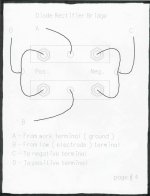
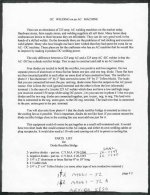
Here are some instructions and diagrams that were posted on one of the welding forums a while back.
 

Attachments

  • ac-dc1.jpg
    ac-dc1.jpg
    74.5 KB · Views: 1,025
  • ac-dc2.jpg
    ac-dc2.jpg
    46 KB · Views: 1,065
  • ac-dc3.jpg
    ac-dc3.jpg
    61.8 KB · Views: 917
   / Turning an AC stick welder into DC
  • Thread Starter
#19  
I have been running the numbers with regard to the current capacity of these AC machines and I'm a little confused.

I know you guys in the US have 220V as well as 110V available for running things such as ovens, washing machines etc.

So are these 225A stick welders running on a 220V circuit and if so what is the typical current availability of such a circuit in a domestic environment?.

In Australia all the domestic stuff is single phase 240V with a general outlet capacity of 10A. 15A circuits are also reasonably common for such things as welders etc, but anything above that and you are getting into industrial 3 phase equipment.

Cheers

Rohan
 
   / Turning an AC stick welder into DC #20  
Rhamer,

For the US and here in Canada we run 110 V, 100 amp service. Some new housing is being pushed up to 200 amp service because of the rise of electrical stuff like computers. This is all 60Hz cycle AC current.

Ovens, Hot Water tanks (electrical), Furnaces (electrical), Welders run on 240V 30 - 50 amp breaker. Pretty much anything else runs on 110V max at 15amp.

There is no 3 phase circuitry in a home. To bring that kind of power into a house would require a high cost for installation.

I have a welder that will produce 300 amps on a 240 volt single phase 45 amp draw. The highest output by a single phase machine at least far as I know.

I hope that has answered your questions if anyone else can add to this go ahead.

Thekid,

Thank you for the diagrams.
 

Marketplace Items

ST205/75R15 Trailer Tires (A55788)
ST205/75R15...
2021 KENWORTH T680 TANDEM AXLE SLEEPER (A59905)
2021 KENWORTH T680...
(15) UNUSED 8'X41' PROTECTION MATS (A60432)
(15) UNUSED 8'X41'...
2019 INTERNATIONAL LT625 TANDEM AXLE SLEEPER (A59905)
2019 INTERNATIONAL...
2012 GROVE TMS900E TRUCK CRANE (A58214)
2012 GROVE TMS900E...
2003 FORD F150 HARLEY DAVIDSON TRUCK (A59575)
2003 FORD F150...
 
Top