moeh1
Gold Member
The local buses weren't running this week until they mixed ULSD Kero in with the diesel. See Cold Freezes Bus Fuel—Closes Schools - 13WHAM.com
Their problem most likely has nothing to do with the science to prove anything about ULSD. Old LSD diesel would have done the same thing.Bob_Young said:If they can't do the science in advance to determine the problems ULSD might cause and how to avert them; then how do we know they did the science to prove ULSD was needed to begin with?


MadReferee said:Their problem most likely has nothing to do with the science to prove anything about ULSD. Old LSD diesel would have done the same thing.
I'll wager the ULSD that the bus company is using is summer blend. They probably bought a significant quantity in the thousands of gallons in the summer to beat the winter price increases. Serves them right for not properly maintaining their fuel with some additives like Power Service. Anything to save a buck.
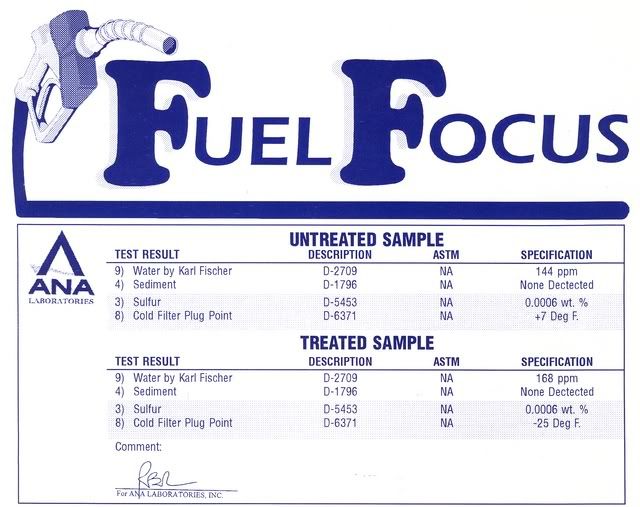
Iowachild said:ULSD is coming right off the treating unit at our refinery with a cloud of -16 degrees F and a pour point of -34 degrees. The "all weather diesel", treated with among other things a pour point improver, had a pour point of -44 degrees F yesterday. BTW we have a terminal in Rochester, NY.
All our crude is Canadian!DieselPower said:That may be very true but not all ULSD that is hitting the pumps has a pour point that low. If the fuel you are talking about comes from PA crude it is naturally lower in paraffin's and higher in aromatic's which lead to lower pour points. However, not everything that is being dispensed is that good. The horrible problems some people are having with temps in above 0 degree F. weather this last weak is proof of that.
Local bus fleet's in Carroll County Maryland had some problems this week and the temp was only down to around +7 or +8 degree's F, and on top of that it is even a winter blend fuel. Around Westminster they cut the winter blend fuel with ULSK 1 (ultra low sulfur kerosene #1) instead of ULSD 1.
One thing I think we need to clear up is some of the terms being thrown around.
Pour Point = The pour point of a fuel is typically 5 degrees F above the temperature at which the fuel fails to flow and turns solid (CFPP). This is also the lowest temperature that the fuel will flow sufficiently to be pumped or transferred.
Gel Point / Cold Filter Plug Point (CFPP) = This is the temperature at which the paraffin waxes in the fuel actually turn solid and clump up.
Pour Point Depressant / Anti-Gel = This is a additive you add to your fuel that lowers the pour point. On the microscopic scale wax molecules are long slender molecules. When they reach the gel point they start to align into clumps that evenly align and start to form microscopic sheets of wax crystals. These clumps are to large to pass through fuel filter media and in severe cases can even form solid clumps in fuel lines. A pour depressant modify's the size and shape of the wax crystals and keeps them from combining with one another to form a gel.
Now, everybody's big question. Do I need a pour point depressant in my fuel? No way of telling without testing your fuel to tell what it's CFPP is. If it's been cold where you are and have not had any problems then your fuel supplier is probably adding a healthy dose of pour point depressants and cutting the fuel with enough ULSK 1 or ULSD 1 to lower the CFPP. If like many you have been having problems I suggest buying some pour point depressant (anti-gel) additive and having it on hand to add to your fuel BEFORE it gel's up. Just keep a eye on the weather reports and when you see a cold spell coming treat your fuel.
Thank you for explaining the difference, and advising end-users to take both with a grain of salt. Not that it matters much... when I asked the managers of the local stations I frequent for the pour and gel point of their winter blend, they -all- said "Gee, I don't know, why would you want to know that?". They've obviously never owned a diesel powered vehicle. I just add PS when temps fall into the teens. I'd rather leave a little money on the table than deal with an incapacitated vehicle in freezing weather.DieselPower said:One thing I think we need to clear up is some of the terms being thrown around.
Pour Point = The pour point of a fuel is typically 5 degrees F above the temperature at which the fuel fails to flow and turns solid (CFPP). This is also the lowest temperature that the fuel will flow sufficiently to be pumped or transferred.
Gel Point / Cold Filter Plug Point (CFPP) = This is the temperature at which the paraffin waxes in the fuel actually turn solid and clump up.
Apparently, you can have TOO MUCH anti-gel additive!?Diesel fuel in school buses jelled, clogging fuel filters. The problem stems from the use of a state-mandated low-sulfur diesel fuel additive. Some districts buy fuel with the additive included while others buy fuel without the additive and add it themselves.
The mandate is new this school year and Monday's extremely cold weather was the first time the additive was needed, Proukou said.
The problem in Spencerport occurred because crews there added the fuel additive to fuel already containing the additive.
The incorrect balance in the fuel caused the fuel to jell.


