Fenceman doing what fencemen do these days

   / Fenceman doing what fencemen do these days #1  

wroughtn_harv

Super Member
Joined
May 12, 2002
Messages
6,092
Location
Denison, Texas
Tractor
2013 Volvo MC85C
I lost my bud LWFrisk which sorta changes the way I post on projects from now on.

You see I used to post pictures and prose here on an ongoing project and Leo would capture it and post it on harveylacey.com.

Harveylacey.com was Leo's passion. It was his baby. He's been fighting cancer since August of last year and that's why harveylacey.com hasn't been updated since October.

I haven't decided what to do about harveylacey.com. There's a part of me that wants to keep it going because it makes my life easier having a place to send someone when they ask how I do something. But then I also realize the reason it's there and so navigatable is because it was Leo's.

I'm doing a fence job in Josephine-Nevada-Farmersville Texas. Yeah, I get confused too. My customer has a Nevada address. Across the street they have Josephine addresses. And a block away they're in Farmersville. And it's all county. /forums/images/graemlins/grin.gif

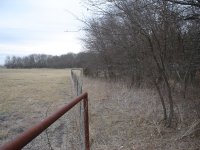
Customer has ten acres that came fenced.
 

Attachments

  • 837196-DSC02399.JPG
    837196-DSC02399.JPG
    53.5 KB · Views: 1,651
   / Fenceman doing what fencemen do these days
  • Thread Starter
#2  
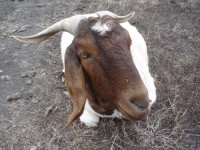
That kind of fencing is okay for guys like Vinnie Van Goat. But it isn't worth a flip for valuable horses.
 

Attachments

  • 837197-DSC02385.JPG
    837197-DSC02385.JPG
    87.2 KB · Views: 1,305
   / Fenceman doing what fencemen do these days
  • Thread Starter
#3  
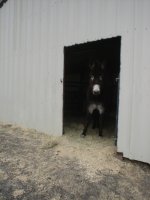
Even old goats have buds. Vinnie's bud is Pascal.
 

Attachments

  • 837201-DSC02411.JPG
    837201-DSC02411.JPG
    63.7 KB · Views: 1,097
   / Fenceman doing what fencemen do these days
  • Thread Starter
#4  
I've got to share a funny story about Pascal. First is him and Vinnie are pets of the worst degree. They came with the property.

So Pascal wasn't halter broke nor had he ever been trailered even though he's two years old and will forever be nothing more than a boy at heart or anything else for that matter.

To put in a new fence we had to remove the old one. That meant putting Pascal into a trailer. But first we had to catch him.

Normally catching him is accomplished with a feed bucket. Think honey and a bee. But Pascal knew something was up. Ten acres is a lot of room to chase a donkey.

So I had the client (We'll call him Gary) go into Pascal's stall and be ready to shut the gate when he went in. Then I jumped into Iris the skid steer and we went on a round up.

In any round up the first rule of thumb is intimidation. I had that one down with Iris' bucket in the up position and rattling like a grandma over a new grandbaby.

When I got Pascal at the door to the stall he decided to have a Mexican face off.

As I approached with the bucket full up and in the rattle loudest position he assumed the cornerback anticipation position.

I stopped and stared.

He stared back.

Then I launched forward rattling the bucket as I yelled at the top of my lungs.

Gary caught the gate behind him.

That was the easy part.

A little donkey can be awful big when they don't want to go into the trailer. /forums/images/graemlins/blush.gif

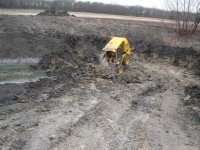
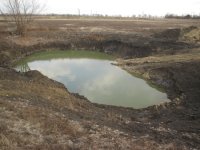
I need lots of dirt to build up a pad where we're going to put a four stall horse barn.

There was lots of dirt in the dried up pond (we're in a drought).
 

Attachments

  • 837203-DSC02408.JPG
    837203-DSC02408.JPG
    80.3 KB · Views: 1,083
   / Fenceman doing what fencemen do these days
  • Thread Starter
#5  
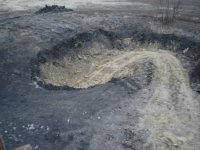
So we removed a lot of dirt from the bottom of the pond before I started anything else because you never know when it's going to rain and then rain some more. And once it starts raining there'll be no more digging in the pond for Iris.
 

Attachments

  • 837210-DSC02418.JPG
    837210-DSC02418.JPG
    70 KB · Views: 997
   / Fenceman doing what fencemen do these days
  • Thread Starter
#6  
And believe it or not, we to some rain last weekend, three and a half inches in about a twenty four hour period.

There'll be no more intentionally driving Iris into the pond.
 

Attachments

  • 837212-DSC02436.JPG
    837212-DSC02436.JPG
    78.4 KB · Views: 919
   / Fenceman doing what fencemen do these days
  • Thread Starter
#7  
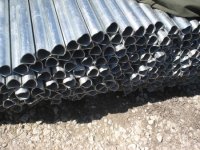
We're looking at thirty two hundred linear feet of five foot high V Mesh horse fence on a welded galvanized two inch (2 3/8 O.D.) pipe framework.

Gary is a helper-student-homeowner-client on this project. We agreed he'd have fun. He's paying for it on a couple of different levels. One of course is physically, he swears he's got an intimate relationship with every grain of sand and piece of stone going into the concrete for the posts.

One of his first chores while I was being the fenceman was to cope five hundred posts. We set up the pipe notcher and let him get after it. And get after it. And then he got after it somemore. In fact, he got after it until he got it.
 

Attachments

  • 837220-DSC02424.JPG
    837220-DSC02424.JPG
    74.1 KB · Views: 1,071
   / Fenceman doing what fencemen do these days
  • Thread Starter
#8  
Here's where Gary gets to have his fun.

There's the sand and gravel, the concrete mixer, ninety four pound bags of Portland cement, he just has to add water. /forums/images/graemlins/grin.gif

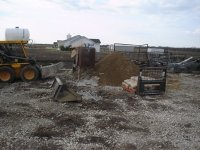
The water tank on top of Iris was required because the clay soil is just about perfectly wrong right now. The big rain soaked down enough to make it clingy. It clings to everything. Mostly itself. And itself gets on everything which attracts more itself to cling to if you know what I mean.

So the old fence man waters his holes as he's augering them in. Not only does it make the holes easier to dig. It also gives him nice even straight up and down holes.

The even straight up and down holes is very important in this contractive-expansive clay soil. One of the biggest mistakes I see others making doing their post holes is they make them cone shaped, bigger at the top than at the bottom. This enables the soil when it expands and contracts to move those posts around like they're marshmellows in a cup of hot chocolate.

Also in this picture you can see where we put the old fence until the scrap man gets over to haul it off.
 

Attachments

  • 837226-DSC02427.JPG
    837226-DSC02427.JPG
    63.8 KB · Views: 1,155
   / Fenceman doing what fencemen do these days
  • Thread Starter
#9  
Keep in mind these are eight feet long posts. The holes are a minimum of three and a half feet deep and they're one foot across.
 

Attachments

  • 837228-DSC02432.JPG
    837228-DSC02432.JPG
    74.2 KB · Views: 932
   / Fenceman doing what fencemen do these days
  • Thread Starter
#10  
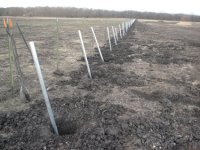
Fencemen don't use strings to set posts.

Fencemen do it by eye.

This line is eleven hundred feet long, about a hundred and thirty eight posts, seventeen cubic yards of concrete (thanks
Gary).
 

Attachments

  • 837234-DSC02446.JPG
    837234-DSC02446.JPG
    55.3 KB · Views: 1,068
   / Fenceman doing what fencemen do these days
  • Thread Starter
#11  
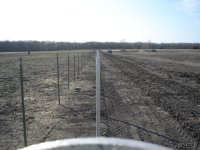
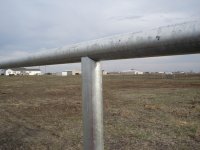
I take longer to set my posts because I set them not only for line but height as I go.


Where I make up for that is when I've got them set then it's a simple matter of laying the toprail in and it's ready to weld.

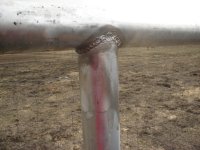
And the weld joint is so clean even Ray Charles on a bad day could sew it up.
 

Attachments

  • 837237-DSC02455.JPG
    837237-DSC02455.JPG
    56 KB · Views: 862
   / Fenceman doing what fencemen do these days
  • Thread Starter
#12  
Some say I put too much concrete in holes too deep and I use too heavy a pipe for just a fence.

But I have to respect those much more smarter than me.

This is the way an engineer designs a fence framework that he has to sign off on. I've seen the same specifications many times on commercial and industrial projects.

Gary wanted a fence that would be good for horses. And he plans on living here for the next thirty or so years. So specifiying a V Mesh with a schedule forty galvanized pipe framework was a no brainer.

I weld it up.

Gary comes in behind me and cleans the weld with a cup brush on an angle grinder. He'll then paint the weld with two coats of cold galvanizing compound.
 

Attachments

  • 837247-DSC02452.JPG
    837247-DSC02452.JPG
    60.2 KB · Views: 854
   / Fenceman doing what fencemen do these days
  • Thread Starter
#13  
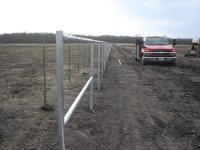
We're doing this side first because the old fence was right on the fence line. The neighbor has seven geldings, all young, all full of it. We put in a temporary fence while we're doing this line. We should have it welded up by Tuesday and start stretching the V Mesh. Then we can take down the temporary fence.

It was a good week. All of us have purchased additional supplies of Advil.
 

Attachments

  • 837250-DSC02450.JPG
    837250-DSC02450.JPG
    56.3 KB · Views: 1,076
   / Fenceman doing what fencemen do these days #14  
Harvey,

Good to see another project from you. I'm always amazed at how nice a straight fence looks, along with what's involved to make it happen!!!

Very NICE.

Eddie
 
   / Fenceman doing what fencemen do these days #15  
</font><font color="blue" class="small">( I set them not only for line but height as I go )</font>

I still don't understand how you do that. I'd get neither line nor height right without pulling a tight line to go by.
 
   / Fenceman doing what fencemen do these days
  • Thread Starter
#16  
It's really quite simple Bird. We set the end posts. Then we put in a line post. When that line post is perfectly in line and at the right height we go to the next line post. If every post is perfectly in line and at the right height when we get to the end every thing is as it should be.

Eleven hundred feet of length and grade variations did complicate this one a bit though. /forums/images/graemlins/blush.gif
 
   / Fenceman doing what fencemen do these days
  • Thread Starter
#17  
Eddie when I was working on that pond you came across my mind. I'd rented a JCB 190T, that's a rubber tracked skid steer that can handle a ton of material at a time.


The reason I rented it was I could take Iris down into the pond but she couldn't make it back out with a load. In fact I'd have to back her out using her bucket. This was because the clay was too damp and slick for a rubber tired skid steer.

The 190T was a whole nother story. Mud wasn't an issue. I'd drive it into the mud, grab a full bucket of wet clay, spin it around, and drive it out with out slipping a track. It was amazing how it works on such a poor surface getting great traction and not wanting to sink.

I thought of your situation and thought it would be the cat's meow for you too.
 
   / Fenceman doing what fencemen do these days #18  
Harvey, I'm still a little fuzzy on getting the height right. Can you give any more detail on that.

Measuring from the ground at each post made my top rail follow the gound variations to closely. So I had to use the string method from about every 6th post to get a somewhat smooth top rail.

Thanks
James
 
   / Fenceman doing what fencemen do these days #19  
Like James, I'm still not clear on that if you're working alone. I can see how it can be done if there are two people; one to do the sighting and one to manipulate the post.
 
   / Fenceman doing what fencemen do these days
  • Thread Starter
#20  
Morning guys,

Here's the way I did that eleven hundred foot line.

1. After I had the old fence out of the way and the temporary fence in I put a marker post inside each property pin on that side. I wanted the fence to be inside the property line four inches. Since Gary is paying for the fence then it's his fence. His neighbor gets all the advantages of the fence except ownership. It's his property, on his property, and the neighbor has no right to attach, damage, or modify the fence.

2. I painted the marker posts to make them visible from the opposite ends. The one on the front got painted red because I had the blue horizon behind it. A silver or white post would disappear. The one down by the creek was painted white so it would stand out in the shadows.

3. I came up about three hundred feet and put another marking post in what I thought was the fence line. I went back to the corner post and checked it. It was off a little bit so I adjusted it. I did this until I had the in between marking post in a perfect line with the two ends. I did this two more times so I had three marking posts in between the two ends.

4. I used four (4) cans of Rustoleum white marking paint putting down first slash marks across the fence line every eight feet. And then following it with another slash mark in line with the fence line.

The way I get the in line mark is I carry a post and plumb it up in line using the marking posts. I sight down the edge of the marking post keeping it perfectly plumb until the edges of the marking posts and the plumb post become one. I put a slash mark with the paint where the plumb post was.

5. I dug the fence holes three and a half to four feet deep with the skid steer's auger with a twelve inch wide bit.

6. I put a day laborer with Gary and had them feeding the concrete mixer. My custom concrete bucket enables the skid steer to carry one full mixer load at a time. They mixed eight cubic yards the first afternoon and seven the next morning by lunch.

7. The first load went to the far end posts. I get three posts per load. After three loads were in I stoppped and sighted in the corner post and removed that marker post. I set that post for grade and line.

8. I went to the first inline marking post and using a Sharpie marked a line for height. I wanted the height to be about sixty inches at that point. The fabric (V Mesh) we're using is fifty eight and a half inches wide. I also had a Sharpie mark on the end post at three and a quarter inches down. These two marks are what I used to sight in for the height of the line posts.

9. There was some grade variations and I had to allow for that. But what I usually go for is keeping the top of the fence as straight as possible from end to end. Horses and normal acitivity will usually bring the grade to the fence over time. The fence is designed to be permanent while the grade is always in a state of flux.

Down by the creek bottom the fence line is in a flood plain. So I intentionally kept the bottom of the fence off the ground to enable minor flooding to happen without affecting the fence. If the gap off the ground is unacceptable to the homeowner I come back with single nine gauge wire strands across the low areas. This keeps my fence looking good and still provides the security the client expects. It also gives a breakaway barrier you might say if there's debris flowing without bothering the fence.

10. Gary and the day laborer never came down to help me with setting the posts. They had their hands full dancing with the mixer. /forums/images/graemlins/grin.gif

I have them mix the concrete stiff. But even with it stiff leaving the mixer we still get it pretty wet because of the ride over rough terrain down to the posts. But once they had the mix just right I was able to start setting posts about two loads behind the one I just delivered.

It went like this. Deliver the concrete to the next holes in line. Then I'd get out of the tractor and go to the next post that needed to be set. First I pull the post up almost out of the concrete. Then I use a hand plumb and see where it's setting for line. I push it down at whatever angle I need to get the bottom of the post in line with the posts already set. This might take a couple of tries.

What I'm looking for is the edge (always the same edge!) of the post I'm setting to disappear into the fence line with the post being perfectly plumb in line. When that happens I look for grade.

I'm looking for the notched end to be in line and exactly, again, looking for the disappearing of the edges with the existing posts. When I have that I check the post for plumb in line. I want it plumb from any direction.

When it's where I want it I go back to the post behind it and look back over the newly set post to the end post verifying it's in line for line and height.

Then it starts all over again.

Two men working together is the most common sighting method used by fence men. It's the way my father taught me. One does the sighting and the other holds the post be set plumb while moving it where the sighter wants.

However one time we hired a fence foreman that could back sight. I took to it like a duck to water for a couple of reasons. Probably mostly because we had a typical male competition. And it was faster, much faster. Once I get into the groove it goes quick.

We once set a line a half mile long with each of us starting at one end. When we were done even we had a tough time telling where we met.

One job we did had five hundred posts. It was an own your own mobile home park in Hemet California, four feet chainlink, three sides, eight inch by two foot footers, lots fifty by seventy. So we had a couple of long lines with all of these short divider lines seventy feet long.

We did them all in one day. Everything was set for line and height for chainlink with a top rail. We almost killed each other not to mention what we did to the helpers. A couple of twenty something males competing is a horrible thing to watch. /forums/images/graemlins/grin.gif /forums/images/graemlins/grin.gif

It's good to be fifty seven and having a skid steer and not needing to compete anymore. /forums/images/graemlins/blush.gif
 

Marketplace Items

2008 FORD F-550XL SUPER DUTY INSULATED BUCKET TRK (A60430)
2008 FORD F-550XL...
2013 KENWORTH T880 HYDRO EXC VACUUM TRUCK (A59823)
2013 KENWORTH T880...
Toro hr:2213.5 (A56859)
Toro hr:2213.5...
2014 FREIGHTLINER 108SD CONCRETE MIXER TRUCK (A59823)
2014 FREIGHTLINER...
UNUSED IRANCH HYD THUMB CLAMP (A60432)
UNUSED IRANCH HYD...
2019 CHEVROLET SILVERADO CREW CAB TRUCK (A59823)
2019 CHEVROLET...
 
Top