Industrial Tires

/ Industrial Tires #1  

Mark Page

Platinum Member
Joined
Sep 27, 2009
Messages
552
Location
Maryland
Tractor
Massey Ferguson 2615 48hp, 4wd, loader
My new machine has industrial tires on all 4 corners.
Since there is no grass to mow, snow to push and the manure pile is frozen, I decided to get in some seat time with my new Massey 2615. I made a couple of passes around the property, shifting gears etc. Decided to run up one of the steeper slopes, about 15-20 degrees. The ground is frozen and slightly wet from the melting frost. Got half way up the hill and the rear tires started spinning. This didn't seem right, tried down shifting and kicked in the diff lock, no help. Put it in 4wd and finished the climb.
It was bugging me that those tires wouldn't pull the hill. Went back out and fired up my 2wd 231s with ag tires on the rear and 4 ribs on the front. The 2615 is heavier than the 231s. Put it in high range 1st gear which is my normal mowing speed and it walked right up the hill, no slipping or sliding. Both machines have ballast in the tires.
I probably should have chosen the ag tire option on 2615, but I didn't want to tear up the turf on tight turns.
Not sure who came up with the ag tire idea, but I'm not impressed.
 
/ Industrial Tires #2  
There's always one style of tire that will out do the other some times, not saying they both won't work. You said when you put it in 4x4 you went right up the hill with your industrial tires , right ? Ag tires would work better in a case like that . But if you were on your field or lawn and it was soft and you cut your tires sharp with Ag's on you would then think I should have had industrial tires on, same with hard pack doing loader work Ag tire's would wear more then ind. tires . Ag's are good in the woods but ind. tires are too if you run chains .Both work, it's up to you to find out how to make them work best. Just my :2cents: which isn't much:D
 
/ Industrial Tires #3  
I asked my dealer about ordering Ag's on the back and Ind's on the front. Kioti said no, but I think this would be the best setup for alot of us. Check out the R4 tire grooving threads here, seems for $50-70 you can get better performance in snow or on turf. Also I guess tire pressures can make a big difference. Ind's can hold alot more pressure but you reduce the contact patch and the tires ability to conform to the ground. I bet if you drop the rear tire pressure on the new tractor down the R1's on your other tractor you might make it up that hill.
 
/ Industrial Tires #4  
All the tires have there intended uses, ag tires work better in field work with loose soild and have less ply's in their construction, and ind. tires have more ply's than ag tires, same as turf tires have even less ply's in their construction. my ind. tires are 10 ply vs. 6 ply ag tires.
david
 
/ Industrial Tires #5  
I do not believe that one can mix tire styles due to the different tire wheel sizes. The MFWD machines need matched sizes for the front and rear wheels/tires a mismatch will tear up the front differential. There is no "perfect" tractor tire style. There are tradeoffs with each style.
 
/ Industrial Tires #6  
My new machine has industrial tires on all 4 corners.
Since there is no grass to mow, snow to push and the manure pile is frozen, I decided to get in some seat time with my new Massey 2615. I made a couple of passes around the property, shifting gears etc. Decided to run up one of the steeper slopes, about 15-20 degrees. The ground is frozen and slightly wet from the melting frost. Got half way up the hill and the rear tires started spinning. This didn't seem right, tried down shifting and kicked in the diff lock, no help. Put it in 4wd and finished the climb.

Industrial tires have the worst traction of all styles. They are rugged and can take a beating, and are ideal for carrying heavy loads, but are absolutely terrible when it gets slippery - even turfs are better for traction (need chains in the winter though). Ind. tires aren't all that great on grass either.

OTOH, you should've been in 4WD in the first place. When I started reading your story, I thought for sure it was going to end with a rollover...

JayC
 
/ Industrial Tires #7  
My replacement tractor I ordered with R-4's, I had them loaded, the tractor it replaced had AG's on it. I can tell the difference with the first snow, the R-4's are far better than Ag's, I did adjust the air pressure in the rear to get a full print. If possible, I stay away from mud with any tire, but I think the added width of the R-4's do help in mud. My experence has been with snow up until now.
 
/ Industrial Tires #8  
Industrial tires are just that...industrial. IE asphalt work, flat level ground.

I had ag tires on my olf JD and i wore thru them in about 5 years on the gravel. They had great traction, but there soft tires. I got industrials on the new tractor because i have flat land so i dont need the added gripping. The ag tires also tore up the ground when it was wet...the industrials dont.

The industrial tires will last alot longer then the ag tires on hard ground.
 
/ Industrial Tires #9  
I do not believe that one can mix tire styles due to the different tire wheel sizes. The MFWD machines need matched sizes for the front and rear wheels/tires a mismatch will tear up the front differential. There is no "perfect" tractor tire style. There are tradeoffs with each style.
I thought so too, but this is right out of the Kioti EX35,40,45,50 shop manual.

5. Relative speed ratio of front wheels
It is ideal to set the speed of the front wheels is 1 ~
5% faster than the one of the rear wheels when the
front wheel drive is in operation. However, some Agricultural
or industrial tires may not fulfill this function.
Therefore, DAEDONG allows -1 ~ 7% of the relative
speed ratio for front wheels.
Now the stock Ags ratio is 1.5% so I don't know what 6% difference feels like(I'd think not too good on pavement in 4wd), but I guess it shows that Kioti is good with quite a range. Also they show that the Ag and Ind rears have same rolling circumference so I'd guess the Ag and Ind fronts would be interchangeable with no problems. After using my tractor for loader work in mud, I still think having the Inds on the front would be good for some more floatation as they are quite a bit wider.
 
/ Industrial Tires #10  
I do not believe that one can mix tire styles due to the different tire wheel sizes. The MFWD machines need matched sizes for the front and rear wheels/tires a mismatch will tear up the front differential. There is no "perfect" tractor tire style. There are tradeoffs with each style.

Actually you can.
 
/ Industrial Tires
  • Thread Starter
#12  
I wonder if anyone makes a front 4 rib tire with the same circumference as the ind fronts I have now.
 
/ Industrial Tires #13  
I have had Turf, R1 and R4 tires on different tractors. B3200 has R4's and is good in mud up to it's belly with a backhoe mounted and round bale in front. On all slopes even with light attachments I use 4wd. It's just better control.
I have had R1's on tractors slip sideways on slopes. Each tire has it's place but I prefer R4's.

The big logging equipment around here all have the R4 style or similar. For 90% of the year they are good without chains. I have never seen a ag tread tire used.
 
/ Industrial Tires #14  
I wonder if anyone makes a front 4 rib tire with the same circumference as the ind fronts I have now.
The Kioti manual also gives instructions on how to calculate actual rolling circumference of tires with your typical loading and it can be adjusted with air pressure.
If it was always dry I'm sure 4 ribs would work surprisingly well in 4wd, any kind of dampness or wet grass though, you'd have to assume you have a 2wd tractor!
R4's should be OK on grass though in 2wd so why would you need 4 ribbers?
 
/ Industrial Tires #15  
My new machine has industrial tires on all 4 corners.
Since there is no grass to mow, snow to push and the manure pile is frozen, I decided to get in some seat time with my new Massey 2615. I made a couple of passes around the property, shifting gears etc. Decided to run up one of the steeper slopes, about 15-20 degrees. The ground is frozen and slightly wet from the melting frost. Got half way up the hill and the rear tires started spinning. This didn't seem right, tried down shifting and kicked in the diff lock, no help. Put it in 4wd and finished the climb.
It was bugging me that those tires wouldn't pull the hill. Went back out and fired up my 2wd 231s with ag tires on the rear and 4 ribs on the front. The 2615 is heavier than the 231s. Put it in high range 1st gear which is my normal mowing speed and it walked right up the hill, no slipping or sliding. Both machines have ballast in the tires.
I probably should have chosen the ag tire option on 2615, but I didn't want to tear up the turf on tight turns.
Not sure who came up with the ag tire idea, but I'm not impressed.

It sounds to me like they worked exactly like they're supposed to: R4's (industrial's) are easier on your turf than R1's (ag's) with the trade-off of reduced traction.
 
/ Industrial Tires #16  
Just to make this thread a little more interesting- there are/were a couple of old timers out my way who used their tractors for logging. They were running R-1's, but they reversed /switched the front tires so they had a better "chance" of being able to go in reverse in the everpresent mud up here. R-1's "goo" forward in mud much better than they "goo" in reverse :( (I can really attest to that.). By switching the fronts they were going "forward" in reverse. There is no perfect tire. One must make the choice(s) and move on from there. I will say that a R-1 owner/operator should look at # of sidewall plies on the front tires- for FEL work R-1's need as much support as possible.
 
/ Industrial Tires #17  
when getting traction more comes into play then just tires. Horse power weight speed range etc.... A log skidder may run an R4 and get great traction because of wieght and balance. A tractor with no extra weight may do better with an ag tire but once an attachment is added it more then likely will tear things up{lawn}. In order for a tire to work at its best there has to be a balance between many factors.
 
/ Industrial Tires #18  
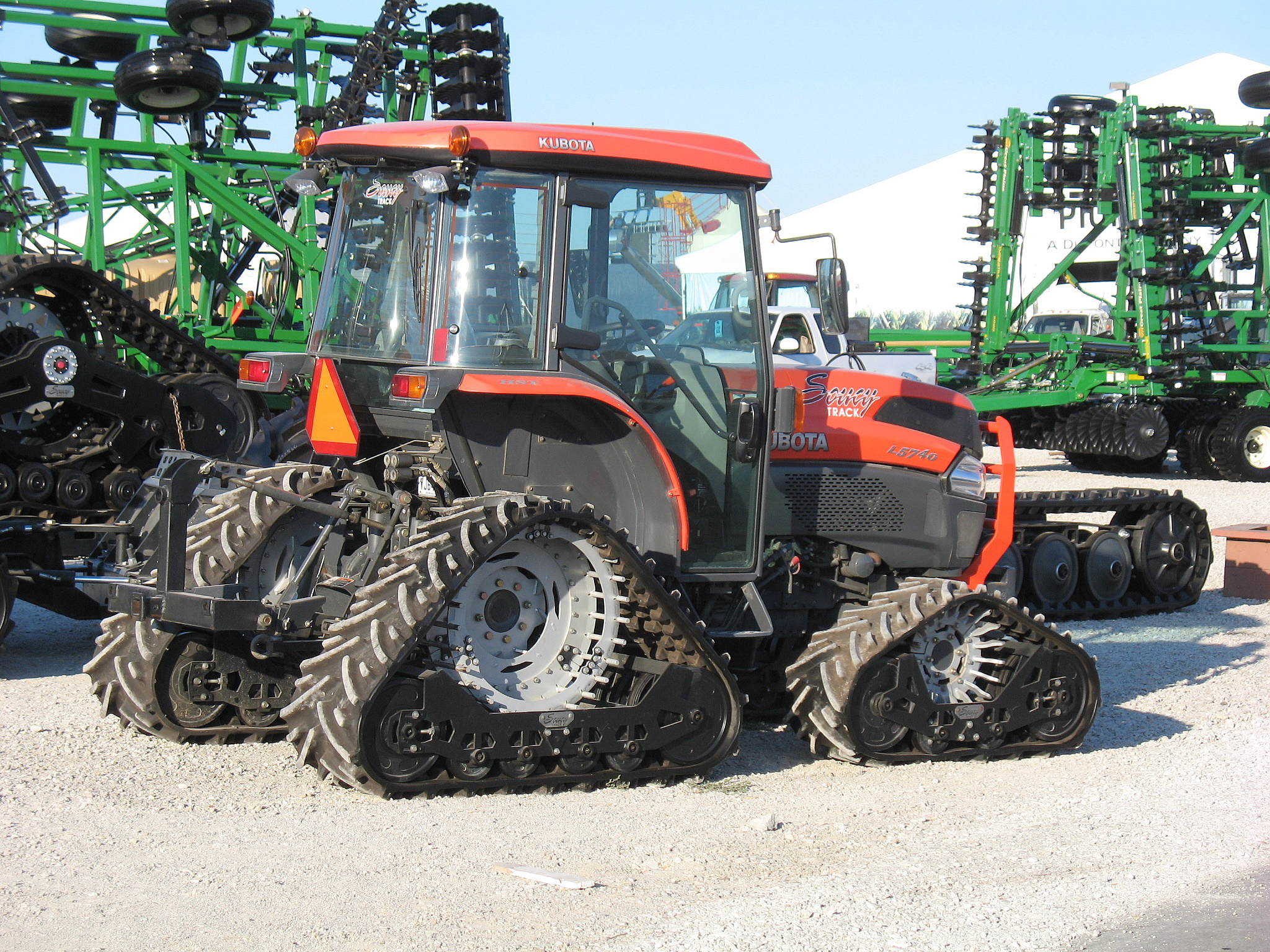
There is no perfect tire.
THIS is the perfect solution:

Kubota_L_5740.jpg


JayC
 
/ Industrial Tires #19  
THIS is the perfect solution:

Kubota_L_5740.jpg


JayC
I think that might cut up a lawn on full lock:laughing:
Also any snowmobiler who's ever had a track come half off miles from home, must cringe thinking about using those in the woods. I'm sure they are probably fine, but there's something to be said for the simplicity of a tire...
 
/ Industrial Tires #20  
Mark, now that you've had the tractor a while longer, what are your impressions? I'm in the same position as you -- 2wd ags, looking to procure 4wd with ags or indies. Mow the yard and have some slopes too.
 
 
Top