y

Another Gauge Wheel Build Post

   / Another Gauge Wheel Build Post #1  

Runner

Elite Member
Joined
May 12, 2007
Messages
3,857
Location
Missouri
Tractor
2024 Cub Cadet Ultima ZTXS5 54, 2007 John Deere 2520, 1989 John Deere 185, 1960 Panzer T70B
Hi everyone, and Happy New Year.

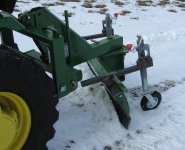
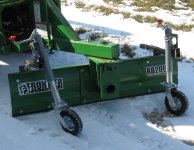
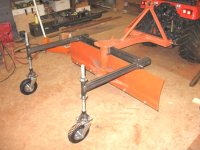
I just built some gauge wheels for my rear blade that I hope to also be able to use on a landscape rake when I get one. Not sure if they're heavy enough for box blade duty.

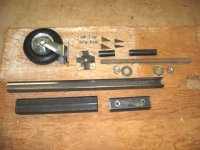
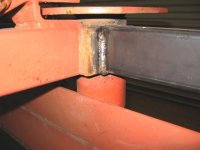
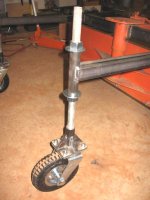
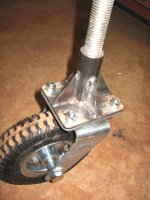
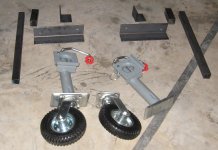
I used the commonly available trailer jacks and wheels (Harbor Freight, etc.), 3 x 3 angle and a couple of different sizes of steel tubing. The object was to do this without modifying the blade, so I used existing bolt holes in the RB2060.

Some pics (pardon the awful welding job):
 

Attachments

  • Gauge Wheel Parts.JPG
    Gauge Wheel Parts.JPG
    253.3 KB · Views: 1,919
  • Gauge Wheels Close.JPG
    Gauge Wheels Close.JPG
    397.8 KB · Views: 1,833
  • Gauge Wheels Outside.JPG
    Gauge Wheels Outside.JPG
    375.1 KB · Views: 1,598
   / Another Gauge Wheel Build Post #2  
Look fine to me, do you use ski's in the winter instead of tires :D
just kidding
Fine job
Jim
:)
 
   / Another Gauge Wheel Build Post #3  
How much did the parts and steel run ya?
 
   / Another Gauge Wheel Build Post
  • Thread Starter
#4  
I've got about $100 in the steel and parts including some leftover steel for other projects. HF has those jacks on sale from time to time for $15 apiece, but they only had one the time I went in there and I didn't feel like waiting for them to go on sale again, so wound up buying them for more at another place.
 
   / Another Gauge Wheel Build Post #5  
Nice job, but have you tired just back-blading or turning the blade around and going forward. Please pardon my comments, but the wheels seem kind of unnecessary, and if you create any kind of pile pulling forward, they seem to limit your ability to then push the pile backward and off of the drive. Otherwise very nice and versatile. Really will come in handy on a rake!
 
   / Another Gauge Wheel Build Post
  • Thread Starter
#6  
Even with the blade turned backwards, I still seem to tear up the gravel more than I want. I see your point about not being able to push backwards when I get to the end of the drive and that is a concern. I plan on just using the loader bucket to move any piles out of the way in that situation.

Also, more than anything, the wheels are going to be for grading the gravel drive, since I do have a regular front-mounted snowplow and blower for this tractor. I'm only using the rear blade for snow plowing right now for a couple of reasons. First, I knew I'd be needing to use the loader and didn't want to go to the trouble to change over to the front blade just to have change it back, and second, I wanted to see what kind of a job the rear blade would do on the snow.

The first time I tried using the rear blade, it became apparent to me that, in order to get smooth results while grading gravel, it would be easier with some wheels or skids.
 
   / Another Gauge Wheel Build Post #7  
Runner said:
Hi everyone, and Happy New Year.

I just built some gauge wheels for my rear blade that I hope to also be able to use on a landscape rake when I get one. Not sure if they're heavy enough for box blade duty.

I used the commonly available trailer jacks and wheels (Harbor Freight, etc.), 3 x 3 angle and a couple of different sizes of steel tubing. The object was to do this without modifying the blade, so I used existing bolt holes in the RB2060.

Some pics (pardon the awful welding job):
I've been scratching my head over how to mount my 2" receiver on my curved back blade. Great design! I've been using your same setup on both my rake and box blade with lots of success. Thanks for posting.
 
   / Another Gauge Wheel Build Post #8  
Nice set-up, great job.

You will enjoy having the precise control!
 
   / Another Gauge Wheel Build Post
  • Thread Starter
#9  
lhfarm - in the interest of full disclosure, this is the result of several running design changes, based on failure. First, I thought it would be neat to keep the pivoting feature of the trailer jacks, however, when I did that, there was too much side play and the wheels tended to spread out more than I thought they should.

So, I decided to 86 the pivot feature and just rigidly weld the jacks to the tubing. Once I did that, I found that the torque on the tubing was bending the receivers mounted to the blade because I only had them mounted on a single angle clip. So I added another angle clip to stiffen the receiver mounting.

If I was doing it again, I'd just use regular 2" trailer hitch material for the tubing and pre-made receivers, even though it would have cost more.

Finally, I must admit, it is a mystery to me why the back blade has the pre-drilled holes in it. Not sure what Frontier intended to be bolted on there. One was square, so as to accommodate a 1/2 inch carriage bolt, and the other was round, about 5/8 inch. Anyway, they were in a handy location for mounting the angle brackets.

Here's what happened before I stiffened-up the receiver mounts:
 

Attachments

  • 100_0062 b.JPG
    100_0062 b.JPG
    358.1 KB · Views: 1,164
   / Another Gauge Wheel Build Post #10  
It would stiffen this a lot more if you run a cross member between the two jacks.

I put wheels on my dirt blade because I was tearing up more than I was fixing.

Now if I just had hydraulic controls for the tilt, angle and each wheel....
 
   / Another Gauge Wheel Build Post #11  
   / Another Gauge Wheel Build Post #12  
I sure like your idea of the quick adjusting leveler jacks. I modded my RB with wheels and they are adjustable but it takes a couple of wrenches. I get it real close then do the fine tuning with the top link. I have real good success reversing the RB and pushing backwards with wheels. I do keep that move to a minimum because my old neck doesn't cooperate well. Ha! Great for managing piles.
 

Attachments

  • Gaugewheels.jpg
    Gaugewheels.jpg
    55.6 KB · Views: 671
   / Another Gauge Wheel Build Post #13  
Runner said:
lhfarm - in the interest of full disclosure, this is the result of several running design changes, based on failure. First, I thought it would be neat to keep the pivoting feature of the trailer jacks, however, when I did that, there was too much side play and the wheels tended to spread out more than I thought they should.

So, I decided to 86 the pivot feature and just rigidly weld the jacks to the tubing. Once I did that, I found that the torque on the tubing was bending the receivers mounted to the blade because I only had them mounted on a single angle clip. So I added another angle clip to stiffen the receiver mounting.

If I was doing it again, I'd just use regular 2" trailer hitch material for the tubing and pre-made receivers, even though it would have cost more.

Finally, I must admit, it is a mystery to me why the back blade has the pre-drilled holes in it. Not sure what Frontier intended to be bolted on there. One was square, so as to accommodate a 1/2 inch carriage bolt, and the other was round, about 5/8 inch. Anyway, they were in a handy location for mounting the angle brackets.

Here's what happened before I stiffened-up the receiver mounts:
I used 2x2x1/4 tubing and ready-made 2" hitches. My weak point was my welding - I broke a couple of welds on my first test runs. I've been working on a mounting bracket for the blade. Your design is simple enough for me to do without a lot of cutting and welding.

Thank,
 
   / Another Gauge Wheel Build Post
  • Thread Starter
#14  
RE: crossmember - I noticed the post from the gentleman who did the wheels for the box blade recently with the cross bracing and it would definitely stiffen up the strucure. I'm thinking that if I try to use these on my box blade, I'll definitely need to use some cross bracing. Connecting the cross bracing with U-bolts was a good idea too.

RE: moveable toplink connector - that sounds like a great idea, I'll have to work on that.

RE: using trailer jacks - well, of course I stole that idea from other posters on here. That's the nice thing about this site, you can read the posts and "shop" for ideas...

Incidentally, I used the famous Harbor Freight 4x6 bandsaw to cut all the pieces for this project. It was new when I started and the motor lasted through exactly four cuts before it started smoking and quit. Fortunately I had an old GE 1/4 horse motor sitting on the shelf (by old, I mean it has oil cups for the bearings...) so I slammed that on there and it now works like a champ. Other than the motor problem, that saw is doing the job very well.

The welding was done with a 50 year old Power Kraft tombstone stick welder (looks to have been made by Lincoln and sold by Wards) that I inherited from
my dad. It has served me well over the years.
 
   / Another Gauge Wheel Build Post #15  
I just got mine done tonight and anxious to try it out tomorrow. I really like the trailer jack idea but after buying steel for 6 projects I needed to keep cost down and I had the all-thread and bushing stock on hand.

Here's the end result. Still have to bore a couple of holes but want to try it out first; maybe there are different locations that aren't apparent now. This is set at furthest extension so I can swivel the blade 360 degrees.

6 finished.JPG

Parts
I used 2x3x3/16 for the outriggers
2x2 "receiver stock" (not 2 1/2 x 2 1/2 x 1/4 standard which has the internal seam that has to be ground down) Receiver stock is a little more money but worth it.
2x2x3/16 extension arms
1" dia all-thread with 1"ID x 1 3/8"OD bushing stock
1/4" plate wheel foot
HF 8" pneumatic wheel - I'll silicone the ball bearing pivot race like someone here suggested (for a dust cover) and hope for the best.

Here are parts for one side

1 Parts.JPG


One of the most difficult process was jigging up to weld the outriggers onto the RB pivot. Lots of alignments to look at.

3 jig2.JPG


This was a very tight welding spot (below the blade pivot plate). Can't say I got any penetration because my angle was so low but I was able to get a bead in here. Other welds are 6011 1/8" root and 7018AC 1/8" over that.

5 tight spot.JPG


This is the hight adjuster

7 det hi adj.JPG


And the wheel detail. The bushing was welded and gusseted to the 1/4" plate then the all thread was plug welded to the plate.

8 det wheel.JPG


Welding done w/old Lincoln AC tombstone and Lincoln Weld Pack 100 HD wire feed, rosin core.

BTW - I too have a HF bandsaw. I've cut a fair amount of steel the past year. Motor is still OK. But I do have trouble getting it to cut (down) square with the table. I normally have to place my stock on the table shimmed 1/8"+/- (side to side) to get a plumb cut. This is especially noticeable once the blade has any wear. New blades are better but I can't replace them as often as it seems to need.
 
   / Another Gauge Wheel Build Post #16  
Runner said:
Finally, I must admit, it is a mystery to me why the back blade has the pre-drilled holes in it. Not sure what Frontier intended to be bolted on there. One was square, so as to accommodate a 1/2 inch carriage bolt, and the other was round, about 5/8 inch. Anyway, they were in a handy location for mounting the angle brackets.

I have the same 6' Frontier rear blade and the square holes on the blade ends are for attaching optional end plates using 1/2" carriage bolts. I have the end plates and they were worth the cost to help channel dirt where one wants it. I believe Frontier also offers skid shoes that can be bolted into those holes.
 
   / Another Gauge Wheel Build Post #17  
mjncad said:
I have the same 6' Frontier rear blade and the square holes on the blade ends are for attaching optional end plates using 1/2" carriage bolts. I have the end plates and they were worth the cost to help channel dirt where one wants it. I believe Frontier also offers skid shoes that can be bolted into those holes.

Do you happen to have a photo of the rear blade side plates? It is on my list of projects to build a set for the back blade posted above. I am especially interested in how the side plates are braced. I am thinking of running a diagonal brace (angle or pipe w/flattened ends, etc) from the front edge of the side plate inward to the blade just above the cutting edge. The plates would be 1/4" thick plate and bolted onto the blade with a couple of angle iron tabs. Do your side plates have any additional reinforcing?
 
   / Another Gauge Wheel Build Post #18  
The most simple brace is to weld an angle or tube from one side panel all the way across to the other panel. If you bolt the dirt panels to the blade, then the whole thing can be unbolted. If you want it all to come apart for storage, then weld some tabs to the panels and bolt the cross brace to the tabs.

Interesting the way you mounted your wheels. There's another post some time ago where steel thread was used, but they also cut spacers out of tubing to adjust the height.

Hope you like it.
 
   / Another Gauge Wheel Build Post #19  
Ray,
I really like how you mounted your wheel frame/base like that. Have not seen others do it like that. It adds a little more weight too ... a desired result.
Very nice job man!
 
   / Another Gauge Wheel Build Post #20  
In the long (short) run those wheels may cause a problem if there is much pressure on them. Do they have bearings? I've tried the HF wheels on small atv trailers. What has outlasted the 3 sets combined so far is some old goat cart wheels I found. Just a 3/4" bolt for an axle and solid bushings in the wheels. just have to grease them once and a while.

rob
 

Marketplace Items

2017 KINZE KNOTCHED SINGLE DISK FERTILIZER OPENER FOR 3000/3500 SERIES PLANTERS (6 ROWS) (A55315)
2017 KINZE...
2346 (A60432)
2346 (A60432)
2024 CATERPILLAR 255 SKID STEER (A60429)
2024 CATERPILLAR...
2000 FORD F-550 XL SUPER DUTY DUALLY SERVICE TRUCK (A60430)
2000 FORD F-550 XL...
2017 Chevrolet Tahoe SUV (A55853)
2017 Chevrolet...
17501-FL (A56857)
17501-FL (A56857)
 
Top