Homemade landscape and trail rake

/ Homemade landscape and trail rake #1  

jimgerken

Veteran Member
Joined
Nov 26, 2001
Messages
1,635
Location
Minnesota
Tractor
John Deere 3720
OK, here goes. I may/will be building a rake for landscape use, for driveway maintenance, and for rocky ATV trail maintenance. I have recently sold my old one, a highly modifyed King Kutter 72 inch, to which I had added just about everything. But before I start, I thought I'd ask all you experts for input on what you feel are valuable features. To stimulate the conversation a bit, so far I am planning:
side-to-side hydraulic swiveling (normally done manually by pulling out a pin..)
weight brackets to allow addition of small suitcase weights
quick-hitch compatibility (I use Speeco brand Q.H.)

This will hang on my 2520, with hydraulic TNT.

When used on the trail, the use is extreme duty, with rocks as big as a foot across expected to move off the trail with the rake's guidance. Any thoughts on using the heavy duty rakes tines Agri-Supply has instead of the standard duty ones. the HD ones are 1.25 x 3/8". they cost 6 bucks each, but I would also space them out a bit further too.

Thanks for any input you have.
 
/ Homemade landscape and trail rake #2  
I am working up plans for a new rake also. A variable ammount of swivel is a good idea. The first one I made for a garden tractor using the standard duty Agri-Supply tines worked very well. I added struts out to the ends and made alternate attach points for those so I could put it at an angle. What I found worked better was a single attach point and a chain out to each leg. I could then change the length 1 chain link at a time which gave a lot more angle adjustment.

Collectively, depending on tine spacing, the standard duty tines are pretty strong. It is when you single one out for punishment such as hanging it up behind a small stump head, that their spring characteristics really get tested. Of course the overall weight of the rake will determine how much force a single tine will have to endure before the 3PH rides up and over, while the end of the tine "pole-vaults", the obstruction. As long as the rock rolls/slides fairly easilly, the standard tines should collectively work them off to the side allright.

Being able to offset the rake to one side or the other, particularly when angled would be desireable. I have to snake thru some trees on my property so a rake too wide is not advisable. But when angled, the pattern gets narrow and getting in near fixed objects is difficult. Being able to offset the pattern outside one tire or the other with the rake at an angle would be a good thing.

My first one didn't have provisions for gauge wheels. The one I am about to start will:) I don't know if I will build in provisions for an offset as it adds substantially to the complexity of the structure. I however don't use the angle feature all that often as I am usually just dragging in the loose branches/fuel to a single point to burn it anyway so I will probably continue to live with the narrower pattern at an angle.
 
/ Homemade landscape and trail rake
  • Thread Starter
#3  
RonMar, how much offset would we want? Would about 1 foot each way (two feet total travel) be enough? I suppose there are at least two ways offset can be accomplished: Put a second swivel axle in the "boom" part that extends back from the 3-point hitch lower cross member. OR put some kind of linear track to slide the tine bar straight sideways, pushed by a small but long (1.5 inch by 2 foot) hyd cylinder.
I agree with the need for this feature. I can remember times I wanted to groom a lot closer to an edge to sweep off some rocks, but the tractor was already close enough to the edge of the trail to suit me for safety reasons.
 
/ Homemade landscape and trail rake #4  
Enough to allow you to get the tines out past the wheels. It would depend on what you were doing I guess. Clearing a path along a bank where it would be desireable for the debris to go over the bank would require more reach as would reaching into a depression or swale/ditch along a road or trail with the forward angled end of the rake to remove debris and gravel from the ditch to the center of the road or trail. It all depends on how close you want the tractor wheels to get to the edge or down into the ditch:).

I was thinking of a crossbar with a center and two offset attachpoints(5 attach points total). By using two cylinders for the support struts out from the drawbar to the crossbar, then you could set the angle wherever you needed it. This combined with gauge wheels and a top and tilt might be pretty good for cleaning ditches. Sort of like the attached top view sketch. The 3PH attach point is at the bottom and the rake crossbar is at the top of the pic. By pulling 3 pins where the drawbar and two cylinder rods meet the crossbar, you could offset them 1 position either left or right.
 

Attachments

  • rake.bmp
    109 KB · Views: 3,974
/ Homemade landscape and trail rake #5  
Looks like a great idea. I would think that one cylinder (with a good stroke length) would do just fine. I have seen Just set it to be half extended when the rake is set straight. Can't wait to see pictures of the progress.:) Good luck!
 
/ Homemade landscape and trail rake
  • Thread Starter
#6  
OK, just getting back to this topic after putting a lot of time in on the hydraulics of the JD 2520. I am needing some help here. I need a few pics of how a real roadgrader works, specifically the part of the mechanism that offsets the blade one way or the other. I am trying to decide how to make the rake offset. I have drawn up a plan to do it with a swing-arm scheme. But I should at least look at the alternatives, in case something looks better. If you can get a pic of a grader, to show the offset mechanism, please put it here for me. Thanks.
 
/ Homemade landscape and trail rake
  • Thread Starter
#7  
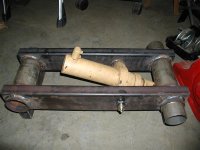
Got a great start on the rake this weekend. I had decided to go with the swing-arm type design. After "sketching it up", and obtaining the trunion-mount cylinder ( the heart of the offset scheme), I made a trip to the junkyard and found a bunch of 2x4, 2x5, 2x6 tubing with 0.188" wall thickness, all for 20 cents a pound. 35 bucks bought all this metal, wow! I milled giant 4 inch holes thru these tubes, and a 1.5 inch hole clear thru for a bushing stock section. After pressing it all together, and tacking it up, it looked like this photo. Also shown is the trunion-mount 3x9 cylinder from Surplus Center, swinging on specially prepped pins in those bushings welded into the tubes. So this important assembly is about complete.
 

Attachments

  • P1010036 (Medium).JPG
    P1010036 (Medium).JPG
    64.4 KB · Views: 3,331
/ Homemade landscape and trail rake
  • Thread Starter
#8  
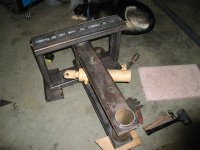
The main frame is shown here, parts are cut to length but nothing is welded yet. Not shown are the plates that the three-point hitch attachment pins stick through. I should maybe explain the "bearing assemblies" that allow the offset and swivel functions. The "axle" part is 3.5 inch pipe, and the "bearing" outer part is 4 inch tubing. There is about 90 thousandths difference between the two diameters, which I feel is too much play in the assembly, so I then add as much galvanized tin flashing material as I can get in there. I was able to get about 60 thousandths worth of tin in there by wrapping it really tight and somehow sliding it together. Once final welding is done, I have a lot of difficulty moving it by hand. I am sure the cylinder will not have any trouble, it has a bit more push than I do. And I added grease zerks so eventually, after paint, there can be some lube added. I have used this method before and it works very well.
 
/ Homemade landscape and trail rake
  • Thread Starter
#9  
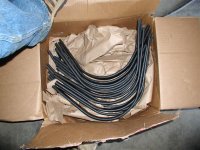
Well, that photo attach didnt work, so here is another attempt. Also, the boxes of tines came from Agri-supply. I opted for the heavy duty ones. 31 tines, for a 78 inch tinebar.
 

Attachments

  • P1010034 (Medium).JPG
    P1010034 (Medium).JPG
    70.8 KB · Views: 3,362
  • P1010037 (Medium).JPG
    P1010037 (Medium).JPG
    85.4 KB · Views: 2,963
/ Homemade landscape and trail rake
  • Thread Starter
#10  
Correction: The tine bar will be 76.25 inches long, I cut it last night.
1.25 inches per tine, plus a 1.25 inch spacing between tines, 31 tines total, and then minus one space (31 tines, but only 30 spaces). The tines have 7/16" holes (two holes per tine) so I purchased grade 8, 7/16" x 1.25" x 20 (fine thread) bolts and nylock nuts. The big drill-athon begins tonight.
 
/ Homemade landscape and trail rake #11  
Hmmm.... looking at your offset swing arm, i wondered what kind of tractor you have.... :) your 4100 will have to try very, very hard to break that swing arm.. ;)

I'll follow your progress as i want to make a rotating and swinging scraper blade, and your swing arm design gives me some new inspiration... I had my co worker at the company curve me a nice moldboard last spring, but i havent had time to begin the actual work on it yet.
A landscape rake is of no interest in our sandy Dutch stone-less soil, but i think you are making pretty much the same as i want, just with a rake instead of a full blade.
 
/ Homemade landscape and trail rake
  • Thread Starter
#12  
OK, I updated my profile. But still the 2520 would have to work very hard to bend that swingarm. Especially with a landscape rake mounted on it. But I think its about correct. My design originally used all 2x5x0.188" tubing, but then I found these other sizes in the junkyard, so I modified the plan a bit. The sizes selected sort of evolved from the pipe sizes. Some parts may be overbuilt, but that's ok. I will still have to add 60-80 pounds of weight to get it to the full digging potential. Weight brackets on the tine bar are part of the plan. If anything in the main frame or swingarm frame flexed or twisted, it would quickly tear apart from the forces from the hydraulic cylinder locked in there and binding on its pivots. I have been carefull to have no mechanical stops anywhere, only the cylinder stroke limit will stop it in each direction.

I am getting a good idea, after reading your post (thanks!). I was expecting to slide the shaft welded to the tine bar up into the rear of the swingarm, and weld a ring on the top. I am now wondering if I should make it slide in and have something clamp or bolt in place to hold it in, so it could be changed out for a blade, or other stuff. ?Hmmm...
 
/ Homemade landscape and trail rake
  • Thread Starter
#13  
Main frame final welded complete, and tine bar milled. 62 holes, 7/16 inch diameter, for 1.25 inch wide tines on a 2.5 inch pitch. Two more pics...
 

Attachments

  • P1010040 (Medium).JPG
    P1010040 (Medium).JPG
    74.3 KB · Views: 1,974
  • P1010038 (Medium).JPG
    P1010038 (Medium).JPG
    47.7 KB · Views: 1,617
/ Homemade landscape and trail rake
  • Thread Starter
#14  
Last night I cut the 3-point pin mount brackets, and the cylinder-end brackets on the NC plasma cutter. Some of these were made of 5/8 inch flat, the thickest I have ever NC cut. Had to run as slow as 7 inches per minute, but the results are quite nice. They have the usual 6 degree bevel, which becomes quite noticeable on a 5/8 thick part, but are otherwise kinda pretty. Very nice cut finish, and the dross (slag) just knocked off with a hammer. Sorry, no pics this time.
 
/ Homemade landscape and trail rake #15  
jimgerkin, you said:
I am getting a good idea, after reading your post (thanks!). I was expecting to slide the shaft welded to the tine bar up into the rear of the swingarm, and weld a ring on the top. I am now wondering if I should make it slide in and have something clamp or bolt in place to hold it in, so it could be changed out for a blade, or other stuff. ?Hmmm...

Here are a couple of sketches that I drew in MS Paint just to sort of get my idea on paper.

I built this blade about 1 1/2 years ago and it worked great. You could pull one cylinder pin and 2 bolts and change from blade to rake (or something else?) in just a few minutes.

I loaned this blade/rake combo to my brother when he built his new house and haven't gotton it back yet (5 hour drive round trip). I'm planning to see him Christmas so maybe I'll get it then.

Anyway, I built mine with hydraulic angle and sideshift. As I said, everything worked great, but I like your design on the swing arm better than mine. The one I built has a swing arm made of 4" x 6" x 1/4" rectangular tubing (read HEAVY). The tubing was turned with the 6" dimension vertical to improve strength. I made the swing arm long enough so tha I could rotate the blade/rake to push backward if I wanted to.

The sketch only shows 1 arm on the blade for the angle cylinder to connect to, but I added another one on the other side so when the blade was reversed, you could still control the blade with hydraulics. This arm is part of the pivot plate that is attached to the blade/rake assembly.

Hope this makes sense.

Mike
 

Attachments

  • Rear Blade Sketch.JPG
    Rear Blade Sketch.JPG
    20.3 KB · Views: 1,481
  • Back Blade Pivot.JPG
    Back Blade Pivot.JPG
    21.4 KB · Views: 1,280
/ Homemade landscape and trail rake
  • Thread Starter
#16  
Mike, thanks for the idea on the bolt-down-thru method. The timing couldnt be better, thats the next thing I build.
This weekend I was able to get the 3-pt pin mount plates drilled and welded in place, the trunion cylinder fixed-end fitting cut out, drilled and tacked on, and the tine bar cap welded to the bar. With no hoses on the cylinder, and all pins installed, and rake assembly mounted onto Speeco quick hitch, I could move the swingarm mechanism full stroke to see how the range worked out. Surprise! it has two inches MORE range than I had predicted, all the extra range ocurring to the right side (perfect). I guess the cylinder has 9.5 inches of stroke instead of the advertised 9 inches. Pics...
 

Attachments

  • P1010041 (Medium).JPG
    P1010041 (Medium).JPG
    58.5 KB · Views: 1,398
  • P1010042 (Medium).JPG
    P1010042 (Medium).JPG
    80.4 KB · Views: 1,116
  • P1010044 (Medium).JPG
    P1010044 (Medium).JPG
    77.3 KB · Views: 1,053
  • P1010045 (Medium).JPG
    P1010045 (Medium).JPG
    89.3 KB · Views: 1,028
  • P1010046 (Medium).JPG
    P1010046 (Medium).JPG
    88.1 KB · Views: 1,081
  • P1010047 (Medium).JPG
    P1010047 (Medium).JPG
    80 KB · Views: 1,052
  • P1010048 (Medium).JPG
    P1010048 (Medium).JPG
    84.1 KB · Views: 1,106
  • P1010049 (Medium).JPG
    P1010049 (Medium).JPG
    76.1 KB · Views: 1,512
/ Homemade landscape and trail rake #17  
Now THAT is a rake mount!

Nice use of the trunion cylinders. Keep the pics comming:)
 
/ Homemade landscape and trail rake #18  
I second what Ron said! I wish I had thought of that when I built mine.

Hope the idea with the swivel post helps. It works pretty good. When I built mine, I built it as a 6 foot rake. I had an older 5 foot scrape that I bought at an auction. The frame was in poor shape so I modified the blade to work with my new rake frame.

When (if) I get it back from my brother, I will try to post some pics.

Good luck with your rake.
Mike
 
/ Homemade landscape and trail rake #20  
Excellent work Jim! I hope you powder coat it when you are done as something with that much effort into it deserves a nice finish...even if some of it gets worn off from use. :)
 

Marketplace Items

(1) 300 GALLON POLY TOTE W/CAGE (A60432)
(1) 300 GALLON...
UNUSED IRMC HIGH END MASSAGE CHAIR (A60432)
UNUSED IRMC HIGH...
2019 ATLAS COPCO QAS 25 T4F NB-3 PHASE GENERATOR (A60429)
2019 ATLAS COPCO...
2018 FREIGHTLINER CASCADIA TANDEM AXLE SLEEPER (A59905)
2018 FREIGHTLINER...
Poly Fuel Tank with Electric Pump (A55851)
Poly Fuel Tank...
2017 INTERNATIONAL PROSTAR TANDEM AXLE SLEEPER (A59905)
2017 INTERNATIONAL...
 
Top