Inline vs Traditional small Square Balers?

   / Inline vs Traditional small Square Balers? #1  

CliffordK

Veteran Member
Joined
Mar 8, 2013
Messages
2,438
Location
Eugene, Oregon
Tractor
Toro D200, Ford 1715, International 884,
Ok,

I'm looking at 2 twine small square balers.
50 lb bales or so.

A couple of years ago, someone baled hay with an inline baler for my mother, and it was a disaster. Not well adjusted baler. Bales were loose. No "flakes" (apparently horse owners like flakes). And a lot of "banana bales". But, I don't think he ever understood baler adjustments.

Anyway, that is the only one I've ever seen in use, so I can't say for sure it was the baler and not the operator.

I like the idea of narrow, 8' to 8'6" towing as I likely will be moving to hay fields not close to my house.

What have other people's experience with the inline balers been? Better or worse than the traditional ones?

Even the used ones can be pretty expensive.
Are they all the same and rebranded?

A couple of used ones I'm seeing. A bit of a drive, but almost accessible.
Hesston 4550
Case International 8550 (I'm not seeing any new inline balers from IH which is suspicious)

Unfortunately I'm not seeing a lot of literature on these balers.

Hesston/Massy uses different numbers now. They seem to have several models. Their 1835 is a lighter duty, and the 1837 & 1839 are medium duty, and the 1841 having larger bales.

So, is the Hesston 4450 similar to the Hesston/Massy 1835?

Anyway, thoughts about comparing these balers to the conventional balers.
And, is there a problem with these balers and lighter bales?
 
   / Inline vs Traditional small Square Balers? #2  
To be honest(im not a real farmer by any sense of the definition but i have thrown my share of a 100,000 square bales) and I dont know of anyone in the area that has an inline baler (as long as im being honest, ) I dont know that i have ever seen one in person. I had to google it. I know it takes a good operator to get a bale just right, We were almost forbidden to grease the knotters on the NH baler my neighbor had because it would't tie right for a few to many bales. WE did anywhere between 8k and 15k bales a year out of that baler and only replaced wear parts mostly. Broke the odd piece now and again but nothing to serious. The moisture has alot to do with how nice your bales are. We have baled everything from 30lb light weights to what im guessing were 120lb monsters that you were lucky the strings didn't explode when you picked the bale up. Just salted them down in the mound since there were going for mulch anyways. The only thing that i remember really giving us trouble is when i would rake the outside row into a double row from the mower, if it was to big it really slowed the baler down and made a terrible chunking noise when the plunger cycled. Best thing you can do is get the chamber full and start adjusting tension and the length of your bales to get them where you like them. Its not to difficult just takes some time to iron out.


I just realized I didn't answer your question, but it did give you a bump TTT.:thumbsup:
 
   / Inline vs Traditional small Square Balers? #3  
Inline balers are suppose to be better than conventional sq balers because of the way the hay flows from windrow to completed bale. I've never been in the field with an inline baler but have been in field with many conventional balers. Normally banana shaped bales are caused from shape/size of windrow and can be solved by driving techniques and/or adjustments to baler. There are some ""older baler"" models that were known for making banana shaped bales.
 
   / Inline vs Traditional small Square Balers?
  • Thread Starter
#4  
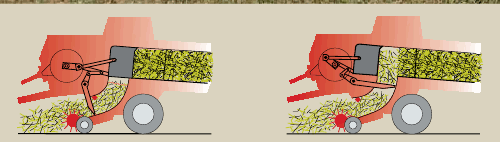
Here is a cartoon from the Massey/Hesston site.

Inline.gif

One would have to expect good right-left symmetry of the bales, assuming one is picking up the windrow in the middle of the baler. However, one might be concerned with top/bottom assymetry. I.E. what happens to the bale when you pick it up.

I think some of the hay that Mom had problems with got an extra day or two of drying, but still, when the neighbor came down with an 20 or 30 year old IH, it did much better.
 
   / Inline vs Traditional small Square Balers? #5  
Former dairy farmer friend in Olympia, WA has a Hesston in-line baler. He swears by it! Years ago his place was a dairy farm; now, it's a You-Pick-Em farm with sweet corn, peas, beans, pumpkins, garlic, strawberries, etc. etc.

And hay. He does both small squares with the Hesston and big rounds. Custom work, too.

AKfish
 
   / Inline vs Traditional small Square Balers? #6  
I can't really see how you could get banana bales out of an inline? Never been able to make that happen myself. No flakes, yes. The windrow was small or the ground speed needed to be increased. I have fed through 1 side of the pickup and never had an issue. I would have to say that guy didn't know what he was doing and had the settings all screwed up and it wouldn't matter what baler he was using.
All inlines are made by Hesston. Case-IH & Hesston had a joint venture back in the 90's and most of the Case-IH hay stuff was Hesston made. Small squares, round balers and big squares. Now labeled as a Massey, Challenger and some older AGCO branded.
I have put many bales through in-lines and will not go any other way. They are easy to work on, have less moving parts and make better bales.( as said, I can't see how he could get banana bales) Even side weight distibution, easy to travel with, nice & compact to store, good ground clearance. I could go on.
As with any hay equipment, dealer support is key. they all will break and you will need parts. If you can't work on a baler, you will need service as well. The principals are the same as any conventional side pull baler, knotters are knotters, pickup is a pickup.
I would be sure to have hydraulic pickup for the head, that is nice for rough ground. I like Hydraulic tension, but it isn't needed. If you're not doing much hay, the smaller 1835 size machine will work just fine. The wider pickup and extra capacity of the 1837 & 1839 machines are nice though.
I've run them from back in the 4600 Hesstons, New Idea versions, Case-IH and now MF branded. If you have questions, fire away.
 
   / Inline vs Traditional small Square Balers? #7  
I see no way a sq bale that's any where close to 36"s long can be made with "no flakes". Everything the plunger head cycles there should be a flake. I need someone to demonstrate that feat to me.
 
   / Inline vs Traditional small Square Balers?
  • Thread Starter
#8  
Thanks MFRED for the comments.
So, would the Case-IH inline balers have International Knotters, or Massey-Hesston knotters? I.E. are the rebranded balers some kind of Franken-Baler? Thus, is parts/service ok for the Internationals?

I suppose that question would also lead to who makes the best knotters?

I'm not quite sure why everyone had problems with the bales mom had two years ago. Perhaps the chamber tension was never set right, so rather than getting 50 lb bales, they were 30 lb bales, which would mean the flakes would not be as crisp. I assume the cut side is on the bottom, so the bales would look different, but that shouldn't affect pulling them apart to feed animals.

I think I'm going to have to just ignore that experience, and assume the bales/moisture content can be set right to give good bales.
 
   / Inline vs Traditional small Square Balers? #9  
Case IH inlines are the only baler you will see around here . After decades of john deere balers the inlines seem a lot faster and more reliable .
 
   / Inline vs Traditional small Square Balers? #10  
In theory: I can see advantages/disadvantages for both designs. The inline baler supposedly has fewer moving parts and the hay does not have to make a 90 degree turn into the bale chamber like it has to on a conventional baler so in theory might produce a more uniform bale and might even have the ability to operate at higher capacity due to this. The downside is that an in-line baler will usually require a bigger tractor to run it because you straddle the windrow (no narrow front tractors either again due to windrow straddling). A good ole conventional baler can pretty much be run with any tractor of sufficient hp even if it is low to the ground or has a narrow front end since you will not be straddling the windrow. Good conventional balers can certainly make a consistent uniform bale if set properly.
 
   / Inline vs Traditional small Square Balers? #11  
The inline hesston IH marketed balers were the first that allowed the bale to get out of the chamber that it would not burn the strings trying to pull it out with the kicker. So they built a very square bale and would compete with the pan kicker for not beating up the bale while moving to the wagon. The knotters used are the deering style which are currently the most common.
 
   / Inline vs Traditional small Square Balers? #12  
im going to go out on a limb here an say that baler wasnt adjusted right.the best reason to run an inline baler is no sore neck from looking back as the hay goes in the baler.
 
   / Inline vs Traditional small Square Balers? #13  
You can run an inline on a shorter tractor, we just hung a mudflap under the hitch to keep the hay from bunching there. Just as we did with the first round baler. If you make good fluffy windrows, yes, it is nice to have a good tall machine. I currently run on 18.4x30 tires with no issues, so they're not all that tall at all. They have very low hp requirements so it makes it nice.
 
   / Inline vs Traditional small Square Balers? #14  
Some friends of mine have a hay business to supply their feed store. They do thousands of bales per year. They use a Hesston in-line and a Bale Bandit. Then, they use a skid-steer to load them in a semi trailer. They claim it's the only way to go.
However, they have about $80K tied up in the baler and bandit. :eek: I couldn't justify that kind of expense. Probably wouldn't live long enough to pay for it either. ;)
 
   / Inline vs Traditional small Square Balers?
  • Thread Starter
#15  
The bale bandits and bale barons look impressive, but not in the plans at the moment.
If I was to build a barn from scratch, I would certainly consider designing it around an automatic bale wagon/stacker, but in the past we would always have to hand stack the hay in the loft, and a bale wagon never seemed too practical.

I talked to someone about grass seed straw. If I wanted to get into that business, I would certainly consider some type of bale accumulator/loader, and probably end up with really heavy either wire bales or 3 tie bales.

Anyway, so my worries about the inline baler are unjustified based on a single bad experience with an inexperienced operator.
 
   / Inline vs Traditional small Square Balers? #16  
Bale bandits/ barons are nice setups. Just expensive. I like them more than the stacker wagons, probably because it will justify another bigger loader tractor or articulated loader.

My new barn will be setup to handle them too, someday I'll get some sort of way to handle small squares better than kicker wagons. But need to have the barn to slide them into easily first to make the move justified.
 
   / Inline vs Traditional small Square Balers? #17  
hey mfred, my fil and I use a kuhns accumulator just the 10 bale version but it feels like you getting away with bloody murder when handling those small square bales. We started baling at 1 and finished up around 430 and I went over after work to help pick them up (in my a/c tractor lol) and we had 900 bales picked up hauled to the barn, and unstacked before 9pm. I have thrown alot of hay so I smile ear to ear everytime we baled hay last summer!
 
   / Inline vs Traditional small Square Balers? #18  
When NH (Fiat Agri) bought CaseIH spelled the end for CaseIH inlines as CaseIH and AGCO had split ownership of Hesston who in the 70's was owned by Fiat Agri. Confusing:confused2: The anti trust judges forced Fiat to sell off different plants around the world and one was CaseIH stake in Hesston. CaseIH balers are now rebadged NH balers since it is CNH, now a division of Fiat. I have been thru the Hesston Kansas Plant and I wouldn't be afraid of anything built there. The inline baler no matter what brand name it carries is a very good design and well built. I do own NH and they have done me well.
 
   / Inline vs Traditional small Square Balers? #19  
When NH (Fiat Agri) bought CaseIH spelled the end for CaseIH inlines as CaseIH and AGCO had split ownership of Hesston who in the 70's was owned by Fiat Agri. Confusing:confused2: The anti trust judges forced Fiat to sell off different plants around the world and one was CaseIH stake in Hesston. CaseIH balers are now rebadged NH balers since it is CNH, now a division of Fiat. I have been thru the Hesston Kansas Plant and I wouldn't be afraid of anything built there. The inline baler no matter what brand name it carries is a very good design and well built. I do own NH and they have done me well.


Did you tour the combine plant too?
 
   / Inline vs Traditional small Square Balers?
  • Thread Starter
#20  
Whew,
What a mess of who owned what when, especially as sometimes a company will buy another company just to gain access to patent rights.

Did Fiat also own Oliver?

I would assume as companies merge, they would tend to drop redundant product lines. But, then what happens if they split off again?

So, I also saw some Ford balers (traditional wide) for sale. Are these maintained by New Holland?
 

Tractor & Equipment Auctions

DEUTZ MARATHON 60KW GENERATOR (A55745)
DEUTZ MARATHON...
2018 Honda Rubicon TRX500FA5 4X4 ATV (A59231)
2018 Honda Rubicon...
JOHN DEERE 7230R TRACTOR (A60430)
JOHN DEERE 7230R...
Bobcat E42 (A60462)
Bobcat E42 (A60462)
Sakai SV505 (A60462)
40 (A52708)
40 (A52708)
 
Top