Advice on Electrical Conduit

/ Advice on Electrical Conduit #1  

ustmd

Platinum Member
Joined
May 6, 2009
Messages
915
Location
Manor, TX (outside of Austin)
Tractor
Kioti CK27 HST
Looking for some advice.

I live on the Black Land Prairie in Central Texas--come call it black gumbo. The soil is mostly clay and the engineers like to say that it has a high soil plasticity, which means it moves a lot depending on the moisture content.

Well, we just broke the record for consecutive days over 100 in Austin and we are in a drought.

I have seen my soil move and crack before, but this level of movement is new.

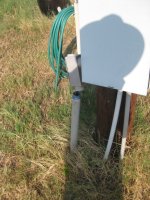
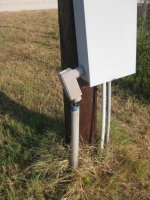
The picture is at my meter serving the barn. As you can see the soil has dropped several inches and taken the conduit feeding the sub panel in the barn with it--the wiring is still in tact.

So I need a short term solution and a long term solution.

For the short term, I considering a trenching out, by hand in 108 heat, the conduit so it can float free. I am hoping that it will rain some day and the ground will swell back to its normal levels.

For the long term, I am wondering about installing some type of slip joint in the conduit...is that common.

I am looking for any feedback/suggestions

Thanks
 

Attachments

  • IMG_2553.JPG
    IMG_2553.JPG
    370.8 KB · Views: 471
  • barn 2.JPG
    barn 2.JPG
    344.2 KB · Views: 318
/ Advice on Electrical Conduit #2  
Last edited:
/ Advice on Electrical Conduit #3  
Don't know if it's allowed on that application, but a short section of liquid tight conduit going into the side of the box would give you enough flexibility. Maybe even make a loop out of it.
 
/ Advice on Electrical Conduit #4  
An expansion joint or slip fitting if you wish, is what you need. Up here where the ground moves every winter due to freeze and thaw cycles they are required.
 
/ Advice on Electrical Conduit #5  
Change the el location. Add another el and relocate the existing el to the bottom of the box. The els will flex instead of pulling apart.

On second thought... Your pics shows several inches of movement. Water-tight flex in a loop is the only sure fix.
 
/ Advice on Electrical Conduit #6  
Expansion joints are now a NEC requirement. Can't tell for sure but that looks like 1 1/2 conduit, the joints allow for about 6" of expansion and contraction in that conduit size. Alternatively Liquid tight flex will also work. In most cases for that diameter of conduit it will need to be liquidtight metallic conduit. Your biggest challenge with that path will be finding the material and the fittings for the ends and, perhaps most importantly ensuring the joint between your existing and the Liquid tight stays watertight. Although that sounds pretty funny right now considering the lack of rain.

Good luck and good for you in trying to address. In recent months have seen some pretty hacked up electrical jobs on TBN. At least you care enough to try to find a solution. That is not always the case.
 
/ Advice on Electrical Conduit
  • Thread Starter
#7  
I appreciate the feedback from everyone.

All I need to do now is get some dynamite to blast the trench out to flex the pipe and convince my wife that we do not need a licensed electrician for this one.
 
/ Advice on Electrical Conduit #9  
That would depend on how it moves. If the movement is just vertical, then an expansion joint would work fine. Expansive soils can move in other directions too...
 
/ Advice on Electrical Conduit #10  
The slip joint is what you need and it is required here (both expansive soils and freeze issues). Flex would not be allowed here. Above ground where it can be struck has to be schedule 80.

Kim
 
/ Advice on Electrical Conduit #11  
Call an electrician. For now if you have an old inner tube you can wrap it around it. Being where it is you may need to have the power company disconnect power to fix it correctly, they may ask you for the name of the electrician doing the work. Either way you need to make sure that the wire inside the box has enough play otherwise you could do real damage. It's possible that you could pull the wires free from the other end and start a fire if they short out. It should be a quick fix so it shouldn't cost too much but better safe than sorry.
 
/ Advice on Electrical Conduit
  • Thread Starter
#12  
Well, I did call my electrician who came out yesterday evening to evaluate--great guy and I highly recommend him.

We are going with the flex line. Supply warehouses in this part of the country don't even stock the expansion joints. Also as dstig1 mentioned, we are actually seeing movement in mulitple directions (the conduit no longer lines up), so the flex line will work better for that issue.

As a side note, the panel has a 200 amps breaker and feeds through to the barn. The wire the previous owner used to the barn is only rated to 150 amps, so I am having a 100 amp breaker put in to protect the line feeding the barn.

The joys of country livin'.
 
/ Advice on Electrical Conduit #13  
Better safe than sorry. I'm a do it yourself kind of guy but sometimes having a professional come out is worth it.
 

Marketplace Items

2021 TORO TRAILER (A65643)
2021 TORO TRAILER...
2022 Bobcat T770 (A64126)
2022 Bobcat T770...
Circle W Stock Trailer (A64127)
Circle W Stock...
Ag Leader PF Advantage Monitor (A65640)
Ag Leader PF...
2008 Chevrolet Silverado 2500 Crew Cab (A62613)
2008 Chevrolet...
2018 JOHN DEERE 650K LGP CRAWLER DOZER (A64279)
2018 JOHN DEERE...
 
Top