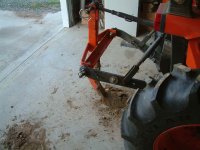
Cultivating Implements

/ Cultivating Implements #1  

Iplayfarmer

Super Member
Joined
Jul 11, 2005
Messages
5,326
Location
Idaho
Tractor
Massey Ferguson 1215, Case 801B
I need advice on what is the best implement for breaking new ground.

I've got a tiller on a 18 hp Iseki that is great for working old gardens and ground that has already been broken. However, it has a bit of a hard time breaking new ground or beating up sod.

I'm going to be tilling up my old pasture (1/2 acre) and re-planting this coming spring, and I need some way to break the ground. In addition, I am probably going to be starting some new gardens for some of my siblings and neighboors.

Things that will be important to me are prioritized as follows...

1) Ease of use - I haven't done a lot with ground engaging implements. I'd love to learn the fine arts of everthing, but I'd love even more to have my pasture tilled, planted and ready to go as soon as possible.
2) Cost - I want to have enough money left after buying this to afford grass seed and some fertilizer.
3) Versatility - It would be nice if whatever I get can be used for other things too (i.e. ground work other than just breaking sod)

The two things that come to mind are a plow and a spring tine cultivator. Are there other implements I should consider? Which of those two fits best with the criteria as listed above?

Also, if I go with a spring tine cultivator I'd like opinions on the Agri-Fab models. There's a dealer just up the road from me.

 
/ Cultivating Implements #2  
I'm surprised that your tiller won't do good in new ground. Let's hope some tiller owners will chime in with some suggestions.

No matter what you choose, I'd advise renting what you can because after the ground is broken, unless you really let the weeds go, you shouldn't have to break it again, or your tiller should do the job. A single moldboard type plow or a single disk type plow could be used. A local dealer here (in Orange, Va) has them for sale and possible rental. These leave the ground quite rough. Farmers normally follow up with a multi-disc plus harrow to smooth the ground or let it sit for quite a spell and let nature even it out.

I've broken new ground using a digging fork in small plots, a Gravely rotary plow in larger plots and a double disk plow on an old Allis Chalmers on really large fields. You basically need to turn the vegetation upside down. The problem you're having with your tiller may be that it doesn't do this. Vegetation will tend to wrap up around the tines/shaft and then not allow it to "drop" down into the earth.

Once the ground is broken, the tine cultivator will work fine. I've an old "soil ripper" from off a JD M that I adapted to my 4010 (an 18 hp machine like your Iseki). However, I don't think your Iseki nor my 4010 will pull those tines through vegetation. It pulled the 7 tines without vegetation with turf tires fine. Ag tires MIGHT allow you to pull it through vegetation.

Ralph
 
/ Cultivating Implements #3  
Just off the top of my head, I'm not sure you can pull much with 18hp. Your tiller should do the job if you go slow and make a number of passes. For grass you're not going to get a better seedbed with anything else.
 
/ Cultivating Implements #4  
You should never break new ground with a tiller
Your tiller just flat won't last.
Either use the scarifiers from your box blade first and break up that top layer of hardpack, or get a real ripper. (big scarifiers)
But just tilling unworked ground will rapidly destroy your tiller.
 
/ Cultivating Implements
  • Thread Starter
#5  
LoneCowboy said:
But just tilling unworked ground will rapidly destroy your tiller.

That's been my fear when I've tried it with the tiller. The tiller just tosses the little tractor around if the ground is too firm. Even if the tractor will last through it, I don't know if I will.

I hadn't thought about the disc. What is going to be easier to use and what is going to be easier to pull between the moldboard plow and the disc? Will the disc even turn up old sod?

I've tried the rippers on the box blade, but they don't turn the sod over. I've made that do for the few plots I've broken in the past, but I keep thinking there's got to be a better way.
 
/ Cultivating Implements #6  
seems like it needs a bottom plow and then a rototill a few weeks later....
 
/ Cultivating Implements #7  
Iplayfarmer said:
I need advice on what is the best implement for breaking new ground.

Also, if I go with a spring tine cultivator I'd like opinions on the Agri-Fab models. There's a dealer just up the road from me.


What you need is a $120 middle buster plow (aka potato plow, King Kutter at Tractor Supply Co).

King Kutter Incorporated

Your Iseki will handle it OK this time of year on rain-softened ground.
Then make yourself a drag out of a couple of old auto tires and some chain to level the plowed ground. Then use your rototiller. Remember to take it easy with the rototiller and don't over-till because rototilling really clobbers the soil microstructure.

I have a 21-hp Kubota B7510HST and have no trouble getting that my KK middle buster 12" into the ground. Just take it easy, go slow.
 
/ Cultivating Implements #8  
For your B7510, did you but the XB series-combo or the TSC standard Middle-Buster?.
 
/ Cultivating Implements #9  
Iplayfarmer said:
I need advice on what is the best implement for breaking new ground.

I've got a tiller on a 18 hp Iseki that is great for working old gardens and ground that has already been broken. However, it has a bit of a hard time breaking new ground or beating up sod.

I'm going to be tilling up my old pasture (1/2 acre) and re-planting this coming spring, and I need some way to break the ground. In addition, I am probably going to be starting some new gardens for some of my siblings and neighboors.

Things that will be important to me are prioritized as follows...

1) Ease of use - I haven't done a lot with ground engaging implements. I'd love to learn the fine arts of everthing, but I'd love even more to have my pasture tilled, planted and ready to go as soon as possible.
2) Cost - I want to have enough money left after buying this to afford grass seed and some fertilizer.
3) Versatility - It would be nice if whatever I get can be used for other things too (i.e. ground work other than just breaking sod)

The two things that come to mind are a plow and a spring tine cultivator. Are there other implements I should consider? Which of those two fits best with the criteria as listed above?

Also, if I go with a spring tine cultivator I'd like opinions on the Agri-Fab models. There's a dealer just up the road from me.

There is a tool, called a "pasture renovator" that'll do a fine job of breaking up compacted soil, albiet not all that deep. HayKing is one popular newer brand. Even the smallest of them may take more HP than you have to work with though.

Has your pasture been used as pasture for a long time? If so, it's going to be hard as concrete. Animals will compact soil far more than any tractor can. If that's the case, expect a hard time with a spring tine cultivator. They don't like extremely compacted soil. (A field cultivator of any type is a SECONDARY tillage tool, intended for use in previously worked ground)

What does do a good job, and will correct the situation with compacted soil is a chisel plow of some description. With so small of a tractor, I'd bet you'll have a difficult time finding any real chisel plows that will work. With that, the best suggestion so far would be to rip it with the box blade teeth. THEN a disc or tiller.

I would consider hiring a local with a bigger tractor and a plow/chisel plow/heavy disc to do the hard part, then use your tractor to finish the seedbed and then plant.

When planting grass, soil doesn't need to be worked into powder. In fact, that's about the worst thing you can do for a seed bed for grass. I'd suggest ONE PASS with a tiller, or better yet, use a disc. Then run over it with some sort of packer (like a cultipacker) Grass's like a FIRM seedbed.

JMHO, and worth about what you paid for it.
 
/ Cultivating Implements #10  
Gamemaster said:
For your B7510, did you but the XB series-combo or the TSC standard Middle-Buster?.

I have the XB series combo. No problem getting it attached to the 3pt hitch. And the 3pt lower arms on the 7510 drop low enough to get the plow at least 12" into the ground, which is plenty deep for my needs.

I have 3 attachments for the combo: the middle buster, the 2"-wide subsoiler chisel plow (both came with the combo) and a 6" wide sweep that I bought for $5 from Agri-Supply (part #15400, see photo). The holes in the sweep mate with the holes in the combo frame with no problem.
 

Attachments

  • DSCF0060-small.JPG
    DSCF0060-small.JPG
    91.1 KB · Views: 511
/ Cultivating Implements #11  
might as well add my 2 cents.....i would cut the grass/stubble/weeds as short as possible. then i would use a turning plow (moldboard plow). a half an acre aint much...with a single bottom 12" plow it would take 2-3 hours if the ground is not very hard. i would do this when its still cold enough for the ground to freeze. this will help to break up the plowed soil some. then i would disk it one or 2 times and then rotary till. if you dont have any of this equipment you could probably find someone who does and just pay them to do it.
 
/ Cultivating Implements #12  
I wonder if you could find a shaft to which you could bolt a six inch sweep that would fit into the slots where the rippers go on a box blade. You might even be able to get a larger sweep type plow than 6 inch, it seems that we used to have some with a wider wing than 6 inches for our cultivator to run between the rows or in the "middles" as we called it. If you replaced all the rippers with that type plow, you could turn over a lot of ground in a couple of passes with the box blade, and it shouldn't pull the tractor too hard.
 
/ Cultivating Implements
  • Thread Starter
#13  
The ground is probably going to be HARD. No one around here remembers the last time that this spot of pasture was worked. I've had animals on it for 4 years and the guy before me had animals too. There are some spots where it is a little rocky too.

I've tried the rippers on the box blade, and my tractor won't pull them very deep. I actually bought some old parts off a guy at a yard sale thinking I may make a middle buster. I may still try that. From all I've heard so far in this thread it sounds like it's either pull a middle buster with my little tractor or hire someone else to do it with a bigger tractor.

Hiring someone else takes half the fun out of it, but I may just go that route. I actually have a few farmers in the area that owe me a few favors.

One other question...It's been suggested that I work the ground pretty early in the spring. One of the reasons I want to till and re-plant is to get rid of some weeds. Would it be better to wait until the foilage is growing and then spray before tilling everything up, or should I just go ahead and till early in the spring?
 
/ Cultivating Implements #14  
Iplayfarmer said:
The ground is probably going to be HARD. No one around here remembers the last time that this spot of pasture was worked. I've had animals on it for 4 years and the guy before me had animals too. There are some spots where it is a little rocky too.

I've tried the rippers on the box blade, and my tractor won't pull them very deep. I actually bought some old parts off a guy at a yard sale thinking I may make a middle buster. I may still try that. From all I've heard so far in this thread it sounds like it's either pull a middle buster with my little tractor or hire someone else to do it with a bigger tractor.

Hiring someone else takes half the fun out of it, but I may just go that route. I actually have a few farmers in the area that owe me a few favors.

One other question...It's been suggested that I work the ground pretty early in the spring. One of the reasons I want to till and re-plant is to get rid of some weeds. Would it be better to wait until the foilage is growing and then spray before tilling everything up, or should I just go ahead and till early in the spring?

If you work the soil before your weeds come out of their winter dormant stage, you'll merely bury them. That isn't the worst thing when we're talking about weeds that result from germinating seed, but SOME noxious weeds sprout from the roots of last years weed crop. Plowing them under doesn't change a lot. The BEST way to kill weeds is to spray them when they're growing plants. Some manufacturers of herbicides even recommend spraying with or shortly after fertilizing. That makes the now healthy, growing weeds want to take up more of the weed killer.

Also, you're going to be contending with weed seed that was dropped last year. Bury them and they can survive months, even years under the soil. For best results in most cases, wait until everything is out of dormancy and growing, but BEFORE they produce this years crop of seed, THEN nuke 'em with the appropriate weed killer(s).

There are literally hundreds, maybe even thousands of species of weeds. No one method of eradication will be the "do all" for every one, short of a complete total kill that may sterilize the soil for a time.
 
/ Cultivating Implements #15  
Mr. Farmwithjunk,

I'm eager to hear more about the ways to prepare soil for the planting of grass from someone in the "Bluegrass State", for I'm about to begin a project where I wish to turn 5 acres of very hard clay soil in central Texas into a lush evergreen/lawned park like setting. My neighbors think I'm crazy, but the family is ready to buy some lawn furniture. So tells us more......
 
Last edited:
/ Cultivating Implements #16  
To answer Mike, 18 hp is more than enough. The problem is weight to get traction. In the early history of tractors, the large majority of these were 16-18 hp, but they were 3,000+ # monsters. The old JD M was about 3,000 # but was only 18 hp.

So, the Iseki will probably pull a moldboard plow if you affix some rear wheel weights.

The problem with a moldboard (and a disc plow, but a little tractor will have trouble keeping from being pushed aside using this type (disc) plow, probably; whereas, the moldboard anchors itself from being pushed aside by digging down into and riding in the soil vs. the disc just lifting it and casing it aside) is that it leaves the ground very rough. Normally, a multi-disc and harrow are used to smooth the humps left behind. They'll be smoothed by weather if you could plow in the fall and not have to use the ground until spring. The rototiller may be a good tool for smoothing out the humps. I used the soil ripper (originally made for the M noted above) behind my little 18.5 hp 4010 to remove the raised rows I'd made with the old Gravely rotary plow. I remade the rows by mounting opposed discs behind each wheel. These were mounted onto the diamond bar that the soil ripper cultivator tines were bolted to.

The soil ripper, which is similar to what is called today a "cultivator", would rip up the soil, but my 4010, like the Iseki, is too light to pull these 7 tines through ground with vegetation. Plus, the soil ripper really won't turn vegetation over to kill it, like a plow does. So, affixing weights to the wheels and pulling a cultivator through the vegetation won't do the trick, unless you first kill the vegetation with Roundup. Most of us don't want to use Roundup extensively in our vegetable gardens. Still, one would probably prefer a plow to turn the dead vegetation over to "compost" it, even if it was killed first.

Ralph
 
/ Cultivating Implements #17  
I like the looks of the middlebuster. What happens when you encounter decent sized rock with it??
 
/ Cultivating Implements #18  
Green is Keen said:
Mr. Farmwithjunk,

I'm eager to hear more about the ways to prepare soil for the planting of grass from someone in the "Bluegrass State", for I'm about to begin a project where I wish to turn 5 acres of very hard clay soil in central Texas into a lush evergreen/lawned park like setting. My neighbors think I'm crazy, but the family is ready to buy some lawn furniture. So tells us more......

The "Bluegrass State" got its name from the "Bluegrass Region" around Lexington in the central portion of the state. (And some smaller areas in west-central Ky) Bluegrass itself is native to the Pacific Northwest. Grass in the bluegrass region of Kentucky gets its name from a blue-ish hue the grass gets during peak growing season. That blue is from high concentrations of naturally occuring lime in the soil. Most of the state ISN'T Bluegrass country. Only 55 miles from Lexington, and we need to ADD significant amounts of lime every few years to keep soil ph in check.


My experience planting "grass" is mostly from re-seeding hay fields. Commonly used pasture or hay grass's here are Timothy, Orchard grass, endophite free fescues, rye, bluegrass, along with clovers and alfalfa.

Grass doesn't need, nor does it do nearly as well with a deep, loose seedbed. Over-working soild into talcum powder consistancy is one of the worst things you can do to prep for seeding grass. Work it to a minimal depth, then FIRM soil after seed is dropped. (Use a cultipacker)

Plant when soil temps are correct for your seed. Some grass's can be "frost seeded". Others can't. Consult your seed supplier for that advice. Soil is merely a carrier for nutrients. Have soil tested before planting. Add nutrients as required. Continue fertilizer program AFTER grass is up and growing too.

I get a laugh when people give advice as if it's carved in stone, one way to do things. Growing any crop, from grass to corn, you read and react. If you aren't skilled at reading plant tissue, I'd also suggest taking a sample for a plant tissue analysis at some point. (Most state Univ. Ag programs, and/or county extenstion programs can guide you to proper testing facilities. And so it goes.... After each and every step, read the results and determine the NEXT step.
 
/ Cultivating Implements #19  
A 12" single bottom moldboard plow would be best. This would do a good job, turning over the sod completely to a depth of around 6". The middlebuster would leave strips unturned and is definitely the wrong choice here. If your tractor has R1 tires, it will handle this small 3-pt hitch plow without the need for wheel weights or tire loading. If you have R4's or turfs which severely limit the tractor's ability to deliver drawbar horespower because of traction issues, then you will need to add tire chains and possibly wheel weights (if the ground is real hard). Late spring is the best time to plow, after greenup but while there is still adequate moisture in the ground. As the soil dries in the summer, it gets harder, but if you go in too early, mud will be a problem. You do have about double the required horespower for this plow and depending on your tractor's weight, with loaded R1's you may even handle a 12" two-bottom. I used a JD-M like that mentioned above for many years on a 12" 2-bottom and it never struggled. A rototiller is not good at breaking new hard ground as you have descoverd. The nice thing about a rototiller is it lets folks with limited traction (usually due to having R4 tires or turfs), put more of thier tractors power into working the loose soil. After you turn the ground over with the plow, that tiller will give you a good seedbed.


Marketplace Items

1999 Jaguar XK8 Convertible (A61569)
1999 Jaguar XK8...
New/Unused Wolverine 72in Quick Attach Grapple Bucket (A61166)
New/Unused...
TEST YOUR BID BUTTON! (A62129)
TEST YOUR BID...
2024 GD Yatian LY05A Model T Replica Electric Cart (A61569)
2024 GD Yatian...
Black Walnut Lumber (A61166)
Black Walnut...
2012 Ram 1500 Crew Cab Pickup Truck (A61568)
2012 Ram 1500 Crew...
 
Top