Culvert repair/extension: Concrete to HDPE

/ Culvert repair/extension: Concrete to HDPE #1  

Sarge338

Bronze Member
Joined
May 6, 2020
Messages
59
Tractor
Mahindra 2555
Good Morning Folks,

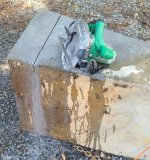
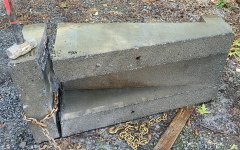
I have a culvert that was installed (I assume) when the home was built, in 1991. In attempting to prep for extending the culvert to widen the driveway a bit, I found the existing culvert was… suboptimal. For starters, it had been completely covered with dirt, leaves, etc. Once I uncovered the end, I found the old, concrete pipe was broken and FULL of mud. When I tried to uncover it to see if I could just cut off the broken bit, and extend it, I found that someone had broken a 5-foot section off of the main culvert pipe, put a “bend” in the line, and “joined” the two sections by putting a piece of sheet metal over it.

Well, I removed the 5-foot section and the “joint” metal. Now I have a jagged, concrete pipe end sticking out about 12” from under the concrete driveway. After cleaning the existing pipe, how would you recommend that I attach a HDPE culvert to this concrete pipe to repair and extend the culvert?

Thanks
 
/ Culvert repair/extension: Concrete to HDPE #2  
Making a joint there could be done with hydraulic cement, but nothing will last. The running water and freeze/thaw will break it apart.

What is the diameter of the culver pipe? I would strongly consider lining it fully with a smaller HDPE pipe. Flow calculations usually prove that the difference in friction coefficients allow better flow through HDPE than concrete, so you won't loose much if anything. And joining the pipe will be much easier (if needed at all). Once lined, you want to protect the ends of pipe with stone or even use a HDPE headwall on each side.
 
/ Culvert repair/extension: Concrete to HDPE #3  
Making a joint there could be done with hydraulic cement, but nothing will last. The running water and freeze/thaw will break it apart.

What is the diameter of the culver pipe? I would strongly consider lining it fully with a smaller HDPE pipe. Flow calculations usually prove that the difference in friction coefficients allow better flow through HDPE than concrete, so you won't loose much if anything. And joining the pipe will be much easier (if needed at all). Once lined, you want to protect the ends of pipe with stone or even use a HDPE headwall on each side.
Manning's roughness coefficient is better for HDPE than concrete but the gains are made the longer the run of pipe gets. On a short run such as what is being considered it would negligible and the cross sectional area of the pipe being attached will control the amount of flow. That being said going smaller is probably not a good idea unless the pipe is already oversized for the drainage area it is servicing.

I would cut the RCP end so it is a clean end cut and so you can butt the other pipe directly up to it without and voids between the joint. Get how ever many bags of Qucikcrete with fiber and pour a collar all the way around. I would pour it as thick and wide as you can get away with in the area you are working in and you can back it up with some plywood cut pieces or if you have thin masonite that works really well and you can just back it up with wood stakes or dirt backfill. Make sure you dig under the joint and get concrete in there also. I would shoot for at least 3-4 inches thick and 12' across the joint (6" on each side). Again if you can get more that will just make it stronger. If you want to go overkill for a driveway connection you can throw some rebar or wire mesh in there for good measure.

It won't meet whatever building code the it would fall under but I have been doing DOT's work for over 20 years most departments have a similar type of connection detail for dis-similar pipes and they typically they require 6" to 8" thick with reinforcing and 1xPIPE ID overlap of the collar on each pipe. So if it was an 18" pipe the collar would be 3' long.
 
/ Culvert repair/extension: Concrete to HDPE #5  
In my mind one major consideration would be are you extending the up stream or the down stream end.
How often has the culvert had heavy flow through it.
A replacement often is cheaper then trying to patch it.
 
/ Culvert repair/extension: Concrete to HDPE
  • Thread Starter
#6  
To answer some of the questions asked…

We are talking about a 15” culvert… packed FULL of mud.

I m looking to extend the culvert on the downstream side of the driveway.

The culvert rarely has heavy flow. It is just for run off drainage… not any kind of steady stream.

The existing culvert is under a concrete driveway, so I don’t think that replacing the culvert would be cheaper.

IMG_4701.JPG
 
/ Culvert repair/extension: Concrete to HDPE
  • Thread Starter
#7  
IMG_4700.JPG
 
/ Culvert repair/extension: Concrete to HDPE #8  
Push the biggest plastic that will go through it, bury it, and readdress if it causes drainage issues more than once a year. But, only if it meets your local requirements, and looks ok to you and yours.

Best,

ed
 
/ Culvert repair/extension: Concrete to HDPE #9  
It doesn't seem like a high flow situation,
I'd get a double wall plastic culvert the same size, butt them together wrap the joint
good with some heavy plastic such as an old pool liner or some of this vinyl bill board material
that they sell for tarps. Compact the bottom of the ditch real good if it's loosened up.
Cover it up and forget about it.
 
/ Culvert repair/extension: Concrete to HDPE #10  
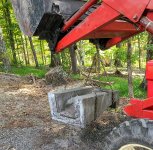
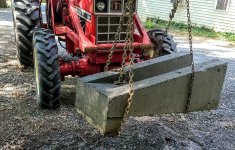
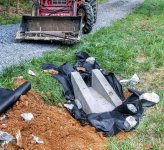
IMO,, you need a "headwall" more than a piece of culvert,,,

Headwall.jpgHeadwall2.jpgHeadwall3.jpgHeadwall4.jpgHeadwall5.jpgHeadwall6.jpg
I have done four of these on my driveway, I got one more to do,,
My neighbor asked why I was doing them,,
I told him,,, "Boredom!!"
 
/ Culvert repair/extension: Concrete to HDPE #11  
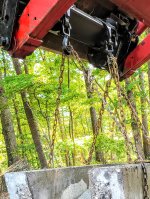
Here the headwall is being placed against the culvert pipe.
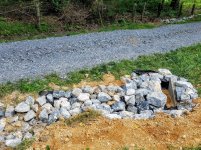
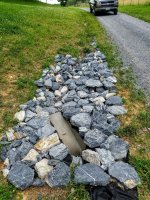
I used the largest rip-rap that could be purchased,,
Headwall12.jpgHeadwall14.jpgHeadwall10.jpgHeadwall9.jpgHeadwall8.jpgHeadwall7.jpg

These pics may be of multiple installs, I started doing these back in 2018,, like I said, there is one more to do.

My culverts used to get clogged with leaves each fall,, not any more,,
The culvert entrances stay spotlessly clean.
 
/ Culvert repair/extension: Concrete to HDPE #12  
Picture number 3 is the first one I did,,
I had not learned to slope the headwall,,
I may pull that one out, and re-install it,,

Those headwalls weigh about 2,500 pounds each,, I hauled all of them on one trailer load.
They sure make a culvert entrance (or exit) bullet-proof.
 
/ Culvert repair/extension: Concrete to HDPE #13  
When I had the rip-rap delivered, the driver told me to stay back over 100 feet,,
the rocks are so big, that they come out of the truck,
hit each other, and throw BIG shards of rock EVERYWHERE!!

Headwall13.jpg

He warned me when I was ordering the rip-rap, some of the pieces would be as big as a car tire.
I was warned not to order it, unless I had a machine to move the rocks.

In the end, the tractor transported the rocks,
but, I placed EVERY one of the rocks final location by hand.

THAT killed my boredom!! :ROFLMAO:
 
/ Culvert repair/extension: Concrete to HDPE
  • Thread Starter
#15  
Which way does it slope? Looks more like it just holds water. Would DOT/ county repair it since it’s in the ROW? My old county would give you the pipe at least.

Oddly enough, the state has a culvert/ditch repair request system. As you might imagine, being a government entity, nothing ever came of the request that I submitted.
 
/ Culvert repair/extension: Concrete to HDPE
  • Thread Starter
#16  
IMO,, you need a "headwall" more than a piece of culvert,,,

View attachment 729213View attachment 729214View attachment 729215View attachment 729216View attachment 729217View attachment 729218
I have done four of these on my driveway, I got one more to do,,
My neighbor asked why I was doing them,,
I told him,,, "Boredom!!"

CADplans,

If your pics ever finish downloading, I’ll take a look at them. LOL. Leaves will be an issue once I get this cleared and repaired, but right now there is so much clay packed in there that it is basically cement. Nothing is getting through.
 
/ Culvert repair/extension: Concrete to HDPE #17  
We clean out soil & root clogged 24" concrete culvert with a flex extension on a power washer and a rented Roto Rooter.

Once cleared, what we did on one job was get steel adapters at each end to go from concrete culvert to steel corrugated & finished the job with a nice looking flanged extensions on the ends.
On a similar job to yours last summer it took two afternoons with cost of materials about two grand.

If you have to replace the entire culvert it can end up costing less because you don't need those expensive adapters. Slope it about 3/4" per foot.
 

Marketplace Items

2015 Ford Escape SUV (A59231)
2015 Ford Escape...
SKID STEER MOUNTING PLATE (A60430)
SKID STEER...
KIVEL 48" PALLET FORKS 3500 LB CAP (A60430)
KIVEL 48" PALLET...
BUNDLE OF UNION STRUT COVERS (A60432)
BUNDLE OF UNION...
(15) UNUSED 8'X41' PROTECTION MATS (A60432)
(15) UNUSED 8'X41'...
UNUSED FUTURE SGB20-20" HYD STUMP GRAB BUCKET (A60432)
UNUSED FUTURE...
 
Top