Drawbar pulling question

   / Drawbar pulling question #41  
Why? I am always amazed when I find I have done things wrong my whole life without ever having a problem.
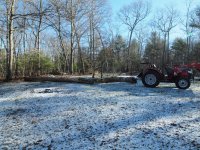
Like people saying you should never use the 3 point draw bar to pull stuff?
That's all I pull with because it raises the tree off the ground preventing snags.
 

Attachments

  • P1064061.jpg
    P1064061.jpg
    5 MB · Views: 336
   / Drawbar pulling question #42  
Exactly what they're made for.
I guess one would have to see them in action to be secure with their workings.
The ones shown seemed to be a little deficient in the sturdy column!
 
   / Drawbar pulling question #43  
especially with the size of the tractor they are on, maybe if it was a bx.
 
   / Drawbar pulling question #44  
The ones shown seemed to be a little deficient in the sturdy column!
I would agree w this.
They would have to be built accordingly.
a fel goes a log way to mitigate front end lift when pulling.
 
   / Drawbar pulling question #45  
I haven't been able to find this via Google searches and don't have all of the data to plug into the formulas. 4x4 Massey Ferguson 1840M HST (39+ hp) with fluid-filled rear R4 tires with loader with say 1,000+ pounds in the bucket and good traction, what's a ballpark figure of how many lbs of force I can put on a cable from the drawbar? 1,000 lbs, 2,000, 3,000? Knowing that helps with what level of mechanical advantage I need and how much rigging gear to buy. thx.

Also, if I can get the cable pull low enough to pull with the backhoe on (and below the axle height), that would be additional weight over the rear tires for traction.

btw, the rest of the story is I'm getting tired of pulling out oak trees utilizing 5 ton come-along's, which won't scale well when I'm clearing 3/4 acre of trees for a garden in the next year (variety of types and sizes). I place a chain 20' high in the tree and cut some of the major roots and bada-bing, the weight of the tree itself does much of the work. My hope is with the tractor and a better mechanical advantage system, I will have to cut less roots (but will dig around them) and I can set up a system to take out more trees in far less time (and with more roots removed)
 
Last edited:
   / Drawbar pulling question #46  
I haven't been able to find this via Google searches and don't have all of the data to plug into the formulas. 4x4 Massey Ferguson 1840M HST (39+ hp) with fluid-filled rear R4 tires with loader with say 1,000+ pounds in the bucket and good traction, what's a ballpark figure of how many lbs of force I can put on a cable from the drawbar? 1,000 lbs, 2,000, 3,000? Knowing that helps with what level of mechanical advantage I need and how much rigging gear to buy. thx.
Short of not having a Nebraska drawbar pull listed for the particular tractor or the inputs necessary to begin to ball park via formula, I do know a Mahindra 8560 w loaded tires, fel and 4wd has about a 7200 lb DB pull.
After that, it's a ball park crap shoot.
This is a tractor that weighs in at about 7200 lbs w 4wd. Add fel and loaded tires and you're about 2500-3000 lbs more.
If one extrapolates abit, then your looking at approximately a tractor able to pull almost 75% of it's weight on dirt.

I think I'd rent a dozer for your clearing job.
 
Last edited:
   / Drawbar pulling question #47  
I'll just bet that nobodies Owners Manual will give an estimate of drawbar pull. Too many unknowns involved. Mine gives everything EXCEPT max drawbar pull. I would say that all four wheels will be digging or breaking ground and that will be the max drawbar pull. It will be different every time you use the drawbar to pull anything.
 
   / Drawbar pulling question #48  
Short of not having a Nebraska drawbar pull listed for the particular tractor or the inputs necessary to begin to ball park via formula, I do know a Mahindra 8560 w loaded tires, fel and 4wd has about a 7200 lb DB pull.
thx. according to the specs, that's about double the hp of mine, will be curious what smaller tractors can pull. That yours is that much is encouraging though, hoping to see at least 3,000 lbs or more and then apply enough mechanical advantage to use only half of that, so as not to abuse the tractor. I'm a firm believer in having more than you need so you don't break things. I couldn't justify a 8560 though :)
 
   / Drawbar pulling question #49  
I haven't been able to find this via Google searches and don't have all of the data to plug into the formulas. 4x4 Massey Ferguson 1840M HST (39+ hp) with fluid-filled rear R4 tires with loader with say 1,000+ pounds in the bucket and good traction, what's a ballpark figure of how many lbs of force I can put on a cable from the drawbar? 1,000 lbs, 2,000, 3,000? Knowing that helps with what level of mechanical advantage I need and how much rigging gear to buy. thx.

Also, if I can get the cable pull low enough to pull with the backhoe on (and below the axle height), that would be additional weight over the rear tires for traction.

btw, the rest of the story is I'm getting tired of pulling out oak trees utilizing 5 ton come-along's, which won't scale well when I'm clearing 3/4 acre of trees for a garden in the next year (variety of types and sizes). I place a chain 20' high in the tree and cut some of the major roots and bada-bing, the weight of the tree itself does much of the work. My hope is with the tractor and a better mechanical advantage system, I will have to cut less roots (but will dig around them) and I can set up a system to take out more trees in far less time (and with more roots removed)
(A) Googling,U-tubing and internet buds are not substituts for inexperience. Chances are the people you find lurking on those places know less than you and will give advice that get's you in over your head.

(B) The ONLY ballast that should be on tractor for traction is wheel weights/liquid in tires and front suitcase weights. Heavy pulling while fel or hoe is mounted can and will severally damage tractor as in break,bend and warp things. Having both on tractor is asking for trouble. That you don't realize that by simply looking at it is scary at best.

(C) I suggest you get 3-4 snatch blocks,3-4 short chains w/hooks,a long cable with hooks and duplicate the way come-a-longs multiply force. You will learn more about mechanical advantge than you could ever hope to surffing the net. Here's a simple but effective set up to get you started. You will figure out more as you experience how they work.
NEVER hook cable back on itself because it will ruin and/or break it. Throw a short chain around tree then hook cable to chain. Connect high on tree as you have been doing then go to base of another tree with cable through snatch block. Cable from snatch block to drawbar and tug away. That arrangement give's max traction but no mechanical advantage. To give 40 horse tractor 80 horse muscles,anchor cable at base of a tree to high on subject tree,through snatch then back to base (or a secound base) through snatch then to drawbar. Unless trees used as anchors are to be removed eventually,protect bark with tire tread or the like. Good luck and I leave you with words my mechanical mentor told me. You can propel a train with a lawn mower engine using gears.
 
   / Drawbar pulling question #51  
Because your engine is usually over the front end. Look at the size axle shaft in rear compared to front. The front is not made to handle near the power of the rear. You can pull backwards, but not in 4x4. Ive seen trucks grenade transfer cases and seen tractors break axles. Then you have the folks that leave it in 4x4 all the time and wonder why it quit working. If it is engaged, any time you turn the slightest, it's in a bind. Usually wears out ring and pinion in that scenario. I don't use 4x4 unless I need it, Go through, and disengage right then.
 
   / Drawbar pulling question #52  
(A) Googling,U-tubing and internet buds are not substituts for inexperience. Chances are the people you find lurking on those places know less than you and will give advice that get's you in over your head.

(B) The ONLY ballast that should be on tractor for traction is wheel weights/liquid in tires and front suitcase weights. Heavy pulling while fel or hoe is mounted can and will severally damage tractor as in break,bend and warp things. Having both on tractor is asking for trouble. That you don't realize that by simply looking at it is scary at best.

(C) I suggest you get 3-4 snatch blocks,3-4 short chains w/hooks,a long cable with hooks and duplicate the way come-a-longs multiply force. You will learn more about mechanical advantge than you could ever hope to surffing the net. Here's a simple but effective set up to get you started. You will figure out more as you experience how they work.
NEVER hook cable back on itself because it will ruin and/or break it. Throw a short chain around tree then hook cable to chain. Connect high on tree as you have been doing then go to base of another tree with cable through snatch block. Cable from snatch block to drawbar and tug away. That arrangement give's max traction but no mechanical advantage. To give 40 horse tractor 80 horse muscles,anchor cable at base of a tree to high on subject tree,through snatch then back to base (or a secound base) through snatch then to drawbar. Unless trees used as anchors are to be removed eventually,protect bark with tire tread or the like. Good luck and I leave you with words my mechanical mentor told me. You can propel a train with a lawn mower engine using gears.
Jax, thank you for your reply; however, you responded to everything but the actual question I had. I'll see if a buddy of mine has a gauge for measuring force and determine it myself.

I already have a 4:1 solution and with my manual 5 ton come-along was in theory applying up to 20 tons of force to a tree 20' up (reduced by friction and some of the angles of course). My post also mentioned only using a portion of what the tractor can do so I don't break anything. My goal is to be able to apply a constant 2,000 lb with the tractor and, with even more mechanical advantage, to apply the same force 20' as with my 5 ton come-along with 4:1. It will be far less resetting and less dangerous.

I completely disagree with your statement concerning utilizing Google for research. I agree you do have to take comments on forums with a grain of salt; however, when I see Harry's reference to a physics book and the formula for determining the forces, that isn't just someone blowing smoke.

I'm an engineer and look at all aspects and yes, Google can make up for inexperience. Would you rather trust your neighbor down the road to show you how to do something or 500 people on-line that can provide a variety of insights and you can cross-reference it with other data? So, that regards, I guess we'll agree to disagree. Take care.
 
   / Drawbar pulling question #53  
I have not read the entire post so maybe this has been brought up already. Talking about drawbars can bring up confusion. People call the cross drawbar that attaches to the lower links a drawbar. I have always related to the drawbar as the bar attached into the framework of the tractor in the lower back that slides in and out horizontally backwards.
 
   / Drawbar pulling question #54  
ETPM, use the factory drawbar for safty. The geometry of the drawbar(NOT 3ph mounted) is set so that even the front comes off the ground you DON'T fip over backwards. As the front goes up the drawbar rotates down and becomes a lever stopping the tractor from flipping all the way over.
This was graphically shown in a practical demonstration at Massey University Ag Dept tractor saftey course. It is scarey if you are on the tractor and spectacular if you are watching. To lower the front without damage reduce the power slowly to avoid slamming the front axle into the ground.
LASTLY the Tutors were very blunt about attatching the chain to the top link pin and pulling from there. DON'T, you can flip the tractor before you can react.

Log Towing: cut a 30 degree(approx) shamfer all the way round on the butt end of a log to reduce dig in. Old loggers trick

Dig In: set up the 3ph so you can lift in the event of a dig in and then lower 3ph so there is no lift for most log towing. I did this on my MF135 to haul out thinning logs and it was effective.
 

Tractor & Equipment Auctions

New Holland WorkMaster 37 (A53317)
New Holland...
New/Unused AGT Industrial SDA-140W Mini Wheel Loader (A57454)
New/Unused AGT...
1998 CHEVEROLET 1500 LONG BED PICKUP TRUCK (A59905)
1998 CHEVEROLET...
PJ  32 FLATBED GOOSENECK (A58214)
PJ 32 FLATBED...
2010 Case 580N (A60462)
2010 Case 580N...
FENCE PANELS (A58214)
 
Top