Help with 3 point fork design please

   / Help with 3 point fork design please #1  

oldboyscout

Silver Member
Joined
Nov 15, 2010
Messages
224
Location
ne PA
Tractor
Kubota B2620
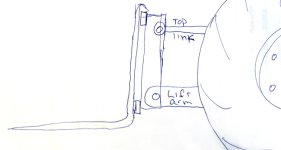
I'm about to build a pallet fork frame for my 3 point hitch. I'd like to keep the top link attachment low, so it is parallel to the lift arms, so the forks stay level when I lift.
Does that increase the forces on the 3 point linkage too much?

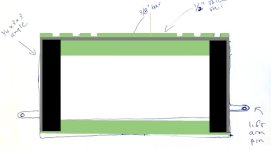
I'm also planning to simply weld the bottom and top bars to vertical 1/4" x3x3 angle, and run 3/8" x 2" bar at right angles to the top and bottom bars to stiffen them. I think this will be way stronger than anything I can lift with my B2620?
 
   / Help with 3 point fork design please
  • Thread Starter
#2  
I'll cut the bars to 27"-width of the lift arm spacing. I need it for pallets 36" wide.
 

Attachments

  • photo-1.jpg
    photo-1.jpg
    60.7 KB · Views: 275
   / Help with 3 point fork design please
  • Thread Starter
#3  
If the top link and lift arms stay parallel, the implement stays level, right?
If the top link is angled up, the more you lift the steeper the implement point up?
 

Attachments

  • photo.JPG
    photo.JPG
    67.4 KB · Views: 284
   / Help with 3 point fork design please #5  
If the top link and lift arms stay parallel, the implement stays level, right?
If the top link is angled up, the more you lift the steeper the implement point up?

Yes, I believe that's right.


Yes, I believe that's right, too.

YES and NO.

It is true ONLY if the toplink is the same length as the lower arms.

IF it is shorter, it will have a different swing arc(radius) than teh lower arms. And would still tilt the forks when raised.

Thy the link in the third post of this thread that I posted
http://www.tractorbynet.com/forums/build-yourself/214292-3-pt-hitch-calculator-cant.html

It is a 3PH calculator to simulate just what you want. You have to take some measurments off your tractor and plug them in, and then some measurments off of the forks you are going to build.

If you are even attempting to figure this out, I am sure you will make good use of that program:thumbsup:
 
   / Help with 3 point fork design please
  • Thread Starter
#6  
Thanks. I'm not worried that it stay PERFECTLY level, just that it doesn't tip so much that my firewood comes tumbling down.
 
   / Help with 3 point fork design please #7  
YES and NO.

It is true ONLY if the toplink is the same length as the lower arms.

Well, I started to include in my post that the pivot points (at the tractor ends) of the lift arms & top link would need to be aligned (in the same plane vertically) for the answer to be Yes, but figured they would be close enough for his plan.
 
   / Help with 3 point fork design please
  • Thread Starter
#8  
so is there any issue with forces being to high from keeping the top link so low?
I know you're not supposed to use the lower top link location on the tractor as it reduces lift capacity.
 
   / Help with 3 point fork design please #9  
I replied to your other post, but I didn't see this one.
How do you intend to keep your lift arms parallel? They lift by rotating, so you'll never keep them level. If it could be done, all carry-alls would be built that way. There will be a point that you have the top link attachment so low that it will bind when you try to lift, but I can't say exactly where that is.
 
   / Help with 3 point fork design please #10  
I replied to your other post, but I didn't see this one.
How do you intend to keep your lift arms parallel? They lift by rotating, so you'll never keep them level. If it could be done, all carry-alls would be built that way. There will be a point that you have the top link attachment so low that it will bind when you try to lift, but I can't say exactly where that is.

I dont think he is talking about lowering the TL.

Basically, in a nutshell, for something to raise and remain parallel, the lower arms and the upper toplink must be parallel to eachother, AND the same length. If that is the case, there is going to be NO binding at all.

So, since most tractors TL are running on a bit of a downhill angle toward the front of the tractor, to get them parallel, you can either RAISE where it is mounted on the tractor, OR lower it on the implement side. For example, if the distance between the lower arm pivot @ the rear axle, and the toplink hole you choose, is 10", you simply make the toplink mount on the implement 10" above the lower pins, and thenn adjust the TL so that it is the samelength as the lower arms, or close to it.

And as far as it creating more stress on the 3PH, it is minimal. Where the big change is, is on the implement.
 
   / Help with 3 point fork design please #11  
I replied to your other post, but I didn't see this one.
How do you intend to keep your lift arms parallel? They lift by rotating, so you'll never keep them level. If it could be done, all carry-alls would be built that way. There will be a point that you have the top link attachment so low that it will bind when you try to lift, but I can't say exactly where that is.

I didn't see where he asked about keeping his lift arms level. Maybe I missed it.

Should be no need for it, though: As long as his lift arms & top link are the same length & parallel to each other, his carry all should stay level ... i.e. a parallelogram.
 
   / Help with 3 point fork design please #12  
Okay, now I see what you guys are saying. But for the carry all to remain level, wouldn't that require the top link to compress as it lifts? Something has to change, though maybe that's not it.
 
   / Help with 3 point fork design please #13  
Three point hitch geometry is so confusing even the inventor got it wrong!

"It is extraordinary in that it has two upper links and one lower link whereas ever since the 3 point linkage has consisted of two lower links and one upper link. Harry Ferguson quickly recognised the problem of the linkage geometry and turned the invention upside down!"

From:
3 point tractor linkage
 
   / Help with 3 point fork design please #14  
Okay, now I see what you guys are saying. But for the carry all to remain level, wouldn't that require the top link to compress as it lifts? Something has to change, though maybe that's not it.

If the lift arms & the top link are the same length & parallel to each other, then no. They would remain parallel to each other, & therefore the carry all would remain level, no matter how high or low you raise or lower the 3PH.
 
   / Help with 3 point fork design please #15  
If the lift arms & the top link are the same length & parallel to each other, then no. They would remain parallel to each other, & therefore the carry all would remain level, no matter how high or low you raise or lower the 3PH.

So, what causes the forks to remain level? Like I said, if it worked it would already be standard practice. It doesn't work.
 
   / Help with 3 point fork design please #16  
This is actually really simple to simulate in real life (other than the program listed at the beginning of this thread).

Go to a post in your polebarn and put two nails in it somewhere abouts 10" appart.

Now take a short peice of scrap 2x4 or something and put two nails in it the same distance appart as the ones on the post.

Now imagine the nails on the post are the tractor side TL pin, and lower pin holes that attach near the rear axle.

The two nails on your scrap board are teh implement TL pin, and lower pins.

Now take two peices of string, equal in length, and about 20" long. These will simulate the TL and lower arm. Attach them to the nails accordingly and pull the strings tight. Now raise and lower the board(implement) while keeping the strings tight (remember the strings simulate NON-flexible steel arms). You will notice that the board in your hand(implement) does NOT change angles as it goes up and down. It only goes closer to the wall as it raises. Same as on a tractor, the implement actually moves a little closer to the tractor @ full raise.

I have actuall used this method when designing my own trailer hitch. (before I stumbled onto that program). The nails In the post were exact simulations of measurments on the tractor. I use them whenever I am designing or changing something else on other implements. Because some things I do want the angle to change, causing the back of the implement to be raised higher.

The method is simple yet effective. Especially if you have a hard time with a spreadsheet program like I keep refering to. And it actually gives you the ability to see it IN PERSON rather than trusting your eyes to the computer:confused2:
 
   / Help with 3 point fork design please #17  
So, what causes the forks to remain level? Like I said, if it worked it would already be standard practice. It doesn't work.

Do what I suggested in my previous post. IT DOES WORK. You cannot deny the physics, plain and simple.

It is not standard practice because most implements are designed to raise AND angle. Making the back of the implement raise more than the front. This is for greater clearence. Most implements, like blades, bushhogs, etc are long. Imagine if your blade only raised perfectally parallel. The rear of the blade would only be ~ 12" off the ground. That isnt much clearence for way back there. It would dig in if you lived in hilly terrain, or trying to load on a trailer.
 
   / Help with 3 point fork design please #18  
   / Help with 3 point fork design please #19  
In this pic, the lift arms & top link are parallel & the same length.

Does this help?

attachment.php
 

Attachments

  • 1.JPG
    1.JPG
    37 KB · Views: 371

Tractor & Equipment Auctions

2020 Freightliner M2 106 AWD Altec DC47TR Digger Derrick Truck (A60460)
2020 Freightliner...
John Deere 2640 2WD Tractor with 146 Front Loader (A57024)
John Deere 2640...
HYDRAULIC THUMB FOR MINI EXCAVATOR (A58214)
HYDRAULIC THUMB...
2014 MASSEY FERGUSON 5612 DYNA-4 TRACTOR (A59823)
2014 MASSEY...
2020 CATERPILLAR 320 GC EXCAVATOR (A60429)
2020 CATERPILLAR...
2024 CATERPILLAR 930 AG HANDLER WHEEL LOADER (A52709)
2024 CATERPILLAR...
 
Top