Hydraulic Question on Reducing PTO Pressure and Flow

   / Hydraulic Question on Reducing PTO Pressure and Flow #1  

SpringHollow

Elite Member
Joined
Dec 9, 2006
Messages
2,656
Location
South of Rochester, NY
Tractor
Power Trac 1850, NH 2120
Hi JJ,

I apologize in advance for the length of this post.

I thought I would get your input on some general hydraulic flow questions and am posting it in the forum so others can learn from your input if needed. If you do not know some of the answers, I am not asking you to spend time researching them. Others, feel free to chime in.

Many implements require pressures and flows lower than what my PT produces. One option is to use the auxiliary PTO circuit but I am using that for so many controls that I would likely have to use the main PTO circuit.

1.) The PTO pump is always running and dumping to the tank (correct me if I am wrong on that). Does running the flow through a pressure relief valve on an implement generate more heat than when the PTO is just dumping to the tank?

2.) If an inline flow restrictor is used, does that generate more load on a pump than a pressure relief? Basically, the question comes down to, should a pressure relief be put into the circuit before the flow restrictor?

I was going to buy some things to play around with and install with quick disconnects so that I could use them on various pieces of equipment. I am not going to worry about reverse capability at this point.

3.) Would the system run cooler or the same using a priority flow divider with the auxillary flow going to the tank versus a flow restrictor? This would give the advantage of being able to run an additional circuit if necessary (unlikely) and if it was cooler, that would also be a plus. An example is Surplus Center - 3/4" NPT 30 GPM ADJ PRIORITY DIVIDER VALVE RD575
I find it strange that the 3/8, 1/2, and 3/4 ported models are rated for the same flows - 30 gpm through a 3/8" port?

4.) Is there a big cooling, noise , etc advantage using a ball and spring pressure relief valve versus a poppet style? If there was, i might give up adjustability of the poppet style like this one Surplus Center - 1/2" NPT 20 GPM 1500-3000 PSI RELIEF VALVE RV-H4 versus the fixed Surplus Center - WJL-50-2000 HYD RELIEF VALVE

I am sure there are other questions I have not thought of.

Thanks for any and all input.

Ken
 
   / Hydraulic Question on Reducing PTO Pressure and Flow #2  
Yes, using the relief will generate more heat, as the orifice is probably much smaller that a port.

A flow restrictor is designed to reduce the volume of fluid, thereby reducing speed of operation. A pressure relief is designed to protect something, a cyl, pump, or whatever. A pressure relief works best if located close by the cyl or motor.

As you know, QD will reduce the flow, less than the source, and that is why they recommend to use one size larger QD's.

Ball and spring relief are used for fast acting and occasional relief, whereas, the poppet relief is used where you need a continuous acting relief. They are quiet and smooth acting.
 
   / Hydraulic Question on Reducing PTO Pressure and Flow
  • Thread Starter
#3  
Thanks, JJ. So it sounds like the best thing would still be an adjustable flow valve without a built in pressure relief with the excess flow plumbed to the return line to the tank. Follow that with a 3 port poppet pressure relief valve also connected to the return line and then a Tee for a gauge for setting purposes, maybe even on a long hose back to the cab if i want to monitor while using things and not have to worry about branches hitting it.

For a typical implement that wants to see only 2000 psi, it will be interesting to see how often the relief opens.

To confuse things for me more, some implements get plumbed one way if in an open center system and another way if it is a closed center system. The PTO is an open center system if i am understanding things correctly - flow goes to the tank when the solenoid is not activated.

Ken
 
   / Hydraulic Question on Reducing PTO Pressure and Flow #4  
SpringHollow; said:
Thanks, JJ. So it sounds like the best thing would still be an adjustable flow valve without a built in pressure relief with the excess flow plumbed to the return line to the tank. Follow that with a 3 port poppet pressure relief valve also connected to the return line and then a Tee for a gauge for setting purposes, maybe even on a long hose back to the cab if i want to monitor while using things and not have to worry about branches hitting it.

For a typical implement that wants to see only 2000 psi, it will be interesting to see how often the relief opens.

To confuse things for me more, some implements get plumbed one way if in an open center system and another way if it is a closed center system. The PTO is an open center system if i am understanding things correctly - flow goes to the tank when the solenoid is not activated.

Ken

You need at least one relief, in the hyd path.

As far as the relief pressure, the item that is using the fluid will develop the pressure by the resistance to the flow of fluid. A lot of times you never get close to the relief pressure. You get the most power when operating at or near the relief pressure.

If the item you are using operates at a lower pressure, you need a relief for that item and anything downstream.

My PTO operates using a flow control valve, with relief, and with variable speed. The fluid not used is returned to tank. If your PTO is solenoid operated, the fluid flows to tank with no voltage, and you have full flow to the PTO when activated.
 
   / Hydraulic Question on Reducing PTO Pressure and Flow
  • Thread Starter
#5  
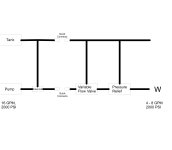
Attached is a simple block diagram of the hydraulic PTO circuit and what I would add. At "W", it is still a "closed" circuit and any implements added at this point should be plumbed for a closed circuit?

I realize the pressure reliefs are protecting the pump from being dead ended.

Ken
 

Attachments

  • Hydraulic Diagram for PTO Pressure-Flow Reduction.jpg
    Hydraulic Diagram for PTO Pressure-Flow Reduction.jpg
    139.7 KB · Views: 547
   / Hydraulic Question on Reducing PTO Pressure and Flow #6  
The relief must go before the flow control. Or else purchase an adjustable priority flow control with the relief valve built in. Relief down stream of the flow control only protects that down stream circuit. It does NOT protect the pump if the flow control malfunctions.

Another way to reduce flow is run the engine slower so the PTO runs slower. Flow controls work Via pressure drop, pressure creates heat which wastes energy.

Roy
 
   / Hydraulic Question on Reducing PTO Pressure and Flow
  • Thread Starter
#7  
I did not draw it but I thought the PTO had a pressure relief valve in its circuit but I do not see it any where in the parts list so I think you may be right. Thanks for catching that! I also see I have to correct the pressure and flow numbers.

Ken
 
   / Hydraulic Question on Reducing PTO Pressure and Flow
  • Thread Starter
#8  
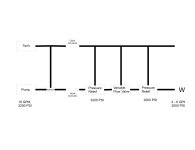
OK, here's the corrected one.

I do realize you can lower rpm's but since this is driven across the ground by hydraulic wheel motors, there is a limit to how low the rpms can go.

Ken
 

Attachments

  • Hydraulic Diagram for PTO Pressure-Flow Reduction.jpg
    Hydraulic Diagram for PTO Pressure-Flow Reduction.jpg
    91.5 KB · Views: 496
   / Hydraulic Question on Reducing PTO Pressure and Flow #9  
If the PTO does not have a relief, I would possibly consider installing the relief before the QD's. That way if one of the QD's gets disconnected during operation your pump is still protected. Might be over cautious, but in my world, "*it does happen) :D
 
   / Hydraulic Question on Reducing PTO Pressure and Flow
  • Thread Starter
#10  
I will have to try and remember to ask Terry if there is one already or not.

Carl or any of you other guys know?

Ken
 
   / Hydraulic Question on Reducing PTO Pressure and Flow #11  
Yes, the PTO has a relief valve. But it is not a full relief, It will bog the engine and eventually kill it. At least on mine it does not give up much.

Relief is built into the PTO control block.

I assume this was your question.
 
   / Hydraulic Question on Reducing PTO Pressure and Flow #12  
I believe all Pt's have a relief in the PTO circuit. If your relief in not on the solenoid valve itself, it is on a hyd block.
 
   / Hydraulic Question on Reducing PTO Pressure and Flow #13  
You also said something about a closed center something as part of the circuit. The fluid generated by a gear pump for an open center circuit must flow continuously.

A closed center circuit will either hold the pressure at the valve, or unload the pump until the pressure is needed, and a variable speed pump is used.

If the wheel motor is good and tight, it will turn, based on the amount of fluid you provide to it.

If you are wanting a lower pressure downstream, you will need another relief valve set for the particular circuit.
 
   / Hydraulic Question on Reducing PTO Pressure and Flow
  • Thread Starter
#14  
Thanks Carl and JJ. I thought it did but it does bog my tractor down too. Like you say, Carl, maybe it is not rated for full flow.

I do remember now talking to Terry about my tractor's PTO circuit one time. Had a bad cartridge in the solenoid valve. He was having me turn on the PTO without anything connected which i always thought you could not do and he said it was ok for a little bit and they used that to help trouble shoot.

I still will keep that 3000 psi one on the circuit, i think. Cheap insurance.

Ken
 
   / Hydraulic Question on Reducing PTO Pressure and Flow #15  
A good way to test the PTO circuit would be to plug a hyd gage into the QD and flip the switch on, and you will read the relief pressure, and can check and set it. If the PTO pump is the only circuit using hyd fluid, you should have enough HP to run the PTO pump.

If you put a 2000 psi relief in the circuit, what will happen is that when the resistance to the fluid in that circuit reaches 2000 psi, it will start dumping and try to maintain pressure at 2000 psi.

What will be using the fluid, a cyl or hyd motor?
 

Marketplace Items

INTERNATIONAL FLAT BED TRUCK (A52707)
INTERNATIONAL FLAT...
(15) WOOD PALLETS (A60432)
(15) WOOD PALLETS...
2015 Vermeer MX125 500 Gallon Drilling Fluid System T/A Trailer (A59228)
2015 Vermeer MX125...
HYDRAULIC THUMB CLAMP FOR MINI EXCAVATOR (A58214)
HYDRAULIC THUMB...
2023 GREAT DANE FLP-0024-00053 53FT FLATBED TRAILER (A59905)
2023 GREAT DANE...
296385 (A57192)
296385 (A57192)
 
Top