Is this the proper way to weld a patch?

   / Is this the proper way to weld a patch? #1  

franklin2

Gold Member
Joined
Dec 28, 2010
Messages
320
Location
Staunton, Va
Tractor
kubota f2000
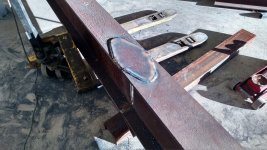
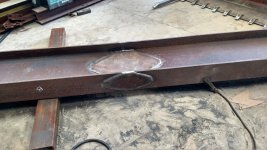
I want to know is the below method the proper way to weld the patch to the I-beam splice? I have a book that says to never weld all the way around the patch, only weld two sides and those sides need to be parallel to the length side of the beam. The book says welding all the way around creates too much stress in the patch and it will tend to crack later. Unless you have a way to heat the whole area red to relax it. I see he welded it at a angle, and I have heard of "fishplating" before. If that is the proper method, how does putting the patch at a angle get rid of the stress from welding all the way around the patch? Just trying to learn something here, not being critical.

447970d1448194327-building-my-bridge-crane-img_20151117_121334287-jpg
 
   / Is this the proper way to weld a patch? #2  
You'll see fish plates more so on equipment, than on structural shapes. There are two schools of thought on welding the fish plate all the way around, or just two side. I really don't know the correct answer. Always left that up to the engineers.
 
   / Is this the proper way to weld a patch? #3  
When an I beam is loaded, all the stress is in the top and bottom plates. The web in the center just keeps the two plates separated. So, what happens in the very middle doesn't matter much. (That's why you drill holes in the center for wire passage, etc.). The purpose of a fish plate is to avoid having an abrupt change in cross section, which leads to a stress concentration at the transition point. It looks like a decent repair to me - what is critical is the top and bottom plate connection.
 
   / Is this the proper way to weld a patch? #4  
im no engineer but the only thing I don't like about the above "patch" is the continuous welding....if it was to crack for some reason the crack would eventually (in theory) keep traveling... now if it was stich weld and cracked only that leg of the stich would be comprimesed and not the entired patch.... just my 2 cents and that 2nd patch on the outside flange? Ive never seen that done b4.. usually just the flange is beveled and filled in.
 
   / Is this the proper way to weld a patch? #5  
As long as the flange scab plate is the top side of the beam or the side opposite of compression forces, I don't see anything wrong with the joint. All the weld areas should be full penetration welds which in severe service would require xray of the welds to confirm.

I personally prefer to fully weld any patch to avoid water intrusion that would cause corrosion to form underneath the patch. With the patch shaped as in the photo, there is very little stress induced into the area.

I worked for 45 years in heavy construction and this is the way it was always specified by engineering. Whether that is 100% the correct way or not might be debatable by some.
 
   / Is this the proper way to weld a patch? #6  
Even though I'm just a hobbyist welder, I've spliced a beam or two.
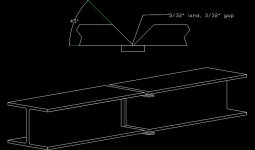
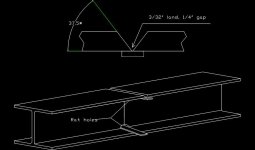
Here are some joint preps I like to use.
 

Attachments

  • 22_5 double bevel beamdxf_dxf.jpg
    22_5 double bevel beamdxf_dxf.jpg
    38.8 KB · Views: 819
  • Backing bar_dxf.jpg
    Backing bar_dxf.jpg
    39.3 KB · Views: 693
  • Rat holes.JPG
    Rat holes.JPG
    42.7 KB · Views: 1,118
  • Beam 22_5_dwg.jpg
    Beam 22_5_dwg.jpg
    36.7 KB · Views: 976
   / Is this the proper way to weld a patch? #7  
Most all of the plates I have seen on heavy equipment, backhoes, and even my little kubota FEL are similar diamond shape and welded all the way around.

I figure the plating isnt even necessary with having beveled everything and welding all the way around assuring 100% penetration. So the plating is just for extra measures since I aint a very good welder.

And it is plated ALL the way around, including the very critical top flange. Here is the rest of the pictures

IMG_20151115_155414894_HDR.jpgIMG_20151117_121344471_HDR.jpgIMG_20151117_121400982.jpg
 
   / Is this the proper way to weld a patch? #8  
I don't see the harm in the fish plates, it's not like you're paying for the labor. On the job site it might be a totally different story!
 
   / Is this the proper way to weld a patch? #9  
When an I beam is loaded, all the stress is in the top and bottom plates. The web in the center just keeps the two plates separated. So, what happens in the very middle doesn't matter much. (That's why you drill holes in the center for wire passage, etc.). The purpose of a fish plate is to avoid having an abrupt change in cross section, which leads to a stress concentration at the transition point. It looks like a decent repair to me - what is critical is the top and bottom plate connection.
sort of... Tension and compression stresses are at a maximum at top and bottom when bending but shear stress due to bending is maximum in the center of the section. Still need to size the 'web' appropriately.
 
   / Is this the proper way to weld a patch? #10  
My home sits on the 4 concrete foam block poured walls with a 3/4" thick 12" tall 52' long I beam running down the length in the middle with 2 pillars sitting on concrete footings. They beveled and welded the 2 beams together with Dual Shield and then did the plates on top, bottom and both sides. Fully welded. They made sure that the welded portions were on top of the pillars. Hope it holds a few more years.
 
   / Is this the proper way to weld a patch? #11  
The truck upfitters use fish plates a lot when modifying a chassis (lengthening, shortening, offsetting). The ones I've seen usually are welded completely around the perimeter of the plate and have a few plug welds in the fish plate.
 
   / Is this the proper way to weld a patch? #12  
sort of... Tension and compression stresses are at a maximum at top and bottom when bending but shear stress due to bending is maximum in the center of the section. Still need to size the 'web' appropriately.
This is true but for a beam of the relative dimensions the OP asked about shear is not the dominant likely failure mode. It would be for a short, thick beam.
 
   / Is this the proper way to weld a patch? #13  
If you want to weld all the way around your fishplate is correct if it were a square plate, you would have only wanted to weld parallel with the beam and plug welded inside the plate.

A vertical weld would only cause a "stress riser" and subsequent failure at that point.

One can weld too much and make a structure more prone of failure.

I have a book I give to new welders called Welding Secrets by Hal Wilson, that illustrates that point as well as others.

In short if you do it wrong you create a "notch" that focuses the stress into the material where it is most prone to fail.

Other than that looks like you didn't clean the weld area well enough leaving rust in the beam that would lead to inclusions in the weld and didn't allow the fillet to completely tie the plate to the beam. It also looks like you were too "cold" from 6 o'clock to 3 o'clock, better at the tip around 7 o'clock but that is the main problem with MIG welding, being that if you are not there watching as it is being laid down, it might look great but have little penetration. Why we have X-ray, dye penetrant, etc to test them after the fact.
 
Last edited:
   / Is this the proper way to weld a patch? #14  
The secrete to getting good penetration with the Mig process, is very simple. Pure power!;)
224-amps, 29-volts.
 

Attachments

  • 29 volts 224-amps.JPG
    29 volts 224-amps.JPG
    183.1 KB · Views: 364
  • Best.JPG
    Best.JPG
    230.2 KB · Views: 361
   / Is this the proper way to weld a patch? #15  
The secrete to getting good penetration with the Mig process, is very simple. Pure power!;) 224-amps, 29-volts.
What gauge wire do you run for that kind of juice?
 
   / Is this the proper way to weld a patch? #16  
The secrete to getting good penetration with the Mig process, is very simple. Pure power!;)
224-amps, 29-volts.
Hard to argue that (except for your spelling)... and purdy weld too!
 
   / Is this the proper way to weld a patch? #18  
Amperage, wire speed, diameter of the wire, how clean the weld area is, shielding gas/flow and where it is all directed all have effects on penetration.

The second photo above (#14) is less than 50% into the parent material looking into the "pie".
 
   / Is this the proper way to weld a patch? #19  
What gauge wire do you run for that kind of juice?
I think that was .035" wire. I ran that with my Lincoln V350-Pro inverter.
 

Attachments

  • 350 Set.JPG
    350 Set.JPG
    236.8 KB · Views: 227
   / Is this the proper way to weld a patch? #20  
I have no idea how many amps I was running. My welder dont show that. Nor does it show wire speed.

My heat settings consist of heat range 1 thru 4. Then the finer settings called heat control which go low, then 1 thru 6, then high. Wire speed is just 1-10

Its a 225A welder. Running 035 wire. I was on heat range 4 and heat control 5. Only 2 settings hotter is max. So I would guess it to be in the ~200A range. And wire speed was 7.5-8 on the dial. These settings are spray welding. Using these same settings welding 1/4" stuff and I have to be careful not to burn through. Its penetrated in there well I can assure you. IT aint coming apart.
 

Marketplace Items

2019 BOBCAT E32I EXCAVATOR (A59823)
2019 BOBCAT E32I...
SD Launch SDLB25 (A53317)
SD Launch SDLB25...
2013 Ford F-150 4x4 Crew Cab Pickup Truck (A55852)
2013 Ford F-150...
2372 (A60432)
2372 (A60432)
GRID SHAPED BUCKET FOR MINI EXCAVATOR (A58214)
GRID SHAPED BUCKET...
2022 Kubota LX2610SUHSD Compact Utility Tractor (A55315)
2022 Kubota...
 
Top