Please school me on an electrical problem.

/ Please school me on an electrical problem. #1  

dukeyjoe

Bronze Member
Joined
Jul 11, 2014
Messages
53
Location
Bryant, Al
Tractor
Mahindra 5035 HST; Long 2610, Takeuchi TL 230 Series 2, Bobcat 773F
Been working on the Ol' Long 2610. Changing filters, fuel lines, freshening up the oil bath air filter and putting a new seat on it (the old one has a few pinch marks in it from the front end getting a bit light). Was my first tractor and has been faithful, except the fuel gauge has never worked. The fuel warning light use to come on, even with a full tank. I isolated the sending unit. It has 3 wires going to it and none of them are hot. What gives?
 
/ Please school me on an electrical problem. #2  
Usually, a sending unit is "in the tank", is this what you are referring to.
These usually never have a live wire, only grounds.
 
/ Please school me on an electrical problem. #3  
Fuel sending units are based on a rheostat. The three wires are likely ground, a signal wire to the gauge and a signal wire to the low fuel light. As the float moves it changes the resistance to ground that the gauge sees, reletive to it's position in the tank. The sending unit can be tested with a multi-meter with an ohm setting, 0-80 ohms is common.
 
/ Please school me on an electrical problem.
  • Thread Starter
#4  
Yes skyhook, this is the sending unit that goes in the top of the tank.
diesel crawler, do I just check each of the three prongs vs. ground?
Thanks to you both for your responses.
 
/ Please school me on an electrical problem. #5  
I've never seen a fuel gauge sender with three wires, but here's my two cents anyway. I believe one of the three is a ground. One may be for a low fuel light, and the third is for the gauge. TYPICALLY a fuel gauge is powered through the ignition/accessory circuit and indicates fuel level based on a variable resistance reading supplied by the float unit in the tank. I think we can all agree on that. As for diagnosing problems, to each his own. I usually start at the sender if I can get to it. Determine which wire is the sender wire and which is the ground(some systems are self grounded, others have a dedicated ground wire. Remove the sender wire, turn the key on, and "flash" the sender wire to ground. If the circuits are good, and the gauge works, the needle will move. Usually to full with a direct ground. If the gauge DOESN'T move, then trace the power to the gauge and or continuity from gauge to sender. In your case, since you never stated what, if anything, the gauge needle does with key on or off, that's hard to call from here. As for the low fuel light -- my guess is you have a third circuit for said light, with a contact on the float unit which simply completes a ground when the float drops to a certain point. Since you stated the light is on all the time, either the wire involved is grounded somewhere else, or the float lever is down all the time(float missing or full of fuel). If so, and all circuits do function, the gauge will read empty all the time.
 
/ Please school me on an electrical problem. #6  
One post will be connection to chasis/battery ground. One post is ground for the guage, then I'm guessing the 3rd post would be ground for low fuel warning light.
 
/ Please school me on an electrical problem. #7  
Normally there are three wires at the gauge, +12v, ground (only for lighting), and then the resistive ground coming from the sender.

And then the sender has two wires, a ground, and an out. As mentioned, the sender varies it's resistance to ground based on fuel level, and passes that to the gauge.
 
/ Please school me on an electrical problem. #8  
Without a schematic its pretty difficult to say for sure, but my guess would be,
2 of the pins are joined, so when the tank is low it would activate a ground for the low fuel light.
At the higher end is where resistance would change, this is where your gauge would show how full it is.
So you could actually check any two pins a get a reading in ohms.
Anywhere between 1 and 120 or so ohms should indicate its not burn out/rusted out,
a NO reading would indicate its toast and need replacement. IMO
So basically, your looking for some sort of reading between the pins.
 
/ Please school me on an electrical problem.
  • Thread Starter
#9  
I should have made things clearer. The low fuel warning light came on intermittently, even when the tank is full. The needle is stuck below empty and has not moved since I got the tractor 110 hrs. ago. The tractor has 804 hrs.

There are 3 wires that plug into prongs on the top of the sender. One prong has some sort of ceramic cover at it's base. Hooking my test light to ground or power, I get nothing when testing the wire that hooks up to the insulated prong. When hooked to power the light comes on with the other 2 wires. After removing some tape, I see that one is grounded on the firewall. The other 2 disappear into the wiring harness.
 
/ Please school me on an electrical problem.
  • Thread Starter
#10  
Will go find one of my 4 meters ;)
 
/ Please school me on an electrical problem. #11  
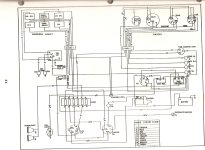
Attached is a wiring diagram for a 2360 that I worked on this past summer for a friend. Looking at tractordata.com, this diagram maybe the same/close for your tractor. The diagram shows three wires coming out of the sending unit 2 black and one brown. I would say the two black wires are ground. One ground the unit to the frame and the other running to the fuel gauge.

With the key just in the on position (tractor not running) touch the brown wire and the black running to the fuel gauge. The gauge should either go to full or to empty. As stated already the fuel sender is a variable resistor. Using an ohm meter and moving the float up and down the resistance will increase and decrease.

NO power should be running to the sending unit.
 

Attachments

  • 2360wiring.jpg
    2360wiring.jpg
    475.6 KB · Views: 4,428
/ Please school me on an electrical problem.
  • Thread Starter
#12  
Thank you all for the help. You are correct JD5210 about there being 2 black wires, however that diagram shows 2 brown wires and a black. To be specific, the thinnest black wire on this sending unit has a green stripe. Here's some updated info:
1) bulb to low fuel warning light was blown, new bulb and now it stays on EVEN when no wires are hooked up to sending unit
2) ran test light to ground and inserted tip into each, got needle on gauge to go to full, turned ignition off and when I turned it back on it was between 1/4 and 1/2 way mark. Once removed, it went back to empty and I could not duplicate this again.
3) around 30 ohms between brown and solid black wire, no readings in any combo with black/green striped wire
4) Bigger problem now! This thing was running a bit rough when I parked it for the winter. First good day this spring, it fired up on the first crank and ran like a top for about 10 seconds, then refused to start again. The forward one half of the engine block behind the FIP was wet with diesel. You could tell that it had leaked during the winter, because it had washed the grease off that side of the engine onto the ground. I thought the old hardened fuel line that goes into the mechanical fuel pump had cracked. Put a new hose on it, changed primary fuel filter (which had a bunch of rust in it) and the secondary filter that was like new, took mechanical fuel pump with priming lever off (had rust covering screen) and cleaned it and then bled the system to the injectors. It ran for about 5 seconds, stopped and will not start. After cleaning all the fuel off the thing, I am noticing a little bit of diesel coming from the engine side of the FIP, but can not see where. I am wondering if the mechanical fuel pump is bad with all that rust in it. The priming lever works well, though. There is no filter between the fuel tank and this pump, which is about to change given the rust coming out of this fuel tank. If the pump is bad, could I put a plate where this pumps ties in to the engine and put an electric fuel pump on it? Is there a specific pressure rating on the pump that I would need to be aware of?
 
Last edited:
/ Please school me on an electrical problem. #13  
On point 1, with the wires disconnected you have no resistance/open circuit, so most likely that is why the bulb is on.

On point 2, there is no voltage on these wires, so a test light is not the correct tool to use. I suggest you test this way, if you can tell which of the 2 wires go to the gauge, disconnect them from the sender and connect the 2 wires together and the gauge should go to full or empty. If you can remove the sender connect your ohm meter to the sender where the wires connected that go to the gauge. Moving the float up and down should change the ohm reading. I you get no change in the ohm reading or it is jumping around replace the sender. Seating diesel fuel all these years most likely it has gone bad.

On point 3, did you connect the ohm meter to the sender or the wires to the gauge? You should be connecting it to the disconnected sender. I would guess you need to remove the sender to be able to move the float.

On point 4, this one I cannot help you with. Suggest you create a new thread maybe with the title Long 2610 Fuel Problem. Before I did the maintenance on my friends 2360. I posted some questions, several other members gave me some very useful information.
 
/ Please school me on an electrical problem.
  • Thread Starter
#14  
Well, it has come a turd floater here, so I won't be able to go any further with this project today. Sending unit is difficult to get out. I have the tank cover/dash ready to come off, but didn't have a 30mm socket to remove the steering wheel nut. I'm this deep in this baby now that there's no turning back. I want to have a fuel gauge that works, especially since there is no way to yard stick it (tank has a spout that comes out 90 degrees). I'll connect those wires like suggested. There are only 2 prongs on the sending unit that show ohms. The solid black and the brown and the brown is grounded to the firewall, so the black w/ green stripe and the solid black have to be the wires that go back to the gauge. When checking the ohms between their respective prongs on the sending unit, I get no reading. Once I get the sending unit out, I'm gonna put a new one in it, especially with all the rust in the tank. I may just remove the tank and try and treat the rust problem. Anyone know of a treatment that works for sealing a fuel tank? I'll try and search for your thread or others with similar fuel problems.
Thanks to all again and I'll post any results I get.
 
/ Please school me on an electrical problem. #15  
Remove the tank if possible, change the sending unit and give your tank a good cleaning.
Your fuel pump may also be toast,clogged etc, once you have a clean supply of fuel with no leaks/air intrusion, this should solve your problems, if your tank is made of metal, I think there was a thread here somewhere on how to clean them.
When you did the "test light" trick on the wires going to the gauge, you introduced resistance through the bulb on the test light, this is why the gauge moved.
Running and stopping like you described, especially when it was also running rough prior to storing it suggested to me, fuel starvation.
Good luck, take your time, you'll get er running again.
 
/ Please school me on an electrical problem.
  • Thread Starter
#16  
Thanks skyhook,
It was definitely starving for fuel, because that screen in the mechanical pump was clogged and the primary fuel filter had a bunch of rust in it, as well. I don't know why they wouldn't have it run to the primary filter first before going to the mechanical pump, unless it has something to do with pressure. I did not tear into the diaphragm section of that mechanical pump. but the primer lever on it pumped fuel through the system, so I have assumed that the cam driven part of the pump should work as well.

I would like to remove the tank, get the rust knocked off the inside and seal it. I have used this product : POR-15 Fuel Tank Repair Kit before to do an old motorcycle tank. I dropped a piece of chain in it and shook the tank back and forth for a while to knock off the rust, then prepped and sealed it. I thought there might be something different out there, specifically for diesel tanks but this product says it will work for any type fuel.

Looking into the the tank through the filler hole, it appears that the rust is isolated at the top of the spout. If I can get the sending unit out, I'll look down through that opening and check out the condition of the rest of the tank, before pulling it. Should I not elect to remove the fuel tank, do you think putting another fuel/water separator in between the tank and the mechanical fuel pump would restrict the flow detrimentally?
 
/ Please school me on an electrical problem. #17  
Thanks skyhook,
It was definitely starving for fuel, because that screen in the mechanical pump was clogged and the primary fuel filter had a bunch of rust in it, as well. I don't know why they wouldn't have it run to the primary filter first before going to the mechanical pump, unless it has something to do with pressure. I did not tear into the diaphragm section of that mechanical pump. but the primer lever on it pumped fuel through the system, so I have assumed that the cam driven part of the pump should work as well.

I would like to remove the tank, get the rust knocked off the inside and seal it. I have used this product : POR-15 Fuel Tank Repair Kit before to do an old motorcycle tank. I dropped a piece of chain in it and shook the tank back and forth for a while to knock off the rust, then prepped and sealed it. I thought there might be something different out there, specifically for diesel tanks but this product says it will work for any type fuel.

Looking into the the tank through the filler hole, it appears that the rust is isolated at the top of the spout. If I can get the sending unit out, I'll look down through that opening and check out the condition of the rest of the tank, before pulling it. Should I not elect to remove the fuel tank, do you think putting another fuel/water separator in between the tank and the mechanical fuel pump would restrict the flow detrimentally?
I don't see a problem, I think it would be a good idea to do so,
the only restriction would be if it gets clogged and, thats a good thing.
 
/ Please school me on an electrical problem.
  • Thread Starter
#18  
Well got the sending unit out. Had to take steering wheel and dash off to get sheet metal off. Inside is better than I feared with rust only at the very top. I think I will just try and knock as much of the rust off in-situ and flush the tank. I'll, then, add another fuel separator between the tank and mechanical fuel pump and any anti rust additives to the fuel, along with keeping it full. Or my **** self will over ride that thought and I will pull the tank an seal it. I, just, hate waiting the 96 hrs. to let it cure and rain is coming again.

The sending unit is a marvel of Romanian engineering :eek: It was all over the place, but it is hard to hold the pins where they need to be while moving the float, which had a hole in it and was full of fuel. I made the hole a bit larger and drained it and plan to use a soldering iron to seal it up again. Haven't had any luck finding a sending unit, yet.
 

Marketplace Items

2016 International DuraStar 4300 S/A Dump Truck (A61573)
2016 International...
2023 Case TV450B (A62177)
2023 Case TV450B...
Brent 420 Grain Cart (A63688)
Brent 420 Grain...
2026 Kearney 7'x16' Trailer (A64119)
2026 Kearney...
2015 Kubota RTVX1100C (A62177)
2015 Kubota...
(APPROX. 128) 1"X6"X8" PONDEROSA PINE (A64281)
(APPROX. 128)...
 
Top