Plow measurement

/ Plow measurement #1  

Bluecheck546

Silver Member
Joined
Aug 28, 2004
Messages
185
Location
SE Georgia
Tractor
04 2015 Mahindra
Hi, what it is the proper way to measure plow , for instance two bottom 14" plow. Thanks.
 
/ Plow measurement #2  
I may be wrong, but I /forums/images/graemlins/confused.gifthink /forums/images/graemlins/confused.gif the plow is measured from the point of the mold board along its bottom to the back of the moldboard. The moldboard is the wear surface along the bottom of the plow share.The # of "bottoms" is how many plows are on the implement. Please somebody correct me if I'm wrong. This may be the big question on "Who Wants to be a Millionaire" /forums/images/graemlins/grin.gif
 
/ Plow measurement #3  
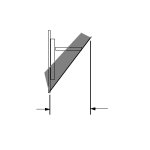
The amount that the plow cuts is the measurement that you need. See attachment.
 

Attachments

  • 813356-Moldboard measurement.jpg
    813356-Moldboard measurement.jpg
    19.5 KB · Views: 1,883
/ Plow measurement #4  
Cool, I am glad someone cleared that up for both of us.
 
/ Plow measurement #5  
Best way I know to measure one is from inside edge of beam on bottom one to the exact same point on beam #2.
 
/ Plow measurement #6  
That is the easiest, but the hardest to try to explain. /forums/images/graemlins/crazy.gif
 
/ Plow measurement #7  
<font color="blue"> Best way I know to measure one is from inside edge of beam on bottom one to the exact same point on beam #2. </font>

That is also the best way we have found--Ken Sweet
 
/ Plow measurement #8  
also, if you want to know the cutting width of a plow when it is at a 30 degree angle, multiply the width by 0.866. for instance, an 84 inch plow at 30 degrees cuts a 84 x .866 = 72.7 inch path.
 
/ Plow measurement
  • Thread Starter
#9  
Thanks to all of you who reply. Sure learn something everyday. Now another question /forums/images/graemlins/smile.gif... After looking around for about a year, I cannot find a single 12 or 14"plow reasonably priced. So I decided to build one, after pricing new parts in local Agri Store I find moldboard,shin, rockshare, and the skeg(foot) for $100 tax incl. The steel that I have laying around should be good enough to do this. I wonder , did anyone ever tried to do this? I'm interested in the angles of the assembly, Diesel_Boy mentioned 30 degres.. it is the a standard setting? Any ideas info will be greatly appreciated. BTW the plow that I'm trying to emulate is Ford 14" (found all of the above mentioned parts allready) Thanks. /forums/images/graemlins/cool.gif
 
/ Plow measurement #10  
You cant build them other than in-line. Or the tractor will be pushed sideways. The moldboard pushes the soil sideways and the flat upright plate on the landside of the furrow supports the moldboard to prevent the front end of your tractor being pushed into the freshly ploughed soil from the previous ploughing lane.
 
/ Plow measurement #11  
Building a plow from scratch might be the easiest thing you've ever done, or it might be an exersize in futility. Here's why.

There's a lot to settng up a plow to pull straight and easy. If you have a big heavy powerful tractor and a small plow, you can just "man-handle" it through most conditions. But if you have a plow that's sized to the tractor, and horsepower is minimal, they have to be set up just right, or you'll work yourself to death.

There's a thing called the DRAFT LINE. That's an imaginary line down the center of the tractor. You can only get so far from that with the center of pull exerted by the plow, or it will drag you side-ways. The plow has to be lined up on that draft line, then the rear tires moved in or out to run just clear of the inside bottom.

Now, LANDING a plow. SOme older 3-point plows had what is known as a landing lever. Some have a bolt adjuster to replace the lever. It adjusts what is refered to in most plow manuals as "width of cut". That's confusing at best. WHat it does is to adjust what direction (relative to the tractors centerline) the plow is pointed. Ever see a plow's drawbar? It has an offset in it from left to right. That serves a double purpose. One is to make the plow run level when the right wheel of the tractor is in the furrow from the previous pass. The other purpose is to make the plow move from side to side when the landing adjustment is made. Too much "width" and the point of the plow digs in too far, making it pull to the left. That pushes the front of the tractor to the right. Too much adjustment in the other direction, and the plow wants to run out of the ground to the furrow side. It also puts too much pressure on the landslides, making the plow pull like an anchor.

Then there's "up and down". The plow must run ALMOST dead level once in the ground. If not, it tends to climb out of the ground OR doesn't want to go IN the ground in the first place. That adjustment is made with the 3-point hitch top link. With proper 3-point hitch geometry, the plow will show a SLIGHT nose-down attitude just as it contacts the ground. That will help pull it in to the ground. As the plow drops to it's predetermined depth of cut, that hitch geometry SHOULD make the front to back attitude run almost dead level. There's where non-standard 3-point specs on some tractors will upset the balance of nature.

And when you adjust one axis, you alter the adjustment of the other somewhat. It takes a little tim to get everything in proper alignment.

Like anything, there's more to plowing than meets the eye.

With some plows, they need to be adjusted as the plow wears too. They'll startoff just fine, and in a few days of plowing, get to where they don't want to work right. The typical garden plow/food plot plow will never see enough use in a lifetime for this to come in to play though.

Finally, there's a good way to determine if a plow is set up correctly. You NEVER use sway bars or chains when plowing. It should be free to move from side to side as needed (When making slight turns...) A plow sould run cenetered on the tractor, with the three poin top link STRAIGHT BACK from the tractor. The plow should run almost effortlessly at a constant depth. And when the furrow wheel is in slight contact with the bank of thatfurrow, the leading plow bottom should be making a full width cut.

Do that and you'll have HAPPY PLOWING!
 
/ Plow measurement #12  
Farmwithjunk, you said it all. Excellent explanation of plow setup. With the proper setup plowing is a beautiful thing, otherwise it can get ugly real fast.
 
/ Plow measurement
  • Thread Starter
#13  
Renze and Farmwithjunk thanks for the replays. Especially Farmwithjunk's detailed info surely gives me much to think about as I'm researching the project. Yes I'm aware of the 3PH geometry and will follow it. My question is... By looking down on the plow, the plow nose(rockshare tip) what is the standard or most common angle between the landslide and the rockshare? I read somewhere that it is 30 degrees is that true? /forums/images/graemlins/confused.gif
Thanks for all your help.
 
/ Plow measurement #14  
There is a bit more to the diving of a plough:

with a one furrow plough, you can adjust it with the top link (the undergrip, "bite" of a plough)
With multiple furrows, this is not adjustable because this will cause a difference in depth between the shares.

When the tip of the plough is at the same depth as the landslide, it lifts the weight of the soil on the moldboard and it is supported by landslide.
This causes the phenomena that is called "ploughing pan"

According to Harry Ferguson's early ideas, the plough has to be adjusted with an agressive bite so that it would dive deep if you dropped the lift arms.
To prevent this, the hitch arms are kept to a certain depth so it will hang on it, the weight on the moldboard is pressing down on the tractor rear wheels giving you traction, and preventing plough pan buildup.

A new plough has the tip about 3 cm deeper than the landslide.

For me, i've used only a worn out blunt MF 3x16" plough on my Zetor 5245, depts varying from 20 to 35 cm according to soil type, and with this plough the weight transfer system (Zetormatic draft control) is useless.

However my friend ploughing in heavy river clay with a 3x18" reversible, has managed to pull their 90 hp front wheel drive Deutz onto the rear wheels by lifting the plough at once, on the end of the field without stopping. /forums/images/graemlins/grin.gif

In that scenario, ploughing is optimal, you get the most traction and the least pan build...


Marketplace Items

2017 Ford Escape 4WD SUV (A61569)
2017 Ford Escape...
Abaco Machines DVL500 Vacuum Lifter (A61568)
Abaco Machines...
2005 Chevrolet Impala Sedan (A56859)
2005 Chevrolet...
2021 Kubota MX6000 (A62177)
2021 Kubota MX6000...
HUSQVARNA RIDING MOWER 46IN DECK (A56859)
HUSQVARNA RIDING...
New/Unused Wolverine Quick Attach Auger (A61166)
New/Unused...
 
Top