Pond Scum

   / Pond Scum #1  

EBS

Member
Joined
Apr 6, 2000
Messages
35
Location
California
Tractor
Kubota B7500/LA302 loader/B4672 backhoe
My son has a 2-3 acre pond (tank) on his place near Paso Robles, Ca. The fish population of bluegills and bass is healthy. There is also a healthy population of green filamentous algae around the shoreline (except along the dam where the drop-off is steep). By the middle of summer the algal bloom forms an unsightly and smelly layer of gas-riddled scum extending 15 feet out from shore. I'm interested in any thoughts about control of this phenomenon. I read the BB discussion about aeration with a windmill driven system, but it mainly focused on the technical issues, not on control of pond scum. I've looked at several web sites advertising various biological, chemical, or mechanical methods to control algal scum, but most look either improbable or too good to be true.
My son's interested in a pump driven aeration system, but I remain skeptical. Do any of you all have direct experience with successful control of pond algal scum by methods that are both affordable and practical? I would appreciate any thoughts.
Ed
 
   / Pond Scum #2  
I think I saw pumps at Harbour Freight (harbourfreight.com) that can be used to circulate the water, actually create a fountain! This should help a whole lot. The pond needs the water to circulate. Notice you never see the scum in rivers, the ocean, etc. It's a one time price and a small electric bill as opposed to chemicals each year.

Bluegrass, Pick It Up!
 
   / Pond Scum #3  
EBS,

The most common cause of filamentous algae is a seasonal influx of nutrients. The first thing I would do is see what kind of land practices are going on in the watershed. Does your son or his neighbors have livestock? If so, that is the root of the problem.

For the cure, I would suggest that your son talk to the local fisheries biologist. They would most likely be aware of methods that are successful in his area. A lot depends on how deep his pockets are, or how much time he is willing to devote to his lake.

If I were making a recommendation for a Texas lake in that condition, I would likely recommend fertilization and installing an aeration system. I would not recommend this if there were livestock that directly accessed the lake, or if the landowner didn't want to spend the time and money. Fertilization "evens out" the availability of nutrients in the pond and allows beneficial (single-celled, non-connected) algae to grow, outcompeting the opportunistic blue-green algae, and giving your pond a pleasing green tint. Aeration prevents fish die-offs in the event of an algae die-off that causes dissolved oxygen levels to crash. If your son gets the go-ahead from his local biologist, and you want specifics on the type and amount of liquid fertilizer to use, send me a message.

A short-term solution would be to apply Cutrine-plus, which is an algalcide. Follow label directions, and don't treat more than a third of the pond at one time to reduce the possibility of fish kills due to low dissolved oxygen. I would recommend AGAINST using copper sulfate, as it is persistent in the environment and can cause a host of problems later on, from increasing algae presence, to inhibiting fish reproduction. Cutrine-plus contains copper also, but in much, much smaller doses.

Please don't take this information as any more than a guideline which may suggest some questions to ask the local California biologist. I don't know, but they may come out and assess his problem for free. Here is a link to their web site:
http://www.dfg.ca.gov

Good luck!

18-33477-tibbsig2.JPG
 
   / Pond Scum #5  
Hi Fishman,

First off, thanks for your informative message! It leads me to a couple of questions I wonder if you might shed some more light on. Would goose feces qualify as a "seasonal influx of nutrients"? If this influx is not repeated will a small growth of filmentous algae die off after a period of time, say after a hard, cold winter?

Our small, 3 year old pond developed some of this algae late this past summer after being occupied by 5-6 Canada geese. It was also a very dry summer and the pond level dropped about 4' from it's spring time high mark. Recent heavy rains brought the level back up by about 1.5' and the algae is currently too deep to see. The pond is aprx. 90'-100' in diameter with very steep sides and about 12' deep when the water level is at it's highest point.

Thanks Again- Dave
 
   / Pond Scum #6  
DaveM,

Yes, waterfowl are a big culprit in many pond algae problems, particularly non-resident birds. What happens is that they show up to nest in late spring and began doing their thing, and then leave in the fall. This is true in the midwest, that is. In contrast, if available nutrients are increased in EARLY spring, that gives the beneficial algae time to reproduce and get a jump on the undesireable filamentous algae. I have seen ponds with resident birds that do fine, because the birds poop year round. It's that sudden influx of nutrients that benefits opportunistic species like filamentous algae.

I am a little uncertain from your discription if you have a problem with filamentous algae or with a rooted plant. You state <font color=blue>"the algae is currently too deep to see"</font color=blue>. If it is filamentous algae, it usually either floats on top (not attached to the bottom), or it dies and sinks to the bottom. If the plant is rooted to the bottom it is something else entirely. The treatment I would recommended for that would be triploid (sterile) grass carp in appropriate numbers (NY law permitting, of course). If the vegetation is not causing you any problems, it might be best just to let it be.

If you have pond questions, you probably should call your local fisheries biologist. They are familiar with your region and can be very helpful. Your results may vary of course./w3tcompact/icons/smile.gif

18-33477-tibbsig2.JPG
 
   / Pond Scum #7  
Thanks again! I'm not 100% sure it's filementous algae but the name sure sounds like a good fit. It has the look of cotton candy... only green in color. It is attached to the bottom and was just beginning to reach the surface and flatten out when we got the rain and water elevation. My thinking (and hoping!) was that once the water returns to it's highest level next spring and if I can keep away next spring's geese that this stuff might just die away without my intervention.

And yes, I need to find out more about my local fisheries and other wildlife officials!

Dave
 
   / Pond Scum #8  
Here is a site that may offer some assistance. PONDBOSS.com Click on "Ask the Boss".


Russ
 
   / Pond Scum #9  
Thanks Rus! I'll check it out.

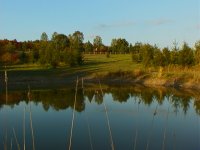
Just remembered I took some photos the other day. Fortunately (or unfortunately!?) no scum is visable in this shot. Our house is kinda visable in the background.

Dave
 

Attachments

  • 8-73199-pond3.JPG
    8-73199-pond3.JPG
    89.5 KB · Views: 154
   / Pond Scum #10  
DaveM,

That sure is a pretty place you have there!

Yes, if you can keep the geese away, you should be in good shape.

18-33477-tibbsig2.JPG
 
   / Pond Scum #11  
Ed--

Ridding a pond of algal bloom is a complex process. If the pond is old enough to have a serious layer of muck resulting from leaves, sticks, dead fish/turtles, etc., then the problem is exacerbated substantially because of the hyperoxygenation resulting from decay. A true solution in such a case might involve actually dredging the bottom, and aeration, etc. probably won't turn the corner. Even with a pond that does not have a lot of muck, I think that unless your son gets both aggressive and lucky, he won't get rid of the current large bloom, which sounds like it probably covers about 1/4-1/2 of an acre, without using Cutrine or another copper product (Tractor Supply sells a different brand, which I believe is cheaper) to kill it off. The good news about these products is that they work almost immediately and used right are not harmful to either flora other than algae or any fauna. When we had algae problems and used copper, we'd kayak around the perimeter just to watch the stuff break up and disappear.

Getting rid of a bloom is, of course, the tip of the scum-berg; the trick is keeping it away. I think that there is essentially universal agreement that managing a small lake to avoid algae depends on aeration and nutrient balance, and there is then some divergence of opinion. Many people add blue vegetable dye to ponds; the effect on the sunlight is supposed to be counter-productive for algae. IMHO, DO NOT use grass carp (white Amur) for algae control; there is a fish called Israeli carp which are supposed to do fairly well, but I don't know from first-hand experience. Marginal plants, water lilies, etc. can help but have to be picked carefully because they can just take over (although most can be controlled with another aquatic herbicide, Rodeo). One resource I found helpful is the website for Inspired by Nature, www.ibnature.com, which is an Ohio company specializing in "holistic" pond maintenance. I was very interested in windmill aeration this spring, but after talking to IBN ended up with a compressor-driven bottom aeration system, which I assume is what you mean by "pump driven." I decided against a windmill-based system because we tend to have long spells of little or no wind when aeration is most important, e.g. in the hottest days of summer, early in the morning. A fountain will aerate only the top foot or so of the water, and so should be thought of as primarily ornamental (but don't discount the therapeutic benefits of moving water; we just finished a waterfall which is a wonderful addition). IBN and others also sell mixes of microbes which feed on algae and really do help but have to be regularly added, and a product called "Aquamats" (www.aquamats.com) which is a fairly-costly (about $100 per each, with 24 recommended for our 3/4 acre pond) system of artificial reefs for ponds. Although skeptical, I bit the bullet on about half the number of aquamats recommended for our size pond, and can report that since about a month after they went in, together with aeration since about May 1 and occasional infusions of microbes, we have been algae-free. They do have a full, money-back one-year warranty.

I do know that you're right about one thing--getting rid of the filamentous algae makes a pond much more pleasant to be around. Good luck!


Rick
 
   / Pond Scum
  • Thread Starter
#12  
Thanks, gentlemen.
Ed
 
   / Pond Scum #13  
Thanks Fishman! Our place is a long-time dream come true.

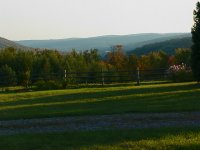
Here's another photo looking south from our deck. I had hoped to get a nice shot of the valley and the fall colors but by the time I got home the sun was already pretty low (producing long shadows) and it was hazier than hoped for.

Dave
 

Attachments

  • 8-73309-southview2.JPG
    8-73309-southview2.JPG
    98.1 KB · Views: 141
   / Pond Scum #14  
Dave,

That sure is pretty! Must be hard to leave and go to work. Heck, my place in the city isn't near as pretty and it is still hard to leave and go to work./w3tcompact/icons/smile.gif

Markv
 
   / Pond Scum #15  
Thanks Mark! Actually, I've found that knowing I'm coming back each night makes going to work a lot nicer./w3tcompact/icons/smile.gif This is the first place I've ever lived where I might just take a vacation and stay home! Plus, this part of the country is really beautiful and my ride in is usually great.

Good luck on your mountain paradise! I spent a little time in Dahlonaga, GA (sp?) when my brother-in-law was an Army Ranger trainer there. Real nice area.

Dave
 
   / Pond Scum #16  
Dave,

You were right close on how to spell Dahlonega, most people miss. Our weekend place (='s favorite place) is about 15 miles east of there, so we know it well. Don't want to give away any secrets about age, but I remember the ranger camp there also./w3tcompact/icons/smile.gif Been a while. They use to train on the area we bought. Given the slopes we have, I do not envy our brother-in-law. Ask him if he remembers the name "Wauka Mountain".

MarkV
 
   / Pond Scum #17  
>>Do any of you all have direct experience with successful control of pond algal scum by methods that are both affordable and practical?<<

Cutrine-Plus liquid applied with a sprayer works for me. There are several internet sites from which it can be ordered.

Chuck in IN
 
   / Pond Scum #18  
The Pond:
Have you tried adding some lime? Raises the PH and just may control the scum.
Egon
 
   / Pond Scum #20  
Egon,
I will add these words of caution. Make sure it's agricultural lime and not quick lime or slaked lime. They may change the pH too quickly and cause a fish kill.

Adding lime is generally considered unnecessary if total alkalinity in your pond exceeds 20 ppm. There are test kits out there for less than $40 which will measure alkalinity.

If your pond has low alkalinity, a <font color=blue>general</font color=blue> application rate is 2 tons (U.S.) per acre. A lot of work if your pond really doesn't need it. If your state fisheries office doesn't assist with these sorts of things (and most don't), you might try hiring a private lake manager <font color=blue>with good credentials</font color=blue>.

18-33477-tibbsig2.JPG
 

Tractor & Equipment Auctions

406 (A52706)
406 (A52706)
Harper TV130 High Dump Turf Vacuum Sweeper (A59228)
Harper TV130 High...
UNUSED FUTURE 16" HYD AUGER (A52706)
UNUSED FUTURE 16"...
KOMATSU PC490LC-10 EXCAVATOR (A60429)
KOMATSU PC490LC-10...
IRET13 ELECTRIC TRICYCLE (A58214)
IRET13 ELECTRIC...
2022 FORD E350 BOX TRUCK (A58018)
2022 FORD E350 BOX...
 
Top