Tie-Rods: Poor Quality

   / Tie-Rods: Poor Quality #1  

moship

Veteran Member
Joined
Nov 2, 2007
Messages
1,244
Location
PA
Tractor
Kubota L3130 HST 4x4 Kubota L4740-3 HST
Noticed a good bit of play in the front right tire/wheel when going down the road and confirmed the tie-rod was bad by lifting the tire off the ground and moving the tire left and right. Ordered a new Tie-Rod for a bit over $110 with tax, so it must be some super deluxe part that will last into the next Millennium.

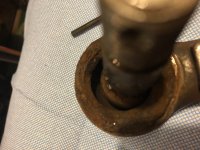
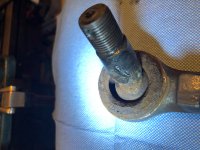
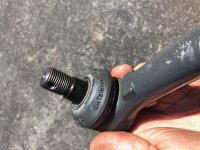
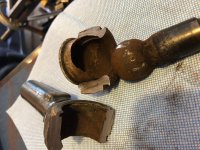
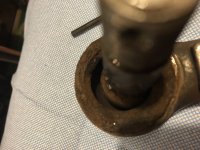
After removing the rubber dust boot I'm thinking it was never packed with grease. The gap between the ball and socket looks like the Grand Canyon and there is no evidence of grease! For reference the stud is 18mm and I believe a 3/16" bit fit in this gap. (See photos below)

After changing 50 or more tie-rods on cars over the years, I just assumed the tie-rod included the castle nut and new cotter pin. But Kubota is more forward thinking and elects to package the tie-rod LESS nut and cotter key. Nothing like a $9 castle nut and another trip to the dealer.

For the record the L4740 has right at 600 hours on it.

I'm likely going to take the boot off the new one to make certain there is grease in it. Also tempted to see if a zerk fitting can be added.

Of the several common design methods for ball joints this is the cheapest design out there, yet priced as a premium part. I don't mind paying for quality but this certainly doesn't look to be the case with this part.

Referencing Messick's, this part is used on 25 models ranging from L4240 thru L5740, L4760 thru L6060 and Mx 4800 thru MX5800.

In the event it is useful to anyone, the stud thread size is 18-1.50 mm (fine pitch).
 

Attachments
  • Tie-Rod 04.jpg
    Tie-Rod 04.jpg
    873.9 KB · Views: 462
  • Tie-Rod 05.jpg
    Tie-Rod 05.jpg
    735.8 KB · Views: 457
  • Tie-Rod 06.jpg
    Tie-Rod 06.jpg
    760.5 KB · Views: 364
Last edited:
   / Tie-Rods: Poor Quality #2  
That failed pretty fast. 600hrs isn't very much. Maybe that ball joint was defective from the factory. We have several tractors with 3-4K hrs and have never replaced front end parts. Sorry for your luck.
 
   / Tie-Rods: Poor Quality
  • Thread Starter
#3  
That failed pretty fast. 600hrs isn't very much. Maybe that ball joint was defective from the factory. We have several tractors with 3-4K hrs and have never replaced front end parts. Sorry for your luck.

I agree that 600 hours isn't too much. This is the first tractor I've had to put tie-rods on. A bit more and the ball would have pulled out of the socket.

Completed the job today... At least the right side.

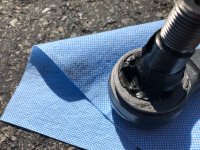
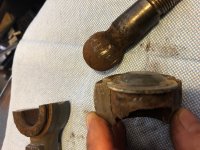
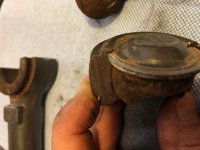
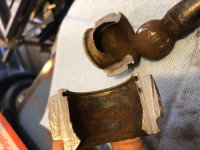
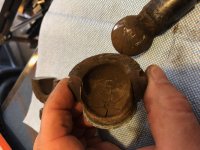
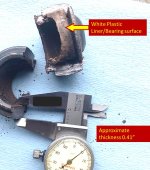
Below are a few pictures showing the ball joint cut apart. There's no evidence of grease, but considering how much metal is worn away and along with only 50% of the plastic ball cage being there it's hard to determine the root cause.

General notes:
1. The female threads are M20x1.5
2. Part Number: TD270-13710
3. Verified new ball joint has grease. It appears to be Moly type.
4. Made my own castle nut as I couldn't see paying Kubota's price. Used a grinder with cut-off blade to make the slots in a new nut. Cost about $1.25. $1 for nut and $0.25 worth of cut-off wheel.
5. Wanted to add a zerk fitting to make them greasable, but concerned I'd damage the new tie-rod. There is a dimple on the side that I'm guessing is for a zerk.
6. There is a plastic cage/bearing between the ball and socket. Much of it is missing or severely worn thin.
7. Top cover is crimped in place. Could water have leaked through this seam and caused the problem?... Who knows.
8. Ball is not hardened as the well worn with missing teeth band saw blade had no problem cutting into the ball.
9. Rubber boot was in good shape with no cuts/tears.

Checked the other side and it is worn about half this amount, so will be replacing in the near future.

Tie-rod is made by QH Talbros, Product | QH Talbros

Here's the link to the ball joint on Messick's showing the different models it is used on. Kubota: END, TIE ROD, Part # TD27-1371

I'd be interested in learning from other owners of 40hp and larger Grand L 40 and 60 series tractor if theirs are loose. Need to lift front end off the ground and rock wheel back and forth in the steering direction.
 

Attachments

  • Tie-rod 17.jpg
    Tie-rod 17.jpg
    1.1 MB · Views: 281
  • Tie-Rod 14.jpg
    Tie-Rod 14.jpg
    841.4 KB · Views: 237
  • Tie-Rod 13.jpg
    Tie-Rod 13.jpg
    670.2 KB · Views: 344
  • Tie-Rod 11.jpg
    Tie-Rod 11.jpg
    668.2 KB · Views: 286
  • Tie-Rod 09.jpg
    Tie-Rod 09.jpg
    676 KB · Views: 252
  • Tie-Rod 08.jpg
    Tie-Rod 08.jpg
    808.7 KB · Views: 279
  • Tie-Rod 07.jpg
    Tie-Rod 07.jpg
    926.4 KB · Views: 273
  • Tie-Rod 02.jpg
    Tie-Rod 02.jpg
    2.5 MB · Views: 262
   / Tie-Rods: Poor Quality
  • Thread Starter
#5  
How do you get grease between the ball and socket? I can see where it would be effective in getting grease inside the boot... guess it would be better than nothing.

Thanks for the suggestion.
 
   / Tie-Rods: Poor Quality #6  
How do you get grease between the ball and socket? I can see where it would be effective in getting grease inside the boot... guess it would be better than nothing.

Thanks for the suggestion.

My thoughts were better than nothing as well... I figured it would eventually get in to the joint.
 
   / Tie-Rods: Poor Quality #7  
Saying there is a fairly large gap between the ball & socket is a GROSS understatement.
 
   / Tie-Rods: Poor Quality
  • Thread Starter
#8  
Saying there is a fairly large gap between the ball & socket is a GROSS understatement.

Hence my description in the original post: "The gap between the ball and socket looks like the Grand Canyon and there is no evidence of grease!" :D:
 
   / Tie-Rods: Poor Quality #9  
There isn't any grease fittings on the front end of a Grand L? Very surprised.
 
   / Tie-Rods: Poor Quality #10  
How do you get grease between the ball and socket? I can see where it would be effective in getting grease inside the boot... guess it would be better than nothing.

Thanks for the suggestion.

I think getting grease in is only half the reason for greasing fittings. Keeping water and dirt out is just as important. If the boot is full of grease I think you are OK.
 
   / Tie-Rods: Poor Quality
  • Thread Starter
#11  
There isn't any grease fittings on the front end of a Grand L? Very surprised.

Neither the L3130 or L4740-3 have grease fittings for the tie rods. Considering the number of grease fittings on a tractor especially with a FEL, two more grease fittings wouldn't be an inconvenience. Same tie-rod is used in the newer Grand 60's, so they don't have them either.

crashz - Agree grease helps to keep water out and to flush out other contaminants or wear particles when a zerk fitting is provided. That's why I prefer tie rods with them.
 
   / Tie-Rods: Poor Quality
  • Thread Starter
#12  
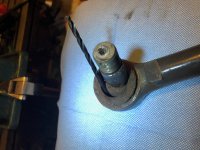
I disliked the idea of the new tie-rods not having grease fittings. Neither the stock ones which were destroyed nor the new ones from Kubota have grease fittings. I don't mind them being maintenance free, but given their short life span and crazy cost for such cheaply made ones is a slap in the face.

I've elected to add grease fittings.

Used a drill press and sturdy vice to hold the tie-rod and drilled slowly until white plastic was hit.

Will they last longer? Who knows without data. I do feel a bit better knowing they can be greased and any moisture can be flushed.

Just thought I'd share...
 

Attachments

  • Tie-Rod 03 Text Bright.jpg
    Tie-Rod 03 Text Bright.jpg
    132.6 KB · Views: 245
  • Tie-Rod 01 Format B.jpg
    Tie-Rod 01 Format B.jpg
    24.3 KB · Views: 232
   / Tie-Rods: Poor Quality #13  
Good write up and good fix.

The ends are similar on the M59 with no grease fitting. 2014 model, 1213 hours. Squeezed the boot and couldn’t “feel” grease. Couldn’t pull the boot down easily without disassembly. Used the grease needle option to puncture boot up toward the ball and did about 10-12 pumps till moly grease came out the puncture. No water. No old grease. Massaged the boot to try to push grease toward the ball. Can tell it’s got grease in it now. 10-12 pumps is a heathy amount of grease. That’s a thick and sturdy rubber boot.
I used similar technique to increase lifespan of auto CV joints.
 
   / Tie-Rods: Poor Quality #14  
Good write up and good fix.

The ends are similar on the M59 with no grease fitting. 2014 model, 1213 hours. Squeezed the boot and couldn’t “feel” grease. Couldn’t pull the boot down easily without disassembly. Used the grease needle option to puncture boot up toward the ball and did about 10-12 pumps till moly grease came out the puncture. No water. No old grease. Massaged the boot to try to push grease toward the ball. Can tell it’s got grease in it now. 10-12 pumps is a heathy amount of grease. That’s a thick and sturdy rubber boot.
I used similar technique to increase lifespan of auto CV joints.

Thanks for mentioning the tie rod ends.... I completely overlooked that on my M59. Just ordered a grease needle from ZORO tonight to do mine. That's one of the few places where I'll use my hand grease gun loaded with moly grease. Many thanks. BTW, NAPA Auto parts carries a moly grease with a higher level of moly in it than any other I've found. I hate moly mess, but do use it in a few select few places. One place being the main backhoe swing pivot.

There are a couple of other places on the M59 Kubota - and maybe other models of Kubota that can benefit from some innovative greasing. Rather than drift off the subject here I'll start a different thread for that.
rScotty
 
   / Tie-Rods: Poor Quality
  • Thread Starter
#15  
Thanks Smokeydog.

You provide a good workaround.
 
   / Tie-Rods: Poor Quality #17  
they are using plastic, probably nylon for the bearing surface. I know that petroleum products are bad for plastic and rubber, it can make them harden and crack, so a fully synthetic grease is best for this.. btw, this is the first time I've ever seen plastic used as a bearing surface for a tie rod, it must be a cheaper method to manufacture, but, you see it wears out fast..
 
   / Tie-Rods: Poor Quality #18  
Ah, yes. Grease compatibility rears it's ugly head. There's not only petroleum vs plastic but also the grease thickeners - which make up most of the grease itself - can be soap, bentonite, barium, or poly urea type. Use the wrong combo and they will harden. Since it's a Japanese part, I'd suspect the original grease to be a poly-urea type thickener.
Lubrisense has a whole series of white papers on the subject of greases for evening armchair reading. Here's one to get started with:
https://www.ocsoil.fi/upload/whitepapers/Lubrisense2.pdf

It seems like the problem with the tie-rod ends in this thread was due to no grease at all...but who knows? As you point out, They may have used incompatible materials in manufacture. I'm still bothered by why moship's tie rods failed at 600 hrs when the boot was still good.
rScotty
 
   / Tie-Rods: Poor Quality #19  
Ah, yes. Grease compatibility rears it's ugly head. There's not only petroleum vs plastic but also the grease thickeners - which make up most of the grease itself - can be soap, bentonite, barium, or poly urea type. Use the wrong combo and they will harden. Since it's a Japanese part, I'd suspect the original grease to be a poly-urea type thickener.
Lubrisense has a whole series of white papers on the subject of greases for evening armchair reading. Here's one to get started with:
https://www.ocsoil.fi/upload/whitepapers/Lubrisense2.pdf

It seems like the problem with the tie-rod ends in this thread was due to no grease at all...but who knows? As you point out, They may have used incompatible materials in manufacture. I'm still bothered by why moship's tie rods failed at 600 hrs when the boot was still good.
rScotty
nylon soaked in water will usually last a long time against a metal part, without any grease used!.. this is what was used here, the nylon acting as a bearing surface, but perhaps it encountered too much stress, and failed. or it got contaminated by a petroleum product, in any case, this is the very first time I've seen a tie rod with nylon as a bearing.. it does seem to be a weak point using plastic!..
 
   / Tie-Rods: Poor Quality #20  
My 2004 L3830 had a worn out tie rod end in 2014, at 1030 hrs. The new one was $75 then and I thought that was a lot.
 

Tractor & Equipment Auctions

2021 CAT 304E2 (A53317)
2021 CAT 304E2...
2019 DRAGON ESP 150BBL ALUMINUM (A58214)
2019 DRAGON ESP...
CAT D5G LGP DOZER (A58214)
CAT D5G LGP DOZER...
Trailmobile Van Trailer (A56438)
Trailmobile Van...
Poly Fuel Tank with Electric Pump (A55851)
Poly Fuel Tank...
500 BBL FRAC TANK (A58214)
500 BBL FRAC TANK...
 
Top