Dirt Dog - All Purpose Plow / Field Cultivator REVIEW + PICTURES

   / Dirt Dog - All Purpose Plow / Field Cultivator REVIEW + PICTURES #1  

jeff9366

Super Star Member
Joined
Jan 14, 2011
Messages
12,787
Location
Alachua County, North-Central Florida
Tractor
Kubota Tractor Loader L3560 HST+ ~~~~~~~~~~~~~ 3,700 pounds bare tractor, 5,400 pounds operating weight, 37 horsepower
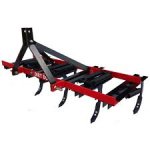
Dirt Dog All Purpose Plow / Field Cultivator


Dirt Dog Model APP 66-5
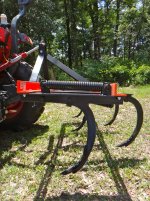
Total Width 66", Working Width 62", Five Tines, Weight 284 Pounds, Paid $835.00 (2010)


Field Cultivator: A Three Point Hitch mounted, secondary tillage implement, used to perform operations such as soil aeration, sub-surface vine and root removal and eradication of deep rooted weeds. Field cultivators are equipped with parabolic curved steel tines, typically spring mounted, to permit the tine to move within the soil and shatter clods. Field cultivators are constructed similarly to chisel plows, but are more lightly built. (Used to aerate compacted residential lots prior to installing irrigation and/or laying sod.)

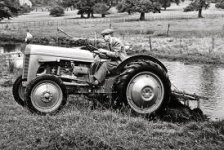
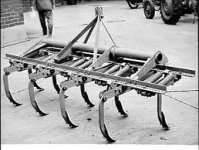
Today the Field Cultivator/All Purpose Plow is NOT one of the best known Three Point Hitch mounted implements. It is, however, one of the oldest designs, having been patented by Harry Ferguson, inventor of the tractor Three Point Hitch, in 1932-1933. The other earliest Three Point Hitch implements were the Ferguson Moldboard Plow, a Ferguson ridger for potato cultivation and a Ferguson row crop cultivator. (Photo#14)

Harry Ferguson, the inventor, termed this implement a 'Tiller'. Ferguson patented arrangement by which the tines are spring loaded, allowing them to kick back if an obstruction is encountered, then return, undamaged, to their normal operating position. Field Cultivators sold today are contemporary replicas of the 'Tillers' sold by the Ferguson organization from 1934.

Today, subject implement is termed a Field Cultivator or an All Purpose Plow. Field Cultivators are available in widths from 54"/Cat 1 to 173"/Cat2, with three to nineteen tines, for subcompact through utility tractors. The three USA marketers are Dirt Dog, Bush Hog and Fred Cain. (LINKS at page bottom.) Former producers were Ferguson, Ford Dearborn, Leinbach and Bush Hog, probably others. Wider, heavier Field Cultivators are available for the Big-Ag market.

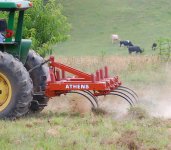
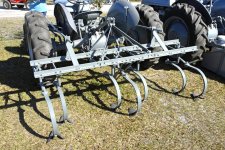
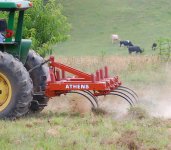
The Field Cultivator and its heavier relation, the Chisel Plow, are both used for conservation tillage. (Photo#5/APP, Photo#6 Athen's Chisel Plow; both manufactured in Georgia.)


WIKIPEDIA TILLAGE - Reduced Tillage
Reduced tillage leaves between 15% and 30% residue cover on the soil or 500 to 1000 pounds per acre (560 to 1100 kg/ha) of small grain residue during the critical erosion period. This may involve the use of a chisel plow, field cultivators, or other reduced tillage implements.

Chisel Plow
The chisel plow is a common tool to get deep tillage (prepared land) with limited soil disruption. The main function of this plow is to loosen and aerate the soils while leaving crop residue on top of soil. This plow can be used to reduce the effects of compaction and to help break up plowpan and hardpan. Unlike many other plows the chisel will not invert or turn the soil. This characteristic has made it a useful addition to no-till and low-till farming practices that attempt to maximize the erosion-prevention benefits of keeping organic matter and farming residues present on the soil surface through the year. Because of these attributes, a chisel plow is considered to be more sustainable than other types of plow, such as the mouldboard plow.

The chisel plow is typically set to run up to a depth of eight to twelve inches (200 to 300 mm). However some models may run deeper. Each of the individual shanks are typically set from nine inches (229 mm) to twelve inches (305 mm) apart. Such a plow can encounter significant soil drag, consequently a tractor of sufficient power and good traction is required.


Field Cultivators and Chisel Plows have parabolic shaped tines in common. Parabolic tines pull much easier through soil than angled shanks, such as those equipping Box Blades. From my observation, this is because parabolic shaped tines have the forward part of the tines in nearly a horizontal position working the soil. Field Cultivator tines are tipped with sharp, chisel points further reducing draft resistance.

Each sharp chisel point on my Field Cultivator is 2" X 10" = 20 square inches, oriented horizontally. Chisel points are uniform 5/16" thick. Tines are 1/2" wide.

Box Blade shanks are angled at 45 degrees to reach the bottom of road potholes and chip out surrounding hard road surface. They are designed for rigidity to apply bludgeon force. Box Blade points have an edge but get fat immediately.

Each Box Blade ripper point on my Rollover Box Blade is 1-1/4" X 5-1/4" = 6-1/2 square inches, oriented at 45 degrees. Orientation at 45 degrees hugely increases draft resistance. Box Blade shanks are 5/8" wide.

The engaged five tine Field Cultivator pulls easily, relative to my five shank Rollover Box Blade, with shanks down.

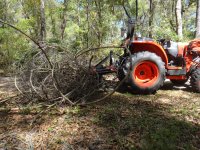
I primarily use my Field Cultivator for removing subsurface wild grape vine roots and runners from recently debrushed and thinned Oak woodlands, where I intend to seed game food plots. (Photo #10) Primary brush removal attachment is a Ratchet Rake on Kubota L2296 Heavy-Duty Round-Back bucket. Land once was cattle range.

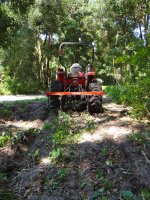
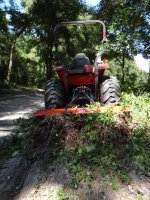
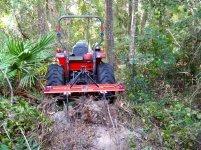
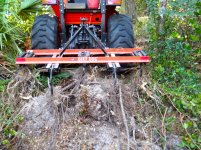
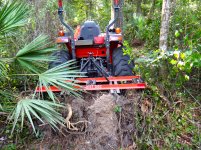
This week I used the Field Cultivator to drag out wild grape vines and a few wild roses, (vines and small corms) growing up the trunks and into the crowns of native Water Oaks. Water Oak roots grow straight down into the soil, so I could back the Field Cultivator up against an Oak's trunk, lower the implement and PULL. Tractor pulled in HST/LOW. (Photo#9 + Photo#11)

Parabolic tines "cup" shallow vine roots, so the implement can drag unwanted vegetation out of the soil without runners fragmenting. (Photos #9,#10,#11)

At the end of a pull, when the Three Point Hitch is lifted, the Field Cultivator self cleans reliably.

I made the right decision in selecting a five tine model rather than a seven tine model for my Kubota L3560. Both five tine and seven tine variations share the 66" X 2-1/2" X 2-1/2" angle iron frame. Seven tines in the soil would be too much for my mid-weight compact tractor.

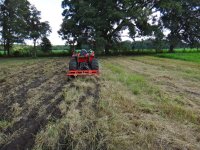
I pulled the Field Cultivator a short distance through a Bahia grass pasture. Field Cultivator tines/points sucked into the soil like a Moldboard Plow, all the way to the frame, aerating deep. The Bahia appeared fine when I finished. It will be a few days before I can be sure of Bahia recovery. Draft resistance on tractor and implement was moderate.

I would like the option to substitute 5 X 10" width, shallow-cultivating row crop sweeps for the chisel points bolted to the tines, to expand current cultivating width of the points from 10" per pass, (5 x 2"=10") to 50" (5 X 10" = 50") with sweeps. I have pictures of Ferguson 'Tillers' fitted with sweeps in England. (Photo#13) However, I have not been able to find sweeps to fit 1/2" width tines.

Row crop sweeps from TSC, Agri Supply, Nichols Tillage and Wiesse are dimensioned to mate with 1-3/4" width shanks on Big-Ag Field Cultivators, not my 1/2" width tines. Also, 1/2" width tines mean I need to use a 1/4"-20 bolt and nut, rather puny considering the draft force exerted on a 10" sweep. (Some report welding on sweeps.)


My soil is Florida rock-free, sandy loam.


LINKS (2) Dirt Dog Manufacturing

ETA Tractor Ripper, Field Cultivator, Tillage Tool
 

Attachments

  • DSC00346.jpg
    DSC00346.jpg
    1.2 MB · Views: 1,301
  • M156.jpg
    M156.jpg
    71.2 KB · Views: 2,276
  • DSC00358.jpg
    DSC00358.jpg
    1.1 MB · Views: 1,080
  • DSC00357.jpg
    DSC00357.jpg
    1.1 MB · Views: 1,106
  • DSC00356.jpg
    DSC00356.jpg
    1.2 MB · Views: 903
  • images-2.jpeg
    images-2.jpeg
    5.9 KB · Views: 1,003
  • DSC00018.jpg
    DSC00018.jpg
    1.1 MB · Views: 943
  • DSC00354.jpg
    DSC00354.jpg
    1.1 MB · Views: 967
  • Unknown-1.jpeg
    Unknown-1.jpeg
    46 KB · Views: 829
  • DSC00352.jpg
    DSC00352.jpg
    1.2 MB · Views: 1,102
  • Front Cover.jpg
    Front Cover.jpg
    182.8 KB · Views: 1,025
  • Unknown-2.jpeg
    Unknown-2.jpeg
    11.9 KB · Views: 939
  • a59215.jpg
    a59215.jpg
    179.7 KB · Views: 2,143
  • _DSC2244.jpg
    _DSC2244.jpg
    272.3 KB · Views: 842
  • Cultivator-S-Tine.jpg
    Cultivator-S-Tine.jpg
    17.3 KB · Views: 1,744
  • 75344_resized_800x800.jpg
    75344_resized_800x800.jpg
    115.5 KB · Views: 777
Last edited:
   / Dirt Dog - All Purpose Plow / Field Cultivator REVIEW + PICTURES
  • Thread Starter
#2  
I would like to occasionally substitute 5 X 10" width, shallow-cultivating row crop sweeps for the chisel points bolted to the tines. I have pictures of Ferguson 'Tillers' fitted with sweeps in England. (Photo#13) However, I have not been able to find appropriate sweeps.

CORRECTION RE: Ferguson Sweeps

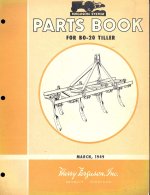
LINK Ferguson BO-20 Tiller Parts List: Tine Assemblies, Soil Engaging Parts (3 pages)

See page 3.

Ferguson sweeps are standard bolt on design. Sweep attachment bolt size is specified as 7/16"-20, so Ferguson tines must have had greater tine width than Dirt Dog 1/2".
 
Last edited:
   / Dirt Dog - All Purpose Plow / Field Cultivator REVIEW + PICTURES #3  
Nice article, Jeff. Very informative & full of useful info.
Great reading - thanks for posting.
Related link to the Ferguson Mfg Co (not sure if it bears any relation to Harry Ferguson) :
Ferguson Products
 
   / Dirt Dog - All Purpose Plow / Field Cultivator REVIEW + PICTURES
  • Thread Starter
#4  
Five additional photos:

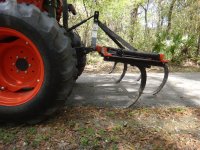
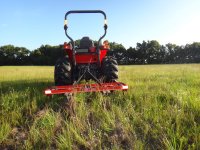
Photo #17 Beauty shot; no shadows.

Photo #18 Beauty shot side view.

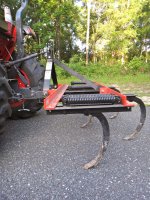
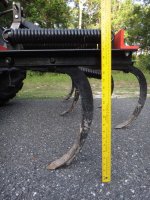
Photo #19 Drop from bottom of frame to chisel point is 18".

Photo #19 Aerating dry, compacted Bahia Grass cattle pasture in HST/LOW + 1/2 throttle.
Points are in ground 6" - 7". Had the grass been shorter points would penetrate deeper.

Photo #20 Maintaining bare dirt area around community burn pile in HST/MED +1/2 throttle.
Points are in ground 12" - 14".
 

Attachments

  • DSC00364.jpg
    DSC00364.jpg
    1.1 MB · Views: 1,942
  • DSC00360.jpg
    DSC00360.jpg
    1.1 MB · Views: 1,058
  • DSC00359.jpg
    DSC00359.jpg
    1.1 MB · Views: 934
  • DSC00361.jpg
    DSC00361.jpg
    1.1 MB · Views: 1,473
  • DSC00362.jpg
    DSC00362.jpg
    1.1 MB · Views: 1,419
Last edited:
   / Dirt Dog - All Purpose Plow / Field Cultivator REVIEW + PICTURES
  • Thread Starter
#5  
July 7, 2015

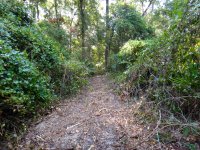
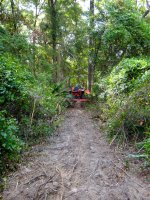
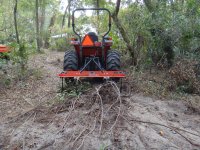
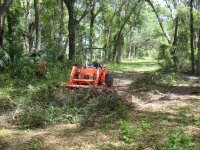
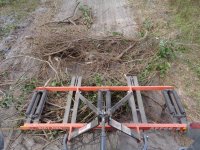
Photo #1 I pushed through thick wild grape vine growth, visible to left and right of track, with tractor and Land Pride RCF2060 Rotary Cutter on July 4, 2015. Impenetrable to a human prior to cut. Yes, this is excellent snake habitat.

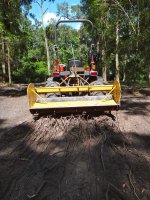
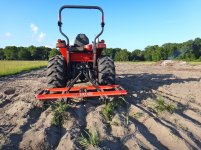
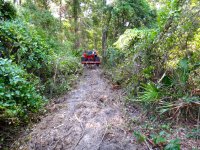
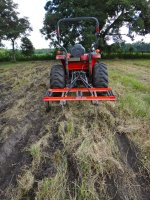
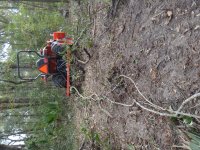
Photo #2 First pass with Dirt Dog APP 66-5.

Photo #3 Vegetation pulled from soil after first pass, Photo #2.

Photo #4 same

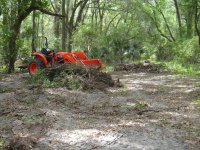
Photo #5 Second pass with Dirt Dog APP 66-5. Soil mostly clear of roots.

Photo #6 Vegetation pulled from soil after second pass, Photo #5. APP is lifted.

Photo #7 You need to be alert in the woods. Note "WIDOWMAKER" branch detached from tree, suspended in dead vines, poised to crash down. Perhaps 60 pounds in weight.

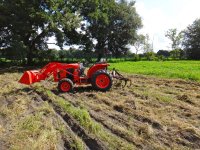
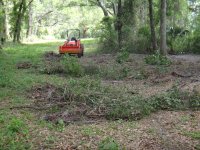
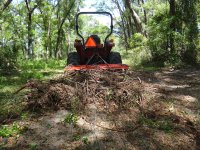
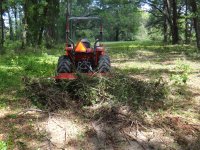
Photo #8 This food plot was planted with Austrian Iron Peas in March. During April we had practically no rain and germination was poor. Weeds and pasture grass smothered the few Austrian Iron Peas which germinated. I mowed with Land Pride RCF2060 Rotary Cutter on July 4, 2015, pulled through the APP 66-5 today. Before planting my wheat-based winter food plot seed during October, I may or may not Disc Harrow. I may just make a pass with my ETA Landscape Rake with gauge wheels, seed, then roll with my Cultipacker. October conditions will dictate. ( I may sow Buckwheat as a green manure and shade out weeds. )

Photo #9 Same. Soil is moist today but has very little ability to hold moisture, which perks through sand down to Florida aquaifer at about 35' depth. When moist soil is fertile. When dry, SAND. Tines are in the ground 8" to 11".

Photo #10 Same. Field Cultivator is adjusted for maximum depth. When slack is pulled out, and tines in soil are pulled back against springs equal to draft force, chisel points will have just a bit of 'down' angle to them. Field Cultivator "sucks" into soil like a moldboard plow. A later planting of Austrian Iron Peas in adjacent strip. Four hundred acres of unirragated Peanuts beyond the fence.
 

Attachments

  • DSC00374.jpg
    DSC00374.jpg
    1.2 MB · Views: 786
  • DSC00375.jpg
    DSC00375.jpg
    1.2 MB · Views: 812
  • DSC00376.jpg
    DSC00376.jpg
    1.2 MB · Views: 1,147
  • DSC00377.jpg
    DSC00377.jpg
    1.1 MB · Views: 928
  • DSC00378.jpg
    DSC00378.jpg
    1.2 MB · Views: 648
  • DSC00379.jpg
    DSC00379.jpg
    1.2 MB · Views: 1,038
  • DSC00380.jpg
    DSC00380.jpg
    1.1 MB · Views: 920
  • DSC00381.jpg
    DSC00381.jpg
    1.2 MB · Views: 1,136
  • DSC00382.jpg
    DSC00382.jpg
    1.2 MB · Views: 4,850
  • DSC00383.jpg
    DSC00383.jpg
    1.2 MB · Views: 2,205
Last edited:
   / Dirt Dog - All Purpose Plow / Field Cultivator REVIEW + PICTURES #6  
Thanks for posting this Jeff.

I been on the fence for awhile about getting a dirt dog chisel plow. The tractors I will use to pull it are 32 and 34 hp. I couldn't decided on the 5 shank or 7 but from your post it sounds like a 5 shank would be about all I could handle anyways.

My soil is much like yours. Pretty much sandy loam with very little clay content. I want to try and preserve as much organic matter at the surface as possible. We garden pretty intensively but put our fields in a rotation system with clover and rye to help minimize chemical and fertilizer inputs.

I own a dirt dog grapple and was really impressed with the fit and finish of the grapple. It is very well built and appears they take a lot of pride in their products.

what do you like best about the product and what are a few things you'd change if any.
 
   / Dirt Dog - All Purpose Plow / Field Cultivator REVIEW + PICTURES
  • Thread Starter
#7  
I believe a five (5) shank APP will do you. Dirt Dog makes the five shank APP in 66" (62" working width) and 60" (56") working width.

What I like best is that it works "as advertised". Easy to pull, while still able to go deep. Uncomplicated to adjust. Very effective eliminating roots from newly cleared ground. Excellent pasture aerator, at least in sandy-loam.

What I like second best is its easy mounting on the Three Point Hitch. I store mine on a sheet of old 1/2" plywood, under a cotton canvas tarpaulin, in the woods. It is easy to "jockey" the APP's 284 pounds on the plywood.

Third best is operating a legacy implement from earliest days of Harry Ferguson's Three Point Hitch.

I wish Dirt Dog would produce shoe-type SWEEPS to bolt on in lieu of the CHISEL POINTS, so APP could be used as a row crop cultivator. I have written DD with this suggestion.

Good tool. Fair price. Great performance per pound.
 
Last edited:
   / Dirt Dog - All Purpose Plow / Field Cultivator REVIEW + PICTURES
  • Thread Starter
#8  
Last edited:
   / Dirt Dog - All Purpose Plow / Field Cultivator REVIEW + PICTURES #9  
One of the most interesting an informative reviews I've read. I have a question regarding the Athens plows being manufactured Georgia. I know of an Athens plow company in Athens Tennessee. Is there a plant in Georgia as well?
Index
 
   / Dirt Dog - All Purpose Plow / Field Cultivator REVIEW + PICTURES
  • Thread Starter
#10  
December 1, 2016 Pictures​

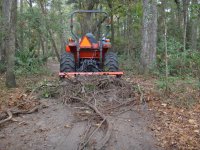
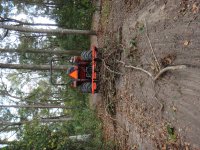
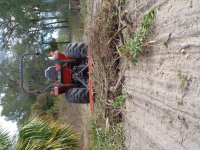
Photo #1 - Photo #4 Dirt Dog APP pulling wild grape vines from woods soil.

Photo #5 - Photo #6 Consolidated vine piles being dragged to community burn pile. APP raised with hydraulic control until points are 2" above ground. Top Length is long in order to orient points upward slightly, to grip vines. Vines so 'hooked' can be dragged long distances with hardly any loss ~~~ as a bonus you get a clean swept trail.
 

Attachments

  • DSC00554.JPG
    DSC00554.JPG
    5 MB · Views: 832
  • DSC00555.JPG
    DSC00555.JPG
    5.1 MB · Views: 515
  • DSC00552.JPG
    DSC00552.JPG
    5 MB · Views: 1,062
  • DSC00551.JPG
    DSC00551.JPG
    5 MB · Views: 547
  • DSC00548.JPG
    DSC00548.JPG
    5.4 MB · Views: 682
  • DSC00549.JPG
    DSC00549.JPG
    4.7 MB · Views: 1,329
   / Dirt Dog - All Purpose Plow / Field Cultivator REVIEW + PICTURES #11  
We have one of those, but I believe it is an old Deering, we used it years ago, I think dad bought it new back in the 50s.
 
   / Dirt Dog - All Purpose Plow / Field Cultivator REVIEW + PICTURES
  • Thread Starter
#12  
April 2017 pictures.
 

Attachments

  • DSC00678.JPG
    DSC00678.JPG
    4.3 MB · Views: 503
  • DSC00693.JPG
    DSC00693.JPG
    5 MB · Views: 400
  • DSC00694.JPG
    DSC00694.JPG
    5.7 MB · Views: 481
  • DSC00696.JPG
    DSC00696.JPG
    5.5 MB · Views: 418
  • DSC00698.JPG
    DSC00698.JPG
    5.6 MB · Views: 391
  • DSC00699.JPG
    DSC00699.JPG
    5.6 MB · Views: 347
  • DSC00680.JPG
    DSC00680.JPG
    5.2 MB · Views: 408
   / Dirt Dog - All Purpose Plow / Field Cultivator REVIEW + PICTURES #13  
I bought an old Fred Cain, I think, that had seen lots of use and needed a few springs, and some tightening up but I can see that this will be a lot of fun to have. I'm planting food plots for wildlife so its not exactly farming, and this will help.
 
   / Dirt Dog - All Purpose Plow / Field Cultivator REVIEW + PICTURES
  • Thread Starter
#14  
I cleared a small area thick with vines today.

Used Ratchet Rake bucket attachment to drag vines from trees and up to 1-1/4" trunk diameter trees and vine roots from the ground. Then consolidated debris into piles with the Ratchet Rake and towed piles to the burn pit with Dirt Dog Field Cultivator. At the pit, unhooked the debris from the Field Cultivator and used the Ratchet Rake to push debris into the burn pit. I used large loppers to cut some 2-1/2" grape vines which wanted to wrap around tractor wheels at burn pit, rather than release easily from Field Cultivator tines.

Few of these slightly elevated tows weighed less than 500 pounds. Most were 750 pounds or more.

Returning to the newly cleared area, used the Field Cultivator to drag out additional subsurface vines, roots and wild climbing rose corms to 12" depth. Then, with the Field Cultivator tines elevated so they just kerf the ground, rough graded. Next I will use a Disc Harrow to even and smooth the area, followed by TR3 rake for finish work. These stages will occur interspersed by rainfall.
 

Attachments

  • DSC00059.JPG
    DSC00059.JPG
    7.9 MB · Views: 406
  • DSC00060.jpg
    DSC00060.jpg
    8.1 MB · Views: 340
  • DSC00058.JPG
    DSC00058.JPG
    7.8 MB · Views: 342
Last edited:
   / Dirt Dog - All Purpose Plow / Field Cultivator REVIEW + PICTURES #15  
I found a Fred Caine in the brush and converted it to fit my little 2610. Still playing around with tine numbers. It was a 9 tine unit. Ive dropped it to 3 tines for now. Pulls nice and easy in my heavy clay soil older pasture so it turns out to be a very handy thing to have since its so adaptable to even a smaller tractor. I think Im going to put two more tines on it and see if I can handle that many. It probably will in some of my already worked areas.
 

Attachments

  • IMG_3927.JPG
    IMG_3927.JPG
    5.6 MB · Views: 396
   / Dirt Dog - All Purpose Plow / Field Cultivator REVIEW + PICTURES
  • Thread Starter
#16  
General guidance is five (5) tractor horsepower required per tine. Seven (7) tractor horsepower per APP tine is more realistic.

You know your clay, I do not.

Enjoy.
 
Last edited:
   / Dirt Dog - All Purpose Plow / Field Cultivator REVIEW + PICTURES #17  
July 7, 2015

Photo #1 I pushed through thick wild grape vine growth, visible to left and right of track, with tractor and Land Pride RCF2060 Rotary Cutter on July 4, 2015. Impenetrable to a human prior to cut. Yes, this is excellent snake habitat.

Photo #2 First pass with Dirt Dog APP 66-5.

Photo #3 Vegetation pulled from soil after first pass, Photo #2.

Photo #4 same

Photo #5 Second pass with Dirt Dog APP 66-5. Soil mostly clear of roots.

Photo #6 Vegetation pulled from soil after second pass, Photo #5. APP is lifted.

Photo #7 You need to be alert in the woods. Note "WIDOWMAKER" branch detached from tree, suspended in dead vines, poised to crash down. Perhaps 60 pounds in weight.

Photo #8 This food plot was planted with Austrian Iron Peas in March. During April we had practically no rain and germination was poor. Weeds and pasture grass smothered the few Austrian Iron Peas which germinated. I mowed with Land Pride RCF2060 Rotary Cutter on July 4, 2015, pulled through the APP 66-5 today. Before planting my wheat-based winter food plot seed during October, I may or may not Disc Harrow. I may just make a pass with my ETA Landscape Rake with gauge wheels, seed, then roll with my Cultipacker. October conditions will dictate. ( I may sow Buckwheat as a green manure and shade out weeds. )

Photo #9 Same. Soil is moist today but has very little ability to hold moisture, which perks through sand down to Florida aquaifer at about 35' depth. When moist soil is fertile. When dry, SAND. Tines are in the ground 8" to 11".

Photo #10 Same. Field Cultivator is adjusted for maximum depth. When slack is pulled out, and tines in soil are pulled back against springs equal to draft force, chisel points will have just a bit of 'down' angle to them. Field Cultivator "sucks" into soil like a moldboard plow. A later planting of Austrian Iron Peas in adjacent strip. Four hundred acres of unirragated Peanuts beyond the fence.

The Dirt Dog looks like quality, and I think the Fred Cain is of similar quality.
I wish that I had bought either of them!

Instead: I bought a NEW same style cultivator (over the phone), from Ken Sweet, at Sweet Farm equipment in Canmer, Ky.
I asked Ken Sweet if it was good quality, and he assured me that, "they are all about the same"
That is NOT TRUE!
It turned out that the distributor (Darrel Harp Enterprises of Red Bay Alabama) actually imported my cultivator from India.
To put it bluntly, it is a piece of made in India crap.
Ken Sweet offered to take it back, He paid a $210 bulk shipping rate, but would not agree to coordinate return at that same $210 rate. Trucking company quoted me $400 for return shipping.
I'm stuck with it now, but want to warn you not to make a similar mistake!
Trust ONLY your very own eyes!
Do not base buying decisions on dealer/seller BS!
 
Last edited:
   / Dirt Dog - All Purpose Plow / Field Cultivator REVIEW + PICTURES #18  
So... now I'm in the market for a field cultivator. :)

I like the Dirt Dog and Fred Cain styles that are being discussed here, but have some additional questions I'd like to pose to everyone. First, with regard to this style of cultivator, should I assume that increased weight represents a generally higher quality implement? I assume that a bit of additional weight is not going to make much difference in terms of the power it takes a tractor to pull one; that the number of tines and the width of each of those tines will determine how much power I need to pull it. I ask because the DD and FC cultivators are not readily available in my area (PNW) and shipping one from EA would cost $400. What I do have available in the area is Braber, which weighs nearly 20% more than the Dirt Dog Jeff specced out for us: Braber Equipment - Heavy Duty Spring Loaded Tine Cultivator --- even paying tax and the higher price, it would be cheaper than the others discussed here.

Another reason I'm interested in the weight and its affect on performance is that I've found a lightly used 9-tined version for sale at a slight discount. I would neither need nor be able to pull this, but it appears that I could simply remove 2-4 of the tines and have a wider, slightly heavier version of a 5-7 tined version. I could feasibly even sell those tines to defray part of the cost, which would again be cheaper because it is used and because I would pay no tax. This, to me, looks like the sort of equipment that can be assessed used fairly easier. Is any part of my logic flawed here?

I also run across two other types of field cultivators and would like to see what others have to say about them. First, this style is lighter and has no springs. I assume it is just a very light duty version without the customization potential of those discussed above.

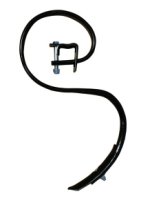
These S-tined styles seem to be the most popular. The sales language suggests that the tines vibrate to better destroy clods. They look less durable than the DD/FC style that has been discussed here earlier, and are lighter in weight. Does anyone have ideas to share regarding the various merits and demerits of the S-tined cultivators in relation to the spring loaded cultivators?

Finally, Jeff posted a picture of the tine depth in another thread. How much of that 17 in ground-to-frame tine can you expect to actually embed into the earth? Put another way, if depth is important, what sort of measurements should we expect to see in the tines on a cultivator?
 
   / Dirt Dog - All Purpose Plow / Field Cultivator REVIEW + PICTURES
  • Thread Starter
#19  
Freep:

I'm in the market for a field cultivator. :)

I like the Dirt Dog and Fred Cain styles that are being discussed here, but have additional questions to pose.

First, with regard to this style of cultivator, should I assume that increased weight represents a generally higher quality implement? I assume that a bit of additional weight is not going to make much difference in terms of the power it takes a tractor to pull one; that the number of tines and the width of each of those tines will determine how much power I need to pull it. I ask because the DD and FC cultivators are not readily available in my area (PNW) and shipping one from EA would cost $400. What I do have available in the area is Braber, which weighs nearly 20% more than the Dirt Dog Jeff specced out for us: Braber Equipment - Heavy Duty Spring Loaded Tine Cultivator --- even paying tax and the higher price, it would be cheaper than the others discussed here.

Field Cultivators constructed like the DD and FC brands, utilize parabolic tine shape and tractor forward motion to pull tines/points into the soil. With Moldboard Plows, this self-sinking action relying on implement orientation is known as "suck" i.e. "plow suck". You regulate Field Cultivator "suck" the same as "plow suck" by adjusting Three Point Hitch Top Link in/out. Additional weight will be positive. While I have never seen a Braber implement, the picture shows a stout piece of equipment.

Another reason I'm interested in the weight and its affect on performance is that I've found a lightly used 9-tined version for sale at a slight discount. I would neither need nor be able to pull this, but it appears that I could simply remove 2-4 of the tines and have a wider, slightly heavier version of a 5-7 tined version. I could feasibly even sell those tines to defray part of the cost, which would again be cheaper because it is used and because I would pay no tax. This, to me, looks like the sort of equipment that can be assessed used fairly easily. Is any part of my logic flawed here?

If the frame is no wider than your rear tire spacing this should be OK.

Personally, buying new, I buy the optimum size/weight gear. For instance, though it would have been easier to order a Fred Cain F/C from everything attachments.com, at the time I was ready to buy ETA offered only a 60" frame width. I needed a 66" frame width, so even though it was a hassle to order the Dirt Dog APP because I had to drive forty miles one way to pick it up from the nearest Dirt Dog dealer, I elected to do so. I remain happy with the decision.


I also run across two other types of field cultivators and would like to see what others have to say about them. First, this style is lighter and has no springs. I assume it is just a very light duty version without the customization potential of those discussed above.

A spring-protected Chisel Plow is a primary cultivation conservation plow. A spring-protected Field Cultivator is a lighter duty primary cultivation conservation plow/aerator, sized for compact tractors. A Row Crop Cultivator is a tertiary cultivation implement for disrupting (little, baby) weeds in soft, moist, well prepared row crop/garden beds.

These S-tined styles seem to be the most popular. The sales language suggests that the tines vibrate to better destroy clods. They look less durable than the DD/FC style that has been discussed here earlier, and are lighter in weight. Does anyone have ideas to share regarding the various merits and demerits of the S-tined cultivators in relation to the spring loaded cultivators?

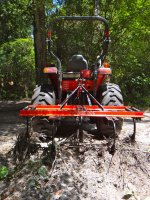
I use a heavier S-tine Cultivator. This is an another implement for secondary cultivation. The primary "fail safe" point on this springless design is the generic clamp bolts, which are about 75 cents each to replace. The secondary "fail safe" point is the generic clamp itself, about $3.50 each, including shipping. I have shovels, as opposed to points, for dirt contact. I break 3-4 bolts per season, one clamp per season and perhaps one S-tine every-other-season. Strangely, I have never replaced a shovel.

As bolts, clamps and S-tines distort individually, the tines no longer align in a straight row as shown in PHOTO #1. Still cultivates well as draft force resistance aligns spring-tines when sunk. PHOTOS #1 - #4

(Do not expect to use a Braber/DD/FC Field Cultivator for weed disruption. The tines/points are too narrow. Nor can points be replaced with shovels. The tines are too narrow for necessary plow bolts.)

I buy the highest quality equipment, then use it hard at times, if the job requires it.

THREAD LINK: https://www.tractorbynet.com/forums...rd-crossings-modular-tool-bar.html?highlight=


Finally, Jeff posted a picture of the tine depth in another thread. How much of that 17 in ground-to-frame tine can you expect to actually embed into the earth? Put another way, if depth is important, what sort of measurements should we expect to see in the tines on a field cultivator?

My L3560 (R4 tires, inflated with air) pulls the five DD APP tines 14" deep in Florida sandy-loam. It has only failed to penetrate once. That was attempting to aerate a horse compacted dry pasture. In tougher soils, moist soil would be necessary, or in dry soil a true Chisel Plow behind a heavy 100-horsepower tractor. PHOTO #5

Since June 2015 total repairs to the hard used DD/APP has been one (1) tine point, which cost $7.95 plus shipping.

FREEP: A pleasure to consider your well thought out, well paragraphed post.
 

Attachments

  • DSC00395.jpg
    DSC00395.jpg
    1 MB · Views: 453
  • DSC00392.jpg
    DSC00392.jpg
    548.6 KB · Views: 237
  • CLAMP.jpg
    CLAMP.jpg
    22.5 KB · Views: 210
  • Unknown.jpeg
    Unknown.jpeg
    27.3 KB · Views: 215
  • M156.jpg
    M156.jpg
    71.2 KB · Views: 255
Last edited:
   / Dirt Dog - All Purpose Plow / Field Cultivator REVIEW + PICTURES #20  
Freep

As to what cultivator is best is really dependent one which application you are planning to use it for. If it is deep cultivation/chisel plowing then the Fred Cain style is hands down the best option and many would say probably the only option. If you are looking at weed control for row crops then an S-tine with Danish sweeps will probably be your best bet. For shallow cultivation on a pre-worked seedbed then a C-tine with chisel tips might be your best option.

I have a Fred Cain 3 point cultivator and a mid-mount cultivator with sweeps on an old BF Avery. I love them both but only for certain applications. The Fred Cain digs deep and I use it mainly for ripping in the spring. The Avery is utilized solely for weed control. For weeds I barely want to go no deeper then necessary because every time you roll soil you bring new soil thats full of weed seeds to that perfect environment where they will germinate.


Marketplace Items

2012 TAKEUCHI TL12 SKID STEER (A60429)
2012 TAKEUCHI TL12...
2007 MACK GRANITE CV713 DUMP TRUCK (A60430)
2007 MACK GRANITE...
2025 Ligchine Spiderscreed Concrete Screed (A59228)
2025 Ligchine...
2014 International WorkStar 7300 4x4 Altec A55F 55ft. Material Handling Bucket Truck (A60460)
2014 International...
Kuhn FC400RG (A60462)
2002 TEREX TA25 OFF ROAD DUMP TRUCK (A60429)
2002 TEREX TA25...
 
Top