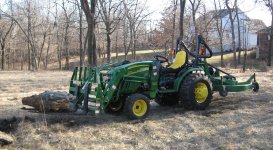
FEL lifting capacity

   / FEL lifting capacity #1  

RWolf

Gold Member
Joined
Apr 1, 2008
Messages
440
Location
Central Texas
Tractor
Current, Power King (antique), Soon to have JD 5103
Based on another thread currently going on it brought up a question and I didn't want to hijack that thread.

A simple question. Do you need to add ballast to perform a full load lift with your FEL? I.e. if your FEL is rated at 1000lbs do you need ballast of any kind to lift the full load?

Also if you don't mind specify brand, model and lift capacity of your FEL.
 
   / FEL lifting capacity #2  
I like little ballast w/full load for travel up/down different grades,also traction trying to get full load.

Don't have specs handy on loader for my L2800.
 
   / FEL lifting capacity #3  
If you are going to move at all with a full capacity load you will need ballast.
larry
 
   / FEL lifting capacity #4  
I think my BX is rated for 700# lift, and with a back blade as my ballast I can tell you its not enough. I will definitely be filling my rear tires at a minimum, and maybe add a little weight to my back blade also.

With no rear attachment on the back you should be VERY careful doing anything with the loader. Even my full size 580 Case uses a rear ballast on models without a backhoe attachment
 
   / FEL lifting capacity #5  
I've always had either the backhoe on or the box blade. Box is around 600lbs and backhoe about twice that. Think my tractor is rated for lifting under 1000lbs up front, so it feels pretty safe.

Now, a few days ago, I did pinch such a large stump and rootball in the backhow that the front tires were hardly on the ground. I added all the root parts I could find, and that put the tires back in firm enough contact with the ground. So, what I'm saying basically, is I needed front ballast, but not in the back yet.

HTH,
Josh
 
   / FEL lifting capacity #6  
I've always had either the backhoe on or the box blade. Box is around 600lbs and backhoe about twice that. Think my tractor is rated for lifting under 1000lbs up front, so it feels pretty safe.

Now, a few days ago, I did pinch such a large stump and rootball in the backhow that the front tires were hardly on the ground. I added all the root parts I could find, and that put the tires back in firm enough contact with the ground. So, what I'm saying basically, is I needed front ballast, but not in the back yet.

HTH,
Josh

Basically any time you do any kind of real digging with the backhoe just get a bucket of dirt in the FEL and with will help backhoe performance all around. On my 580 Case all models with extendahoes HAVE to have additional iron ballast on the front of the frame in addition to the loader. A couple thousand pounds of sand makes a BIG difference when ripping roots, digging clay, etc.
 
   / FEL lifting capacity #7  
My 4010's loader will lift 1/3 yard of gravel chock full. It has loaded rear tires, and it needs at least about 300# on the 3ph to not be tippy. One STILL must drive VERY SLOWLY and not lift that load very high while travelling. All it takes is for a tire to drop into a hole or a tire to go over a hump to cause it to tip over on 3 wheels. Gotta always be prepared to drop the loader and/or 3ph load very faster or rear back on the seat opposite to where it wants to tip (but with seat belt on).

I hauled 22 tons of gravel with it to gravel a tractor path that goes across the hill before plunging down 100 feet to the creek overflow area below.

Put 1/3 yard in the loader and 1/3 or more yard in a carryall in the back. Now that is a nice distribution. Very stable. STILL I don't go very fast with this load.

Ralph
The naked gardener
God's original intent
 
   / FEL lifting capacity
  • Thread Starter
#8  
Good info, I've generally not needed any ballast with a full load. Seems the bypass will cut out when I reach my maximum. About the only time I've needed any ballast and even then I don't think it helped much is when I get a load off-center then the tractor will start acting squirrelly. At that point I reload and center my lift. Maybe loaded tires would help and I'll need to try it out.
 
   / FEL lifting capacity #9  
I have a CK25 with loaded tires, total weight around 4400 lbs with the loader and no back implement or other weights. My bucket is 1/3 of a yard. It is very stable when loading the bucket with dirt or gravel. However, when I put the the toothbar on and fill the bucket with basketball sized granite rip-rap way out on the the teeth, the rear end would start to get a little light. I added a rear scraper blade and it balanced it out better. Bottom line is that you need rear ballast of some sort.
 
   / FEL lifting capacity #10  
Tractor- l3400 loaded R-1's @~500lbs
loader-la463
Lift specs
@pins 1153 lbs
@bucket center ~1050 lbs
@bucket edge 853 lbs

With 12 cement blocks in bucket @ 50lbs each = 600lbs at bucket center, over 400lbs under spec and with loaded rears and no implement, cant move in 2wd and hit the brakes a little too fast, rears bounce up. No way would I lift it to full heigh even 450lbs under spec and loaded rears. But kubotas are know to be very light machines.

Even with a 6 foot backblade @ about 250lbs or my finish mower @ about 350lbs, the loader has enough power, if you get caught under a root or whatever, to lift both rears in the air. But I think that is the equivellent to lifting more than the spec. With the mower on I was able to move 850lb I-beams that were centered about 6" beyond the bucket edge (on forks) and felt very stable.

Whenever I am doing dirt work, the only way I can get enough weight that the loader cant over power is with the 5' bushhog @ 500lbs and sticking way back. With it on, the hydraulics will stall/go into bypass, before the rears lift.
 
   / FEL lifting capacity #11  
Good info, I've generally not needed any ballast with a full load. Seems the bypass will cut out when I reach my maximum. About the only time I've needed any ballast and even then I don't think it helped much is when I get a load off-center then the tractor will start acting squirrelly. At that point I reload and center my lift. Maybe loaded tires would help and I'll need to try it out.

Dangerous, your tractor is seriously under ballasted. All you need to do is drop one front tire in a small depression and you will pivot on it and go over.

I have always followed the very specific instructions that came with my Ford 2120. IGNORE the weight of the tractor. The rear end ballast needs to equal or exceed the weight lifted. Add the rear wheel weights or fill load plus 1.5 times the weight on the 3 point hitch to come up with the effective rear weight. The weight on the 3 point hitch is multiplied by 1.5 to account for it's cantilevered location.

Andy
 
   / FEL lifting capacity #12  
Forgot my lift capacity: ~1300 lbs.
 
   / FEL lifting capacity #13  
My John Deere 2520 is supposed to have about a 1,000 lb lift capacity on the loader. I tried lifting my snowblower on a pallet with my pallet forks with no ballast just to see what it would do. The forks weigh about 400 lbs and the blower is about 250 and the machine was extremely light in the rear end. I would not have tried moving very far or on any uneven surface like this.

I'm pretty sure my tractor would be standing on it's nose if I tried a full-load lift with no ballast.

My normal operating mode is with 3 wheel weights per side (360 lbs total) and either my rear finish mower (675 lbs) or my box blade (about 400 lbs) on the hitch. In this configuration, the machine feels completely stable.

One thing that hasn't been mentioned (and I don't see it in the manual) is that rear ballasting (on the three-point hitch) also takes some of the stress off the front end components (wheel bearings, etc.). I never really thought about this until I saw it mentioned in some other threads on this site.

For the record, John Deere recommends a minimum of either loaded rear tires or 3 wheel weights per side AND a 824 lbs of ballast on the three-point hitch.
 

Attachments

  • 100_0415 B.JPG
    100_0415 B.JPG
    758.6 KB · Views: 226
   / FEL lifting capacity #14  
39 PTO HP Kubota with cab (Grand L 4610HSTC) Loader is good for about 1500 lbs. HD box blade or heavy 6 ft brush hog stabilizes the loaded tractor. Tires not filled IAW manual prohibitions)

Without ballast the loader is powerful enough to pull rear tires right on up into the air the full travel of the hydraulics. Without ballast the rear tires may make such light contact with the ground as to not allow the fronts to steer with much of a load in the bucket.

Be especially careful when turning the front wheels very much to steer with a heavy load in the bucket as it changes the geometry and can start a turn over. Much worse with insufficient ballast on the back like a 3PH implement as mentioned above. A carryall with plenty of weight is a good alternative for ballast in tires. The rear wheels loaded with liquid or using wheel weights (as I do) will help but the wheels have much less leverage and for the same weight an implement or carryall on the 3PH is much better.

The heavier the FEL load the more you need to keep it low to the ground as much as you can.

With a loaded FEL N_E_V_E_R ......I mean NEVER!! take your hand off the FEL control (joystick.) Be prepared to immediately slam it to the limit to drop the load if you start to tip over.

Pat
 
   / FEL lifting capacity #15  
L5030HSTC with loader good for over 1500 lbs, loaded rears plus a 7 ft snowblower way out the rear keeps it pretty stable. Without the blower the loader can pull the rear right up.
 
   / FEL lifting capacity #16  
I carried some full buckets of sand and managed to lift one rear slightly. So I'm buying $7K worth of ballast.

In the form of a Woods BH70-X.
Might be used for more than ballast also :)
 
   / FEL lifting capacity #17  
ck30 kioti

Usually have bh on. But, when I don't weight is still not an issue other than when I get a root on one side etc.. Then I have a bit more power than my rear wants to handle. Loads of dirt etc are no problem. No loaded tires or other weight in back.
I guess sometimes it pays to have a heavier tractor when using the FEL.
 
   / FEL lifting capacity #18  
I've pushed my little 254 jinma to the limit{NOT RECOMMENDED = DANGER}. I have carried loads{logs} that passed the limit of the loader. I have even had the tractor balancing on the front 2 wheels while moving a log{again NOT recommened}. When I did this it was one of those deals, tired and in a hurry{being stupid}. Like others have said either have weighted tires or have some type of weight to balance things out. If what you are wanting to move is to heavy then make more trips or get a bigger machine. I have been VERY lucky safety should come 1st.
 
   / FEL lifting capacity
  • Thread Starter
#19  
Good replies thanks. One thing this thread brings to mind is how manufactures balance their machines. It seems that in most cases people have more lift than balanced weight and there's a really good reason to ballast. I think JD went with a phlosophy that if you can't lift it you can't tip it. If I know I'm going to do a lot of loader work then I will put my BB on. But for that quick trip to put a round bale out for the horses I don't. My property is pretty flat and right now the only holes are the ones I've created by clearing the land of cedar trees. And I'm careful as to what I'm carring in the bucket in that area of the pasture.
 
   / FEL lifting capacity #20  
But for that quick trip to put a round bale out for the horses I don't. My property is pretty flat and right now the only holes are the ones I've created by clearing the land of cedar trees. And I'm careful as to what I'm carring in the bucket in that area of the pasture.

Don't recall what tractor you have and don't know how heavy your round bales are but... The round bales I feed require a rear implement to be safe. Tractor gets really light in the rear end carrying a round bale with no rear implement for ballast. I have done it but don't prefer it.

Critters like armadillos (or other burrowing animals) might just surprise you and put a hole where you will find it at an inopportune time. I have critter made holes that just appear at random and they will jar a 3/4 ton 4x4 P/U pretty good. I have no doubt that hitting one could cause my tractor to turn over if I were carrying a round bale with no implement for ballast.

There is just no guarantee that a soft spot after a rain or a critter dug obstacle will not be in the wrong place at the wrong time.

Pat
 

Tractor & Equipment Auctions

2015 Ford F-250 Pickup Truck (A59230)
2015 Ford F-250...
2016 UTILITY 53X102 REEFER TRAILER (A59905)
2016 UTILITY...
UNUSED FUTURE EQUIPMENT SEAT (A60432)
UNUSED FUTURE...
TAYLOR WAY 962 48" HYD TILLER (A57192)
TAYLOR WAY 962 48"...
2020 Ram Promaster City 1500 Cargo Van (A59230)
2020 Ram Promaster...
KIOTI SL7504-PL SKID STEER (A60429)
KIOTI SL7504-PL...
 
Top