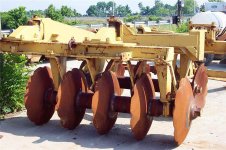
farmers use undersized disc harrows?

/ farmers use undersized disc harrows? #21  
A disc harrow doesnt really cover corn that good from what i see it covers corn about good as it does grass .

My guess is that whatever or whoever it is that you have seen has been using the wrong disk. The farms that I've seen, when they disk over corn fields, there is not much left.
 
/ farmers use undersized disc harrows? #22  
I've been looking for a 3-point disc for my 39 HP John Deere 1070 tractor. After not finding one (at a reasonable price) I was able to use one that a neighbor has. It's a 10' disc and have no problem pulling it I'm not sure I buy the 100 HP per 20' of disc.

If I tried to pull a 10 footer (or even an 8 footer) with my Kubota 46hp, it would cough, roll over, and die. :laughing:
 
/ farmers use undersized disc harrows? #23  
My question is what does a no till planter look like, a normal seed dril? So back to my question, how long can you no till plant before soil compaction from years of settling soil affects root growth and ultimitly plant growth and yeild? Think of just spraying roundup on your hard compacted yard and making a hole with a screw driver and putting corn seed in there, and then disking up another section of your yard after the roundup. All other things equal like water fertilizer etc my thoughts are the loose dirt will grow healthier plants and better yields. Maybe this can be overcome by more fertilizer and the cost difference is there in fuel consuption etc. im sure this was studied before they actually started doing it by all the major ag universities, but me never farming other than play farming with baby tractors for deer and birds, i cant seem to understand it.

-nate
 
/ farmers use undersized disc harrows? #24  
So back to my question, how long can you no till plant before soil compaction from years of settling soil affects root growth and ultimitly plant growth and yeild? Think of just spraying roundup on your hard compacted yard and making a hole with a screw driver and putting corn seed in there, and then disking up another section of your yard after the roundup. All other things equal like water fertilizer etc my thoughts are the loose dirt will grow healthier plants and better yields. Maybe this can be overcome by more fertilizer and the cost difference is there in fuel consuption etc. im sure this was studied before they actually started doing it by all the major ag universities, but me never farming other than play farming with baby tractors for deer and birds, i cant seem to understand it.

Certainly the success of no-till varies with soil, climate etc.

My understanding is 'nature' takes care of the soil in no-till. Worms, microbes etc. 'work' the soil and provide soil structure. Each harvest leaves a layer of organic material that builds the top of the soil. Compaction is an issue of course but you are going over the field less and need to pay more attention to _when_ you are going over the field.

Soil has been doing it's thing 'no till' long before we were around ;)


In gardening 'no till' and 'the living soil food web' is big with 'eco' gardners
 
/ farmers use undersized disc harrows? #25  
My question is what does a no till planter look like, a normal seed dril? So back to my question, how long can you no till plant before soil compaction from years of settling soil affects root growth and ultimitly plant growth and yeild? Think of just spraying roundup on your hard compacted yard and making a hole with a screw driver and putting corn seed in there, and then disking up another section of your yard after the roundup. All other things equal like water fertilizer etc my thoughts are the loose dirt will grow healthier plants and better yields. Maybe this can be overcome by more fertilizer and the cost difference is there in fuel consuption etc. im sure this was studied before they actually started doing it by all the major ag universities, but me never farming other than play farming with baby tractors for deer and birds, i cant seem to understand it.

-nate

You actually have it backwards. Traditional tillage is the cause of soil compaction. That's one of the "pros" of no-till.
 
/ farmers use undersized disc harrows? #26  
You actually have it backwards. Traditional tillage is the cause of soil compaction. That's one of the "pros" of no-till.

Do the no till farmers still run a sub soiler ever two or three years?

We used a no till planter for our food plots for years, but will be going to broad cast next year as the planter is just too big; really versatile unit though.
 
/ farmers use undersized disc harrows? #27  
Do the no till farmers still run a sub soiler ever two or three years?

We used a no till planter for our food plots for years, but will be going to broad cast next year as the planter is just too big; really versatile unit though.

No, I've never seen one used.
 
/ farmers use undersized disc harrows? #28  
No, I've never seen one used.

Just curious as we talked our renters to try no till for a few years and they did. They have gone back to conventional tillage except for beans when the son took over operation and I haven't really talked to them about it.

Unlike most around here, they don't burn the fields as we have spoken with them and are in agreement on this.

I don't farm anymore, but need to read up a little more on no till. We try to manage our land in the most responsible way for soil conservation, wildlife and forestry.
 
/ farmers use undersized disc harrows? #29  
10 years ago almost every field around here was no till. The last few years a few farmers have gone back to conventional tillage. I’m not sure why to be honest. I thought perhaps it was because of some weeds becoming gly resistant, but the farmers we rent to still no till everything and do just fine. Next time I talk to them I’ll ask why some have switched. All the farmers around here know each other pretty well.
From a conservation standpoint, I see positives and negatives to both. No till retains MUCH more moisture in the soil and there’s less loss from dust/loose soil, however there’s a lot more run off from no till.
Over time this creates some pretty large ruts.
 
/ farmers use undersized disc harrows? #30  
10 years ago almost every field around here was no till. The last few years a few farmers have gone back to conventional tillage. I知 not sure why to be honest. I thought perhaps it was because of some weeds becoming gly resistant, but the farmers we rent to still no till everything and do just fine. Next time I talk to them I値l ask why some have switched. All the farmers around here know each other pretty well.
From a conservation standpoint, I see positives and negatives to both. No till retains MUCH more moisture in the soil and there痴 less loss from dust/loose soil, however there痴 a lot more run off from no till.
Over time this creates some pretty large ruts.

The run off may have been an issue as a significant portion of our land is on an incline. Sub soiling allows more water to percolate as we have a pretty high clay content. I will have to do some checking.
 
/ farmers use undersized disc harrows? #31  
Do the no till farmers still run a sub soiler ever two or three years?

We used a no till planter for our food plots for years, but will be going to broad cast next year as the planter is just too big; really versatile unit though.

Many will still rip no till ground. They use rippers that disturb very little of the surface.
 
/ farmers use undersized disc harrows? #32  
all disk's are not created equally and some may require a bit more HP per foot to pull than others.

34" diameter disc's, 20" spacing, 5 disc's per gang

Some specifications for the disk pictured.

Not very wide but A thirty HP tractor may have trouble moving it. :D

Granted, this is not the normal disk, but it does show that they come in different categories and for different uses and a general category really does not apply.:D
 

Attachments

  • Rome disk.jpg
    Rome disk.jpg
    191.3 KB · Views: 307
/ farmers use undersized disc harrows? #33  
Many will still rip no till ground. They use rippers that disturb very little of the surface.

Thanks, that is what is used on our land, you can hardly tell it has even been done; looks like they are going close to three foot deep; really love the sound of a 325 horse pulling those things. In preparation for the upcoming wheat harvest, they just pulled in a John Deere no till drill for the wheat beans.
 
/ farmers use undersized disc harrows? #34  
Thanks, that is what is used on our land, you can hardly tell it has even been done; looks like they are going close to three foot deep; really love the sound of a 325 horse pulling those things. In preparation for the upcoming wheat harvest, they just pulled in a John Deere no till drill for the wheat beans.

Wheat beans?
 
/ farmers use undersized disc harrows? #35  
10 years ago almost every field around here was no till. The last few years a few farmers have gone back to conventional tillage. I知 not sure why to be honest. I thought perhaps it was because of some weeds becoming gly resistant, but the farmers we rent to still no till everything and do just fine. Next time I talk to them I値l ask why some have switched. All the farmers around here know each other pretty well.
From a conservation standpoint, I see positives and negatives to both. No till retains MUCH more moisture in the soil and thereç—´ less loss from dust/loose soil, however thereç—´ a lot more run off from no till.
Over time this creates some pretty large ruts.

There is less erosion with no till. Crop residue retards the erosion. Less compaction with no till and less runoff. However, since we don't work the fields like conventional tilling, little ditches with time become bigger ditches after heavy rains. The bigger ditches are often filled in the spring before planting.

Conventional till still probably gives overall better yeilds, if the rainfall is good on the conventional till. Compaction is much less with no till. Less traveling over the fields with no till. Glycolate resistance is starting to show in some areas. In the past, some farmers used Roundup on everything each time they sprayed. Monsanto even encouraged the practice. This is creating the resistance. We don't see the problem in our crops. We spray with other chemicals before planting and now use the Roundup only later when the crops are growing. I would guess 90% of corn and beans planted now use Roundup tolerant seed.
 
/ farmers use undersized disc harrows? #36  
 

Marketplace Items

SKID STEER ATTACHMENT TILLER (A58214)
SKID STEER...
500 BBL FRAC TANK (A58214)
500 BBL FRAC TANK...
CATERPILLAR 255 SKID STEER (A52709)
CATERPILLAR 255...
3-Stage Forklift Mast with Forks (A59228)
3-Stage Forklift...
1000000 (A47477)
1000000 (A47477)
2015 CATERPILLAR 953D CRAWLER LOADER (A60429)
2015 CATERPILLAR...
 
Top