Connected Battery Jumper Cables Wrong

   / Connected Battery Jumper Cables Wrong
  • Thread Starter
#21  
This happened to me with my F-150. We were on our way home from vacation about 1:30 in the morning. Some guy needed a jump. I said red on the positive. He responded yes. Well he didn't know red or positive. My battery was smoking. Now I always make the connections myself. The clamp that connected to the battery post was broken somehow. Luckily I was able to make enough of a connection to make it the remaining hour home. This was a couple of years ago. My 150 is fine. I did eventually have to replace the battery. But it was 12 years old so it was about time to replace it.

Thanks for all the posts - I think I am lucky that no batteries blew up - Can't imagine that wold have made my mug look any better!
 
   / Connected Battery Jumper Cables Wrong #22  
Having a significantly weaker battery in the chain probably saved you. If you connected together two healthy batteries (or course, why would you?), you probably would have had a different outcome.

Another factor could be your jumper cables. They may have been a weak link. You can buy big beefy cables, but they don't seem to be the norm.
 
   / Connected Battery Jumper Cables Wrong
  • Thread Starter
#23  
Having a significantly weaker battery in the chain probably saved you. If you connected together two healthy batteries (or course, why would you?), you probably would have had a different outcome.

Another factor could be your jumper cables. They may have been a weak link. You can buy big beefy cables, but they don't seem to be the norm.

You are right!!
 
   / Connected Battery Jumper Cables Wrong #24  
Having a significantly weaker battery in the chain probably saved you. If you connected together two healthy batteries (or course, why would you?), you probably would have had a different outcome.

Another factor could be your jumper cables. They may have been a weak link. You can buy big beefy cables, but they don't seem to be the norm.

You are right!!

...and they're expensive.
 
   / Connected Battery Jumper Cables Wrong #25  
Fun,

I think you're OK. If you did any serious damage, you would already know about it - when it comes to electronics or fuses/fusible links, they're done as soon as you let the smoke out of them. It did put a strain on your truck alternator, but obviously not enough to kill the rectifiers and probably no worse than the load from starting the engine.

The other major factor that saved you here, is you just don't really ever get a good low-impedance/high-current connection with jumper cable clamps. Despite the size of the clamp, there really is not much actual contact area (and therefore current-carrying capacity) with the battery terminal or clamp. Both of which are typically somewhat oxidized anyway, which makes the resistance of the connections even that much higher.

Which is why:
1) You can't usually just start the car having the dead battery right away, you usually have to try to "charge" it some from the booster vehicle first. Because you can't pull all of the amps needed to crank the dead car through the jumper cables and weak clamp connections.
2) Jumper cable clamps heat up with use.
3) Jumper cables with really heavy gauge wires are useless anyway because you can't improve much on the clamp connections, which are the bottleneck.

If you could have gotten solid low-impedance connections between the two systems, then odds are you would have blown something up - perhaps literally.

And since I see at least one flawed set of jumper connections posted, it wouldn't hurt to review the proper technique:

1) + clamps to + terminals of both batteries (keep - clamps from touching anything)
2) - clamp to - terminal of good battery.
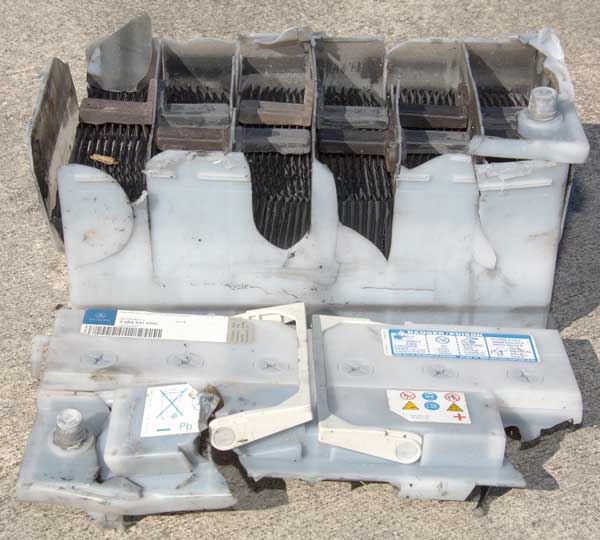
3) - clamp to solid bare metal of engine or transmission of car with dead battery (e.g., engine block, motor mount bracket). This last connection is when the spark happens, and you don't want that near the dead battery, which could ignite hydrogen gas venting from the dead battery, causing it to explode in your face. Like this one:

Car-Battery.jpg


Remove connections in the exact reverse order. :thumbsup:
 
   / Connected Battery Jumper Cables Wrong
  • Thread Starter
#26  
Fun,

I think you're OK. If you did any serious damage, you would already know about it - when it comes to electronics or fuses/fusible links, they're done as soon as you let the smoke out of them. It did put a strain on your truck alternator, but obviously not enough to kill the rectifiers and probably no worse than the load from starting the engine.

The other major factor that saved you here, is you just don't really ever get a good low-impedance/high-current connection with jumper cable clamps. Despite the size of the clamp, there really is not much actual contact area (and therefore current-carrying capacity) with the battery terminal or clamp. Both of which are typically somewhat oxidized anyway, which makes the resistance of the connections even that much higher.

Which is why:
1) You can't usually just start the car having the dead battery right away, you usually have to try to "charge" it some from the booster vehicle first. Because you can't pull all of the amps needed to crank the dead car through the jumper cables and weak clamp connections.
2) Jumper cable clamps heat up with use.
3) Jumper cables with really heavy gauge wires are useless anyway because you can't improve much on the clamp connections, which are the bottleneck.

If you could have gotten solid low-impedance connections between the two systems, then odds are you would have blown something up - perhaps literally.

And since I see at least one flawed set of jumper connections posted, it wouldn't hurt to review the proper technique:

1) + clamps to + terminals of both batteries (keep - clamps from touching anything)
2) - clamp to - terminal of good battery.
3) - clamp to solid bare metal of engine or transmission of car with dead battery (e.g., engine block, motor mount bracket). This last connection is when the spark happens, and you don't want that near the dead battery, which could ignite hydrogen gas venting from the dead battery, causing it to explode in your face. Like this one:

Car-Battery.jpg


Remove connections in the exact reverse order. :thumbsup:

Thanks Diez. - Good info - Truck and Impala have made it abou 1000 miles each or so with no symptoms so I agree - Not enough load carrying cappacity to do the damage that would be possible.

Was that battery photo taken by you and if so did the explosion spray acid??
 
   / Connected Battery Jumper Cables Wrong #27  
Nope, that was just a photo I found on the interweb. Thankfully I've only ever witnessed one battery explosion (intentionally, from a safe distance), which was pretty spectacular. By all accounts I know of, they always spray acid and shrapnel. Supposedly a few thousand people each year suffer serious eye injuries or blindness from exploding lead-acid batteries. Wearing safety goggles when working around them is a VERY good idea.

Some eyewitness accounts for your enjoyment: Battery Safety
 
   / Connected Battery Jumper Cables Wrong #28  
Thanks Diez. - Good info - Truck and Impala have made it abou 1000 miles each or so with no symptoms so I agree - Not enough load carrying cappacity to do the damage that would be possible.

Was that battery photo taken by you and if so did the explosion spray acid??

I did something fu**** stupid.
my tractor was having issues starting in a cold weather. so i went to jump it with my other tractor. so just being so freaking cold and dump, i connected the cables to the right terminals on the running tractor. then i just assumed (which was my fU*** up) that the bigger terminal was the positive. so i connected the positive terminal to it and it sparked and melt part of the battery cable so i took it right off. it took only a split of second before i took the cable off.
i reconnected the jumping cables the right way and fired up the tractor and no problem. several days later. i started having issues starting the tractor. (when i go to start the tractor it either gives me a nice start with no problems or it just gives a soft one click as if the battery dead. then i started noticing sparks going on around the starter and now i can't get it to start.

any thoughts ???
 
   / Connected Battery Jumper Cables Wrong #30  
well i just learned the hardway to always check terminals before connecting cables. but thanks for the suggestion. although it doesn't help with my current situation right now
 
   / Connected Battery Jumper Cables Wrong #31  
   / Connected Battery Jumper Cables Wrong #32  
   / Connected Battery Jumper Cables Wrong #33  
I doubt my wife would know how to pop the hood. Even if she did she probably wouldn't know where the battery is. I think that's why she married me, to maintain her car.
Mine could manage it if she has to, but would prefer that I do it. I put them in because if she has them, hopefully someone will know how to use them...

Aaron Z
 
   / Connected Battery Jumper Cables Wrong #34  
Mine could manage it if she has to, but would prefer that I do it. I put them in because if she has them, hopefully someone will know how to use them...

Aaron Z

I have AAA and told my wife to call them since I can't always be there to help for flat tires or a jump start.
 
   / Connected Battery Jumper Cables Wrong #35  
After briefly reversing leads on a friend's truck many years ago, I got into the habit of not clamping the last connection right away.

On the last connection, I'll leave the jaws closed, and lightly tap the outside of the jaw connection on the post of the dead battery. If sparks seems excessive, I'll re-check all my connections again, before clamping the final connection on. I've never actually reversed jumpers again, but I still keep that ritual up.

Batteries can be dangerous. I often have safety glasses in my vehicles. Thanks for starting this up OP, it's a good reminder to slap on some protection.

Rgds, D.
 
   / Connected Battery Jumper Cables Wrong #36  
Reminds me of Foxworthy's line.....

IF you have jumper cables in your car, AND your wife knows how to use them.... You Just Might Be Canadian !

Rgds, D.
 
   / Connected Battery Jumper Cables Wrong #37  
You were lucky. I fellow I worked with hooked them up backwards and the battery blew up. He lost an eye in the process.
 
   / Connected Battery Jumper Cables Wrong #38  
......... i started having issues starting the tractor. (when i go to start the tractor it either gives me a nice start with no problems or it just gives a soft one click as if the battery dead. then i started noticing sparks going on around the starter and now i can't get it to start.
any thoughts ???

On many models Kub uses a fusible link near the starter - a short loop of heavy red wire with a white connector. It's main purpose is to protect the instrument panel from just that kind of reversed connection of jumpers. Yours is likely partially or fully burned out. A new one is under $10 - need to know the tractor model to order the correct one. Meanwhile you can use a piece of house wire temporarily. (you didn't hear that from me) Take care, Dick B

p.s. have a look at this thread
 
   / Connected Battery Jumper Cables Wrong #39  
After briefly reversing leads on a friend's truck many years ago, I got into the habit of not clamping the last connection right away.

On the last connection, I'll leave the jaws closed, and lightly tap the outside of the jaw connection on the post of the dead battery. If sparks seems excessive, I'll re-check all my connections again, before clamping the final connection on. I've never actually reversed jumpers again, but I still keep that ritual up.

Batteries can be dangerous. I often have safety glasses in my vehicles. Thanks for starting this up OP, it's a good reminder to slap on some protection.

Rgds, D.
I cringed when I read your post. The last connection is never on the battery, it's always on grounded bare metal away from the battery.

You are lucky to not have one explode like this one in the old part of the thread.

--------------------------------

And since I see at least one flawed set of jumper connections posted, it wouldn't hurt to review the proper technique:

1) + clamps to + terminals of both batteries (keep - clamps from touching anything)
2) - clamp to - terminal of good battery.
3) - clamp to solid bare metal of engine or transmission of car with dead battery (e.g., engine block, motor mount bracket). This last connection is when the spark happens, and you don't want that near the dead battery, which could ignite hydrogen gas venting from the dead battery, causing it to explode in your face. Like this one:

Car-Battery.jpg


Remove connections in the exact reverse order. :thumbsup:
 
   / Connected Battery Jumper Cables Wrong #40  
I understand your point Xfax, about preferred connection.

What I'm describing as a technique works equally well when your final connection is to a motor mount. Even at -40, if you solidly clamp your final connection to a motor mount with a reversed lead, you have created a huge explosion risk.

Rgds, D.
 

Tractor & Equipment Auctions

Caterpillar 320 (A60462)
Caterpillar 320...
500 BBL FRAC TANK (A58214)
500 BBL FRAC TANK...
2016 Chevrolet Traverse SUV (A59231)
2016 Chevrolet...
2003 International 4300 Cab and Chassis Truck (A55852)
2003 International...
2023 RTVXG-850 SideKick (A56438)
2023 RTVXG-850...
Kubota MX5400 land mgmt package
Kubota MX5400 land...
 
Top