I'm glad you got it functional.
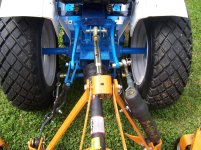
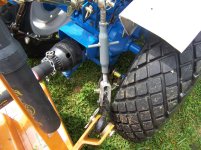
The basic idea of "why it works" is centered on the geometry of the links. If the top link and your lift arms are the same length, and fastened the same distance apart in height, the implement will lift exactly level. Shortening the top link relative to the lower links will move the far end of the implement higher than the near end, even if it starts out level. The same thing can be accomplished by decreasing the separation on the tractor side. You're coming closer to a triangle in layout, which would simply pivot around a single point.
The multi-link design has some attractive benefits. First, it lets the tractor lift more than it otherwise could. The less separation between the links on the tractor side, or the shorter the top link, the less load the machine can lift, but it will lift it higher. Put another way, a short top link/reduced separation has less mechanical advantage, thus more movement, at the implement.
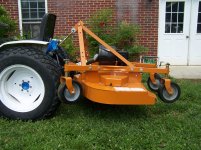
By adding the inward facing pins, you in effect lengthened the lower links (decreasing the effective top link length) and moved the mower farther away from the tires, too. Then, lowering the top link made the rear lift more than it otherwise would, and so did shortening the top link. These things can all happen and still have the mower sit flat, but you will notice the angle changes much more drastically when you lift the implement, compared to how it was before.
When I run my disk or am trying to finish grade something, I like to have the implement set such that it lifts as level as possible front to back, so that I can adjust the height or depth without so much impact on the angle of the implement. Conversely, trying to bash down heavy undergrowth with my brush mower, or to take big bites of a dirt pile with the box blade, I set the top link to the lowest pin hole, and shorten the top link if possible. This lets the back of the implement lift as high as possible.
It is good to do research and get your mind around what it will/won't do, or what adjustments are possible, but really the best way is to just go experiment. What works for my machine and implement combinations in my conditions may not give you anything like the results you are looking for. The basic fundamentals are the same, but the desired outcome is not necessarily identical.