User circuit DK45 Cab

   / User circuit DK45 Cab #1  

kiotiken

Veteran Member
Joined
Aug 29, 2011
Messages
2,378
Location
Dunrobin, Ont
Tractor
2012 Kioti DK45 HST Cab
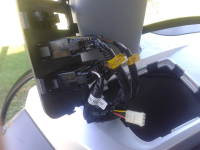
I'm adding LED work lights to my DK45 cab. They are 18W and I'm installing 4 in the front and 4 facing the back. Looking at the wiring harness at the switches, there's one unused connector. Is that from the "users power1" or "user power2" circuits?

I'm total clueless when it comes to electrical wiring, I was planning to copy what they did for the existing work lights. Should I run new wires back to the fuse box or can I use the single unused connector to feed two switches, one for the front and one for the back?

Thanks


ForumRunner_20130929_135446.png
 
   / User circuit DK45 Cab #2  
I'm adding LED work lights to my DK45 cab. They are 18W and I'm installing 4 in the front and 4 facing the back. Looking at the wiring harness at the switches, there's one unused connector. Is that from the "users power1" or "user power2" circuits?

I'm total clueless when it comes to electrical wiring, I was planning to copy what they did for the existing work lights. Should I run new wires back to the fuse box or can I use the single unused connector to feed two switches, one for the front and one for the back?

Thanks


What i did was just add a new lighted switch in the empty spaces of the switch consul and run it back to the spare fuse block on the left side of my seat. Mine doesnt have the unused wiring harness next to the existing switches like yours does.


View attachment 339085

if your hooking up 8 x 18 watts of lights to a single switch. youll need to wire in a solenoid or contactor. Then the switch would only need to power up the closure circuit of the solenoid, which will be in the miliamp range. The line side that is powering the lights will have to come from a source that can supply the total amperage draw of the lights.

am i correct in assuming your thinking of adding 1 lights, each 18 watts?. if so thats aprox 12 amp draw. So of theres a spare 15 amp circuit available youll have no issue at all.

Its possible to find a 12 amp toggle switch i suppose, but its common practice to wire the lights to a contactor, then control the on off function by powering up the contactor.
 
   / User circuit DK45 Cab #3  
Actually, you have 2 - 6 amp draws. Assuming you want to operate the front and rear lites the front and rear lites separately. Given that, you said you were not an electrical guy, I am so, I'll explain. I'll apologise now if you already know all this.

The lites for the front, need to be wired in parallel not in series (daisy chain). I can draw you a picture if required. The rear are done the same way.

Eash lite is 18 watts.

18 watts / 12 volts = 1.5 amps X 4 lites = 6 amps (same for the rear)

GRS is correct, you should use a relay to switch the power to the lites, but with two strings of lites (1 front, 1 rear), you need two relays, each controlled by its own switch. Effectively, the switch operates the relay and the relay operates the lites.

Grey area ahead! With 6 amp draw, you could wire from fuse to switches to lites directly. Boom, done.
 
   / User circuit DK45 Cab
  • Thread Starter
#4  
Thanks guys. For some reason, 12v wiring just flies over my head. What I was hoping to do is use the extra circuit Kioti leaves for us to feed two switches, one for the front and one for the back. I'm not really sure how contactors or relays work but I was thinking that since it is a 20A circuit, I would be fine since all my lights are only 12.

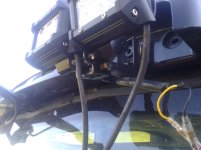
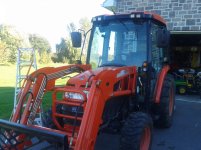
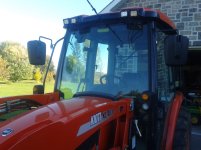
So since I really don't understand what I'm doing and I don't want a repeat of PickeringChris experience, I took another look at what was there and decided to ditch the OEM lights and replace them with the LED's. I modified the brackets a little, changed the way the LED mount on their brackets so that I could mount two lights on one bracket and I'm off to the races. I figure the old ones were 55W, or 110W for the front and the new ones are 18W X 4 for the front or only 72W total, so I should be OK, right? Anyway, I roughed it all in and installed it loosely and just went out to try them out in the dark. HOLY CRAP !!!! :eek: They're bright, and I only have the fronts done so far. It works well since I have two pointed a little lower and two pointed up for distance. I have a slightly different plan for the back, but I'll do the same and ditch the OEM lights.

So, is that unused connector (bottom of the first pic I posted) the 20A circuit they leave for us?

20130929_162244.jpg
20130929_162258.jpg
20130929_162304.jpg
 
   / User circuit DK45 Cab #5  
Looks awesome! :thumbsup:

Now I gotta go shoppin'. :laughing:
 
   / User circuit DK45 Cab #6  
The white connector on the harness you accessed in your cab is marked user or something similar. It can be used for a work light or whatever so long as you stay within the amperage rating of the fuse that it's wired to. The most basic difference between AC and DC voltage is that DC is direct current, fed from a 12 volt supply, your battery to a hot and ground returns to actual earth, via the chassis and tires. household wiring is a hot, neutral and a ground which also makes it way back to earth through a ground rod driven into the ground. Most off road light kits come with a wiring harness and a relay to allow one to wire them up fairly easily. The advantage you have with your LED lights is more light with less amp, (current) draw off your battery. And less heat generated, longer bulb life, and just better all round look too. The fuse acts like a house breaker- when there is too much draw, of current through the wires in a circuit, the breaker, or in the case of 12 volt DC, the fuse breaks(opens) and allows the wires to not burn up. The relay helps reduce the current in parts of the wiring and allows the lights to be controlled by a switch in the harness which closes the circuit through the relay and lights your lights.

If you put a space between each pic you upload, between each attachment they will have some room between each and be easier to view on the page...

Nice job; now use some dielectric grease to seal the ends of those bullet connectors. Ideally you'd use heat shrink tubing to make a waterproof seal on each.
 
   / User circuit DK45 Cab
  • Thread Starter
#7  
Looks awesome! :thumbsup:

Now I gotta go shoppin'. :laughing:

Thanks, and yes, you do! Everybody says what a difference LED lights make over the factory lights so my expectations were high. I was still amazed at the difference.
 
   / User circuit DK45 Cab
  • Thread Starter
#8  
The white connector on the harness you accessed in your cab is marked user or something similar. It can be used for a work light or whatever so long as you stay within the amperage rating of the fuse that it's wired to. The most basic difference between AC and DC voltage is that DC is direct current, fed from a 12 volt supply, your battery to a hot and ground returns to actual earth, via the chassis and tires. household wiring is a hot, neutral and a ground which also makes it way back to earth through a ground rod driven into the ground. Most off road light kits come with a wiring harness and a relay to allow one to wire them up fairly easily. The advantage you have with your LED lights is more light with less amp, (current) draw off your battery. And less heat generated, longer bulb life, and just better all round look too. The fuse acts like a house breaker- when there is too much draw, of current through the wires in a circuit, the breaker, or in the case of 12 volt DC, the fuse breaks(opens) and allows the wires to not burn up. The relay helps reduce the current in parts of the wiring and allows the lights to be controlled by a switch in the harness which closes the circuit through the relay and lights your lights.

If you put a space between each pic you upload, between each attachment they will have some room between each and be easier to view on the page...

Nice job; now use some dielectric grease to seal the ends of those bullet connectors. Ideally you'd use heat shrink tubing to make a waterproof seal on each.

grs, rmorey, CM, I appreciate the info. I did look up relays and contactors to try and learn something for next time. I'm still confused about them and why they're needed (not that I doubt any of you at all) and why a switch can't handle 6 or 12 V, after all, household switches can handle 15V. Do the factory switches simply control relays somewhere before they hit the lights, both front and back?

I was also having a hard time understanding why there are 3 wires from the switches. Rick mentioned that you need to wire them in parallel, so I was kind of assuming there's a hot wire for each light on the circuit and one ground wire that's shared. Now that you guys are talking about relays (and assuming Kioti is using one), I'm confused over why there are 3 wires again. Wouldn't you have power to the relay (2 wires), a switch connected to the relay (again, two wires) and 3 wires running from the relay to the two sets of lights?

CM, for you, I'll start adding a space. I thought I was being nice by at least breaking them on to separate lines! Those bullet connectors have something in them from the factory, not sure if it's dielectric grease. I can't use heat shrink tubing since the lights have to be disconnected in order to open the roof panel of the cab (along with the radio antenna). Kioti did a poor job IMO with access to the roof, not only do you have to disconnect the lights and radio, you have to remove the grey light bar at the front of the cab.
 
   / User circuit DK45 Cab
  • Thread Starter
#9  
Oh ya, I've been smelling coolant anytime I have the heat turned up. Obviously hasn't been a burning issue over the summer, but since I finally had the roof open, I took a closer look. I was expecting a line to be leaking but found a big pool of coolant around what I'm pretty sure is a mixing valve. It seems to leak (and I figured it out from the smell) only when the heat is turned on full or close to it. I kept feeling around the ceiling looking and feeling for coolant to be leaking through, but it was caught in an area of the roof and seems to have stayed put up there.
 
   / User circuit DK45 Cab #10  
Ken here is a simple explanation for the why and where to use relays. Relays are often used for two reasons.

Reason one is that relays often have large contacts that can handle large currents, and be controlled by switches or micro controllers that can only handle small currents.

Think large currents (a lot of amps) will require large wires to safely carry that current. Small currents can be safely handled by little bitty wires. So by using a small switch or an electronic module of some kind that can only deal with small currents to control a relay that can handle large currents you now have an easy method to control those large currents and still have small switches or microprocessors doing the controlling.

OK, now on two the second reason. The second reason is controlling large currents from a remote location. Instead of bringing large wires back to a switch that is rated for large currents for example back into your cab then back out to where the current is needed, why not put a relay out on the firewall to control those large currents? Lets control if from a little switch or micro controller located somewhere else remotely.

The benefits are you save on the amount of large wire, you save on having to have a large switch rated to control that much current and you save on the losses of running the large wire long distances instead of a short distance.

Furthermore in the case of the Micro controllers there is not a good way to make them able to even handle those large currents at all.

Now for a simple explanation of how the relay works inside. The relay has a coil of very small wire inside that when a very small current is passed through this wire it makes a magnetic field.. In other words it is an electromagnet. The magnet that is created when current is flowing is near a piece of steel called the pole piece. Attached to this piece of steel is a moving copper contact to carry high currents. There is also a non moving copper contact to mate with the moving contact to carry this current on and out of the relay body.

When the magnet attracts the piece of steel and attached moving copper contact, it moves toward the fixed contact and they mate together and the high current flows through these contacts.

When the small coil current is removed by the switch or micro controller the coil is no longer magnetic and the steel pole piece moves back to the relaxed position by pressure from a small spring. When the relay is energized by the coil, it has enough power to overpower the small return spring pressure.

Now you know how relays work inside, and a couple of reasons to use them:)

James K0UA
 
   / User circuit DK45 Cab
  • Thread Starter
#11  
Thanks James, that was a great explanation. The cost benefit of using less wire seems to be greatly off set by the cost of a relay, but the losses from running long distances makes a lot of sense. Obviously having smaller, nicer looking switches is important to.

I have no idea how much current the factory switches can handle and if they use a relay, but I did ask to buy a couple from my dealer when I was planning more lights. He quoted me over $50 each, so I quickly took a pass. Not sure if that indicates a switch that can handle higher amps.
 
   / User circuit DK45 Cab #12  
Thanks James, that was a great explanation. The cost benefit of using less wire seems to be greatly off set by the cost of a relay, but the losses from running long distances makes a lot of sense. Obviously having smaller, nicer looking switches is important to.

I have no idea how much current the factory switches can handle and if they use a relay, but I did ask to buy a couple from my dealer when I was planning more lights. He quoted me over $50 each, so I quickly took a pass. Not sure if that indicates a switch that can handle higher amps.

Unknown on the switches, I would have to see their rating. Another reason to use relays, but not in our low voltage application like in a vehicle, but in high voltage applications, for safety. For example if you were switching a high voltage you would not want it anywhere near the operator, but a simple low voltage switch could control high voltage/high currents through a relay or series of relays remotely, keeping the operator safe. There are many many other reasons, but that is enough for now.:)

James K0UA
 
   / User circuit DK45 Cab #13  
grs, rmorey, CM, I appreciate the info. I did look up relays and contactors to try and learn something for next time. I'm still confused about them and why they're needed (not that I doubt any of you at all) and why a switch can't handle 6 or 12 V, after all, household switches can handle 15V. Do the factory switches simply control relays somewhere before they hit the lights, both front and back? <SNIP>

KK, don't know if it's a typo, but household~AC and DC~ Tractor/auto switches are both rated in AMPS, not volts, (though household switches rate for instance 120V/15A). This is because one could be using a dryer receptacle, for instance, which uses 240V wiring, (essentially 2 qty 110V wires=240V) and a load rating of 30 Amps.
Look at it this way: your tractor wiring is geared to higher draw lights that suck up more current, (in amps) than your LED lights do. So most lights wiring is designed to handle the load of a higher demand light or whatever is at the end of the circuit drawing x amount of amps. Volts is potential, amps is load applied through the circuit. So in a water analogy, the dam holds so many volts, and the pipe size allows so many amps, (current) to flow through a certain size pipe,(ex: wire rated for 15 amps). And excess current/flow is stopped, (to protect the wiring from overheating, by a fuse melting when there is excess flow/current/amps). The relay allows one to open the dam's gate to allow the current/amps to flow without the operator putting themselves at risk by having to open the gate personally - the switch activates the remotely located relay, which does the work for them. All is well in Holland, land of locks and dams, and damsels.:laughing:


From KK Quote: " CM, for you, I'll start adding a space. Thanks KK! I thought I was being nice by at least breaking them on to separate lines! Those bullet connectors have something in them from the factory, not sure if it's dielectric grease. I can't use heat shrink tubing since the lights have to be disconnected in order to open the roof panel of the cab (along with the radio antenna). Kioti did a poor job IMO with access to the roof, not only do you have to disconnect the lights and radio, you have to remove the grey light bar at the front of the cab."

Sure seems like Kioti fell down on the cab roof. Is is supposed to open? Having to remove all the above to open the cab roof sounds ridiculous.
Kioti's dealer price on a relay to run lights is likely more a dealer markup of a Kioti proprietary relay than anything special about it from any other relay that could do the job. Though think about the amount of copper and other wiring components that go into one and that could explain it too. Wiring components and wire these days are NOT cheap. You should be able to find an online supplier of offroad lights/wiring to buy a little less costly relays and such, for future reference.

Let's see pics, properly spaced, of those bad boys blistering paint off the neighbors car AT NIGHT!:cool2:
 
   / User circuit DK45 Cab
  • Thread Starter
#14  
KK, don't know if it's a typo, but household~AC and DC~ Tractor/auto switches are both rated in AMPS, not volts...

No, not a typo, just a disconnect between my brain and the keyboard. Amps is what my brain wanted on the screen.

Sure seems like Kioti fell down on the cab roof. Is is supposed to open? Having to remove all the above to open the cab roof sounds ridiculous.

Ya, it's supposed to open, it's even hinged on the back. My JDB cab was hinged as well, but you didn't have to disconnect the lights to open it. Also, there are 8 bolts to remove for the front grey light bar that has to come off, not to mention 4 more bolts for the roof. Two of the roof bolts only come off when you remove the grey light bar, and you can't disconnect the lights until the roof is open, so you end up with a disconnected light bar balanced on the windshield wiper that would be dangling by the lights if it fell. NOT the best design I can think of.

Kioti's dealer price on a relay to run lights is likely more a dealer markup of a Kioti proprietary relay than anything special about it from any other relay that could do the job. Though think about the amount of copper and other wiring components that go into one and that could explain it too. Wiring components and wire these days are NOT cheap. You should be able to find an online supplier of offroad lights/wiring to buy a little less costly relays and such, for future reference.

To be fair, I asked for the identical switches and the factory switches are lit. They are just switches for $50 and to me, lit or not, that seemed crazy. I don't doubt my dealer has that marked way up though.

Let's see pics, properly spaced, of those bad boys blistering paint off the neighbors car AT NIGHT!:cool2:

I'm going to work on the rear lights and finish up the front lights tonight. Not sure how much I'll get done, but I will post pictures when I am. It's absolutely crazy the difference with just the 4 lights on the front. 4 more are going on the back and if I don't sell the 2 remaining lights (bought a pack of 10 on ebay), I may try and find somewhere to stick them too.
 
   / User circuit DK45 Cab
  • Thread Starter
#15  
Another reason to use relays, but not in our low voltage application like in a vehicle, but in high voltage applications, for safety. For example if you were switching a high voltage you would not want it anywhere near the operator, but a simple low voltage switch could control high voltage/high currents through a relay or series of relays remotely, keeping the operator safe.

James K0UA

Makes sense, especially for the push button start on a Prius!
 
   / User circuit DK45 Cab #16  
Lots of good stuff here. I cant add anything. James did a great job explaining the relays. :thumbsup:

Funny, if you wanted Kioti parts, ya gotta pay! A few minutes in Cdn Tire or any auto parts place would get you the same basic switches and relays for 1/3 the price. Good thing we didnt have to buy these tractors one piece at a time! :laughing:
 
   / User circuit DK45 Cab #17  
No, not a typo, just a disconnect between my brain and the keyboard. Amps is what my brain wanted on the screen.
Well then, amps it is! Just wanted to make sure of what you were referring to...


Ya, it's supposed to open, it's even hinged on the back. So, open for user to add ventilation, or open to remove top completely- what's their intended purpose? My JDB cab was hinged as well, but you didn't have to disconnect the lights to open it. Also, there are 8 bolts to remove for the front grey light bar that has to come off, not to mention 4 more bolts for the roof. Two of the roof bolts only come off when you remove the grey light bar, and you can't disconnect the lights until the roof is open, so you end up with a disconnected light bar balanced on the windshield wiper that would be dangling by the lights if it fell. NOT the best design I can think of.
You're a master of understatement! I can't imagine what they were thinking with that crazy sequence of dis-assembly?! Maybe the lightbar was an afterthought after the cab/roof had been stamped for production...


To be fair, I asked for the identical switches and the factory switches are lit. They are just switches for $50 and to me, lit or not, that seemed crazy. I don't doubt my dealer has that marked way up though.
Probably right about small markup- and ridiculous price for just a switch, lit or not. That's where OEM's get us.


I'm going to work on the rear lights and finish up the front lights tonight. Not sure how much I'll get done, but I will post pictures when I am. It's absolutely crazy the difference with just the 4 lights on the front. 4 more are going on the back and if I don't sell the 2 remaining lights (bought a pack of 10 on ebay), I may try and find somewhere to stick them too.

Curious, can you let us know what a 10 pak runs in el norte Americano dollares? (Ameribucks) You could put the extras on your JD lawn tractor.

Thanks,

CM
 
   / User circuit DK45 Cab
  • Thread Starter
#18  
So, open for user to add ventilation, or open to remove top completely- what's their intended purpose?

Curious, can you let us know what a 10 pak runs in el norte Americano dollares? (Ameribucks) You could put the extras on your JD lawn tractor.

Thanks,

CM


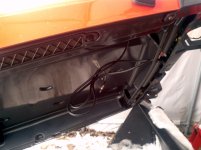
There's a lot of stuff up there, radio, speakers, heating equipment, wiring etc. The roof tilts open to gain access to all of it. Even with the roof tilted open, there's still a ceiling in the cab, it just provides access to what's between the cab ceiling and the roof. On top of that, the SE cabs (I don't think the S cabs were the same) are two layered. The orange molded plastic cant be seperated from the inner black plastic and the space they've created between them is used as ducting for the heating/AC system. It's actually pretty cool. If you need to take it right off (as I did to have it repaired) you take the last four bolts out of the hinges in the back. Here's what it looks like up there.

2013-01-03_11-31-00_932.jpg

Here's the two layers of the roof.

2013-01-03_11-31-42_353.jpg

No JD lawn tractor here just the Kioti and a Ferris ZTR. When the sun goes down in the summer, it's time to stop mowing the lawn anyway! I put them on kijiji, but I'll find somewhere to put them on the Kioti if they don't sell. Maybe chute lights for the snow blower ala 4shorts. My winning bid on a 10 pk was $270 USD and they have the "buy now" option around $320. They shipped from China (where else) and I had them in about 10 days. They are much higher quality than I expected, which is nice.
 
Last edited:
   / User circuit DK45 Cab #19  
Ken, keep the last 2 for spares in case you tear one off or it goes defective.. You will be assured of having matching replacements for years to come.

james K0UA
 
   / User circuit DK45 Cab
  • Thread Starter
#20  
Ken, keep the last 2 for spares in case you tear one off or it goes defective.. You will be assured of having matching replacements for years to come.

james K0UA

A defective Chinese product, really, that happens? hmmm, not a bad point.
 

Tractor & Equipment Auctions

PALLET OF 15 4X8 GROUND PROTECTION MATS (A58214)
PALLET OF 15 4X8...
TOOTHED BUCKET ATTACHMENT FOR MINI EXCAVATOR (A58214)
TOOTHED BUCKET...
2025 CFG Industrial NT20-CZ Mini Excavator (A59228)
2025 CFG...
Case Wheels for Combine/Firestone Tires w/ extra rings NO RESERVE (A56438)
Case Wheels for...
2016 Doyle 10T Tender (A56438)
2016 Doyle 10T...
1604 (A57192)
1604 (A57192)
 
Top