Splicing a small I beam together

   / Splicing a small I beam together #1  

ericher69

Veteran Member
Joined
Aug 19, 2008
Messages
1,666
Location
Ontario Canada
Tractor
2008 Kubota b2920
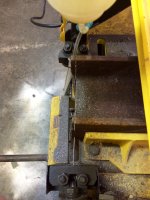
Purchased two lengths of used Ibeam that I will be splicing together.

This beam is for a trolley and small chain fall to help lift my b2920 implements to an acceptable working height. Max 500lbs.

Total span will be 15' when spliced.

Pieces are 11' and 4'

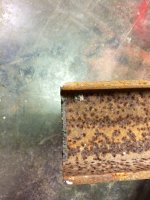
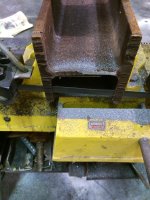
Beam is 5" by 3" by 1/2" thick

Here are some pictures

Prep, fit up and welding will be done by myself and directly supervised by a weldor with 30 years experience as a structural and high pressure weldor.

Will most likely weld with Millermatic 252.

Challenge will be clamping together so that it stays straight and doesn't warp.

Sent from my iPhone 5s 64Gb using TractorByNet
 

Attachments

  • image-1970543713.jpg
    image-1970543713.jpg
    493.9 KB · Views: 469
  • image-1691063203.jpg
    image-1691063203.jpg
    526.7 KB · Views: 370
  • image-864445073.jpg
    image-864445073.jpg
    537.4 KB · Views: 507
   / Splicing a small I beam together #2  
Looks like a great project, I'm following along!
 
   / Splicing a small I beam together #3  
I am sure your "helper" will let you know, but make sure you have a double V bevel on each piece, that way you can put an equal amount of weld on each side to prevent or at least lessen warpage. The biggest issue would be side to side warpage and may require some diamond shaped heat to straighten after all the welding is complete. This can be lessened by welding one side then the opposite quickly. The more times that you heat it up and allow a cool down, the more warpage you will get.
 
   / Splicing a small I beam together
  • Thread Starter
#4  
I am sure your "helper" will let you know, but make sure you have a double V bevel on each piece, that way you can put an equal amount of weld on each side to prevent or at least lessen warpage. The biggest issue would be side to side warpage and may require some diamond shaped heat to straighten after all the welding is complete. This can be lessened by welding one side then the opposite quickly. The more times that you heat it up and allow a cool down, the more warpage you will get.

Yes thank you for the tip!

I'm thinking if I clamp it well.

Tack in several places

Weld and allow to cool while clamped it should not move too much.

Was thinking of bridging the weldment top and bottom with a 2.5"x12"x3/8" piece of flat stock with welds and plug welds for extra reinforcement and not to interfere with the trolley.

Sent from my iPhone 5s 64Gb using TractorByNet
 
   / Splicing a small I beam together #5  
I did this 15 yrs ago for storage shelving. Simple clamping for straightness; was very easy, and it came out perfectly straight with no fussing around. Then added doublers top bottom and web. My I-Beams are a little larger, (6x4?) but much thinner ( 1/4" & the web may be 3/16 ? ) and 22 feet long. They are still in use.

What is the lift capacity of the hoist?
 
   / Splicing a small I beam together
  • Thread Starter
#6  
I did this 15 yrs ago for storage shelving. Simple clamping for straightness; was very easy, and it came out perfectly straight with no fussing around. Then added doublers top bottom and web. My I-Beams are a little larger, (6x4?) but much thinner ( 1/4" & the web may be 3/16 ? ) and 22 feet long. They are still in use. What is the lift capacity of the hoist?

Good to hear!

500lbs

Sent from my iPhone 5s 64Gb using TractorByNet
 
   / Splicing a small I beam together #7  

Proof it with 2000 lbs hanging on the splice and then you can lift 500 lbs with no worries. If it were me I'd proof it for 4x then add a doubler over the bottom weld just because I'm A/R, and because I can. It can be about anything. For example 1/8" x2" flatbar 3 1/2" long (or thicker if trolley has the clearance).
 
   / Splicing a small I beam together #8  
Unless there are reasons this won't fit with your trolley we usually use a backer plate on the top and bottom of the flanges and one on the Web. Single bevel your beam leaving about .125 gap and weld your first pass to the backer plate and both beams. Then fill the groove. This should leave the inside of the flange flush for your trolley wheels after welding and grinding smooth.
Make the plates about 6 to 10 inches long and they also will help hold your joint straight when welding.

There are a few other ways to make it work but the single bevel is simplest and does not require any back grinding to connect the root passes.

If you need any other advise feel free to ask.
 
   / Splicing a small I beam together #9  
Proof it with 2000 lbs hanging on the splice and then you can lift 500 lbs with no worries. If it were me I'd proof it for 4x then add a doubler over the bottom weld just because I'm A/R, and because I can. It can be about anything. For example 1/8" x2" flatbar 3 1/2" long (or thicker if trolley has the clearance).

Beam calculators are out on the Web that can be used for sizing. If you have questions on what your beam can hold I can get you solidworks simulation reports.
 
   / Splicing a small I beam together #10  
Blade, sounds like ericher already has the beam but internet beam sizing calculator would tell you the minimum beam size. If the calculator tells you max deflection allowed for the 5x3x1/2 that's interesting too. I'll bet that beam won't deflect (zero) under 500 lbs, and not much in a proof test.

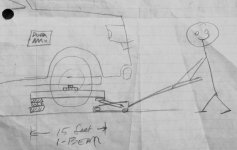
Proof test is pretty easy for small loads like 4x 500lbs, here's a pic where you can use your pickup and a floor jack. I bet one front wheel is near 2,000 lbs which is probably enough but lifting both front wheels would be more like 4,000 lbs. I bet that beam can take 4,000 lbs (but better check it with the calculator first and stop pumping the jack if you reach max allowable deflection).

If you snap a chalkline on the beam (unloaded) and leave it stretched when you load it, you can see (and measure) the deflection.

image.jpg

You could even (geek warning) work backwards from the deflection measurement and calculate the proof weight.
And then go on the internet and print up an official aluminum sign (for your overhead lifting device) that says "500 lbs capacity, proofed at 2___ lbs per TBN standards."

If you proof it at 4,000lbs then someday down the road you can hang a 1,000 lb hoist on it no worries (if 4x is good enough for you).
 
   / Splicing a small I beam together
  • Thread Starter
#11  
Proof it with 2000 lbs hanging on the splice and then you can lift 500 lbs with no worries. If it were me I'd proof it for 4x then add a doubler over the bottom weld just because I'm A/R, and because I can. It can be about anything. For example 1/8" x2" flatbar 3 1/2" long (or thicker if trolley has the clearance).

Unless there are reasons this won't fit with your trolley we usually use a backer plate on the top and bottom of the flanges and one on the Web. Single bevel your beam leaving about .125 gap and weld your first pass to the backer plate and both beams. Then fill the groove. This should leave the inside of the flange flush for your trolley wheels after welding and grinding smooth. Make the plates about 6 to 10 inches long and they also will help hold your joint straight when welding. There are a few other ways to make it work but the single bevel is simplest and does not require any back grinding to connect the root passes. If you need any other advise feel free to ask.

Was going to V groove-single bevel each beam clamp in place, tack well, check straightness, root pass, let cool, check straightness, top pass, let cool, check straightness, grind weld if needed where plates go then weld and plug weld plates.

Beam calculators are out on the Web that can be used for sizing. If you have questions on what your beam can hold I can get you solidworks simulation reports.
thanks but never plan on lifting over 500lbs. Reason I gave the 500lbs chain fall; if the chain fall won't lift it then it's heavier than 500lbs.

Sent from my iPhone 5s 64Gb using TractorByNet
 
   / Splicing a small I beam together
  • Thread Starter
#12  
Blade, sounds like ericher already has the beam but internet beam sizing calculator would tell you the minimum beam size. If the calculator tells you max deflection allowed for the 5x3x1/2 that's interesting too. I'll bet that beam won't deflect (zero) under 500 lbs, and not much in a proof test. Proof test is pretty easy for small loads like 4x 500lbs, here's a pic where you can use your pickup and a floor jack. I bet one front wheel is near 2,000 lbs which is probably enough but lifting both front wheels would be more like 4,000 lbs. I bet that beam can take 4,000 lbs (but better check it with the calculator first and stop pumping the jack if you reach max allowable deflection). If you snap a chalkline on the beam (unloaded) and leave it stretched when you load it, you can see (and measure) the deflection. <img src="http://www.tractorbynet.com/forums/files/welding/390358-splicing-small-i-beam-together-image-jpg"/> You could even (geek warning) work backwards from the deflection measurement and calculate the proof weight. And then go on the internet and print up an official aluminum sign (for your overhead lifting device) that says "500 lbs capacity, proofed at 2___ lbs per TBN standards." If you proof it at 4,000lbs then someday down the road you can hang a 1,000 lb hoist on it no worries (if 4x is good enough for you).

Thanks for the do it yourself version of test-nice DMax!

After listening to an engineer for a recent beam replacement for a 3 season porch; don't think I'll go that route ever again (not trying to offend any engineers) not a pleasant experience.

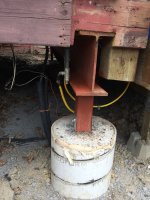
Long and short of it was a 19ft span with a post each end.

This is what he sized 10"x5-3/4"x1/2" 700lb monster beam supported by two 36" bigfoots with 14" sono tubes. Way overkill IMHO! But hey I'm no engineer so...

Sent from my iPhone 5s 64Gb using TractorByNet
 

Attachments

  • image-335104452.jpg
    image-335104452.jpg
    556.3 KB · Views: 288
   / Splicing a small I beam together #13  
Good lord. You could park a truck on that or 200 lbs per foot snow load. Theres all kind of engineers some so full of hot air you could poke a hole in them and do some plastic welding. Maybe he's been sued for a job with his stamp on it, that would change a guys outlook. BTW Where'd you get this engineer, he wasnt free advice on a forum was he?
:laughing:

Well anyway back to your project. Thats why its nice to proof it yourself, when you say "I proofed it with 4x" then you can ignore all the hot air. Or 5x or 10x.
 
   / Splicing a small I beam together
  • Thread Starter
#14  
Good lord. You could park a truck on that or 200 lbs per foot snow load. Theres all kind of engineers some so full of hot air you could poke a hole in them and do some plastic welding. Maybe he's been sued for a job with his stamp on it, that would change a guys outlook. BTW Where'd you get this engineer, he wasnt free advice on a forum was he? :laughing: Well anyway back to your project. Thats why its nice to proof it yourself, when you say "I proofed it with 4x" then you can ignore all the hot air. Or 5x or 10x.

I know! Plan on closing in later with windows, patio doors, insulating, new roof truss etc etc.

Had it over engineered.

No wasn't free and not from a forum. Place I purchased beam from; truss, LVL and beam company

LVL would have been 16"x3 thick plus needs to be capped/waterproofed for outdoor use

Sent from my iPhone 5s 64Gb using TractorByNet
 
   / Splicing a small I beam together #15  
If you tack it good and weld the the web first you should be good but a lot times for splicing beams, the best way is to clamp another piece of beam a few feet long under the splice. Double bevel the web and leave a bit of a gap for penetration. Bevel the flanges on the top side only. Trying to do a double would be more difficult. The flanges are easy to get at with a grinder so after welding the inside, you can grind/gouge into the weld from the outside to ensure full penetration.
 
   / Splicing a small I beam together
  • Thread Starter
#16  
If you tack it good and weld the the web first you should be good but a lot times for splicing beams, the best way is to clamp another piece of beam a few feet long under the splice. Double bevel the web and leave a bit of a gap for penetration. Bevel the flanges on the top side only. Trying to do a double would be more difficult. The flanges are easy to get at with a grinder so after welding the inside, you can grind/gouge into the weld from the outside to ensure full penetration.

Ok thanks for the tips

Life got in the way so hopefully will be able to post an update in next few days

Sent from my iPhone 5s 64Gb using TractorByNet
 
   / Splicing a small I beam together #17  
Ericher69,
Beams are categorized by height dimension and weight per foot. Weigh your small piece and calc wpf. I can run a program and give you loading and deflection based on uniform beam. You could then consider derate based on weld. What is your mounting plan? Like pole / beam at both ends? I need support span width dimension ( like 15' minus twice width of support.)
I bought this program and used it on my own shop and porch projects.
Rob
 
   / Splicing a small I beam together
  • Thread Starter
#18  
Ericher69, Beams are categorized by height dimension and weight per foot. Weigh your small piece and calc wpf. I can run a program and give you loading and deflection based on uniform beam. You could then consider derate based on weld. What is your mounting plan? Like pole / beam at both ends? I need support span width dimension ( like 15' minus twice width of support.) I bought this program and used it on my own shop and porch projects. Rob

15'

Beam will be 15'7" to accommodate a 3.5x3.5" at each end


Small piece is clamped in place now so no go on weighing

Thanks

Sent from my iPhone 5s 64Gb using TractorByNet
 
   / Splicing a small I beam together #19  
Thanks for the do it yourself version of test-nice DMax!

After listening to an engineer for a recent beam replacement for a 3 season porch; don't think I'll go that route ever again (not trying to offend any engineers) not a pleasant experience.

Long and short of it was a 19ft span with a post each end.

This is what he sized 10"x5-3/4"x1/2" 700lb monster beam supported by two 36" bigfoots with 14" sono tubes. Way overkill IMHO! But hey I'm no engineer so...

Sent from my iPhone 5s 64Gb using TractorByNet

Look at it this way.... will you ever have to worry about it ever again?? Nope. He did his job.
 
   / Splicing a small I beam together
  • Thread Starter
#20  
Look at it this way.... will you ever have to worry about it ever again?? Nope. He did his job.

No

Rather the engineer err on the "overbuilt" side of things instead of the "it's good enough" side of things.

Sent from my iPhone 5s 64Gb using TractorByNet
 

Tractor & Equipment Auctions

2018 Trail King Lowboy (A56438)
2018 Trail King...
2015 Ford F-350 4x4 Service Truck (A59230)
2015 Ford F-350...
2023 KRT ST900HD STAND-ON SKID STEER (A60429)
2023 KRT ST900HD...
HYDRAULIC THUMB CLAMP FOR MINI EXCAVATOR (A58214)
HYDRAULIC THUMB...
Club Car Electric Utility Cart (A55851)
Club Car Electric...
2021 METSO QUOTEC NORDTRACK S3.7 MOBILE SCREENER (A60429)
2021 METSO QUOTEC...
 
Top