Starter wiring help

/ Starter wiring help #1  

CMV

Platinum Member
Joined
May 10, 2015
Messages
914
Location
NC
Tractor
Kioti NX4510HST (previous LS XJ2025H, JD 500C)
83 JD 500C backhoe.

Electrical is 100 different kinds of screwed up on the machine. I had the starter relay (or solenoid relay or starter solenoid - I see it called several things but I"m not talking about the solenoid that's parked on top of the starter but the solenoid/relay before the starter & it's solenoid) bypassed. Small wire from start switch to solenoid (that's affixed to starter), main battery +12V direct to same solenoid. Worked for a while & now has finally died out. I still get a click from the solenoid but the starter motor doesn't even attempt to operate. Bought a generic heavy duty 12V 100A 4 post relay/solenoid/whatever you call it not to confuse it with the one mounted on the starter and wired that in, but no joy. Starter was weak already and would sometimes grind or turn for a second & stall out.

So anyway.....I have a new starter on the way that has it's solenoid attached. I also ordered the proper part # starter relay & it is also on the way. Since I'm not much of an electrician, figured I'd ask what to do with these parts when I get them. With the relay out of loop, I can't just follow the old wiring.

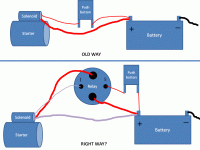
The way I THINK I should do it is this: +12V from battery terminal to either 'large' terminal on the relay, beefy cable from the other 'large' terminal on the relay to the 'large' terminal on the starter solenoid, small wire from battery +12V terminal to momentary push button start switch, small wire from other terminal on momentary push button start switch to 'S' terminal on relay. Now past that I'm unsure. Does another small wire go from the 'I' terminal on the relay to the small terminal on the starter solenoid or is it unused?

I also don't quite understand the purpose of the starter relay. Doesn't the solenoid mounted on the starter do the exact same thing + engage the bendix? I understand that the full starting amperage can't go thru the momentary push button start switch - it would fry instantly as small as the contacts & wires are. But how does that relay help anything? It gets the +12V signal from the momentary switch, closes it's contacts, & lets the +12V flow to the starter solenoid at high amps, then opens it contacts when it loses the +12V signal from the pushbutton opening the circuit and cutting off the high amp +12V to the starter mounted solenoid. I get that. But doesn't the same thing happen with the momentary switch +12V signal going straight to the solenoid mounted on the starter?
 
/ Starter wiring help
  • Thread Starter
#2  
Worth 1,000 words.....

Top is what I had. Bottom is what I think I should have. Purple wires I'm not sure if they should be there or not.

starter.gif
 
/ Starter wiring help #3  
If you don't get any results here, try putting your thread in the John Deere Owner Operator forum. Your hoe probably has the same starter wiring as the Ag tractors.
 
/ Starter wiring help #4  
The I terminal is something that ford used a lot. The I stands for ignition, and supply's full 12v to the coil when cranking. Most ford coils don't run 12v normally, but at startup the hotter juice helps. For your application you can ignore that.

As to the purpose of the relay you bought, and yes relay is the correct term, (solenoids done work...like door locks or starter bendix, relays do not) I am unsure if you need it or not. Think of it as a switch to control high current with low current. The relay could be relaced with a large 100a+ switch that you manually actuate. But a relay just takes low current for the actuation.

So without seeing the setup, or knowing the machine, it is unclear if you need the high current going to the starter solenoid. Or if the solenoid also acts as a relay. Since you have a heavy gauge wire going direct from battery to starter, I am gonna assume the solenoid also acts as the relay and the 4- post one you bought is not needed.
 
/ Starter wiring help
  • Thread Starter
#5  
I know "old way" in the pic above works. What I don't know is if it works well or is a durable setup. Maybe w/o the relay it's causing harm to the starter or solenoid and greatly reducing their lives? Or it may be simply redundant in a system with a bare bones electrical system.

Literally the only thing in the entire electrical system that I know of that works properly is the ignition key turns on/off the fuel solenoid. Absolutely nothing else is as it should be. :) I don't really care - I don't run it on roads or operate it at night. Would be nice if it charged it's own battery though..... luxuries....
 
/ Starter wiring help #6  
I am leaning toward a relay being redundant. But shouldn't hurt anything. Just ignore the I terminal, make sure the base has a good ground, and wire battery to big terminal. Other big terminal to starter solenoid and key to S and it should work same as before.
 
/ Starter wiring help #7  
Here's my 2cents, there is no need for the relay in the second pic,
the solenoid on the starter does the same thing, on older Fords the starters had their "solenoids" mounted on the fender wall and not on the starter.
The starter in your first pic takes a small current from the ignition to the solenoid to activate the solenoid and open a path of larger current from your battery to the starter.
So I agree with LD1 in that the relay is redundant.
 
/ Starter wiring help #8  
I have pasted below an earlier post of mine which might give some trivial background info on what is happening electrically.

I would offer two possible explanations for the need for the additional relay.
1. The push button contacts, and the gauge of wire going to the push button may not be sized to handle the current the solenoid on the starter can draw. A voltage drop in the circuit going to the push button might be large enough that the starter solenoid cannot pull in.

2. The back EMF I explain in the material below can be in the order of hundreds of volts which is going to go somewhere. The flyback diode I also refer to is designed to safely bleed off this high voltage. Without the flyback diode, the smaller relay may be able to at least direct the EMF away from the push button where it might give a person a bit of a jolt

The most practical test I would do before concluding that the starter is bad is to use a volt meter. Any cheap one is adequate. Should cost less than $20. Measure the voltage where the starter solenoid connects to the actual starter motor with the other meter clamp connected to the battery ground post the battery ground as someone turns over the tractor. If the voltage drops to around 10 volts something is wrong and not even a new starter will work. If you do this and have some voltage numbers we can discuss possible causes.


Earlier post dealt with topic "Re: Relay switch seems to keep Failing."

One small part that is often overlooked when dealing with multiple relay failures is the Flyback diode.
When the coil inside a starter solenoid is activated or deactivated it generates a high voltage pulse of electricity called, in technical terms, ``back EMF or electromotive force.``
Manufacturers in recent years have provided a diode to bleed off this voltage so that nothing else is damaged. Usually the damage is done to a small relay used to activate the starter solenoid.
The biggest challenge is finding the diode in the wiring harness. Youtube will have lots of examples on testing diodes.
The first image is a small portion of the Kioti wiring diagram showing the diode.
The second image if from a Kohler powered zero turn mower also showing the diode.
Hope this may give you one more thing to check out.
17g7cy.jpg

2ztk2s0.jpg


Dave M7040
 
/ Starter wiring help #9  
Sten drive boats are wired like your right way picture without the big gray wire and the I wire goes to coil with standard ignition, like was said you don't need it. I ask the ? about this in service school and I was told, it's was to be able to use a smaller wire when running a long ways.
 
/ Starter wiring help #10  
83 JD 500C backhoe.

Electrical is 100 different kinds of screwed up on the machine. I had the starter relay (or solenoid relay or starter solenoid - I see it called several things but I"m not talking about the solenoid that's parked on top of the starter but the solenoid/relay before the starter & it's solenoid) bypassed. Small wire from start switch to solenoid (that's affixed to starter), main battery +12V direct to same solenoid. Worked for a while & now has finally died out. I still get a click from the solenoid but the starter motor doesn't even attempt to operate. Bought a generic heavy duty 12V 100A 4 post relay/solenoid/whatever you call it not to confuse it with the one mounted on the starter and wired that in, but no joy. Starter was weak already and would sometimes grind or turn for a second & stall out.

---------------------
Did you remove both cables from the battery, clean both ends of each cable and the grounding surface?

The next most likely thing is an internally corroded positive cable.

Get a digital multimeter and watch this video: http://www.youtube.com/watch?v=XhRPLgH6uZg

If you need it: Multimeter Tutorial

And: Voltage Drop Testing
 
/ Starter wiring help
  • Thread Starter
#11  
Battery cables are all new. They were in rough shape so I made new ones from #1 & #10 wire for the leads going to the switch & relay.

Batteries for the machine are new. The electrical is pretty bad & just about every connector from the main harness is cut or disconnected. Alternator doesn't charge battery, so I bought 2 new size 27 Advance Auto Gold batteries and alternate them - 1 in the machine, 1 on the charger. I just run it off the battery since turning over the starter & holding open the fuel solenoid are the only tasks the electrical system are performing (I think). I put quick disconnect terminals on the batteries & cables so swapping is easy.

I haven't put at multimeter on anything just because I didn't see a need to. Simple circuit path with all bright, shiny, & tight connections. I also haven't tried +12V stright to the starter motor since it was weak anyway. New starter comes with new solenoid so both get replaced at once. Even if the solenoid is the culprit as I suspect, the starter motor doesn't have much life left and may as well replace since it has to come off anyway.
 
/ Starter wiring help #12  
-----------------------

I haven't put at multimeter on anything just because I didn't see a need to. Simple circuit path with all bright, shiny, & tight connections. I also haven't tried +12V stright to the starter motor since it was weak anyway. New starter comes with new solenoid so both get replaced at once. Even if the solenoid is the culprit as I suspect, the starter motor doesn't have much life left and may as well replace since it has to come off anyway.
The multimeter would tell you if it is the solenoid.

Good luck and keep us posted. :thumbsup:
 
/ Starter wiring help
  • Thread Starter
#13  
I put in a fresh battery, run the machine for a few hours (4 at most), then the batteries get swapped next time I run it. They charge on a 2 amp automatic charger for only a few hrs until it says they're full & stops charging. Unless I turn the machine off and then restart it during the day - which I rarely do - it's always starting on a fully charged battery.

I use this machine very little.

It looks like the previous owner was working on the electrical. The alternator looks new. From the number of pigtails that are disconnected and the way some things are wired to get by, but not as they should be, I assume there is a fault somewhere that was either too difficult, costly, or time-consuming to run down. I could always go with a 1-wire alternator and not have to swap batteries, but it's not that big a deal to me.

I'll do the multimeter checks to see what they show after I get everything swapped out. I would think that with my method that the starting circuit is always seeing more available juice than say if the machine sat idle for a few weeks in between uses. With the battery swaps, the starter sees a fuly charged battery vs one that has been discharging for a few weeks. If I were starting & stopping it frequently throughout the day or leaving a battery in place until it was too weak to turn over the engine, then it would be a lot worse.

This isn't a production machine. I don't use it to make a living. I just maintain a private shooting range. Light grading and berm maintenance. Whatever other uses I can find for it to justify keeping it :) But I don't mind some work-arounds or little issues with it. As long as it runs, drives, & digs when I want it to, I'm happy.

I'm almost at the point where I'd be better served by a mediium sized tractor with a FEL and box blade. The major work that I needed a machine this size for is almost complete. I just need to keep it in good enough shape to get what I gave for it when it's time to sell :)
 
/ Starter wiring help #14  
I've lost track of the number of times I've ran a tractor with no charging system. either swapping batteries or hooking up the charger when parking the tractor. As you said, it's only starting the engine and opening the fuel solenoid. A charged battery will do that many, many times, depending on how much rotation is needed to make the engine fire.

Good luck with your repairs.
 
/ Starter wiring help
  • Thread Starter
#15  
A battery tender would be great. But there are no utilities run to my property so I run stuff off a generator. I do have a 100W solar system I'm not using. I keep thinking about putting that on this machine. The charge controller would keep from overcharging the battery & it would stay topped off. That's only about 8 amps while it's running which probably wouldn't keep up with much, but plenty to fully charge the battery between uses.

I do have a couple battery tenders at home and I could use those for the battery that's not installed in the machine at the time.
 
/ Starter wiring help #17  
Need advice on wiring a push button and toggle switch on a 1950s mass ferg to 35
 
/ Starter wiring help #18  
Need advice on wiring a push button and toggle switch on a 1950s mass ferg to 35
You couls probably adapt this schematic to work to get your tractor going....
Yes it was original done for a VW sand rail, but its pretty generic for basic electrical if you can adapt...

5491644417_0293bfe2de_z.jpg


IF you tractor is a diesel skip the part about distributor and coil....

And you might get better response if you has started new thread with your request instead of tacking it the end of a 6 year old thread....

Dale
 
Last edited:
/ Starter wiring help #19  
83 JD 500C backhoe.

Electrical is 100 different kinds of screwed up on the machine. I had the starter relay (or solenoid relay or starter solenoid - I see it called several things but I"m not talking about the solenoid that's parked on top of the starter but the solenoid/relay before the starter & it's solenoid) bypassed. Small wire from start switch to solenoid (that's affixed to starter), main battery +12V direct to same solenoid. Worked for a while & now has finally died out. I still get a click from the solenoid but the starter motor doesn't even attempt to operate. Bought a generic heavy duty 12V 100A 4 post relay/solenoid/whatever you call it not to confuse it with the one mounted on the starter and wired that in, but no joy. Starter was weak already and would sometimes grind or turn for a second & stall out.

So anyway.....I have a new starter on the way that has it's solenoid attached. I also ordered the proper part # starter relay & it is also on the way. Since I'm not much of an electrician, figured I'd ask what to do with these parts when I get them. With the relay out of loop, I can't just follow the old wiring.

The way I THINK I should do it is this: +12V from battery terminal to either 'large' terminal on the relay, beefy cable from the other 'large' terminal on the relay to the 'large' terminal on the starter solenoid, small wire from battery +12V terminal to momentary push button start switch, small wire from other terminal on momentary push button start switch to 'S' terminal on relay. Now past that I'm unsure. Does another small wire go from the 'I' terminal on the relay to the small terminal on the starter solenoid or is it unused?

I also don't quite understand the purpose of the starter relay. Doesn't the solenoid mounted on the starter do the exact same thing + engage the bendix? I understand that the full starting amperage can't go thru the momentary push button start switch - it would fry instantly as small as the contacts & wires are. But how does that relay help anything? It gets the +12V signal from the momentary switch, closes it's contacts, & lets the +12V flow to the starter solenoid at high amps, then opens it contacts when it loses the +12V signal from the pushbutton opening the circuit and cutting off the high amp +12V to the starter mounted solenoid. I get that. But doesn't the same thing happen with the momentary switch +12V signal going straight to the solenoid mounted on the starter?

Any relay/solenoid is basically an electrical switch.
They typically have a ‘always’ hot supply and ground wire and then a load wire. Until an internal coil is energized by typically a ignition switched hot supply the relay sits on a standby status (if you will) meaning that the load wire does not have power applied until the coil wire is hot. This completes (closes a switch) the circuit allowing the always hot wire to energize the load wire.
This slightly oversimplified, but is the overall effect. Sorry for all the ‘typically’ and ‘usually’ qualifiers, but like everything mechanical, there are millions of exceptions to the ‘norm’ and the exception police will muddy the picture.
A DC electric system is about as simple as possible just break it down.
Again simplified but a starting system just uses multiple switches to engage a small motor to turn a bigger motor.

Remember to break the circuit into smaller parts.
Years ago I wired a wrecker for lots of flashing lights and different patterns. It is just ONE step at a time. Several switches to energize relays many of which then energized other relays and special electrical switches.
Actually the hardest part of that job was to provide the wiring diagram of what I had done as other might need to work on the system if something went wrong as I lived in a different town than were the wreck was at.
 

Marketplace Items

(18) WOOD PALLETS (A60432)
(18) WOOD PALLETS...
2008 CHEVROLET C8500 DUMP TRUCK (A59823)
2008 CHEVROLET...
2025 GIDDY UP 7'X14' BLACKOUT XTREME CARGO TRAILER (A60430)
2025 GIDDY UP...
2017 KALMAR OTTAWA T2 4X2 SPOTTER TRUCK (A60430)
2017 KALMAR OTTAWA...
2017 CATERPILLAR TL642D TELESCOPIC FORKLIFT (A60429)
2017 CATERPILLAR...
SWICT 72" SKID STEER BUCKET (A60430)
SWICT 72" SKID...
 
Top