dbotos
Silver Member
Didn't see it in the service or owner's manual. Service manual had a line drawing of how to check it, but didn't give a value. P/N is E5205-65512 (replaced E5205-65511).
Thanks. Perhaps that's why they don't give a value. I do have a clamp-style DC ammeter, so I could check the current as you described.
I've been told so long as you measure any resistance in the plugs, they are good. If you get a "O" ohm reading, they are open and not functional. Also, remove/disconnect the bridge between the plugs, so as to check each plug individually

Here are the currents I measured yesterday afternoon:
front: 15 A initial, 8 A settled
middle: 14.6 A initial, 7.6 A settled
rear: 14.9 A initial, 7.8 A settled
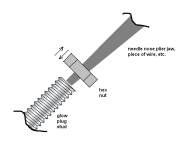
FYI - the little hex nuts that hold the wiring on are M4 x 0.7 (in case you happen to drop one and then can't find it). I did come up with a technique to help avoid that:
View attachment 457767
Essentially something to hold the nut until it catches the threads when installing or to catch the nut when it comes off the end of the stud when removing.
I would call those good numbers and healthy plugs. You have the right meter for the job; the initial current (15A) would blow the fuse in the typical consumer multimeter (10A max). Good tip. Dropping any small part into dirt, grass, or gravel is extremely frustrating (and that ain't speculation).
By the way, if you ever remove glow plugs, be extremely careful not to break them. Go slow; use lots of patience and penetrating oil. If you break a plug you generally have to pull the head and take it to a machine shop to get the broken part out. Also, if you ever remove glow plugs, clean out the carbon out of the hole with a wire brush. If you shoot, bronze gun-cleaning brushes work well.
Good tip, I will try to remember the bore brush idea.:thumbsup: