Those with lightning storms, how do you protect electronics?

   / Those with lightning storms, how do you protect electronics? #41  
Speaking on grounding, could a person increase the amount of ground they are getting if they had a ground wire attached to a metal goat fence and metal t posts? Would a hundred t posts spread out over a large area, but only a foot or two in the ground, all connected with the wire fence, accomplish anything?
The fact t posts are not driven very deep, probably very little. You can test it with a megger.
 
   / Those with lightning storms, how do you protect electronics? #42  
100 T posts 2' feet in the ground is 200' of additional contact with the ground. Over a larger area. Greatly multiplying the ground grid compared to one 8' ground rod, but probably not if you're already bonded to a utility water pipe.
 
   / Those with lightning storms, how do you protect electronics? #43  
Funny story about wells. When we moved into our house (on top of a hill) we lost well pump twice in 5 years from lighting. Lightning hit tree in the woods behind the house (500-1000' away) and the surge current from the trees to the ground travels to the path of least resistance which happened to be the 60' ground rod which happens to be our well casing. Current surge into the well casing arced over the submerged pump insulation to get to the grid (a really good ground), killing the pump motor. After the second time, I ran a #4 wire from the main breaker panel, next to the ground rod connection, and bonded it to the well casing. 23 years later we have never had a pump problem.

Remember the current will always follow the path of least resistance.

Paul
 
   / Those with lightning storms, how do you protect electronics? #44  
Lightning currents DO NOT follow the path of least resistance. Lightning currents follow all paths. There will be much more current flow in the paths with low resistance than in the paths with high resistance. But ALL possible paths will distribute some currents.
 
   / Those with lightning storms, how do you protect electronics? #45  
The only thing predictable about lightning is it will hit something..
 
   / Those with lightning storms, how do you protect electronics? #46  
I always heard as seen by slow motion video first thing is a dart tracker goes from ground up to the cloud, then lightning follows that back down. The people who survived a lightning strike it couldn't have been a direct hit but one of the secondary ones. My thought is lightning rods work because it's a ground potential up in the air, lightning will strike someplace else. If lightning were to directly hit a rod it would blow it and the wire apart.
 
   / Those with lightning storms, how do you protect electronics? #47  
We had a lightning strike last year that came in through the cable line, took out the DVR, went from there through the HDMI cable to our 55" Vizio and zapped the main board. I know it sounds crazy but we like that TV so much we got the board repaired, no longer available, and fixed it. Spent about $250. It's a full-array backlight with anti glare screen and has awesome picture quality. It's about 7 years old. A guy that runs a radio and tv repair shop that been in business since 1938. Unplugging the TV or the DVR from the wall socket would not have done any good. Now we disconnect the the HDMI cable from the TV.
 
   / Those with lightning storms, how do you protect electronics? #48  
The only thing we ever fried was our treadmill circuit board, from static electric.
 
   / Those with lightning storms, how do you protect electronics? #49  
Lightning currents DO NOT follow the path of least resistance. Lightning currents follow all paths. There will be much more current flow in the paths with low resistance than in the paths with high resistance. But ALL possible paths will distribute some currents.

By the way it is not just lightning currents that don't follow the path of least resistance ALL electricity DC and AC always follows ALL paths. Think of it like this How would lightning "know" which path is the path of least resistance. It doesn't "know". Say you took a power supply of 12 volts, and you had 3 resistors across that supply of 3 different values of resistance. Current will of course flow in each resistor according to each resistance. The resistors with the lowest resistance will carry the most current, the resistors with the highest resistance will carry the least amount of current.
 
   / Those with lightning storms, how do you protect electronics? #50  
By the way it is not just lightning currents that don't follow the path of least resistance ALL electricity DC and AC always follows ALL paths. Think of it like this How would lightning "know" which path is the path of least resistance. It doesn't "know". Say you took a power supply of 12 volts, and you had 3 resistors across that supply of 3 different values of resistance. Current will of course flow in each resistor according to each resistance. The resistors with the lowest resistance will carry the most current, the resistors with the highest resistance will carry the least amount of current.

You are correct since ground is an omnipotential path. However my point, to have been simplistic, is that the current densities will be proportional to the resistivity of the substrate. A 60' steel rod (or pipe) has a significant surface area in contact with the ground (dirt in this context) and therefore will have a lower impedance path compared to other paths. Pictures of lightning strikes to the surface sometimes show these paths of highest current density, which implies the lowest resistance.

paul
(ee old guy and former ham operator)
 
   / Those with lightning storms, how do you protect electronics? #51  
You are correct since ground is an omnipotential path. However my point, to have been simplistic, is that the current densities will be proportional to the resistivity of the substrate. A 60' steel rod (or pipe) has a significant surface area in contact with the ground (dirt in this context) and therefore will have a lower impedance path compared to other paths. Pictures of lightning strikes to the surface sometimes show these paths of highest current density, which implies the lowest resistance.

paul
(ee old guy and former ham operator)

Thank you Paul. Don't be a former...Get back on the horse and rejoin. We are doing new things in digital modes, Band conditions are poor as we are in between cycle 24 and cycle 25, but we have digital modes now that will decode signals at -26 dB below the noise floor in a 2.5khz bandwidth. Get back in, as we need folks with technical expertise. 73 de K0UA
 
   / Those with lightning storms, how do you protect electronics? #52  
Back in the 80s I buried a lot of low voltage stuff around here. It was getting blown up on a regular basis. Or more specifically what was at each end. It's when I realized that underground stuff is far more prone to lightning damage then overhead plant. It kind of attests to the ground being like a sponge for lightning charges.

So, lightning hits a tree having nothing to do with my wires underground. But the charge attempts to dissipate in the ground and makes a B-line for my shiny copper which probably has some sort of ground potential at each end, and blows that stuff apart.
 
   / Those with lightning storms, how do you protect electronics? #53  
Thank you Paul. Don't be a former...Get back on the horse and rejoin. We are doing new things in digital modes, Band conditions are poor as we are in between cycle 24 and cycle 25, but we have digital modes now that will decode signals at -26 dB below the noise floor in a 2.5khz bandwidth. Get back in, as we need folks with technical expertise. 73 de K0UA

I let it laps in the early '70 when I went to college. I had no money for equipment (I had been using a friends rig, Drake TR4 with a gallon linear, tri-band beam on a 30' tower) and at school no way to have any stuff outside the dorm/frat, plus not much free time. After school got married, kids, etc and never seemed to find the time to re-up the license. I still occasionally do some SWL. Mmaybe after I retire I will find the time and motivation to get back in. I had an uncle who was a 2 letter old timer (W4TB) who was partly responsible for getting me started. He worked for Bell Labs and was on the team that developed Telstar. He told stories about when he was a late teen, living in a city, he would clip on to the overhead trolley power line on the street, run the wire into the second floor window and use the 600 VDC to power his final. Said they never discovered his connection.

paul
 
   / Those with lightning storms, how do you protect electronics? #54  
I let it laps in the early '70 when I went to college. I had no money for equipment (I had been using a friends rig, Drake TR4 with a gallon linear, tri-band beam on a 30' tower) and at school no way to have any stuff outside the dorm/frat, plus not much free time. After school got married, kids, etc and never seemed to find the time to re-up the license. I still occasionally do some SWL. Mmaybe after I retire I will find the time and motivation to get back in. I had an uncle who was a 2 letter old timer (W4TB) who was partly responsible for getting me started. He worked for Bell Labs and was on the team that developed Telstar. He told stories about when he was a late teen, living in a city, he would clip on to the overhead trolley power line on the street, run the wire into the second floor window and use the 600 VDC to power his final. Said they never discovered his connection.

paul

That is quite an interesting story Paul about the 600 volt "drain" I suspect it was a pretty "stiff" supply too, probably capable of many amps of current. On getting back in to Amateur Radio, it is somewhat different than "the old days", not that you can't operate just like you did back then, but there are so many other things to do involving technology. There is no CW requirement any more for any of the license classes, but there is still a lot of CW activity. Especially during contests and DXpeditions . Something about the simplest form of communication still appeals to a lot of folks. According to ClubLog my activity is about 15 percent CW, about 80 percent Digital modes and about 5 percent SSB phone operation. Let me know if I can do anything to help. 73 de K0UA
 
   / Those with lightning storms, how do you protect electronics? #55  
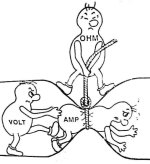
This cartoon explains ohms law :)
Relation of voltage (pressure), current (amount), ohms (resistance) through a wire.

I'm in the process (Thanks for this discussion!) of installing lightning rods on my house. I have a few questions. I'm on top of a hill, old house with two chimneys. I have a 100ft. spool of braided copper on order, so I was going to put copper spike on each chimney (I have antique ones with amethyst ball on them) which I'll use copper straps each chimney, copper braid across to connect both, then down to an 8ft. copper ground rod near the existing power company ground rod which I'll connect together.
Any thoughts or ideas appreciated! ohmvoltmp.jpeg
 
   / Those with lightning storms, how do you protect electronics? #56  
TAccording to ClubLog my activity is about 15 percent CW, about 80 percent Digital modes and about 5 percent SSB phone operation. Let me know if I can do anything to help. 73 de K0UA

I am really surprised. CW was a PIA for me licensing, and I never did much CW. What I find surprising is how small SSB has become. Back in the 70's it was THE big thing.

As I said, when my time becomes open in the future I will look at it again.

paul
 
   / Those with lightning storms, how do you protect electronics? #57  
Hoping for a reply, anyone experienced in installing lightning rods on a house. Old house, so amethyst balls are decorative. How long (high) should rods be?

I'm in the process (Thanks for this discussion!) of installing lightning rods on my house. I have a few questions. I'm on top of a hill, old house with two chimneys. I have a 100ft. spool of braided copper on order, so I was going to put copper spike on each chimney (I have antique ones with amethyst ball on them) which I'll use copper straps each chimney, copper braid across to connect both, then down to an 8ft. copper ground rod near the existing power company ground rod which I'll connect together.

Any thoughts or ideas appreciated!
 
   / Those with lightning storms, how do you protect electronics? #58  
Hoping for a reply, anyone experienced in installing lightning rods on a house. Old house, so amethyst balls are decorative. How long (high) should rods be?

I'm in the process (Thanks for this discussion!) of installing lightning rods on my house. I have a few questions. I'm on top of a hill, old house with two chimneys. I have a 100ft. spool of braided copper on order, so I was going to put copper spike on each chimney (I have antique ones with amethyst ball on them) which I'll use copper straps each chimney, copper braid across to connect both, then down to an 8ft. copper ground rod near the existing power company ground rod which I'll connect together.

Any thoughts or ideas appreciated!

Check out: Lightning Rod Parts Equipment

paul
 
   / Those with lightning storms, how do you protect electronics? #59  
I don't want to say it's not a science. But I don't think it's that critical. We had ones installed back in 72. They grounded the steel structure and roof over the chimneys and put three short (maybe 10") rods along the roof. My Dad gave them some old aluminum overhead type wire to use and just steel scrap for the earth rods.

Despite being in a valley next to a hill, we have seen a lot of lightning. Close by and I am sure on occasion it has hit the house and the protection system. My point is, (I believe) that something will afford you protection and is better than nothing. I do believe that it is important to have robust components and connections that will stand the test of time.

Recently I did some excavation work and buried a large galvanized truck headache rack that was in the scrap. That has become a new ground. I welded a half inch stainless bolt to it and soldered lugs onto the connecting copper cable. In contrast, they had only wrapped the alluminum around some bolts in the untreated cold rolled flat bar used for the ground rods.
 
Last edited:
   / Those with lightning storms, how do you protect electronics? #60  
Thanks so much. I'm thinking I can do it myself and save a lot of money. A 100ft spool of 1/2" braided copper is about $53. Copper ground rods about $23 each, I'll use two cut shorter for rods. Maybe I'll cut out two copper devils with pitchforks in the air like they used 100 years ago! ☺☺☺☺☺
 

Tractor & Equipment Auctions

2023 GMC Sierra 1500 4x4 Crew Cab Pickup Truck (A56858)
2023 GMC Sierra...
2019 Ford F150 XL (A57148)
2019 Ford F150 XL...
2025 BOBCAT ZT7000 MOWER (A59905)
2025 BOBCAT ZT7000...
Club Car Carryall 500 Utility Cart (A59228)
Club Car Carryall...
2018 John Deere 1653 (A56438)
2018 John Deere...
2024 CATERPILLAR 305 CR EXCAVATOR (A60429)
2024 CATERPILLAR...
 
Top