GENERATOR QUESTIONS FOR YOU EXPERT ELECTRICIANS

   / GENERATOR QUESTIONS FOR YOU EXPERT ELECTRICIANS #61  
Still trying to understand this. Much information on the Internet and Youtube but mostly people just Parroting information they heard or read about, without any real technical understanding. Just take this wire off here and attach it here to make it work, kind of thing.

So forget about the derating for a moment. How can you take two legs of a three phase generator that are 120 degrees out of phase and use them to replace a single (split) phase 120/240 winding coming out of your utility transformer? It may work, but can't be the same????

As far as the 208 vs 240 goes. I just remembered a Fiasco from last summer. I was asked to provide the controls for a hydraulic pump on a tilting table for processing bagged fire wood. The pump was 240V as ordered by a friend for the friend I was working for, and as requested by the customer, or was it an assumption?

Anyway it kept tripping out when delivered to the customer. A lot of head scratching and wasted man hours, only to discover that the customer has 208 feeding his cord ended (240V) receptical. They ended up putting in a transformer.
 
   / GENERATOR QUESTIONS FOR YOU EXPERT ELECTRICIANS #62  
208 is used all the time on 220/240 systems and is of no issue. A lot of apartments I worked on were supplied 3/0 to panels knowing everyone would have 208 volts. In the 100痴 of times I致e done this in over 35 years as an electrician I have had no issues. On average the only appliances using 208/240 in a residential panel are a/c, water heater, general heating and dryers. These are not effected by 208.

even if you rewire a 6 or 12 wire 3/0 to operate as single phase, you do get a loss in overall amperage available. Then again, I may be wrong Generator Phase Conversions: Electrical Conversion, Single Phase, Three Phase Power

It does get confusing.
An electric stove is pretty anemic on 208, motors run hotter and cannot support overload as well, etc. Essentially a continuous brownout on 240 equipment.
 
   / GENERATOR QUESTIONS FOR YOU EXPERT ELECTRICIANS #63  
An electric stove is pretty anemic on 208, motors run hotter and cannot support overload as well, etc. Essentially a continuous brownout on 240 equipment.
Beg to differ. Ive seen apartments full of electric stoves on 308 over the years. One company I do work for is using an old electrical stove on 208 as a powder coat oven for small parts. Very hot

As for motors, I’m talking about residential applications here. For industrial motors that’s a different ballywack, Not too many Residential units have 240 motors.
 
   / GENERATOR QUESTIONS FOR YOU EXPERT ELECTRICIANS #64  
Our Baldor generators at work can run single phase (120/240), 3 phase power and light (120/240/208 high leg), 3 phase power (120/208), and 3 phase power (277/480). Its changed via a switch and hooking up the leads at the transformer properly for the voltage required.

How can you take two legs of a three phase generator that are 120 degrees out of phase and use them to replace a single (split) phase 120/240 winding coming out of your utility transformer? It may work, but can't be the same????

Most of the time you can't. Most configurations will get you 120/208V.
As you probably know:
(3)-120V windings connected in a STAR (WYE (Y)) configuration give 3 phase 208V, and any 1 phase to neutral (center of the 'Y') is 120V.

HickoryFarm (above) indicates a generator that can give "3 phase power and light (120/240/208 high leg)".
This suggests a (3) 240V windings connected in a delta (triangle) configuration, where one 240V winding has a center tap (at the "120V", middle location). that gets grounded (referenced to 0 Volts).
Let's call the corners of the delta configuration (connection points of the 3 windings) phase "A", "B" and "C" and bring them to a 3 phase panel. We also bring the center tap of one winding, ground it and call that neutral. Let's say winding with center tap is between phase "A" & "B" terminals.

Voltages would be:
AB=AC=BC= 240V : 3 phase, 120 degrees out of phase with each other.
Voltage from 2 phase to neutral would be: AN = 120V; BN= 120V, 180 degrees out of phase with each other (because they're derived from one winding with a center tap, like the pole mounted 120/240V transformer).
The voltage from (Wild Leg/high leg) C to neutral: CN = 208V (1 phase).

Remember CN= 208V this way: 3 phases 120 degrees apart, connected in a delta (triangle) configuration. Draw a equilateral triangle where each side is 240V "long". 1/2 way (center tap) between corners "A" & "B" (at the 120V mark) call this "N". Draw a line from opposite corner "C" to "N". We now have a right angle triangle that we know 2 sides of (AN = 120V, AC = 240V, thus (Pythagoras of Samos (c. 570 c. 495 BC) says: ) CN MUST be 208V.
 
   / GENERATOR QUESTIONS FOR YOU EXPERT ELECTRICIANS #65  
Thanks. I have to draw that out. But how much of the total rated power can you draw, single phase?
 
   / GENERATOR QUESTIONS FOR YOU EXPERT ELECTRICIANS #66  
Thanks. I have to draw that out. But how much of the total rated power can you draw, single phase?

Same if you draw out a star/wye ("Y") configuration, where each branch (leg) of the "Y" represents a winding and is 120V "long" and 120 degrees apart. It's easy to see (and reasonably easy to calculate) geometrically that the distance from one "Y" end "leg" to another would be 207.8V (208V).

These configurations DO make sense geometrically in accordance to the shape of their names. Greek letter D (Delta) which is shaped like a triangle and Wye (Y).

Have to get back to you on total rated power
 
   / GENERATOR QUESTIONS FOR YOU EXPERT ELECTRICIANS #67  
You are one of the few that certainly understands what really makes this stuff work.
 
   / GENERATOR QUESTIONS FOR YOU EXPERT ELECTRICIANS #68  
Same if you draw out a star/wye ("Y") configuration, where each branch (leg) of the "Y" represents a winding and is 120V "long" and 120 degrees apart. It's easy to see (and reasonably easy to calculate) geometrically that the distance from one "Y" end "leg" to another would be 207.8V (208V).

These configurations DO make sense geometrically in accordance to the shape of their names. Greek letter D (Delta) which is shaped like a triangle and Wye (Y).

Have to get back to you on total rated power

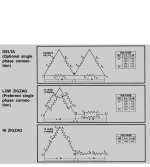
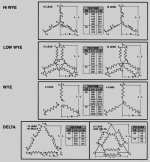
Here are some diagrams of the different configurations, the T1 to T12 numbers are the leads coming off of the generator head, you can see the different options depending on how you wire them:
Single phase wiring:
attachment.php


3 phase wiring:
attachment.php


Here is another thread by sewerzuk detailing how he re-wired his 3 phase MEP-004 genset to single phase: MEP-004a re-wire for single phase operation, with video - SmokStak

Aaron Z
 

Attachments

  • single phase connection diagram.JPG
    single phase connection diagram.JPG
    61.9 KB · Views: 207
  • 3 phase connection diagram.jpg
    3 phase connection diagram.jpg
    80.9 KB · Views: 196
   / GENERATOR QUESTIONS FOR YOU EXPERT ELECTRICIANS #69  
Yeah this post went haywire....to the original posters question-no. You cannot hook them together and your best bet is to sell them and get the correct size from the money you make from them plus a little extra.
3 phase is nice, efficient but expensive. Most equipment will run on 208 to 240 no problem. A proper electrician will always check the voltage to make sure the mtor they are running will work....in the example above the electrician should have paid for his mistake.
 
   / GENERATOR QUESTIONS FOR YOU EXPERT ELECTRICIANS #70  
Very, very interesting. 6600 Volts on Y ??:eek: Are those for different versions of alternators?
Figuring the effects of the phase differences into the diagrams is not something I am capable of. I'm sure Nicola Tesla could look at them and say, "sure, that will work" lol
 
   / GENERATOR QUESTIONS FOR YOU EXPERT ELECTRICIANS #71  
Very, very interesting. 6600 Volts on Y ??:eek: Are those for different versions of alternators?

Figuring the effects of the phase differences into the diagrams is not something I am capable of. I'm sure Nicola Tesla could look at them and say, "sure, that will work" lol

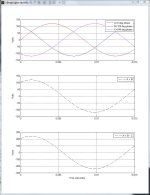
OK, here's the WHY. I made up a computer 'simulation' of signal generators for 120V, 60 Hz. operation. There are 3 signals: 0 phase lead, 120 degrees of phase lead, and 240 degrees of phase lead. Lead or lag doesn't really matter in the Big picture.

I show on the plot the 3 separate signals (A, B, C) plus combinations of them produced by simply adding or subtracting them. Note that adding 2 together keeps the frequency, produces a single phase and still rolls at 120 Hz.

What is interesting to me is when you add and subtract the 3 signals, it looks like you can still get 60 Hz but can achieve 240v peak to peak. Sure, there's no phantom extra power or current being produced, but you get the picture for the device you are trying to run.phase_additions.JPG

Here's the [MatLab program. You can surely run this concept in Excel, etc.

w=60; % That's w as in omega [ frequency ]
ph=120; % Phase lead increment
t=0:.0005:.015; % generaqte a time base
a=120*sin(2*pi*w*t); % A signal
b=120*sin(2*pi*w*t+1*ph*pi/180); % B signal
c=120*sin(2*pi*w*t+2*ph*pi/180); % C signal

figure('Numbertitle','Off','Menubar','None','Name','3 Phase Signal Additions')
subplot(3,1,1)
plot(t,a,t,b,t,c) % plot all 3 separate signals
ylabel('Volts')
legend('A=0 deg phase','B=120 deg phase','C=240 deg phase')
grid on
subplot(3,1,2)
plot(t,a+b,'k--') % Plot B added to C
ylabel('Volts')
legend('A + B')
grid on
subplot(3,1,3)
plot(t,a+b-c,'k--')
ylabel('Volts')
legend('A + B - C') % Plot A + B - C
grid on
ylabel('Volts')

asp=spline(t,a); % these next computations verify that
[amax,tamax]=fnmax(asp)`% the net frequency is still 60 Hz.
[amin,tamin]=fnmin(asp) % Yes all the frequencies are still 60 Hz.
aHz=1/(2*(tamin-tamax)) % 60 Hz. reported

absp=spline(t,a+b);
[abmax,tabmax]=fnmax(absp)
[abmin,tabmin]=fnmin(absp)
abHz=1/(2*(tabmin-tabmax)) % 60 Hz. reported


abcsp=spline(t,a+b-c);
[abcmax,tabcmax]=fnmax(abcsp)
[abcmin,tabcmin]=fnmin(abcsp)
abcHz=1/(2*(tabcmin-tabcmax)) % 60 Hz. reported

xlabel('Time (seconds)')
 
   / GENERATOR QUESTIONS FOR YOU EXPERT ELECTRICIANS #72  
I have remembeed that and the next time someone asks, I will scribble that on a cocktail napkin.

I am impressed when people can do stuff, I can't. A little frustrated that I don't think I have what it takes to ever be able to do that. Maybe, understand it in basic terms, but not to do the math.
 
   / GENERATOR QUESTIONS FOR YOU EXPERT ELECTRICIANS #73  
Some mil gens will let draw full amperage from 1 leg, 2 legs, or 3 legs, by have a switch and alternator that is wound to do that, sometimes referred to as a 12 wire. However the 804 and 814 do not have that function. Motors, can be wound to run on 208v/120 degree two wire, and 240v/180 degree two wire. Most modern AC are Ok, submerged well pumps often want 240v/180 degree. Stoves, hot water they don't care. However break load its current has to be figure via wattage/volts= amps. Also HVAC breakers should be used, they will carry larger loads longer. Not sure your point of the graphs
 
   / GENERATOR QUESTIONS FOR YOU EXPERT ELECTRICIANS #74  
Some mil gens will let draw full amperage from 1 leg, 2 legs, or 3 legs, by have a switch and alternator that is wound to do that, sometimes referred to as a 12 wire. However the 804 and 814 do not have that function. Motors, can be wound to run on 208v/120 degree two wire, and 240v/180 degree two wire. Most modern AC are Ok, submerged well pumps often want 240v/180 degree. Stoves, hot water they don't care. However break load its current has to be figure via wattage/volts= amps. Also HVAC breakers should be used, they will carry larger loads longer. Not sure your point of the graphs
The MEP 002, 003, 802 and 803 will let you switch between single and 3 phase with just a switch.
The MEP004 does not do that as wired from the factory, BUT the conversion done by sewerzuk DOES allow you to switch from 3 phase to single phase and pull a full 15kw just like you could with 3 phase.
From what I read, the 804 has 4 of the wires connected inside the head and only 10 come out, so it CANNOT be (easily) reconnected for single phase like the 004 could.

Aaron 5
 
   / GENERATOR QUESTIONS FOR YOU EXPERT ELECTRICIANS #75  
An electric stove is pretty anemic on 208, motors run hotter and cannot support overload as well, etc. Essentially a continuous brownout on 240 equipment.

Regarding 208V & 240V supply mismatched with 208V & 240V equipment:

In general, induction motors are somewhat self-regulating. Their impedance (resistance) and power requirements are not fixed. They will self-alter their power input as the mechanical load output calls for it. As mechanical load changes, they alter their power input by changing the amount of current input and their power factor. (They are also somewhat self-regulating when it comes to operating close to their rated rpm without running away (over-speeding) and increasing torque when rpms dip, but that's another related story)
Running a 240V motor on 208V is a 13% voltage drop, which is off the chart, but you can see the effect on motor amps, starting torque etc...:
voltage-variation-effects.jpg

For (non-motor) purely resistive loads (heaters, stoves, hairdryers, block heaters, etc...) the power (heat) output will be effected by something like "the difference of the square of the voltage" or the square of the voltage differences"...blah blah blah, I can never exactly remember so I have to figure it out by working backwards from the Wattage to figure out the device's resistance (in Ohms), and then forward with the new voltage to Watts (power).

Example: 2400W heater (at 240V) => 10Amps; Heater must be 24 Ohms
Those 24 Ohms at 208V : Power is (V^2/R) 1802.6 Watts (or 208V/24 Ohms = 8.66Amps, 208V x 8.66amps = 1802.6 Watts)

So, running a 240V rated heater at 208V gives (1802.6W/2400W) 75% power output.

ahha....

75% is: 208^2 / 240^2 = (43, 264/57,600) = 75% ...so the power reduction factor is one "square of the voltage" divided by the other "square of the voltage".
 
   / GENERATOR QUESTIONS FOR YOU EXPERT ELECTRICIANS #76  
So the point is stay away from 3 phase gensets, that don't show you how to connect windings that give you 120/240V single phase. If buying a new diesel genset get a single phase dedicated alternator with digital feedback for the voltage regulator. Go to the mecc alte site they got lots info. You can get nice 10 -30 kw gensets with Kubota or Perkins with mecc alte gens, in aluminum level 2 cabinets. Use Deep Sea controller and dumb Generac ATS. It will do every thing you want including send txt messages
 
   / GENERATOR QUESTIONS FOR YOU EXPERT ELECTRICIANS #77  
Why Digital Feedback? Sounds like just more fancy S#%t to go wrong. Why convert the analogue voltage of the output to digital as feedback into the VR?

As much as I like the military sets I would prefer something a little easier to work on. Where the military sets may shine, is for EMP protection. Who knows when a guy may be glad he had that.

As far as Resistive Loads Don't care about Voltage. That's true, but who wants a range with poor output on the burners or oven? In a commercial environment fed with 208 from the Utility, they would increae the wattage of resistive loads to compensate. It's not the same as running 240 volt heaters, meant to run on 240, on 208.
 
   / GENERATOR QUESTIONS FOR YOU EXPERT ELECTRICIANS #78  
Beg to differ. Ive seen apartments full of electric stoves on 308 over the years. One company I do work for is using an old electrical stove on 208 as a powder coat oven for small parts. Very hot

As for motors, I知 talking about residential applications here. For industrial motors that痴 a different ballywack, Not too many Residential units have 240 motors.
I have experience with 208 on a 240 stove. The burners can barely make it to red. Oven is the same story. Sure it will get hot. The elements run longer to make up for low heat output. With low heat load thats fine. Put a load of food in there (evaporating water) and it struggles in response. - - Usable if you have to. Sorta like a broken leg.
 
   / GENERATOR QUESTIONS FOR YOU EXPERT ELECTRICIANS #79  
Regarding 208V & 240V supply mismatched with 208V & 240V equipment:

In general, induction motors are somewhat self-regulating. Their impedance (resistance) and power requirements are not fixed. They will self-alter their power input as the mechanical load output calls for it. As mechanical load changes, they alter their power input by changing the amount of current input and their power factor. (They are also somewhat self-regulating when it comes to operating close to their rated rpm without running away (over-speeding) and increasing torque when rpms dip, but that's another related story)
Running a 240V motor on 208V is a 13% voltage drop, which is off the chart, but you can see the effect on motor amps, starting torque etc...:
View attachment 628719

For (non-motor) purely resistive loads (heaters, stoves, hairdryers, block heaters, etc...) the power (heat) output will be effected by something like "the difference of the square of the voltage" or the square of the voltage differences"...blah blah blah, I can never exactly remember so I have to figure it out by working backwards from the Wattage to figure out the device's resistance (in Ohms), and then forward with the new voltage to Watts (power).

Example: 2400W heater (at 240V) => 10Amps; Heater must be 24 Ohms
Those 24 Ohms at 208V : Power is (V^2/R) 1802.6 Watts (or 208V/24 Ohms = 8.66Amps, 208V x 8.66amps = 1802.6 Watts)

So, running a 240V rated heater at 208V gives (1802.6W/2400W) 75% power output.

ahha....

75% is: 208^2 / 240^2 = (43, 264/57,600) = 75% ...so the power reduction factor is one "square of the voltage" divided by the other "square of the voltage".

Yes.

Thank you.​

BTW, as I think you alluded; AC induction motors idle near synchronous - - 1800 or 3600 for 60HZ. - Slip arises, reducing speed a little, when torque is called for. Output power and heat are the result. Undervoltage allows/causes more slip, more current and more heat at a given torque.
 

Tractor & Equipment Auctions

*Selling at Royal Auction Tampa, FL Location* (A59228)
*Selling at Royal...
15200 (A56857)
15200 (A56857)
2010 MULTIQUIP 25KW GENERATOR (A55745)
2010 MULTIQUIP...
KUBOTA X1140 CREW RTV (A52706)
KUBOTA X1140 CREW...
2017 KOMATSU HM400-5 OFF ROAD WATER TRUCK (A60429)
2017 KOMATSU...
2022 Bobcat T66 (A53317)
2022 Bobcat T66...
 
Top