Solutions For Spray Priming Plywood

   / Solutions For Spray Priming Plywood #1  

Panik

Platinum Member
Joined
Mar 29, 2013
Messages
508
Location
NW Ga - somewhere near that time zone thingy
Tractor
Kubota bx2360
Not quite rural living but I was hoping to get some suggestions/solutions about an issue I'm having at work.

Backstory is that I work at a municipal environmental education center that focuses on an maintains a collection of animal species native to northwest GA. It's a pretty awesome gig because I get to wear a ton of different hats on any day of the week (zoo keeper, janitor, manager, educator, career counselor, etc). The only downside is that working for the government, especially a smaller municipality, means that we don't exactly have a lot of funding. Most of what we build and create is done using as little cash and as much "creative acquisition" as possible.

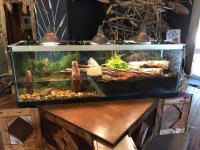
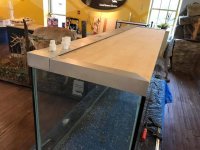
Whenever we get a new snake specimen I get to construct locking, slide top lid enclosures such as the one below that houses our resident cottonmouths. Everything in the build process is pretty dialed in and quick at this point except for priming the plywood lids for finish painting. Even with good wood surface prep brushing on and subsequently sanding down primer to achieve a smooth base coat takes more time than the entire rest of the build. (Finish coat is rattlecan satin black)

To that end I have been considering investing in some type of cheap, small capacity spray system to improve the priming part of the process. The concerns are:

- This literally would be a single purpose tool that would get used about 4 times a year for coating about 4-6sq foot at a time
- We have at our disposal a 6 gallon pancake compressor (exact specs unknown)
- Did I mention affordable?
- Other than cleaning the paint sprayer my old boss used for painting houses 20ish years ago when I was an apprentice, I have absolutely no frame of reference for sprayer technology.

Any thoughts or ideas would be appreciated. Understand I have no problem researching things on my own.... but given paint sprayers have been a bit out my wheelhouse I'm lacking on where to start.
 

Attachments

  • Cottonmouth1.jpg
    Cottonmouth1.jpg
    522.1 KB · Views: 130
  • Cottonmouth2.jpg
    Cottonmouth2.jpg
    411.2 KB · Views: 121
   / Solutions For Spray Priming Plywood #2  
If you're going to rattle can the finish coat, why not rattle can the primer? Seems the time spent in sanding is the slow-down...
Am I missing something?
 
   / Solutions For Spray Priming Plywood
  • Thread Starter
#3  
If you're going to rattle can the finish coat, why not rattle can the primer? Seems the time spent in sanding is the slow-down...
Am I missing something?

Back of the napkin cost - I can prime 3-4 lids with one quart of primer vs having to spend double the amount or more for enough rattlecans to prime a lid to a smooth paint-able surface. (feel free to pick at my "math" here)

(Part of the trade-off here is that I'm not able to buy true high grade plywood and even with good surface prep I still have to contend with priming over imperfections in order to have a decent finished product)

The other end of the equation is that if I can find an affordable and workable solution I am able to become proficient in using for spray priming, the next step would be to play around with moving away from rattlecans for the finish coat.
 
   / Solutions For Spray Priming Plywood #4  
We purchased a sprayer from Harbor Freight, for my wife to use, on some of her furniture repurposing projects... I wasn't expecting much... but I have to say that little sprayer puts down a good finish with a little practice... at work we have a $1K + CAP HVLP system for spraying doors & trim / cabinets... so I have something to compare it to... decent sprayer for under $100...


Couple other ideas...

Being this a completely painted piece you could grab a gallon tub of Bondo & mix up a little to give your Ply a perfectly smooth surface, a quick coat & sanding & you would need one coat of primer. Bondo goes a long way, dries fast, can be mixed as needed, & sands perfectly smooth. Then you could even get away without a sprayer & use foam rollers designed for door / cabinet smooth finish & just roll both the primer & finish coats.

Would save cleaning a sprayer for painting such a small piece...
 
   / Solutions For Spray Priming Plywood
  • Thread Starter
#5  
Dictcg - Thanks for the suggestion on the sprayer, especially since you have the experience to make comparisons! $85.00 can definitely be covered by our petty cash drawer.

I like the idea of using Bondo. Regardless of whether we get a cheap sprayer I am going to experiment with bondo. One of the issues I've encountered is finding a suitable material to seal/fill the cut edges of the plywood we use. Not shown in the pictures I posted are the plywood trim pieces used to secure/hide the margins of the vinyl coated hardware cloth used to cover ventilation openings in the slide lid. End "grain" plywood is a pain to seal to a smooth surface and it sounds like this would be a perfect place to start playing with bondo.... with an eye to developing the skill to skim coat the entirety of the plywood lid.
 
   / Solutions For Spray Priming Plywood #6  
Wouldn't using rollers be just as effective in applying whatever you want to put on the plywood.

Make whatever you are applying as thick/thin as needed and roll it on.

I've always found - rattle cans may be quick but they can tend to be wasteful.
 
   / Solutions For Spray Priming Plywood #7  
I like the idea of using Bondo. Regardless of whether we get a cheap sprayer I am going to experiment with bondo. One of the issues I've encountered is finding a suitable material to seal/fill the cut edges of the plywood we use. Not shown in the pictures I posted are the plywood trim pieces used to secure/hide the margins of the vinyl coated hardware cloth used to cover ventilation openings in the slide lid. End "grain" plywood is a pain to seal to a smooth surface and it sounds like this would be a perfect place to start playing with bondo.... with an eye to developing the skill to skim coat the entirety of the plywood lid.

it will definitely work for your end grain issues... after a couple practice runs you'll figure out how much to mix at a time based on your needs & its working time.

We use it on damaged furniture during a repurposing project that will be painted & I use it when making epoxy countertops for the edges & any repairs prior to doing the epoxy pours... It is very economical after figuring out how much to mix-up at a time... dries fast, is very easy to use & sand to a super smooth finish... & can even be used on contours... definitely try it...
 
   / Solutions For Spray Priming Plywood
  • Thread Starter
#8  
Wouldn't using rollers be just as effective in applying whatever you want to put on the plywood.

Make whatever you are applying as thick/thin as needed and roll it on.

I've always found - rattle cans may be quick but they can tend to be wasteful.

I generally agree with you about rattlecans which is why I’ve only ever use them for the finish coat. On the other hand everything is a trade off.....

With rattlecans/spraying I can hang the piece and spray the top coat of paint on both sides in one go and, more importantly, pretty easily get a smooth finish

The above is actually why I was asking for advice on a sprayer for priming. Trying to roll/brush both sides of a hanging piece is a pain. Priming one side of the lid and waiting for it to try dry before priming the other is a time suck for me. I’d rather trade a little wasted paint on over spray from a spray gun, like the one recommended, for a bit more time efficiency.

(And yes, I do realize all of this is relative to individual technique 👍🏻)
 
   / Solutions For Spray Priming Plywood #9  
I Remodel homes for a living and do a fair amount of painting. It can be anything from latex on sheetrock, to high gloss enamel on cabinets.

For what you are doing, I would buy a can of Zinnsser 123 Primer for about $20 a gallon. I would get a 4 inch roller and use a foam roller for a smooth finish. It dries pretty quickly. Since its wood, I would do a second coat of primer. Put the roller in a plastic bag and wrap it tight after you use it the first time, and you can use it over again for the second coat. I do this for painting jobs that last all week!!!

Then I would hit it was a palm sander, or just a block of wood and sand by hand with some 100 grit paper. Sanding will take two minutes. You just smooth it out and it will be like glass.

I would not use a sprayer because of all the time it takes to clean the sprayer. It's also more money for Paint Thinner to spray it, and Lacquer Thinner to clean the sprayer.
 
   / Solutions For Spray Priming Plywood #10  
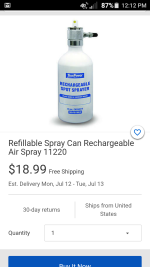
Would something like this work?
 

Attachments

  • Screenshot_2021-07-04-12-12-43.png
    Screenshot_2021-07-04-12-12-43.png
    174.6 KB · Views: 98
   / Solutions For Spray Priming Plywood
  • Thread Starter
#11  
For what you are doing, I would buy a can of Zinnsser 123 Primer for about $20 a gallon. I would get a 4 inch roller and use a foam roller for a smooth finish. It dries pretty quickly. Since its wood, I would do a second coat of primer. Put the roller in a plastic bag and wrap it tight after you use it the first time, and you can use it over again for the second coat. I do this for painting jobs that last all week!!!

Then I would hit it was a palm sander, or just a block of wood and sand by hand with some 100 grit paper. Sanding will take two minutes. You just smooth it out and it will be like glass.

I would not use a sprayer because of all the time it takes to clean the sprayer. It's also more money for Paint Thinner to spray it, and Lacquer Thinner to clean the sprayer.

Just swinging back around to this. Eddie what you described is pretty much my exact process, except I've been using a high quality, angled bristle brush and an orbital with 220grit (better cutting control).

Slowly spooling up to start another enclosure for when I get caught up on everything else at work. Picked up a 4" foam roller and I am also going to try the bondo trick someone else suggested for sealing/smoothing the edges of the plywood.

That being said, I do want to pick up one of the Harbor Freight $15.00 purple, gravity feed guns and some Floetrol to play with sometime down the road. Apparently folks have good success boring out the nozzle to 2.0mm for running primer. I really really am appreciative of the concept of being able to prime both sides in one go and I enjoy experimenting. Once college starts back up in the fall, I'll have no shortage of interns to help with the cleanup.
 
   / Solutions For Spray Priming Plywood #12  
I've been doing a lot of finish wood sanding, so I've gotten used to the palm sander over the orbital sander. But you are right, using the orbital will be faster and a better choice for something that you are going to paint.

I've become kind of a sand paper snob when buying 5 inch disks for my orbital. My absolute favorite are Shop Smith. They just remain sharp and continue to remove material a lot longer then any other brand. It's not even close how much longer they last!!! After that, I'll buy Diablo disks at Home Depot. I tried the other brands like Gator and Craftsman, and they are just horrible. It's amazing to me how one company can put out a product that performs so poorly, and still remain in business.
 
   / Solutions For Spray Priming Plywood
  • Thread Starter
#13  
I've been doing a lot of finish wood sanding, so I've gotten used to the palm sander over the orbital sander. But you are right, using the orbital will be faster and a better choice for something that you are going to paint.

I've become kind of a sand paper snob when buying 5 inch disks for my orbital. My absolute favorite are Shop Smith. They just remain sharp and continue to remove material a lot longer then any other brand. It's not even close how much longer they last!!! After that, I'll buy Diablo disks at Home Depot. I tried the other brands like Gator and Craftsman, and they are just horrible. It's amazing to me how one company can put out a product that performs so poorly, and still remain in business.

Totally agreed regarding sand paper... For work I buy packs of diablo and call it good. I don't use enough or do enough finish work for it to be an issue.

OTOH, I also play around with making knives and definitely have preferences depending on what I'm using the sand paper for. For cutting bevels I like most of Red Label Abrasives' ceramic belts. They are a good balance of quality and cost for hobby user. For intermediate hand sanding I use the 3M bulk packs of 150-220 sheet paper you can get in Home Depot - they work well enough and I can get "bulk" amounts on the way home so I don't have to worry about being stingy and making a sheets last until I can order more.

I also use a benchtop disc sander pretty frequently for doing full length tapers on knife blanks. Oddly enough, the black ceramic 40 and 60 grit discs I can get a Lowes cut and last longer than anything else I've found so far. I'm not a fan of their finer grit offerings though.
 
   / Solutions For Spray Priming Plywood #14  
l
Not quite rural living but I was hoping to get some suggestions/solutions about an issue I'm having at work.

Backstory is that I work at a municipal environmental education center that focuses on an maintains a collection of animal species native to northwest GA. It's a pretty awesome gig because I get to wear a ton of different hats on any day of the week (zoo keeper, janitor, manager, educator, career counselor, etc). The only downside is that working for the government, especially a smaller municipality, means that we don't exactly have a lot of funding. Most of what we build and create is done using as little cash and as much "creative acquisition" as possible.

Whenever we get a new snake specimen I get to construct locking, slide top lid enclosures such as the one below that houses our resident cottonmouths. Everything in the build process is pretty dialed in and quick at this point except for priming the plywood lids for finish painting. Even with good wood surface prep brushing on and subsequently sanding down primer to achieve a smooth base coat takes more time than the entire rest of the build. (Finish coat is rattlecan satin black)

To that end I have been considering investing in some type of cheap, small capacity spray system to improve the priming part of the process. The concerns are:

- This literally would be a single purpose tool that would get used about 4 times a year for coating about 4-6sq foot at a time
- We have at our disposal a 6 gallon pancake compressor (exact specs unknown)
- Did I mention affordable?
- Other than cleaning the paint sprayer my old boss used for painting houses 20ish years ago when I was an apprentice, I have absolutely no frame of reference for sprayer technology.

Any thoughts or ideas would be appreciated. Understand I have no problem researching things on my own.... but given paint sprayers have been a bit out my wheelhouse I'm lacking on where to start.
Use a roller for your plywood painting job.
Quick application, with minimal cleanup.
 
   / Solutions For Spray Priming Plywood #15  
Use a roller to apply the paint, glue screen door molding on the edges to hide the end grain. Fill and sand with Elmers wood filler.
 
   / Solutions For Spray Priming Plywood #16  
Collectivly most info so far is good but there's caveats you should be aware of. Your pancake compressor will not support a HVLP gun like that purple Harbot Freight mentioned. I don't think you can succesfully "drill out" orfice of gun. Northern Tool lists orfice size on theirs so I suggest theirs if you get a compressor capiable of supporting a HVLP. Bondo is secound to non for quility in professional hands but take's pratice to apply before it sets up and to avoid applying more than needed which is very time consuming to cut down. I suggest a water base like Elmers which is more forgiveing eventhough less durable. Filler fits into 3 catagories, heavy(Bondo and Elmers) for large voids and must be followed by mediumun(paste about the consistancy of pancake batter) Oak grain filler,fine which usually come's in the form of spray primer-filler. If the above all-in-one sprayer can handle primer-filler I suggest it to follow a medium filler and for final finish. All in all roller and brush is a good choice and here's how you can use either on a hanging panel. Cut a recyangular 1/4" plywood about 10-12"X 3-4",drive 4 small nails through corners and glue/screw or nail a handle on side oppisite nail points. One hand holds this contraption on wet, previously painted side to hold it still while secound side is being rolled.
 

Tractor & Equipment Auctions

(2) UNUSED 320/85R24 TRACTOR TIRES / WHEELS (A57192)
(2) UNUSED...
Toro Zero Turn Lawn Mower (A56859)
Toro Zero Turn...
2016 ISUZU NPRXD 14' BOX TRUCK (A60430)
2016 ISUZU NPRXD...
UNUSED KJ 11' X 19' ALL - STEEL CARPORT (A52706)
UNUSED KJ 11' X...
Kubota SVL 75-2 (A53317)
Kubota SVL 75-2...
2020 CATERPILLAR CB13 SMOOTH DBL DRUM ROLLER (A60429)
2020 CATERPILLAR...
 
Top