Time for a new portable generator

   / Time for a new portable generator #41  
I have two Honda inverter generators, I love them for clean power, but mostly because they run a long time on a gallon of gas and they are quiet!!

IF I want to run my whole house, I MUCH prefer my pto generator, as my tractor is always ready to go and it works perfectly!

SR
 
   / Time for a new portable generator #42  
Ok so new question.... is the need for a inverter type hype as some have posited in this thread? I want to run the router for internet and the tv. Since we live in an area prone to tornados keeping up on those issues is important. I do have a place I can keep the generator out of the weather and still running and hooked up to the house.
SPECS, it's about AC specs, equipment is designed to run according to power grid specs. Power Companies can not buy, sell, transfer power between companies without being synchronized. This is why wind turbines and solar farms go down if purchasing utility has a power or substation failure.

60Hz is the US standard, at 58Hz A/C motors run a little slower, at 62Hz A/C motors run a little faster - power can't be sold if out of sync.

Sine wave - the voltage switches between -170 volts and +170 volts 60 times per second. Regular generators and true sine wave inverters will generate this waveform.
Simple_sine_wave.svg.png
RMS - root mean square is the average of the voltage swing. Usually 120 volts, inside of a power plant I have measured 140-145 volts at their outlets.


Typical inverters generate a stair stepped wave form. The more steps, the better the inversion waveform.

320px-Sqarish_wave,_5_level.png


My pellet stove is plugged into a UPS for computers. On power failure it beeps and provides about 10 min. of runtime. The motors will run on the stepped wave form but makes more noise, motor speeds up & slows down because of the stepped voltage. Kind of like driving a car with a vibrator on the bottom of your shoe.

Any generator producing between 110-130 volts should be fine. Dedicated generators with own motor will do best job of maintaining 60Hz. My main concern is waveform. AC power is a sine wave, a true sine wave or a highly stepped wave form waveform is the best.
 
   / Time for a new portable generator #43  
It's raining here so I did some research and found that inverter generators typically run the motor based on need. Therefore, quieter and more fuel-efficient. In turn, they invert the power to AC as Win7 describes above giving you 'clean' sine wave electricity. This conversion does incur some loss of power so that is why they provide fewer watts and cost more.

I don't think there is a choice that fits all.
I have a digital, plug-in hertz/voltage meter so I am going to stick with that and my cheap genny.

Thanks i7win7, that was helpful.
 
   / Time for a new portable generator #44  
I too would like some information on the need for an inverter. My simplistic understanding is that you want 60 hertz at all times or it could damage sensitive equipment.
So far, my 2 generators seem to be doing just that. There may be more I don't understand or maybe my sample size it way too small.

I just bought a 12500-watt dual fuel for $999 to run the house.
We just went through a gas shortage that affected the entire southwest. It lasted a couple of weeks without a natural disaster or a terrorist attack. For that reason, dual fuel was my #1 priority.
If I really do need an inverter genny, then I will go buy a small one and isolate the tv and laptops to one room.
I've got two gas powered generators mainly because of hurricane season here on the gulf coast. I've never considered dual fuel because during the only major hurricane I've had to suffer through (Katrina),
propane was harder to find than gasoline. I wouldn't mind one that ran off of natural gas but I've only got one accessible gas line that used to feed a gas grill and I can't find anybody that knows if it will be suitable for a large generator. I don't want to buy one only to find out it won't run on the little 3/8" line.
 
   / Time for a new portable generator #45  
Inverter generators have a lower total harmonic distortion (THD) compared with some non-inverter generators. Whether that is important for your equipment is a "it depends" issue. As @grsthegreat points out there are lots of generators out there that produce quality power and something close to 60Hz. Much of the quality has to do with the design of the generator head and how the voltage regulation is done. There are some cheap ones that put out electricity with lots of extra electronic "noise", I.e. electricity at frequencies other than 60Hz. (Lots of examples on YouTube, if you are curious.) If you run that "noisy" power into a motor, it turns up as some additional heat. If you run it into electronics, well, it depends on the design of the internal power supply. The power supply may filter the noise out and it may not, depending on the design. It may be harmful, and it may not be, depending on the design. A $2. charger is going to have fewer features or protections compared to a $100 one. Surge suppressors can cut much of the noise out, and the more of them you have the more energy that can be absorbed in a spike, and the more the noise gets soaked up around the house, improving the power quality- but that isn't their primary function.

To me, the big plus to inverter generators is that they can throttle way down to meet low loads at low rpm, which saves fuel, and reduces noise. Those may or may not matter to other folks.

Finally, while it is true that inverter generators stair step the voltage levels, they do it 40-100,000 times per second, so the resulting power is basically indistinguishable from a sine wave except with an oscilloscope. I.e. It is round off error.

All the best,

Peter
 
   / Time for a new portable generator #46  
inverters are needed for random things, electric heating blankets, cheap ups's, and some electronic controls on boilers, are about the only place i have seen them as a requirement.

anything that uses switching power supplies (wall wart devices) which have 100-240 range labeled on them, could careless about clean power.

inverter generators are quieter and generally use less fuel then non inverter generators, that's about it.

inverter generators can also be parallel to increase their total wattage (not voltage)


at the end of the day you need to figure out how much you plan to use it.

if your up in the 10's of thousands of hours, your looking at something "prime" rated

otherwise, most people if they are lucky will put 100 hours on a generator,

I have off brand inverters and a regular HF generator, they are all over 10 years old, they all work fine.


to OP you might want to be careful with the HF junk comment, the Non inverter series, were HIGHLY rated by Consumer Reports for years, I have one and it works great.
 
Last edited:
   / Time for a new portable generator #47  
I've got two gas powered generators mainly because of hurricane season here on the gulf coast. I've never considered dual fuel because during the only major hurricane I've had to suffer through (Katrina),
propane was harder to find than gasoline. I wouldn't mind one that ran off of natural gas but I've only got one accessible gas line that used to feed a gas grill and I can't find anybody that knows if it will be suitable for a large generator. I don't want to buy one only to find out it won't run on the little 3/8" line.
It wont. Nothing smaller than 3/4” recommended, larger for long runs.
 
   / Time for a new portable generator #48  
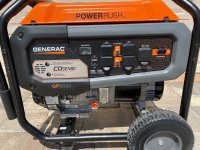
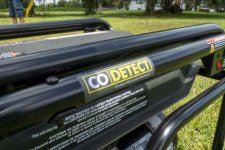
Been enjoying thread . Question ? Anybody here own a portable genny with a carbon dioxide sensor like I have only seen down here on a couple Generac and Ryobi models and has bypassed it . Seems like these sensors go bad quick or are real sensitive and shut down units and there might be like a 10 /15 minute reset time , not sure just asking .
 

Attachments

  • 00x0x_czeQepmqVUgz_0CI0t2_600x450.jpg
    00x0x_czeQepmqVUgz_0CI0t2_600x450.jpg
    214.6 KB · Views: 117
  • Ryobi-6500-Watt-Portable-Generator-with-CODetect-07-650x434.jpg
    Ryobi-6500-Watt-Portable-Generator-with-CODetect-07-650x434.jpg
    225.1 KB · Views: 133
   / Time for a new portable generator #49  
Yas, run into units with carbon monoxide sensors. I have never seen one that failed, and i personally would never bypass one. I had a good friend die of CO Poisoning years ago. Nothing to fool with.
 
   / Time for a new portable generator #50  
You can always find a CO2/propane sensor at an RV online store.

Those on an RV have a 7-year shelf life if I remember correctly. There will be a label on the back to verify that. IF you have one, look on the back to see if it has expired. You can also test it by triggering a bbq or cig lighter. Light it up, blow it out but continue to depress the button.

Also, they tend to get gummed up if there are aerosol cans being used in the area. PAM spray, hair spray etc. will set them off but also degrade them faster.
Be safe everyone.
 
   / Time for a new portable generator #51  
I had a Honda EU2000i mainly for camping and to have a little power during outages. I often boondock camp and sometimes I need to run the A/C for a short period to cool the camper off. The Honda wouldn't do it. I almost bought a used Yamaha 3000 off Marketplace but someone beat me to it. So I bought a Champion 3400 inverter and no regrets. No worrying about someone stealing the Honda, RV plug, starts easier than the Honda does after prolonged sitting. One thing is don't believe decibel ratings as there is no standard for testing. The 3400 was about the same noise level as my old Honda maybe a tad more. I have an open frame Generac for bigger stuff but this was for the rare times I need a generator for camping.
 
Last edited:
   / Time for a new portable generator #52  
I was a big Honda generator fan, and currently own two-2000w and a 3000w unit. Initially, all were very reliable and I used them constantly. Then came the day my usage decreased and my needs for a portable generator went down, so I put two away in storage and used just one of the 2000w for everything. It was a bad idea, cuz these gensets apparently hate ethanol fuels and both my stored generators after just 5 months no longer start. They are extremely vulnerable to ethanol during storage, and I learned it the hard way.

So in an emergency, I purchased an electric start Champion 4750w dual fuel generator (with 30amp RV plug), and two new 40lb propane tanks. I can run for over a week on propane, and starts every time. Now after 2 years, I can certainly recommend the Champion dual fuel generators operating only on propane.

From my experience, Honda generators are fine under continuous use. For any storage over a month, drain the tanks and burn the gas out of the carbs. Consider switching to non-ethonal fuels for all Honda gensets.
 
   / Time for a new portable generator #53  
Note that while many smaller non-inverter generators have a 240v outlet (my old 3300W Generac did), few inverter generators of any size do - that few that I've seen with a 240v outlet were (like 7000W+).

I used that Generac here and there for three years to cover our well, two refrigerators, one freezer, and occasional other small loads... and no, it didn't run all of that at once; if we needed to run the water, I'd have to disconnect the fridge/freezer loads and let the well run on its own - flush all the toilets as necessary, refill the dish tub in the sink, and a big drinking water jar, then wait a couple minutes for the well to turn off, and reconnect the fridge loads. It was cumbersome but it worked, and the 3300W unit was much less thirsty than a larger unit that would've run it all together.

(We use a whole house battery/solar system now, no generator - yet. I'm considering adding a generator for winter power failures to top up the batteries...)
 
   / Time for a new portable generator #54  
OMG. Ive been running generators to power my house for 25 years, and none were inverter. One was even a chepo unit purchased used from rental yard at auction.

just use the standard surge suppressor that i normally use for electronics, and computers are fed thru UPS sources. I have never burnt out an electronic device except for an oven that went during a lightning strike on my ground mount transformer. Since that strike, i installed a whole house surge suppressor and no further issues.

Ace surge device of some sort is a very good idea. I had one in my electrical panel, just downstream of the main 100 amp breaker. There was a lightning strike to Hydro pole very close by that damage to a lot of peoples equipment, but, although my main breaker was tripped, there was no damage to anything in the house.

The surge suppressor, however, was toast, as I guess it sacrifices itself when there’s a lightning strike. I just have to replace it with a new one.

That same lightning strike damaged a neighbor’s automatic standby generator but not mine. And I have a theory about that. The normal procedure is for the Hydro line to enter the transfer switch first, and then go to the main electrical panel. However, in my case, I didn’t want not want to go through the hassle of having the meter removed and waiting for the work and then having it replaced again, so I simply took out all of the circuit breakers except the main 100 amp breaker from my panel, then ran the line out of that now empty panel into the automatic transfer switch. Then I bought a separate panel for all of the circuits, and installed that downstream of the transfer switch. Then I installed the surge suppressor into the main panel that only had the 100 amp breaker. That way the lightning strike never made it to the automatic transfer switch, because the (upstream) surge suppressor theoretically stopped it, and that single hundred amp breaker tripped as well.

For you Generator Experts, does that sound like a valid theory?
 
   / Time for a new portable generator #55  
I was a big Honda generator fan, and currently own two-2000w and a 3000w unit. Initially, all were very reliable and I used them constantly. Then came the day my usage decreased and my needs for a portable generator went down, so I put two away in storage and used just one of the 2000w for everything. It was a bad idea, cuz these gensets apparently hate ethanol fuels and both my stored generators after just 5 months no longer start. They are extremely vulnerable to ethanol during storage, and I learned it the hard way.

So in an emergency, I purchased an electric start Champion 4750w dual fuel generator (with 30amp RV plug), and two new 40lb propane tanks. I can run for over a week on propane, and starts every time. Now after 2 years, I can certainly recommend the Champion dual fuel generators operating only on propane.

From my experience, Honda generators are fine under continuous use. For any storage over a month, drain the tanks and burn the gas out of the carbs. Consider switching to non-ethonal fuels for all Honda gensets.
If you don't mind, which Honda engine was on them? I hate ethonal fuel as a general rule and don't run it in small engines if I have any choice.
 
   / Time for a new portable generator #56  
...

From my experience, Honda generators are fine under continuous use. For any storage over a month, drain the tanks and burn the gas out of the carbs. Consider switching to non-ethonal fuels for all Honda gensets.
I believe this applies to all small gasoline engines. Both my log splitter and my generator are Honda engines. I always run them until they are empty. With the log splitter, that's when I call it a day for splitting wood. If I have just a few rounds left and I run out of gas, I just put a little bit of gas in the tank and then let it run until it's empty after I run out of round. With my Honda generator, if I have gas in it, I drain the gas out and then run it until it dies.

I ran my Honda generator back in February during the big freeze, but before that, it might of been more then a year since it was started. My log splitter is only used in the Spring and Fall, so it sits for months at a time. Both start easily every time I want to use them.
 
   / Time for a new portable generator #57  
@check that sounds like a perfectly wired whole house surge suppression.

Moving all of your home circuits to a new panel is not a trivial amount of work. Putting a surge suppressor in the now empty main panel next to the main breaker is electronically exactly what one wants to do.

Time is everything with surge suppression, and given the basically fixed speed of electrons in wires, time is distance. So putting the whole house surge suppressor as close to the incoming power as possible, and moving all of the other circuits into a separate panel, beyond a transfer switch puts them far away and gives the surge suppressor as much time as possible to react and clamp the voltage spike by shorting the surge to ground. The greater amount of electrical surge (energy) that the suppressor can short to ground, the more likely it is that your man breaker will open, putting up an even larger barrier to the surge. (Which it did in your case)

(y)(y) Thanks for sharing.

All the best,

Peter
 
   / Time for a new portable generator #58  
For some reason Honda continues to use bare steel float bowls on their carbs. Left sitting with ethanol in them will rust inside and mess up the whole works.

I haven't stayed in touch with newer small engine stuff but fuel injection with components made to withstand ethanol would be preferred.

I even had an issue with my old 99 Ford Mustang that I need to get out and drive more often. I let it sit for over a year one time and it rusted the fuel pump armature. When I dumped the fuel filter from the inlet side it was full of rust. The tank was spotless inside and has a coating on it. The fuel pump was dead so I assume all the rust came from it and maybe the inside of the filter. Thankfully all the rust was trapped between the pump and filter so replacing those two parts got it going again.
 
   / Time for a new portable generator #59  
I believe this applies to all small gasoline engines. Both my log splitter and my generator are Honda engines. I always run them until they are empty. With the log splitter, that's when I call it a day for splitting wood. If I have just a few rounds left and I run out of gas, I just put a little bit of gas in the tank and then let it run until it's empty after I run out of round. With my Honda generator, if I have gas in it, I drain the gas out and then run it until it dies.

My Honda generator and Kohler-engined log splitter both have fuel valves. When I shut them off I turn off the fuel and let the engine run the carburetor dry. No need to drain the tank or use non-ethanol fuel that's hard to find and very expensive here. I do use fuel stabilizer though. And they don't sit unused for more than about 8 months.
 
   / Time for a new portable generator #60  
I have had customers generators taken out by lightning strikes on their own property, but usually a set of mags and a control panel takes care of damage. Most of the times just rebooting the control panel fixes issues.

I placed a siemens 140,000 A surge suppressor on my house. Hopefully it will protect the gen also, but not sure it would.

we get occasional lightning storms, but no huge ones, so im not too worried. I once looked into a protection system for generator power and control wires, but as usual i never followed thru with it.
 

Tractor & Equipment Auctions

Redirective Crash Cushion Guardrail (A59230)
Redirective Crash...
1608 (A57192)
1608 (A57192)
Greenworks Commercial 82V CZ60R Zero-Turn Mower- DEMO UNIT (A56438)
Greenworks...
2006 GMC C5500 BUCKET TRUCK (A59905)
2006 GMC C5500...
2010 Deere 318D (A60462)
2010 Deere 318D...
500BBL SKIDDED FRAC TANK (A58214)
500BBL SKIDDED...
 
Top