Building a custom home - HVAC options - could use a bit of help please!

   / Building a custom home - HVAC options - could use a bit of help please! #41  
You are making a big decision and I think you need more advice. I've built several custom houses and a good HVAC system is critical. Depends on where you are, and the cost of fuel and electricity. Here in KY where electricity has been relatively inexpensive, I went for 2 systems, for a 4000ft house. Heat pumps 18 seer with propane backup under 35 degrees. A big concern is the duct system behind the walls, once installed and drywalled you are stuck with it. Contractors can be lazy (one of mine was). Many want to steer you to the easiest or a buddy. You need a second opinion from a real pro. The old days of one furnace and one a/c unit over in the corner of the basement are long gone.
 
   / Building a custom home - HVAC options - could use a bit of help please! #42  
Get a second opinion, I've built 2 new home myself and worked in HVAC for 20 years , company I worked for is the largest
Water furnace dealer in the nation, we installed up to 1000 units per year. If installed correctly they are the best and most energy efficient
system going , a zoned system is a great way to go, just make sure the HVAC company knows what the heck they are doing no matter what type system
you end up having installed.
 
   / Building a custom home - HVAC options - could use a bit of help please! #43  
I have had a geothermal system in my 2300 sq ft home in northern Ohio for 7 years.
I love it.
 
   / Building a custom home - HVAC options - could use a bit of help please! #44  
What ever system you decide on remember that energy costs NEVER go down and this is a lo-o-o-ng term investment.
Over the years you can (will) replace the equipment for a reasionable cost. The equipment is designed to be replaced, if there is access and space to do so. On the other side of the coin increasing the insulation is a nightmare.
 
   / Building a custom home - HVAC options - could use a bit of help please! #45  
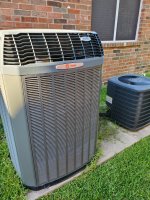
We had a Trane put in as our main system in our house in the DFW area. I want to say it is an 18 seer? The important part for is and that on would highly recommend is the variable speed fan. It barely seems to be running and still keeps it comfortable in the Texas heat. Saves us a bundle on electricity. It is especially good on those days when it is humid, but not too hot. The system still cycles on low power and keeps it comfortable. The older systems were either on full blast or off. On warm humid days it would be sticky because the old system only kicked on once in awhile.

Attachments

  • 20210825_183605.jpg
    20210825_183605.jpg
    4.2 MB · Views: 1,301
 
   / Building a custom home - HVAC options - could use a bit of help please! #46  
I have an opinion about geothermal HVAC systems that may not be popular, but it is based on owning 2 homes over the years with geothermal heating and cooling. My experiences are both with open-loop geothermal, so maybe folks with a closed loop system have had different experiences...

I don't see myself having a 3rd home with geothermal HVAC. Although it is absolutely true that geothermal is, by far, the most economical way to heat or cool a house from an operations perspective, there are downsides to geothermal that folks generally never mention.

1) The up-front cost is very high. Even with Federal and State tax incentives, geothermal is still expensive. Best case is that the tax incentives bring the installed cost into the same realm as a conventional heating/cooling system. And remember, these are TAX incentives -- typically, you still have to pony up the cash upfront and then get it back later through reduced Federal and State income taxes.

2) While this is true for all kinds of HVAC, you really REALLY need to make sure that the company you are using understands how to install geothermal properly. These are very sophisticated systems and a mistake in installation can cause you a lot of pain and suffering, and they can take a long time to identify and correct.

3) Geothermal systems require far less maintenance than traditional HVAC systems, but they do require some maintenance and occasionally repair. Not every HVAC company is well-versed in the ins-and-outs of geothermal. This reduces your options in the event that you have a falling out with the installing company, or in the event that company goes out of business, or if you need an emergency service in the middle of the winter. It does force the homeowner into being something of an expert in geothermal systems so that you can make an emergency repair on your own, or do some regular maintenance to save a few bucks.

4) Any very high efficiency equipment is going to be sophisticated. This almost always means that cost of replacement parts may shock you. As an example, I have a Florida Heat Pump split unit. The fan motor failed in the air handler. The cost of the new fan motor was $1600. I thought I was being lied to, so I called a number of other HVAC outfits. Two of them did not work on geothermal units (see my point above), but they told me that I was being robbed because a new fan motor was about $800 installed. A third outfit that did work on geothermal regularly told me that since Bosch had bought Florida Heat Pump, the prices on parts had gone up some and that the variable speed fan motor in my air handler was indeed a $1600 part. That $1800 repair ($1600 parts, $200 labor) ate up a LOT of the energy savings that the geothermal unit had brought me over the years.

5) This applies to open-loop geothermal, and likely isn't an issue for closed loop systems. The first home I owned with geothermal HVAC used a single well for supply, return and domestic water. It took the better part of a full winter to identify the proper height at which to hang the pump such that I would not suffer thermal mixing or freezing of the return water. This was a painful experience. My current home has a dedicated return well. This has eliminated that issue, but there are others. Water quality becomes a huge concern with open-loop geothermal. When my current supply well suddenly began producing large amounts of particulate matter at year 5 of geothermal use, I found myself struggling to find a proper filtration solution that wouldn't have me cleaning the filter daily. One must also have a properly sized and installed water pumping solution. I ultimately went with a constant pressure pump and a small pressure tank to limit the number of starts and stops that the pump would otherwise encounter when supplying a geothermal heat pump.

Anyway, these are just a few of the less-positive aspects of geothermal heat pump ownership. There is a lot to be said for a conventional HVAC system...
I agree with you. We have two geo units in two separate buildings, both are closed loop. i designed both system and they work real well, they have never gone into back up and both are going on 20 years. I wouldn't even consider geo where you are, heat pumps have come a long way. If I was to do it again and in your case as far south as you are i would use a heat pump cased coil on top of a propane furnace as the air handler and as back up heat.

i guess i have never understood why it is so hard to find some one to repair goe thermal. They use the same water source heat pumps in commercial office buildings, they just pump the water up to a cooling tower. The unit in my shop is exactly what they use. They have them stuffed in the ceiling all over the place in some older office buildings. The units for home use are basically the same thing with the air handler attached. When we had to replace the compressor on one of our units I called a commercial heating contractor. We ordered the parts they came out and installed it.

It sounds like most of your issues are because of the open loop and on the air handler side. When we installed ours finding someone that would install the ground loop correctly was not easy. Now there is companies out there that is all they do.

In our area the companies that "install geo" use a separate company to install the ground loop. Then they sub out the tin. Then they slid in there fancy geo unit/air handler. It is so proprietary that is ridiculous. (water furnace)We use a separate geo unit that feeds a cased water coil on top of a standard forced air propane furnace for one. Then we have one of the fancy self contained(water furnace) for our home.
 
   / Building a custom home - HVAC options - could use a bit of help please! #47  
I can't imagine installing straight air conditioning when you need heat as well. Heat pump is the better way to go. I am heating in Canada with a heat pump and my backup heat source does not kick in. Depending on the outdoor temperature, I get between 2.5Kw and 4KW of heat per 1KW of electricity to run it. Geothermal is even better, but very expensive up front.
 
   / Building a custom home - HVAC options - could use a bit of help please! #48  
Probably already mentioned, but i had a heat pump unit installed and if i had an option - i would never go with a heat pump again. I like heat, not semi- warm air. That is also coming from an old fart too… :)
 
   / Building a custom home - HVAC options - could use a bit of help please! #49  
Why are you even considering gas furnaces when heat pumps are more efficient? And geothermal, if you can get it, is even more efficient.
 
   / Building a custom home - HVAC options - could use a bit of help please! #50  
Who designed the house? My dumb ol engineer response is call a Mechanical Engineer, who should have been a sub to the Architect.

I’m Facilities Engineer for the Forest Service. I read a couple of hours a night to stay current on the changes in the codes, and efficiency of new systems and products. I know quite a bit about a lot of things, but that mostly just gets me to the point I can ask intelligent questions of the folks who have specialized areas of knowledge.

I would never consider installing a new heating system in a building of that size without it going through a good Mechanical Engineer who is familiar with the current industry standardS, and in high efficiency green buildings.

Modern buildings should be almost completely air tight, and have heat exchanging air make up systems installed.

I installed an ultra high efficiency minisplit heat pump system, with a “smart” control system in one of our buildings four years ago. Winter temps drop into the low teens Pretty regularly, with occasional cold snaps where it doesn’t get above 0F for one or two weeks. The only time the system has had to kick on the emergency heat, is when someone comes in at an unscheduled time and bumps their thermostat up. The system has learned how much heat loss the building has, and how much heat it can make at what the outside temperature is, and turns on early enough to get to the desired temperature at the desired start of the day. Compared to the ducted oil burner it replaced, it is heating for about half of the cost per degree-day.

This is one of those one chance to get it right, and fifty years of regret kind of decisions. And, as one of he other posters mentioned. The life cycle cost on a building is about 20% in initial construction and 80% operation and maintenance.
 
   / Building a custom home - HVAC options - could use a bit of help please! #51  
There’s nothing wrong with using two central systems for this build. It’s a well proven approach with common systems that can be readily serviced by many different contractors. I do have a word of caution about using a single central return for each system. The area near each central return will be noisy because all the air for that unit will have to go through the one grill. Plus, air circulation will suffer in bedrooms and any other rooms that may have their door closed for extended periods of time.

Another potential benefit of a central system with dedicated returns is the ability to get isolation for quarantines. Some of the available
electrostatic air cleaners are capable of killing airborne virus particles, and having dedicated returns in bedrooms and living areas will do a better job of containing exhaled aerosol particles and taking them back through the filter before they can spill out to other areas of the home. It’s crazy that we have to think like this in these times, but I wish I had a central system for exactly these reasons. My house uses hydronic heat and mini splits for cooling. I miss the better air filtering that I had in my previous home.

Proper air sealing and insulation are really important areas to focus on for heating and cooling performance and cost. Some times you can spend a ton on technology that is supposed to be more efficient, only to have it underperform because other more important details were overlooked.
 
Last edited:
   / Building a custom home - HVAC options - could use a bit of help please! #53  
I did a similar installation 6 year ago, and just pulled out the calculator & did the math on energy consumption. It became obvious that the most energy-efficient units were the best deal, even if I had to borrow the money to deal with the initial cost.

It is true that the local climate is a factor, but generally speaking you're either heating more up north or cooling more down south, so the heat pump side doesn't change much. On the auxiliary heating side, I think you'll find that the high efficiency units really aren't significantly more expensive.

In NC, my guess is that the heat pump will be your most efficient heat source most of the time, since you don't get extreme cold. That being the case, it's worth noting that your location also lends itself to solar energy production, so having a heat source you can run off of electricity could get really cheap if you also install solar. (I ran the numbers and found that here in SW Ohio, solar paid for itself in about 9 years, and again, borrowing the money at current rates, I'd still come out ahead financially if I installed panels on our entire barn roof.)

Finally, I also found that the higher efficiency equipment tended to also get better reviews for longevity.
 
   / Building a custom home - HVAC options - could use a bit of help please! #54  
Sorry-forgot to address the two-stage vs single stage question. two stage is indeed more efficient, and pays for itself quickly enough to justify the up-front cost.

A word of caution... An embarrassing number of installers will put in a two-stage system without wiring it to take advantage of the option. My installer did that, and I didn't notice he had cheated me until I replaced a faulty thermostat two years later and spent 30 minutes trying to figure out why there weren't enough wires going to it. When I sought the advice of a reputable HVAC tech, he told me he saw that about half the time.
 
   / Building a custom home - HVAC options - could use a bit of help please! #55  
I'd like to add to what Milkman 636 said. About 4 years ago we put in new HVAC systems in the house (Carrier) and when I brought up installing electro static air cleaners the dealer (Crystal City Heating) asked me why? He told me about a UV air purification option that kills viruses and sold for about half the price.
We've been very happy with that advice, it even removes cooking odors.
Per the dealer the life span of the UV bulb is about 10 yrs.
 
   / Building a custom home - HVAC options - could use a bit of help please! #56  
We have a mini-split heat pump in our MIL cabin and it works quite well, except there is no real air filtering. We run a separate air filter with a carbon & hepa filter in it.
 
   / Building a custom home - HVAC options - could use a bit of help please! #57  
Sorry-forgot to address the two-stage vs single stage question. two stage is indeed more efficient, and pays for itself quickly enough to justify the up-front cost.

A word of caution... An embarrassing number of installers will put in a two-stage system without wiring it to take advantage of the option. My installer did that, and I didn't notice he had cheated me until I replaced a faulty thermostat two years later and spent 30 minutes trying to figure out why there weren't enough wires going to it. When I sought the advice of a reputable HVAC tech, he told me he saw that about half the time.
No! Not two-stage. You want the variable speed. Think of it like the difference in speed control between a tractor with 2 speeds and a 4 range HST with infinite range.

Definitely need to make sure it is installed correctly, but get the best system, it pays for itself.
 
   / Building a custom home - HVAC options - could use a bit of help please! #58  
No! Not two-stage. You want the variable speed. Think of it like the difference in speed control between a tractor with 2 speeds and a 4 range HST with infinite range.

Definitely need to make sure it is installed correctly, but get the best system, it pays for itself.

Two-stage is better than single stage. But, they do require two-stage thermostats to actually function as a true two-stage system. If a single stage thermostat is used the units will automatically go to the higher stage after a predetermined amount of time during an on-cycle. Two-stage thermostats will allow the units to cycle as long as they need to at the lower stage, as long as the room temperatures are not drifting farther away from the setpoint. I have had good experiences with both 2-stage heating and cooling. A good installation will require that the installer takes the time to setup the correct fan speeds for both stages to achieve appropriate temperature differentials between return and supply air. Pushing for fully modulating units will increase both the initial costs and future repair costs.
 
   / Building a custom home - HVAC options - could use a bit of help please! #59  
I have an opinion about geothermal HVAC systems that may not be popular, but it is based on owning 2 homes over the years with geothermal heating and cooling. My experiences are both with open-loop geothermal, so maybe folks with a closed loop system have had different experiences...

I don't see myself having a 3rd home with geothermal HVAC. Although it is absolutely true that geothermal is, by far, the most economical way to heat or cool a house from an operations perspective, there are downsides to geothermal that folks generally never mention.

1) The up-front cost is very high. Even with Federal and State tax incentives, geothermal is still expensive. Best case is that the tax incentives bring the installed cost into the same realm as a conventional heating/cooling system. And remember, these are TAX incentives -- typically, you still have to pony up the cash upfront and then get it back later through reduced Federal and State income taxes.

2) While this is true for all kinds of HVAC, you really REALLY need to make sure that the company you are using understands how to install geothermal properly. These are very sophisticated systems and a mistake in installation can cause you a lot of pain and suffering, and they can take a long time to identify and correct.

3) Geothermal systems require far less maintenance than traditional HVAC systems, but they do require some maintenance and occasionally repair. Not every HVAC company is well-versed in the ins-and-outs of geothermal. This reduces your options in the event that you have a falling out with the installing company, or in the event that company goes out of business, or if you need an emergency service in the middle of the winter. It does force the homeowner into being something of an expert in geothermal systems so that you can make an emergency repair on your own, or do some regular maintenance to save a few bucks.

4) Any very high efficiency equipment is going to be sophisticated. This almost always means that cost of replacement parts may shock you. As an example, I have a Florida Heat Pump split unit. The fan motor failed in the air handler. The cost of the new fan motor was $1600. I thought I was being lied to, so I called a number of other HVAC outfits. Two of them did not work on geothermal units (see my point above), but they told me that I was being robbed because a new fan motor was about $800 installed. A third outfit that did work on geothermal regularly told me that since Bosch had bought Florida Heat Pump, the prices on parts had gone up some and that the variable speed fan motor in my air handler was indeed a $1600 part. That $1800 repair ($1600 parts, $200 labor) ate up a LOT of the energy savings that the geothermal unit had brought me over the years.

5) This applies to open-loop geothermal, and likely isn't an issue for closed loop systems. The first home I owned with geothermal HVAC used a single well for supply, return and domestic water. It took the better part of a full winter to identify the proper height at which to hang the pump such that I would not suffer thermal mixing or freezing of the return water. This was a painful experience. My current home has a dedicated return well. This has eliminated that issue, but there are others. Water quality becomes a huge concern with open-loop geothermal. When my current supply well suddenly began producing large amounts of particulate matter at year 5 of geothermal use, I found myself struggling to find a proper filtration solution that wouldn't have me cleaning the filter daily. One must also have a properly sized and installed water pumping solution. I ultimately went with a constant pressure pump and a small pressure tank to limit the number of starts and stops that the pump would otherwise encounter when supplying a geothermal heat pump.

Anyway, these are just a few of the less-positive aspects of geothermal heat pump ownership. There is a lot to be said for a conventional HVAC system...

Every variable speed fan motor OEM costs $1600 to the consumer. We replace them with PSC motors for $800, seems like a bargain.
 
   / Building a custom home - HVAC options - could use a bit of help please! #60  
Please don't say that loud enough for my systems to hear you. ;-) I think they were about 3 or 4 years old when we bought the house, had it cut in 3 pieces and moved about 25 miles to a new location (paid someone with freon tools/experience to pump them down & reconnect/recharge at the new location). That was in 1997. It would be nice to upgrade to a higher SEER rating, but they just won't die; or at least won't die dead enough that I can't fix them. I've replaced the control boards in both furnace/air handlers (within the last 5 years or so), an air pressure sensor in one air handler (not sure that one wasn't the control board), and a capacitor, the fan, and the crankcase heater in one compressor. These failures were scattered across more than a decade, and I did all the troubleshooting and repairs, with a bit of help from the interwebs. If I'd been paying an HVAC contractor, I suppose I might have been more motivated to install new hardware by now, but as long as the rare and random repair costs stay well under $100, it's difficult to spring for new systems.

The coils started going south in the early 2000s, innovation donchaknow
 

Tractor & Equipment Auctions

2020 ISUZU NQR BOX TRUCK (A58214)
2020 ISUZU NQR BOX...
Honda EM3500S Portable Gasoline Generator (A59228)
Honda EM3500S...
UNUSED FUTURE FT-CL100C HYD CLAMP GRABBER (A52706)
UNUSED FUTURE...
2022 FORD F-150 XLT CREW CAB TRUCK (A59823)
2022 FORD F-150...
159115 (A60430)
159115 (A60430)
UNKNOWN  20 FLATBED GOOSENECK (A58214)
UNKNOWN 20...
 
Top
