Okay this is odd. The Vultures are back.

   / Okay this is odd. The Vultures are back. #22  
When our youngest was at Purdue, there was a very tall radio tower a block over from the apartment. Late every afternoon several dozen vultures would come and circle around it for close to an hour, then slowly, one-by-one, they'd land on it until all of them were done. Then they'd roost there overnight. In the morning, they'd face the sun and spread their wings out to warm up. After about an hour one-by-one, they'd take off an circle up and finally drift away on the breezes. It was pretty interesting to watch.
 
   / Okay this is odd. The Vultures are back. #23  
Its a common myth that Vultures circle over potential meals. They circle when they have found a good thermal. :)
Turkey vultures also circle around food. It can be hard to tell the difference but often they will go lower if it's food. We had a dead deer on the leach field a couple years back and the vultures kept coming by real low. They did not land, maybe because there was not a good path for takeoff.

Small groups circle together when they are migrating. They catch thermals and circle but they also keep moving in a consistent direction, if slowly compared to say geese.

One of my professors studied vultures. I was kinda glad I didn't get to work for him on that as vultures will puke on you if you annoy them.

There was a house in the suburbs around here that used to get a flock of vultures roosting on the roof for a few weeks every winter. I think the house was just situated right for sunning and flying away (it was on a hill). That must have been interesting for the occupants.
 
   / Okay this is odd. The Vultures are back. #24  
There's an old mostly dead Oak tree down the road. I've seen 10 or 15 black headed buzzards perched in it while out walking. As I approach, they all hit the air and the whomp-whomp-whomp of their wings is quite loud.
 
   / Okay this is odd. The Vultures are back. #25  
From Wikipedia:

"The black vulture also occasionally feeds on livestock or deer. It is the only species of New World vulture which preys on cattle. It occasionally harasses cows which are giving birth, but primarily preys on newborn calves.

In its first few weeks, a calf will allow vultures to approach it. The vultures swarm the calf in a group, then peck at the calf's eyes, or at the nose or the tongue. The calf then goes into shock and is killed by the vultures.

These vultures are known to kill baby herons on nesting colonies, and feed on domestic ducks, small birds, skunks, opossums, other small mammals and young turtles."
 
   / Okay this is odd. The Vultures are back. #26  
Went down to get the mail yesterday and saw the grass is greening up. This is in Eastern Washington. The grass greening now is very odd as normal here is about foot of snow cover every where and grass shouldn't even be visible for at least another month.
 
   / Okay this is odd. The Vultures are back. #27  
Turkey vultures also circle around food. It can be hard to tell the difference but often they will go lower if it's food. We had a dead deer on the leach field a couple years back and the vultures kept coming by real low. They did not land, maybe because there was not a good path for takeoff.

Small groups circle together when they are migrating. They catch thermals and circle but they also keep moving in a consistent direction, if slowly compared to say geese.

One of my professors studied vultures. I was kinda glad I didn't get to work for him on that as vultures will puke on you if you annoy them.

There was a house in the suburbs around here that used to get a flock of vultures roosting on the roof for a few weeks every winter. I think the house was just situated right for sunning and flying away (it was on a hill). That must have been interesting for the occupants.
Definitely both! If they're circling high, it's cruising a thermal, but I see them over the meadow here circling all the time much lower, typically in a gradually decreasing radius circle, getting lower and lower and then they land. They probably can drop more quickly like raptors, but the prey's dead already and they can be much more chill about the descent.

(I'll bet your deer wasn't quite... tenderized? yet. around here they tend to go after stuff that's pretty well seasoned, if you get my drift)
 
   / Okay this is odd. The Vultures are back. #28  
Its a common myth that Vultures circle over potential meals. They circle when they have found a good thermal. :)
you're no fun. By the way, they must look for their meals. You think they drive around?

"Vultures take advantage of rising air currents or thermals for flying.

And so, they soar in circles to stay within the bounds of a thermal.

But they also circle the dead to ensure their food is indeed dead.

But they find dying animals by smelling decay gases.

Otherwise, they visually look for the carcasses.


If a vulture is circling you, then it may have smelled a dead animal around.

Or perhaps, the vultures are just migrating.
 
   / Okay this is odd. The Vultures are back. #29  
Someone is about to tell us more than they know about this. Buzzards can't smell,no bird can. On the other hand with eyesight like eagles,they see flies on animals from quite high then can tell the difference in flies as they circle lower above animals. If animal has injury that is starting to rot and attract green flies,buzzards often begin eating although animal is alive.
 
   / Okay this is odd. The Vultures are back. #30  
When a deer gets killed near us, the turkey buzzards hang out in the surrounding trees and on our rooftop. You can hear them land and take off, it is a considerable bump if are upstairs. The first time it happened, I walked out to get the trash cans and saw 6 or 8 buzzards sitting on limbs across the road. Walking back, I saw about 12 sitting in trees across the back. I looked up to see 6 sitting on our roof. When I went inside, my wife was freaking out wondering what was striking the roof.
 
   / Okay this is odd. The Vultures are back. #31  
what state are you in?

The robins never left this year. I saw them at Christmas, New Years, and even today. First time I can remember that.
Robins don't migrate. They hang out in the thicket over winter. They show themselves in winter when you get a warm stretch and the ground is soft enough for them to poke around for worms.
 
Last edited:
   / Okay this is odd. The Vultures are back. #32  
I love the term "buzzard" but as a bird enthusiast if you look in the bird books vultures are vultures.... buzzards are a totally different bird.
Buzzards are raptors.... yes hawks. They hunt and kill their food. Vultures are scavengers. Basically nature's cleanup crew.
But here in Texas, vultures are buzzards LOL.
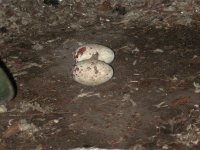
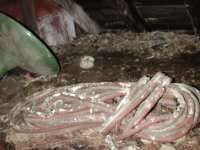
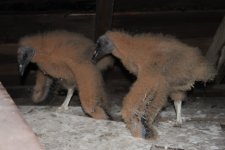
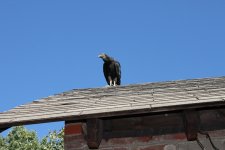
BTW, years ago there was a vulture nest in my fathers out building up in the loft. It was able to get in through a hole in the roof. Got pictures of the nasty, pooped-on nesting area. Yes area... they don't build nests. They just lay the eggs on the loft floor. I got pictures of the eggs and then the chicks. These are American vultures. Their heads are black when they mature.
 

Attachments

  • 0008.jpg
    0008.jpg
    2.4 MB · Views: 231
  • 0009.jpg
    0009.jpg
    2.5 MB · Views: 157
  • 0019.jpg
    0019.jpg
    1.5 MB · Views: 140
  • 0026.jpg
    0026.jpg
    1.9 MB · Views: 156
   / Okay this is odd. The Vultures are back. #33  
Robins don't migrate. They hang out in the thicket over winter.
Yep. The robins around here hang out in my woods back of the house all winter.
 
   / Okay this is odd. The Vultures are back. #34  
We've had several days in a row with temps barely reaching 20F north of the 43rd parallel at mid-day. It's nothing new. Not much here for insect eaters this time of year, and who tags/monitors seasonal robin migrations? I suggest that perhaps ours are hanging out in the Indiana woods and Indiana's may have flown further south. I also suspect that's why I see bluebirds in Winter along with juncos that are scarce in the warm season. YMMV but we all live in different local climates and one observation doesn't always fit all. What happens in Southern states doesn't represent a National trend to me.
 
   / Okay this is odd. The Vultures are back. #35  
Our vultures are still around, saw one yesterday overhead.
Lots of birds yesterday as above freezing and sunny.
With todays snow, not seeing much movement out there.
 
   / Okay this is odd. The Vultures are back. #36  
Robins don't migrate. They hang out in the thicket over winter. They show themselves in winter when you get a warm stretch and the ground is soft enough for them to poke around for worms.
Yes, but they showed themselves all year. Never hunkered down like normal.
 
   / Okay this is odd. The Vultures are back. #37  
It's up to 10F here right now (9:30 AM) and our ground is frozen at least 6" deep under the snow. I'll be watching for robins to poke around in it for worms. They're sneaky and routinely do it without disturbing the snow just like everywhere else in the country.
 
   / Okay this is odd. The Vultures are back. #38  
Someone is about to tell us more than they know about this. Buzzards can't smell,no bird can. On the other hand with eyesight like eagles,they see flies on animals from quite high then can tell the difference in flies as they circle lower above animals. If animal has injury that is starting to rot and attract green flies,buzzards often begin eating although animal is alive.
I'm hoping that this post is an example of Cunningham's Law, because the first sentence was immediately proven correct since the subsequent sentence was wrong.

While they lack the vomeronasal organ that most mammals, amphibians, and reptiles use to detect odor particles, many species have olfactory bulbs, a structure in the forebrain that receives odor signals from the nasal cavity.

 
   / Okay this is odd. The Vultures are back. #39  
Someone is about to tell us more than they know about this. Buzzards can't smell,no bird can. On the other hand with eyesight like eagles,they see flies on animals from quite high then can tell the difference in flies as they circle lower above animals. If animal has injury that is starting to rot and attract green flies,buzzards often begin eating although animal is alive.
What would the audubon society know about birds?
tv_curser.gif
Turkey vultures have an extraordinary sense of smell. They have been known to be able to smell carrion from over a mile away which is very unique in the bird world. The turkey vulture has the largest olfactory (smelling) system of all birds.

 
   / Okay this is odd. The Vultures are back. #40  
Someone is about to tell us more than they know about this. Buzzards can't smell,no bird can. On the other hand with eyesight like eagles,they see flies on animals from quite high then can tell the difference in flies as they circle lower above animals. If animal has injury that is starting to rot and attract green flies,buzzards often begin eating although animal is alive.
  • Black Vultures have a much shorter tail than Turkey Vultures , so short that their feet are sometimes visible beyond their tail’s end. Interestingly, Black Vultures, like most other birds, lack a sense of smell. However, sense of smell is highly developed in Turkey Vultures and is their primary method of locating the rotting carcasses they eat.
 

Tractor & Equipment Auctions

Redirective Crash Cushion Guardrail (A59230)
Redirective Crash...
2020 Bobcat MT85 (A53317)
2020 Bobcat MT85...
Peterbilt 377 Semi-Truck (A56438)
Peterbilt 377...
2020 Chevy Silverado (A56438)
2020 Chevy...
2018 CATERPILLAR 259D SKID STEER (A60429)
2018 CATERPILLAR...
208320 (A58375)
208320 (A58375)
 
Top