Electrician question - Screw-in breakers?

   / Electrician question - Screw-in breakers? #1  

California

Super Star Member
Joined
Jan 22, 2004
Messages
16,651
Location
An hour north of San Francisco
Tractor
Yanmar YM240 Yanmar YM186D
I'm near one of the areas in NorCal that had a disastrous fire a couple of years ago. Close enough that ash was falling here. Now the insurance companies are abandoning us.

This is an old farmhouse with old farmer-installed wiring. The 200 amp main panel installed 60 years ago must have had some sort of permit and inspection but the older wiring beyond it is pretty chaotic. With no perimeter foundation, the place will be destroyed when the next large earthquake comes, so it's not worth it to remodel up to modern specs.

I answered 'yes' to some issues on the insurance renewal questionnaire - for example knob & tube wiring remaining and inaccessible serving the ceiling lights. Also there are two sub-circuits that have twin 15 amp screw-in fuses, one in my shop and one at a sunporch addition. These specifically increase insurance cost. I got the answer back that since my farmhouse was built before 1970 they won't renew.

I have a different agent looking for coverage but I think the fuse issue may at least cause a higher insurance cost.

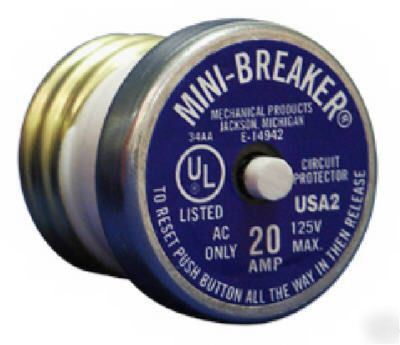
So - is there any such thing as a breaker that screws into a fuse socket?

Failing that, is it reasonable to jumper across those sub-panels if the main panel breakers that feed those sub-panels, are 15 amp breakers?

I could install new breaker boxes at those two locations but that seems pointless.

Any advice?
 
   / Electrician question - Screw-in breakers? #3  
I suspect you’re getting dinged on the age of the system and overall cobbled up work apposed to the fuse itself. I highly doubt a screw in breaker is going to fix the issue.
 
   / Electrician question - Screw-in breakers?
  • Thread Starter
#4  
I suspect you’re getting dinged on the age of the system and overall cobbled up work apposed to the fuse itself. I highly doubt a screw in breaker is going to fix the issue.
Nothing can fix the mess of wiring here. I don't let anyone plug in two high-amperage appliances on a single circuit - hair dryer and microwave etc. At least there are several discrete circuits, so I can't remember the last time we tripped a breaker. Those glass fuses are unchanged in the 50 year history I'm familiar with.

That sunporch doesn't need anything that draws high current and the shop's outlets are on a more recent circuit, so the fuses only control lighting, which is now led's so minimal load.

Dad's advice was the place is hopeless, bulldoze it when he died. Now I'm feeling the same way. Patch things together as I get older (WWII baby) and I tell my kids the same thing. But I do want competent liability insurance so I have to meet some of the demands the insurer requests.

Digging It thanks for the photos! I'll go looking for similar.
 
   / Electrician question - Screw-in breakers? #5  
Nothing can fix the mess of wiring here. I don't let anyone plug in two high-amperage appliances on a single circuit - hair dryer and microwave etc. At least there are several discrete circuits, so I can't remember the last time we tripped a breaker. Those glass fuses are unchanged in the 50 year history I'm familiar with.
To be honest, I can’t blame an insurer for not wanting to touch that.
 
   / Electrician question - Screw-in breakers? #6  
This is an old farmhouse with old farmer-installed wiring. The 200 amp main panel installed 60 years ago must have had some sort of permit and inspection but the older wiring beyond it is pretty chaotic. With no perimeter foundation, the place will be destroyed when the next large earthquake comes, so it's not worth it to remodel up to modern specs.

I answered 'yes' to some issues on the insurance renewal questionnaire - for example knob & tube wiring remaining and inaccessible serving the ceiling lights. Also there are two sub-circuits that have twin 15 amp screw-in fuses, one in my shop and one at a sunporch addition. These specifically increase insurance cost. I got the answer back that since my farmhouse was built before 1970 they won't renew.

So - is there any such thing as a breaker that screws into a fuse socket?

Failing that, is it reasonable to jumper across those sub-panels if the main panel breakers that feed those sub-panels, are 15 amp breakers?

I could install new breaker boxes at those two locations but that seems pointless.

Any advice?
older wiring beyond it is pretty chaotic. With no perimeter foundation.

When I was an Electrical Contractor (retired), my insurance company did not allow me to work on houses that had the old socket screw in fuses or if the building did not have a foundation, clearly stated in the policy. Had to quit woring on these structures in the late 90's

The unseen problem with screw in type fuses is that a 15 amp fuse was able to be replaced with up to a 30 amp fuse. Do you know if that ever happened?
A 14 guage wire is fine with a 15 amp fuse, as the fuse will blow and protect the wire from overheating. If you overheat a 14 gauge wire by placing a 30 amp fuse in the screw in socket you can no longer protect the insulation or copper wire from failing.
When you allow more electrical current on the wire than it is rated for it will eventually cause the insulation to expand and contract enough to seperate the insulation from the wire. I have seen cracks in the insulation where you could see the copper. Once you have the exposed bare wire that is visible through a crack in the insulation you can get carbon tracing to wood or other flamable material. At that point it is just a matter of time with the right circumstances and you can get a fire.

There is a conductor properties table in the National Electric Code that give resistance values per thousand foot. This is why a wire needs to be looked at like it is a resistor. If there is resistance there is the ability to produce heat. Heat is directly proportional to the amount of current flow in the wire.
 
   / Electrician question - Screw-in breakers? #7  
older wiring beyond it is pretty chaotic. With no perimeter foundation.

When I was an Electrical Contractor (retired), my insurance company did not allow me to work on houses that had the old socket screw in fuses or if the building did not have a foundation, clearly stated in the policy. Had to quit woring on these structures in the late 90's
OK, I understand screw-in fuses, but why no foundation?
By no foundation do you mean the sills for the building are sitting directly on the ground?
 
   / Electrician question - Screw-in breakers? #8  
The trip characteristics between fuses and a breaker are different. Fuses trip out earlier than breakers.
If you have old wiring on those two circuits with the fuses, I would recommend replacement with fast blow fuses rated for the wire size. The only drawback would be any inductive loads may blow the fuse. But at least I would have the thought that the fast blow fuses is the safest solution.
 
   / Electrician question - Screw-in breakers? #9  
OK, I understand screw-in fuses, but why no foundation?
By no foundation do you mean the sills for the building are sitting directly on the ground?
Frost heave and settling of the structure.
 
   / Electrician question - Screw-in breakers? #10  
Failing that, is it reasonable to jumper across those sub-panels if the main panel breakers that feed those sub-panels, are 15 amp breakers?

I could install new breaker boxes at those two locations but that seems pointless.

Any advice?
My first thought without more information would be to go with fast blow fuses in the subpanels, best protection.

Jumper across subpanels? How many circuits (how many fuses) are in each subpanel? If the subpanel with fuses is fed by a 15 amp circuit breaker from the main panel, I would just leave it like it is. You would have more circuit protection devices for the wiring.
I may be missing something here as I am only going on what I understand from your post.
 
Last edited:
   / Electrician question - Screw-in breakers? #11  
This is kind of weird. Fuses are safer and more reliable than breakers. The originals could be defeated by sticking a penny in the socket, but inserts and fusestats prevent that.
 
   / Electrician question - Screw-in breakers?
  • Thread Starter
#12  
To be honest, I can’t blame an insurer for not wanting to touch that.
:D .
That's pretty much what I said as a teen after Dad inherited, and I had to work for him making the upgrades that I now know were non-spec - to put it politely. I learned so much carpentry that a decade later after college I joined the Carpenter's Union, then went on to buy and renovate rentals.

Now a generation later all that old half-assed work is my problem.

Perimeter foundation: One of the projects we did late 1950's was replace the rotted mudsill foundation - redwood 4x8's on native ground - with piers and posts. Short posts on the uphill side, to 3.5 ft tall on the other side. I now know the piers should have been set in wet concrete instead of just ramming the earth where each would be set. That halted rot, but I'm afraid the little farmhouse will leap off its posts in a big earthquake. It's not bolted down to anything which is the minimum earthquake spec. No frost heave in this mild climate.

I've been careful to never have any but 15 amp fuses on-site. Quick-blow would be preferable but just to answer an insurance questionnaire honestly I can't run glass fuses any more. Hopefully those push-button screw in breakers then answering 'no fuses anywhere' will meet that requirement.

I think this little house, originally 500 sq ft before several add-ons, came from the Sears catalog pre-cut. That was common 100 years ago when a jobsite didn't have electricity, and it looks similar to other pre-cut plans. I can't determine if the electricity was built in or added later. The knob & tube stuff visible in the basement looks like it was installed by a farmer, not an electrician. Come to think of it indoor plumbing was the first remodel. One wall in the bathroom has outdoor lap siding under the later plywood.

Ok, the next step is get some screw in breakers like shown above. There are lots of other non-code issues too, such as a mature Redwood tree pushing against the side of the guest cabin/bunkhouse. The insurance agent wanted it cut down. No way. Grandma and I planted that when I was little! I'm determined to just live with all the oddities here and leave it to my kids to resolve stuff after I'm gone. This isn't our primary home, we have a nice place over in the Central Valley, so leaving stuff here 'good enough' is all I want to do.
 
   / Electrician question - Screw-in breakers? #13  
And just think you had to have power in most places before you could have indoor plumbing (to power the well pump).
 
   / Electrician question - Screw-in breakers? #14  
I think this little house, originally 500 sq ft before several add-ons, came from the Sears catalog pre-cut.
Sorry to post this, The History of Sears Kit Homes - The Craftsman Blog but your comment led me down a rabbit hole again. I've read about the Sears mail order homes before, but always am ready to read about old times.

I still find it sadly ironic that they got their start doing mail orders, yet couldn't keep up with online sales which were their ultimate demise. Even 40 years ago Sears was a great place to do business. When I was starting out I worked a decent paying job in summer, and in winter was working for minimum wage at an apple orchard. My Sears card allowed me to pay for things like unexpected auto repairs in the winter months, and pay them off the next summer.
I suppose that my Discover card is a continuance of Sears Financial, yet it isn't the same.
 
   / Electrician question - Screw-in breakers?
  • Thread Starter
#15  
And just think you had to have power in most places before you could have indoor plumbing (to power the well pump).
Nah.
p1020761rwindmill-climb-2007-jpg.533086
 
   / Electrician question - Screw-in breakers? #16  
Can you build or assemble a new house and convert the old one to a storage shed by removing the plumbing in the bathroom and kitchen?

Bruce
 
   / Electrician question - Screw-in breakers? #17  
   / Electrician question - Screw-in breakers?
  • Thread Starter
#18  
Can you build or assemble a new house and convert the old one to a storage shed by removing the plumbing in the bathroom and kitchen?

Bruce
We've thought seriously about buying a factory-built home to replace the guest cabin, and possibly one to replace this house. Particularly as I get older and eventually won't be able to do major projects alone - as the disintegration of these buildings accelerates.

But there's no urgent need to replace either so I just continue to patch things back together year after year, same as Dad and Grandpa before me. The most recent project was typical, replace all the faucet washers indoors and garden too, after I heard the pump start in the middle of the night. Everything I took apart was badly worn.

The whole place is like that. On the other hand the site is gorgeous and all the neighbor places have recently sold to another generation of rich San Franciscans - none of whom have the million $ view that we do. We love it here. Grandparents did the right thing buying this as their retirement place 70 years ago. Back then, the apple crop covered their cost of living. But even then it was primitive compared to the nice home they left to Dad's sister. For example I remember the heater ran on kerosene dripping into a pool of flame. They wouldn't let me get near it. Now I'm the third generation of 'Grandpa Apple'.
 
   / Electrician question - Screw-in breakers?
  • Thread Starter
#19  
That is why I said most places and a few places had springs on high ground that could feed up into the house.
This windmill ran a plunger-style pump, same mechanism as a hand-pumped well, to fill a thousand gallon redwood tank in the upper floor of that water tower.

The well beneath it now has water some 30~50 ft down but I think limited quantity. The modern (1950's) well that replaced it is down a couple hundred ft.
 
   / Electrician question - Screw-in breakers? #20  
The Aeromotor windmills are still made in the USA in San Angelo Texas, visited there last March.

Nice video and how they are manufactured and how they work.
 

Tractor & Equipment Auctions

2014 Lamar Pipe Trailer (A60460)
2014 Lamar Pipe...
GEARMATIC WINCH (A58214)
GEARMATIC WINCH...
2011 KENWORTH T370 (INOPERABLE) (A58214)
2011 KENWORTH T370...
1996 International Water Truck with a Caterpillar Engine (A56438)
1996 International...
2018 F550 Bucket Truck (A56438)
2018 F550 Bucket...
FOUR WAY BLADE SKID STEER ATTACHMENT (A58214)
FOUR WAY BLADE...
 
Top
