Relays and diodes

   / Relays and diodes #1  

Harry in Ky

Veteran Member
Joined
Jan 27, 2012
Messages
2,479
Location
Winchester Ky
Tractor
Allis Chalmers ED 40
I've been studying the circuit diagrams and operation of various electrical functions in the service manual for the Kioti DK 35 45 50 tractor.

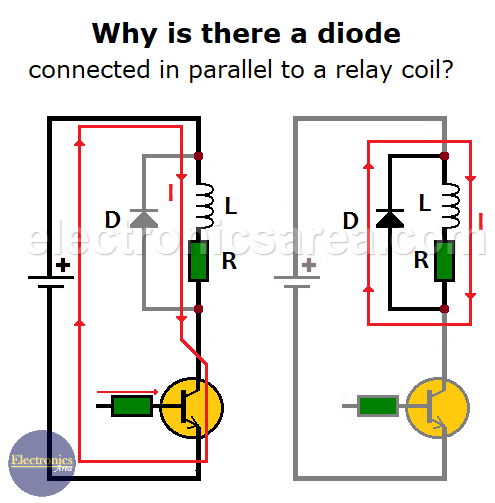
I see a number of relays (not all, but some, including the start relay) that have a diode placed in a loop around/between the terminals for power and ground on the coil circuit. Having dealt with this style relay for years, I don't understand the need for a diode in this application. Maybe someone can give me a "nutshell" explanation for why that might be needed?

I'm not looking for long winded breakdown on the theory of diodes/rectifiers, atoms and molecules, protons and neutrons or any of that. I know what a diode does. I just don't see why there would be one here.
 
   / Relays and diodes #2  
Can you post a circuit diagram?
 
   / Relays and diodes
  • Thread Starter
#3  
Not really. I don't have anything I can post and am not computer literate enough to make one up.
 
   / Relays and diodes
  • Thread Starter
#6  
From that I'm picturing something on the order of induced voltage as in an automotive ignition coil. Points open and close, circuit in primary coil winding generates voltage in secondary winding, that sort of thing. Maybe not precisely the same, but some of the principles overlap a bit.
 
   / Relays and diodes #8  
From that I'm picturing something on the order of induced voltage as in an automotive ignition coil. Points open and close, circuit in primary coil winding generates voltage in secondary winding, that sort of thing. Maybe not precisely the same, but some of the principles overlap a bit.
The voltage is induced the same way as an ignition coil. When power is removed from the relay coil the magnetic field collapses just like in an igniton coi.
Ericl
 
   / Relays and diodes
  • Thread Starter
#10  
How about that? I've installed more of those relays than I can count, on all sorts of tractors, for all sorts of reasons. A good many with computers. No one has ever accused me of damaging their computer because of a diodeless relay. You learn something new every day, whether you want to or not.
 
   / Relays and diodes #11  
Yes that's what the diode across relay coil is for, to dampen reverse or back emf. No diode means noise or a voltage spike happens along the supply line which can cause damage.
Sometimes you get lucky without it, but better safe than sorry.
I'm a retired electronic technician 43 years.
 
   / Relays and diodes
  • Thread Starter
#12  
And you have seen how many tractors damaged by improperly wired relays? I've only been working on tractors since 1972 and haven't found one yet. Go figure.
 
   / Relays and diodes #13  
I'm replying to your original post..."What's the diode for". I and others gave you the answer, it's not an argument. People do things for years that "work", it doesn't mean it's the correct way or should be done that way.
Reverse EMF is purpose of the diode.
 
   / Relays and diodes
  • Thread Starter
#14  
I get the picture, and yes, my question was answered.

Thanks to one and all.
 
   / Relays and diodes #15  
Keep in mind some applications have external diodes across relay socket, some applications have diode internally inside the relay case..... When replacing a relay do it by part number(style)...
 
   / Relays and diodes #16  
And you have seen how many tractors damaged by improperly wired relays? I've only been working on tractors since 1972 and haven't found one yet. Go figure.
Things change and so a diode may be necessary now where it didnt used to be. I can give you a case in point. My old 2000 something Lexus lost the left low beam headlight function. I have been trying to find the fault. The fault is in the positive wire, not the ground. So far no luck. But since I need a left low beam I wired in a relay. So when the right low beam turns on the relay I added is energized and it supplies power to the left low beam. But when I turned off the headlights the voltage spike burned out the right low beam. The headlight was old but still... So I added a diode across the relay coil. No more burned out headlights. More important is no more voltage spikes that might damage other electronics. It could be the same for your tractor.
Eric
 
   / Relays and diodes #17  
Your relays are equipped with "Kickoff Diodes" A relay is basically a coil that stores energy in the circuit like pushing down with weight on a spring. When the voltage is removed from the coil currents rushes back in the circuit in the opposite direction.
Like releasing a coiled spring, this current shorts across the diode resulting in a brief pulse of heat (like dropping voltage across a resister), this short across the diode makes the coil switch off quick that making the contacts on relay switch off fast.
 
   / Relays and diodes #18  
I've been studying the circuit diagrams and operation of various electrical functions in the service manual for the Kioti DK 35 45 50 tractor.

I see a number of relays (not all, but some, including the start relay) that have a diode placed in a loop around/between the terminals for power and ground on the coil circuit. Having dealt with this style relay for years, I don't understand the need for a diode in this application. Maybe someone can give me a "nutshell" explanation for why that might be needed?

I'm not looking for long winded breakdown on the theory of diodes/rectifiers, atoms and molecules, protons and neutrons or any of that. I know what a diode does. I just don't see why there would be one here.
Diodes make sure there is no feed back on a circuit .
 
   / Relays and diodes #19  
Snubber diode, flyback diode, the names continue. There are pre-made cubes called "arc-killers" that contain various combinations of diodes, resistors, and capacitors that all help quell the breakdown voltage that is produced when the coil is de-energized. A relay coil or a solenoid coil can have this phenomena. Without them voltage spikes can occur, and/or relay contact points can be eroded.
 
   / Relays and diodes #20  
I've been studying the circuit diagrams and operation of various electrical functions in the service manual for the Kioti DK 35 45 50 tractor.

I see a number of relays (not all, but some, including the start relay) that have a diode placed in a loop around/between the terminals for power and ground on the coil circuit. Having dealt with this style relay for years, I don't understand the need for a diode in this application. Maybe someone can give me a "nutshell" explanation for why that might be needed?

I'm not looking for long winded breakdown on the theory of diodes/rectifiers, atoms and molecules, protons and neutrons or any of that. I know what a diode does. I just don't see why there would be one here.
As others have said, when voltage is removed from the coil, the magnetic field generated by the coil collapses, generating a voltage spike in the circuit. To protect sensitive components from the spike, a diode is used to "bleed off" the spike.
 

Tractor & Equipment Auctions

1996 Ford Ranger Pickup Truck (A59230)
1996 Ford Ranger...
5004 (A55851)
5004 (A55851)
2015 Peterbilt Dump Truck (A55973)
2015 Peterbilt...
24in pin on excavator tooth bucket (A56438)
24in pin on...
2013 Ford C-Max Energi Hybrid PHEV Hatchback (A59231)
2013 Ford C-Max...
CATERPILLAR 627K SCRAPER (A52707)
CATERPILLAR 627K...
 
Top
