Mud Mess Jobsite

   / Mud Mess Jobsite #1  

chris the wrench

Silver Member
Joined
Sep 15, 2017
Messages
115
Location
Chinook Pass
Tractor
Kubota L3902 & BCS 853
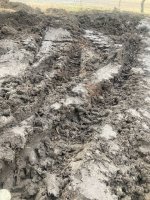
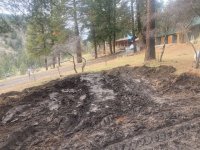
We are building a few pole style covers on our property this year and with the warm winter(aka crappy skiing) I thought I would get a head start. About a month ago I cut a terrace, roughly 24'x24' feet into one of our gentle slopes. The cut side is probably 20-24" below the previous grade. When I did this the temps were constantly below freezing and the ground dug and moved really nicely. I had it pretty dang level. I piled extra high on the downhill side to allow for some compaction. Well today I decided to do a little touch up and get it closer to ready for putting post holes in. Welp that was a mistake. Tires sank to the belly of the tractor, and my once pretty dang close job site is an absolute cr@p show now. Mud everywhere, tractor tire trenches going every direction.

This will be a gravel floor when it's done.

What are my options to deal with the current mud mess:
Wait for constant warm/dry weather to naturally dry it?
Add some gravel/rock, but will that just add to my mess?
Lime?


Thoughts/suggestions, besides don't do that again!
 

Attachments

  • IMG_7743.jpeg
    IMG_7743.jpeg
    251.5 KB · Views: 167
  • IMG_7744.jpeg
    IMG_7744.jpeg
    301.3 KB · Views: 163
   / Mud Mess Jobsite #2  
I think I might start building while you're dirt dries out and just touch up the grading when you can work the dirt.
Pretty spot there!
 
   / Mud Mess Jobsite #3  
Wait it out, adding rock or gravel will just mix in and raise the surface grade and it will never have any stability.
I have a large aversion to cut and fill it almost never gets compacted well enough and continually settles for 3-5 freeze thaw cycles.
 
   / Mud Mess Jobsite
  • Thread Starter
#4  
I have a large aversion to cut and fill it almost never gets compacted well enough and continually settles for 3-5 freeze thaw cycles.
I hear what you are saying. On the filled side there will be 3 posts, each set bout 24"-30" below the previous grade height. So even after compacting my gravel may settle some, but I think the structure shouldn't be affected and I can add more gravel as needed.
 
   / Mud Mess Jobsite #5  
If you have to proceed now digging that out and replacing with workable material is the only real solution. Waiting for it to dry is a lot easier.
 
   / Mud Mess Jobsite #6  
Hard to tell from the pics but there appears to be a lot of organic matter in that soil.
You can never build a pad out of that material.
To build a pad that an engineer would sign off on I had to cut all the organic matter from the site then build the pad up with clay.
If you dont take the topsoil off the downhill side before you start building it up the fill can slip because it will not bind with the topsoil.
Have seen this occur many times.
 
   / Mud Mess Jobsite
  • Thread Starter
#7  
Hard to tell from the pics but there appears to be a lot of organic matter in that soil.
All the grass/brush/roots were scalped before the original digging, anything thats there now is from stuff that blew in or tracked in.

But I hear what you are saying. Our snow load automatically qualifies us for having to have an engineer involved for even the smallest carport.
 
   / Mud Mess Jobsite #8  
I think the main problem was the soil wasn’t or wouldn’t compact on the initial fill.
I haven’t done any commercial work in a few years. To get good compaction with smaller equipment you need to spread no more than a 8 to 10 inch lift of fill then with a full bucket run back and forth compacting that layer before adding the next.
I did this 40’ x 50’ pad for my neighbor this year. The fill area goes from 6” to 3’. The clay was barely damp enough to get compaction. I thought I was going to need to wet it some.
But it turned out well.


IMG_6596.JPG
 
   / Mud Mess Jobsite #9  
@chris the wrench

How far down is rock? Also how far down is the frost line, and were you planning on putting your (concrete?) piers in below the frost line? Given that the site is on a slope, I would want the piers pretty far into native soil, especially given your snow loads...

Given the slope in the photo, I would strongly encourage you to plan on a swale and an impermeable membrane, or even a concrete footing on the uphill side to keep rain and melting snow from seeping in. Since you already know that the black soil you have liquified with water, I think that it would be great preventative medicine to do a fair bit to keep it from ever getting wet in the future.

My personal preference would be to dig it out and put rock / gravel / fines down in compacted layers. Your soil is undoubtedly different, but I have a similar looking soil that loses all cohesiveness when wet. Either you don't build on top, or you keep it from ever getting wet.

All the best,

Peter
 
   / Mud Mess Jobsite
  • Thread Starter
#10  
How far down is rock? Also how far down is the frost line, and were you planning on putting your (concrete?) piers in below the frost line? Given that the site is on a slope, I would want the piers pretty far into native soil, especially given your snow loads...
Frost line is 24”, piers will be 48”(I believe, but I have not gotten final engineering drawings). So on the filled side they would still be 24-30” below the native grade.
 
   / Mud Mess Jobsite #11  
48" by? I defer completely to a local engineer; just curious.

All the best,

Peter
 
   / Mud Mess Jobsite #13  
Anything that you do now will just create more problems later. I understand that you want to get started but spring will be here before you know it.
 
   / Mud Mess Jobsite #14  
I think the main problem was the soil wasn’t or wouldn’t compact on the initial fill.
I haven’t done any commercial work in a few years. To get good compaction with smaller equipment you need to spread no more than a 8 to 10 inch lift of fill then with a full bucket run back and forth compacting that layer before adding the next.
I did this 40’ x 50’ pad for my neighbor this year. The fill area goes from 6” to 3’. The clay was barely damp enough to get compaction. I thought I was going to need to wet it some.
But it turned out well.


View attachment 851219
Good advice except place fill max lift of six inches
 
   / Mud Mess Jobsite #15  
here is your choice …
-wait for it to dry
-scrape that soupe and replace with sand then gravel
-add a lot of gravel on top until it become solid

you played in it for too long while wet. first option might take a while for the other two you should still wait for things to dry up at least a little, the second option it might just keep sinking while you are digging but there is ways of doing it … lay sand and remove the mud in front of it then replace that void with sand while creeping forward and repeating this process. the second it will take a lot of material and it will push the mud to the side and mud will infiltrate the gravel but eventually you will get it … the last two options will cost ya but all three will work, but none is perfect for you at this point.
 
   / Mud Mess Jobsite #17  
Good advice except place fill max lift of six inches
not ready to say max on the six inch lift, do you think 2 inch makes that much of a difference? on culvert replacement on the highway we did 10 to 12 inch lift with sand and 8 to 10 inch lift with gravel but that was compacted with diesel plates and plenty of water, it passed compaction tests every time...
 
   / Mud Mess Jobsite #18  
The depth of the lift is related to a couple of things;
  • What you are compacting
    • Rock
    • Gravel
    • Sand
    • Clay soil
    • Loam type soils
  • the force of the compaction
    • Weight of the machine
    • Area of the machine tires / roller
    • Any vibratory force
    • The type of roller; e.g. sheep's foot vs smooth vs tire
  • the cohesiveness of the material
    • Dry vs wet
    • Clay vs sand
    • Smooth vs angular
    • Size of the material
I personally would be hesitant to say X inches of lift is ok without knowing most or all of the above. Professional engineers have tons of material for specifying this, and often field check to verify the reality over the theory.

I think we would all agree that the OP @chris the wrench has an issue, and that there might be a few solutions.

All the best,

Peter
 
   / Mud Mess Jobsite
  • Thread Starter
#19  
I think we would all agree that the OP @chris the wrench has an issue, and that there might be a few solutions.
Just one issue? Thanks, I appreciate the optimism! But I appreciate the feedback more.

-scrape that soupe and replace with sand then gravel
-add a lot of gravel on top until it become solid
I was thinking something similar to what you are describing, but the price for rock/sand delivery to me is quite high(atleast for this project). That being said I was initially planning on hauling in a bunch of 3/4 minus and spreading it on the existing earth as my floor, but with this current condition, or even if it's all dried out by May, Im wondering if I will need to bring in some 3-4" minus, compact and then add my 3/4" minus topcoat.


I appreciate all the responses, I think Im going to go with the wait for it to dry out naturally method. I went out this morning and it was partially refrozen enough to walk around so I could take some more measurements. Apparently I put the majority of the cut away material further downhill then the footprint of the building will be, so where the 3 of the 4 posts will be going on the downhill side there is maybe 2" of fill ontop of the natural earth while one post will go in what was in a dip and will probably have 8-10".

Im still surprised by how much I chewed up the natural earth that I had exposed(not the fill), with ruts yesterday. :eek: argh!!
 
   / Mud Mess Jobsite #20  
3 to 4 inch minus material compaction is out of this world, very pricy as it is very heavy... but that's the best you can get in my opinion, I wouldn't put material right over the ruts it will create a uneven sub contact and it will eventually translate to the surface... at least back blade it first and put that 3/4 inch material on top, one lift of 10 inch and it might or might not be solid at that point depending how soft the ground is, its hard to tell just like that but that will be the material that will give you the best chance. The issue if if it keep raining, now you have a hole that would retain the water in that's less then ideal.

You need about 25 cubic yard of material to fill this hole as is.
 

Tractor & Equipment Auctions

Rooster Weathervane (A59231)
Rooster...
2018 ARIENS RIDING MOWER (A56859)
2018 ARIENS RIDING...
2012 International WorkStar 7300 AWD Altec DC47TR Insulated Digger Derrick Truck (A60460)
2012 International...
2016 MACK CXU613 MID-ROOF SLEEPER (A58214)
2016 MACK CXU613...
2020 Caterpillar D5K2 LGP Crawler Tractor Dozer (A56857)
2020 Caterpillar...
2024 CATERPILLAR 305 CR EXCAVATOR (A52709)
2024 CATERPILLAR...
 
Top