2 wheel or 4 wheel?

/ 2 wheel or 4 wheel? #21  
"You're right about the N's not being "that bad" also. Compared to a wheel hoe or a spade fork, I'll take an 8n any day of the week. The Sherman transmission is great, yes. I had one on my '52. It engages between the motor and transmission, though, so the PTO gets slowed down too. If you could put it in low range and still have 540 PTO RPM, that'd be great, but you can't. Makes life easier backing up that firewood wagon, though. I don't know what the **** they were thinking making reverse so fast. Also, when I'm talking about N's, I'm not including the jubilees or the hundred series. They aren't in the same series or class of tractors. Overhead valves, live hydraulics, optional live power, power steering, and different gear options make the hundred series MUCH MUCH better machines! "

Interestingly, the NAA, 600 and 800 series don't cost a lot more than an 8n. People want 2-3 grand for an 8n, and that's usually what the NAA and 600s go for. 800s too sometimes, nicer (parade ready) examples of NAA, 600 and 800 seem to hit the 5-7K range around here. But, parade 8Ns are priced that way too. I don't believe in Parade value myself...take your show tractor and stuff it, I've got work to do!

I was also thinking, a Troy Horse is a pretty serious machine, the Italians would call it a 2 wheel tractor and not a "garden tiller". In my head your dad had a 2 wheel and 4 wheel tractor, just like me!
 
/ 2 wheel or 4 wheel? #22  
Great discussion, everyone!

I spoke with EarthTools again, and they seem to get nervous about anyone trying to use their tractors on much more than 1/2 acre. I told them I'd hire out the plowing with a 4 wheel tractor and use the 2 wheeler for everything else, but even with 1 acre they said that's a "mega-farm" for a 2 wheeler. I know of people (and not just Jean-Martin) using BCS on an acre or more, so I know it's doable. But according to Earthtools at least, that's people who have no problem with working crazy hours. For a 4 wheel tractor, an acre can be plowed/cultivated in a matter of hours. For 2 wheels, 1 acre means dawn to dusk plowing (or harrowing or whatever) for 2 whole days. Presumably this is precisely what Jean-Martin does. So the question here becomes "Is it worth it?"

That's where we get back into the discussion of bed spacing. Many vegetable growers appreciate being able to straddle rows or jump over rows easily, which has led to the popularity of the 30" bed. The minimum tread spacing on most 4 wheel tractors is 48", which is slightly too wide to straddle (I'm 6'4" so I'm able to do it just barely, but there's nothing wrong with staying on one side of the path, harvesting down the row, then coming back up the other side to harvest the other half). On the other hand, many growers working with 4 wheel tractors plow rows "on the flat" or use some kind of bed shaper to make narrow single rows. It's not really a permanent bed system, but the plowing is more efficient so that doesn't matter so much. However, this tends to leave more open bare soil, which gets weedy and can erode away on the wind if kept well-weeded. This can be mitigated with mulch (whether plastic or organic matter).

There is the question of row-feet per acre. The land I'm working with is about 540' x 150', which is just shy of 2 acres. With 60" strips (4 wheel tractor spacing) and 100' beds, I get 30 rows of beds with 5 beds per row (10 feet head on the end of each bed for turnaround). That's 150 beds and 15,000 row feet. If I use 42" strips (2 wheel tractor spacing), I get 43 rows, but still 5 beds per row. You don't magically get more beds per row if you don't need 10 feet of turnaround, because the beds are still 100 feet long. If the width was 100' instead of 150', I could easily rearrange so that some beds on the end run perpendicular, but in this case there's simply going to be wasted space no matter what. Anyway, that gives 215 beds total, which means 21,500 row feet. Now, on the surface, it looks like "more row feet = more vegetables = more money per acre", right? Well, the devil is in the details. With 48" beds, I can plant more rows of carrots and beets and spinach and all the small vegetables. Then, for large vegetables, like say tomatoes... so tomatoes are going to be trellised up, and the leaves below the lowest fruits will be removed, creating light and space for small vegetables like more carrots to be interplanted directly beneath the tomatoes. With 30" beds I'd worry about root competition and available light, with 48" I'm not as worried. Then there's the bed hogs like melons and squash. If you do 30" beds, you're sacrificing a lot of beds to let them sprawl. With 48" beds (plus paths), you're only sacrificing one adjacent bed for sprawl.

And then we get to the heart of it all: is it truly feasible to use BCS/Grillo on the whole 2 acres? Those machines force you to stay small, because if you try to do too much with them you get burnout. In all likelihood I wouldn't cultivate more than 1 acre with the 2 wheel, which would be something closer to 11,000 row feet. Certainly you can still make a living off of that. But I happen to have extra land.

Of course there are more considerations. Commercial grade rowcovers and landscape fabrics are more common in 4 foot widths than 30". High tunnels are usually 14 feet wide, which is just enough for 3 4' beds plus two paths. (Granted, it's also the right size for 4 30" beds plus paths). And then there's the issue of breakdowns and repairs, which was one of my main concerns about using an old 4 wheeler. I'm not sure that I have an answer, except to say that because (used) implement prices are so much cheaper for 4 wheel tractors, I can buy 2 tractors and still come out ahead of buying all new gear for 2 wheelers (I can't wait for years scouring classified ads in a 500 mile radius for a used BCS). I'm not yet convinced that I need a 48" version of the Rinaldi power harrow when a disc can do almost as good a job for a fraction of the price. I acknowledge that repair bills for 4 wheel tractors could be hefty. In the "Organic Farmer's Business Handbook", Wiswall estimates (from experience) that the average annual repair bill for a Ford 4000 is $300.

So, all in all, I think I'm finally convinced to go the 4 wheel tractor route. Maybe in 2 years I'll look back at this post and think "Ha! What a fool!" Oh well, that's life.

I bookmarked an article in I think Yesterday's Tractors about "What to look for in a used tractor" which went over some of the mechanical stuff to look at. Does anyone have any other resources like that?

I'd love to chat with you sometime about more specific stuff on spacing if you'd like. Our rear tires on the Kubota are adjustable. They're at 53" on center right now. That leaves 40" between tires. All of the people who spend time on the farm can hop over the rows. We get a LOT of crop on one acre of land. I do not feel that the tractor impedes that goal. Our tires could actually be an inch or two closer together, and i think the next frame size down would allow you an even narrower bed. We are making raised beds that fit between the tires in our system, by the way.

Also, regarding hoop houses, we've got two of those, a 14x88 and a 30x96. The 14x has three beds and two aisles. The 30x has five beds and six aisles. Yes, the 14x is a better use of space, but I hate picking spinach from the outside beds in the spring. You've got to be outside in the cold and rain instead of in the hoop house. If you can at all manage it, I highly recommend a wider high tunnel.

If you can find his number, Martin Diffley (started Gardens of Eagan) is an incredible tractor resource for old iron. He can tell you everything there is to know about veggie growing with any tractor you can think of. He does equipment consulting now, and should be easy to track down.

In two years, if you think not having a 2 wheeler is a problem, you can always add one!
 
/ 2 wheel or 4 wheel? #23  
"You're right about the N's not being "that bad" also. Compared to a wheel hoe or a spade fork, I'll take an 8n any day of the week. The Sherman transmission is great, yes. I had one on my '52. It engages between the motor and transmission, though, so the PTO gets slowed down too. If you could put it in low range and still have 540 PTO RPM, that'd be great, but you can't. Makes life easier backing up that firewood wagon, though. I don't know what the **** they were thinking making reverse so fast. Also, when I'm talking about N's, I'm not including the jubilees or the hundred series. They aren't in the same series or class of tractors. Overhead valves, live hydraulics, optional live power, power steering, and different gear options make the hundred series MUCH MUCH better machines! "

Interestingly, the NAA, 600 and 800 series don't cost a lot more than an 8n. People want 2-3 grand for an 8n, and that's usually what the NAA and 600s go for. 800s too sometimes, nicer (parade ready) examples of NAA, 600 and 800 seem to hit the 5-7K range around here. But, parade 8Ns are priced that way too. I don't believe in Parade value myself...take your show tractor and stuff it, I've got work to do!

I was also thinking, a Troy Horse is a pretty serious machine, the Italians would call it a 2 wheel tractor and not a "garden tiller". In my head your dad had a 2 wheel and 4 wheel tractor, just like me!

Yep, you're right on both accounts! I can't believe why anyone would buy an N when you can get a hundred series for almost the same price. I know my dad would have been much happier with one of those instead of the N's.

And, yes, the Horse definitely qualifies as a tractor. There aren't many other implements available for it, but it's a tractor. They hold value too, just like the 4 wheelers. I see them on Craigslist around here for $600-1000.

Since we got the three point tiller, the Horse mostly gets used in the hoop houses and in a few places where the tractor can't get because of crops in the way. I certainly use it, but I could live without it if I had to.
 
/ 2 wheel or 4 wheel? #24  
Now, that said, there's plenty of other tractors but much newer that are much better suited. Unfortunately, if you want to run three point equipment, which is a huge plus, we have to skip most of the farmalls.

Hold on now! My daddy always told me "Son, if it ain't red, leave it in the shed!!" And think about this: Why farm some when you can FARMALL???
 
Last edited:
/ 2 wheel or 4 wheel?
  • Thread Starter
#25  
Last night my partner told me "First you were all excited about walk-behinds. Then you switched over to 4 wheel tractors. Then you were back to walk-behinds. Yesterday you were all about the 4 wheels. Tomorrow I fully expect you to extol the virtues of 2 wheel tractors and shun the 4 wheel."

So I slept on it and now I'm back on the 2 wheel tractor wagon. She's a smart cookie.

Anyway, here's my reasoning. Marketing. All the millennial hipster farmers are using BCS. How can we save the world if we aren't using 2 wheel tractors? 4 wheel tractors, like, pollute the planet or something. My equipment has to match my image, you know. I'm growing an epic beard, I'll be growing microgreens and kale. I'll be selling to juice bars and using an iPad at the farmer's market. I'll get my friend to play his gourd banjo at my booth, singing songs about collard greens and butter beans.

Hm, then again, those old Fords do have that "vintage" cachet. Antique vintage stuff is always hip.
 
/ 2 wheel or 4 wheel? #26  
Arrows,
The obvious answer is to get both. You should always have an extra Arrow in your quiver.
 
/ 2 wheel or 4 wheel? #27  
Last night my partner told me "First you were all excited about walk-behinds. Then you switched over to 4 wheel tractors. Then you were back to walk-behinds. Yesterday you were all about the 4 wheels. Tomorrow I fully expect you to extol the virtues of 2 wheel tractors and shun the 4 wheel."

So I slept on it and now I'm back on the 2 wheel tractor wagon. She's a smart cookie.

Anyway, here's my reasoning. Marketing. All the millennial hipster farmers are using BCS. How can we save the world if we aren't using 2 wheel tractors? 4 wheel tractors, like, pollute the planet or something. My equipment has to match my image, you know. I'm growing an epic beard, I'll be growing microgreens and kale. I'll be selling to juice bars and using an iPad at the farmer's market. I'll get my friend to play his gourd banjo at my booth, singing songs about collard greens and butter beans.

Hm, then again, those old Fords do have that "vintage" cachet. Antique vintage stuff is always hip.

Well, to be eco friendly you just need anything diesel. Actually the ford 861 came in a diesel variant. a kubota or like that bcs 853 on craiglist I posted a new thread about, are diesel. My rationale is that you can burn used french fry oil, your tractor exhaust is supposed to smell like french fries, and the way I see the so called "carbon footprint" is that if you burned the exact amount of carbon that the oil producing plants took out of the air it would be carbon neutral, BUT there's a lot of carbon that goes into plant fibrous material that does not go into the extracted oil product, perhaps even more carbon goes back into the soil and is trapped there. Even if the tractor that farmed the oil crop is petroleum fueled (likely), field tractors are so efficient at planting huge crops, I think we might be looking at a net carbon sequesting operation by running biodiesel! Now that's internal combustion guilt free, even for angsty millenials!
 
/ 2 wheel or 4 wheel?
  • Thread Starter
#28  
Well, to be eco friendly you just need anything diesel. Actually the ford 861 came in a diesel variant. a kubota or like that bcs 853 on craiglist I posted a new thread about, are diesel. My rationale is that you can burn used french fry oil, your tractor exhaust is supposed to smell like french fries, and the way I see the so called "carbon footprint" is that if you burned the exact amount of carbon that the oil producing plants took out of the air it would be carbon neutral, BUT there's a lot of carbon that goes into plant fibrous material that does not go into the extracted oil product, perhaps even more carbon goes back into the soil and is trapped there. Even if the tractor that farmed the oil crop is petroleum fueled (likely), field tractors are so efficient at planting huge crops, I think we might be looking at a net carbon sequesting operation by running biodiesel! Now that's internal combustion guilt free, even for angsty millenials!

Seriously though! I wanted to get a diesel Grillo to run biodiesel from the old grease from my restaurant customers, but EarthTools said they've seen a lot of problems when people try to do the homebrew stuff, messing up the engine or whatever. Maybe they're just saying that for liability reasons? Ok, I get that it voids the warranty, that's to be expected. But I also want to protect my $4000 investment by running the kind of fuel it was designed to run on. You're running biodiesel, right? You ever had problems?
 
/ 2 wheel or 4 wheel? #29  
Seriously though! I wanted to get a diesel Grillo to run biodiesel from the old grease from my restaurant customers, but EarthTools said they've seen a lot of problems when people try to do the homebrew stuff, messing up the engine or whatever. Maybe they're just saying that for liability reasons? Ok, I get that it voids the warranty, that's to be expected. But I also want to protect my $4000 investment by running the kind of fuel it was designed to run on. You're running biodiesel, right? You ever had problems?

They say that because fry oil and biodiesel is highly variable in quality. One guy does a great job making it, the next guy doesn't so much as strain it before he dumps it in. if you are set up with the proper equipment to make actual bio-diesel, and do a good job, you'll likely not have problems. To be sure, you can cut it with diesel. Colder, use more diesel, maybe make B50 (50/50 diesel). Warmer, use less diesel, B80. It wouldn't mess up the engine, just plug up the injectors, and maybe fry the injection pump. It still can be an expensive repair, but it's not a wrecked engine.
 
/ 2 wheel or 4 wheel? #30  
Seriously though! I wanted to get a diesel Grillo to run biodiesel from the old grease from my restaurant customers, but EarthTools said they've seen a lot of problems when people try to do the homebrew stuff, messing up the engine or whatever. Maybe they're just saying that for liability reasons? Ok, I get that it voids the warranty, that's to be expected. But I also want to protect my $4000 investment by running the kind of fuel it was designed to run on. You're running biodiesel, right? You ever had problems?

well, I haven't tried it because my 9n and now my bcs, are gas. However, if and when my acme gas engine gives up the ghost, I'd be very interested to replace it with a diesel. I'd like to try to raise canola or sunflowers and make my own biodiesel. And to the naysaying and fearmongering, I say this. Do a good job making it, and NO GUTS NO GLORY!
 
/ 2 wheel or 4 wheel? #31  
For any kind of grain or field crop farming, you either inherit it, or you go into big debt. But for vegetable farming you don't have to go into debt, or it can be quite minor. you don't need a lot of land to produce lots of veggies...I just point to jean martin fortier in quebec, he works 1.5 acres, all with a BCS and hand tools, and he grosses in the six figure range, even after he pays his hired help they keep like 70 grand, so it's a middle class lifestyle for him and they never really had any debt to speak of. Eliot Coleman says that's the one nice thing about vegetable farming, that you don't need to go into debt to do it. It's unlike field crop farming or big cattle ranching in that regard, where they say "get big, or get out!"

I find the old utility tractors are usually in the 2-5K range, but 9n are out there for 1500. They don't have hydrostatic or 4wd, but in many cases they are equal or more powerful than machines costing 10 times or more money. Hydro robs power. I mean a 9n is close to 30 hp, what does a kubota 30 hp of the same weight class cost? 15-20K? Or more depending on options?!? A ford 861 is not a lot bigger footprint than an 8N but it's around 60hp, that's just nuts! Power steering, live hydraulics, live PTO. They sell for 3-5K. Probably 30-40K for something like that from Deere or Kubota I'll bet. Lots of retired farmers restore old tractors as a hobby, and there are some great running machines out there. Just don't buy one that's beat all to **** and left outside all year for 50 years, heck for the money you save you can buy two so you won't be lacking the use of it when one of them needs repairs.

I'm actually envious of the people in Wisconsin. The farm density is higher or has been higher due to all the dairy farms, and it's like a utility tractor paradise over there! I wonder if it isn't the best place in the USA to buy old american tractors. Close to Michigan too where they made a lot of that stuff! When I get bored I look on craigslist tractor ads and think "if only that beauty was here and not 500-700 mi away in Wisconsin!"

Look at this beautiful piece of old American Iron!

105_0523.jpg

Thanks for getting me to dreaming about reliving the past with that photo. If I had the money and covered storage I would have to have that 861.

OP this was the tractor that Dad used to put out truck patches. A 6.5' disk, 2 bottom plow and a 2 row corn planter with an assortment of plates for different kinds of seeds plus a two row set of cultivators would work well for little cash if it was just a working tractor and not for show like this one in the photo. A nice walk behind tiller would be the icing on the cake.
 
/ 2 wheel or 4 wheel?
  • Thread Starter
#32  
Well, I've carefully considered everyone's input, and kept researching all kinds of tractors. I searched the heck out of craigslist and found a couple BCS's (both 749's) each about 300 miles away from me. What I've read about the 749's seems like they're high-maintenance. The transmission oil and filter have to replaced every 100 hours, which will come up frequently in a large market garden application. Then there's the gas engine, with today's fuel necessitating annoying storage procedures.

Then I started looking into old Yanmars and Kubotas from the 70s-early 80s. And that's when I figured out that I could get a narrow-width tractor with a diesel engine, 3pt hitch, independent PTO (in the case of Kubota) or powershift (in the case of Yanmar), independent hydraulics, 20-30 HP, 4wd and possibly a bucket loader, a wide range of low and high gears, and a simple reliable design that any shade-tree mechanic can understand, with good parts availability. All for somewhere around $5000. And I don't have to drive over 300 miles to find one. I think I'm sold. Gonna go check out some of these over the next couple days.

Question: does having a bucket loader on the front affect traction when pulling discs and plows? Obviously I'd put weight on the back anyway, but didn't know if I'd need more weight than usual.
Hm, I guess any tractor with a loader would have 4wd anyway....
 
/ 2 wheel or 4 wheel? #33  
Question: does having a bucket loader on the front affect traction when pulling discs and plows? Obviously I'd put weight on the back anyway, but didn't know if I'd need more weight than usual.
Hm, I guess any tractor with a loader would have 4wd anyway....

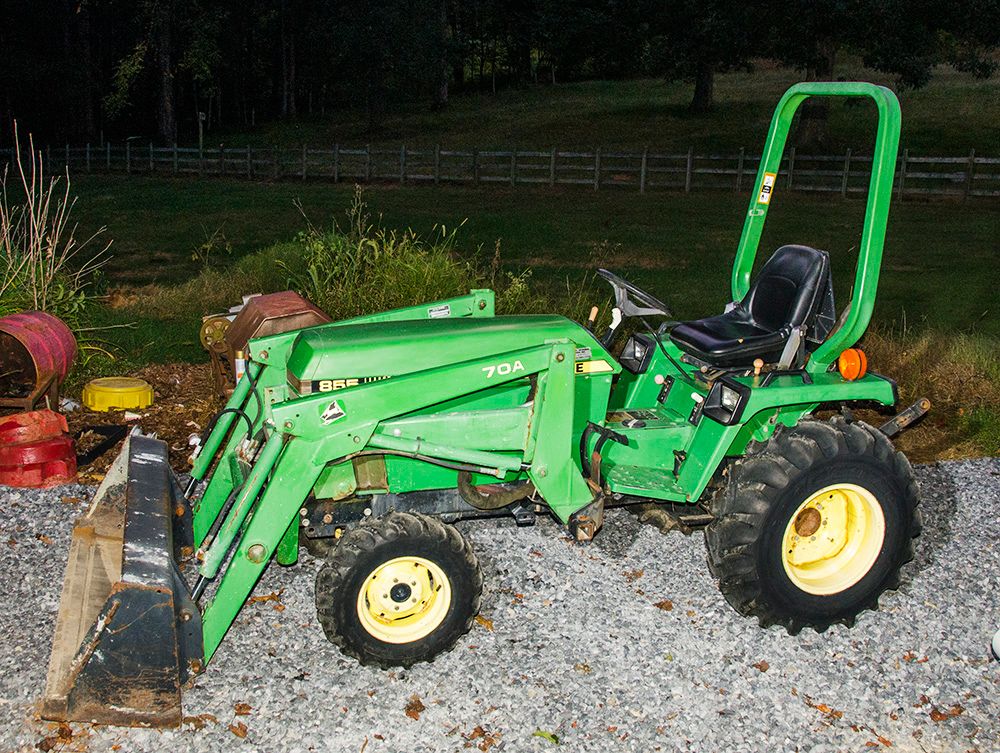
DO NOT buy one unless it has a quick detach loader,,
I have two loader equipped tractors, either loader can come off in about 3 minutes,,,

855-2_zpsieeaffsi.jpg


Gardening is ZERO fun with a loader on the front,,, you are constanty knocking over stuff!!,,,, :confused2:
 
/ 2 wheel or 4 wheel? #34  
Well, I've carefully considered everyone's input, and kept researching all kinds of tractors. I searched the heck out of craigslist and found a couple BCS's (both 749's) each about 300 miles away from me. What I've read about the 749's seems like they're high-maintenance. The transmission oil and filter have to replaced every 100 hours, which will come up frequently in a large market garden application. Then there's the gas engine, with today's fuel necessitating annoying storage procedures.

Then I started looking into old Yanmars and Kubotas from the 70s-early 80s. And that's when I figured out that I could get a narrow-width tractor with a diesel engine, 3pt hitch, independent PTO (in the case of Kubota) or powershift (in the case of Yanmar), independent hydraulics, 20-30 HP, 4wd and possibly a bucket loader, a wide range of low and high gears, and a simple reliable design that any shade-tree mechanic can understand, with good parts availability. All for somewhere around $5000. And I don't have to drive over 300 miles to find one. I think I'm sold. Gonna go check out some of these over the next couple days.

Question: does having a bucket loader on the front affect traction when pulling discs and plows? Obviously I'd put weight on the back anyway, but didn't know if I'd need more weight than usual.
Hm, I guess any tractor with a loader would have 4wd anyway....

I'd say since the loader is attached to the tractor, overall it puts more weight to all wheels than if not attached. But i'd never want to keep one on a field tractor day after day. Clunky and in the way. Some modern ones are not too bad to take on and off, I think a lot of older units are a bugger
 
/ 2 wheel or 4 wheel? #35  
I have a koyker K6 for the front of my 1977 4430. It takes about half an hour to mount and dismount it. I hate it, and wish I'd never bought it. It's nearly never on because I also have a 317 Deere skid steer. Loaders on tractors are always a compromise. They're bulky, add weight to the front axle, and not very user friendly. I grew up on a 60 cow dairy farm and we never had a loader on a tractor. I now know why. Skid steer loaders are unbeatable in just about any task versus a tractor and loader.
 
/ 2 wheel or 4 wheel?
  • Thread Starter
#36  
Hm, yeah, I was wondering about the awkwardness of having a loader attached when it's not being used. Well, the guy with the FEL tractor isn't returning my emails and voicemail, so maybe I'm dodging that bullet anyway.
 
/ 2 wheel or 4 wheel? #37  
Bill, I see in your tagline you own both a double moldboard plow and a dual rotary plow. What is or would be your preference for breaking new ground? Off hand it seems like the rotary plow would be simpler since it doesn't seem like tire weights or having larger diameter or width tires for the added traction is as much of an issue.

My next soilworking implement purchase is probably gonna be a rotary plow. For my immediate use it seems like the single rotary plow would be just fine for running it in a circular route around my established rectangular shaped raised beds to maintain their raised height, and it's a lot cheaper than the double. The only issue is if I'm gonna regret it in the future when I want to break new garden plots, there I can see some real time saving in being able to go up and down and keep all the soil thrown in the same direction. With the single rotary people are either driving back to the original plowing point or working on the outermost edges of the new plot and eventually meeting up in the center. I read that the dual rotary is best for working on slopes, but honestly out here in great plains farming country the fields are very flat, I'd say virtually pancake flat! Do you think the dual rotary plow is worth the extra $650 vs the single if buying a new plow?
 
/ 2 wheel or 4 wheel?
  • Thread Starter
#38  
Do you think the dual rotary plow is worth the extra $650 vs the single if buying a new plow?

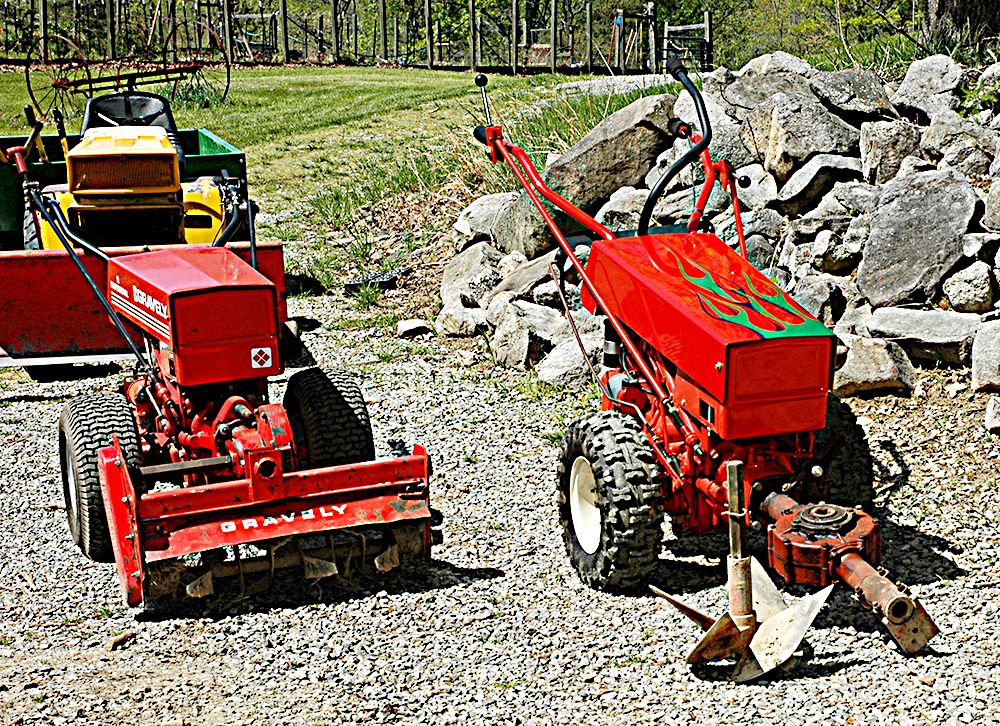
I know you weren't addressing me, but I just wanted to say that while I was searching craigslist I found a couple of old Gravely's with dual rotary plows. These are the originals, with no safety features - they spin the blades out in the open and god help anyone who gets in the way! But if cash is tight, you can get a good machine for no more than $1000.
 
/ 2 wheel or 4 wheel? #39  
My next soilworking implement purchase is probably gonna be a rotary plow.

My favorite soil working tool is my rotary plow.
I use it seldomly for garden plowing (I do not believe in turning over a garden, that is another story!!:confused2:)

I use the rotary plow for planting smaller plants (not trees) such as blueberries.

I have probably planted over three hundred plants with it.

I have cleaned ditches, installed gutter run-off pipes,,, etc with it.
This is a pic of my rotary right after I had planted a 200 foot row of periwinkle for my daughter.

5665Plow_zps282a6e17.jpg


Some of the periwinkle was placed in a trench, more steep locations, I just used the rotary to dig a hole.

Over the years, I have picked up three rotary plows,,, and I have two brand new, un-used plows.
So, I do not worry about damaging one,, let the rocks come on!!
 
/ 2 wheel or 4 wheel?
  • Thread Starter
#40  
Alright, I am now the proud owner of a Yanmar YM2500! Right up until I called the guy to say I'd take it, I was still analyzing craigslist BCS's vs. this tractor. If there's anyone in my area who has a 2 wheeler, I'd totally be up for doing a contest to compare one acre of Yanmar vs. one acre of BCS. I suspect the two wheelers will still give a finer seedbed (since I'll just be using a disc and chain harrow, until thousands of dollars rain from the sky so I can afford a Rinaldi), but since I'll be transplanting most things, I don't think that will be too much of a problem for me.
 

Marketplace Items

2019 DRAGON ESP 150BBL ALUMINUM (A58214)
2019 DRAGON ESP...
2018 Toyota C-HR SUV (A59231)
2018 Toyota C-HR...
2016 WANCO WTSP PORTABLE ARROW BOARD (A60429)
2016 WANCO WTSP...
iDrive TDS-2010H ProJack M2 Electric Trailer Dolly (A59230)
iDrive TDS-2010H...
UNUSED FUTURE FT-CL100C HYD CLAMP GRABBER (A52706)
UNUSED FUTURE...
Case 1020 25ft Draper Head (A61307)
Case 1020 25ft...
 
Top