Ok, I finally made my mind. I am going to order the WR long kit. What make me decide my mind is the realization that the hydraulic hoses aren;t as cheap as I thought. So the project may (there is a risk factor here) cost slightly less ($100-$200) best case scenario with many hours on thinking and planning, or a lot more (without even calculating labor hours)
Even though I LOVE diy the route, I believe that this is not my battle! As I have other projects (a plasma CNC on the assembly stage, a firewood processor on the design phase, and the
grapple almost ready to by built) I do not think that this project will be the best use of my time! It is still my most productive winter of my life!

Thank you all for your inputs!!!
Well I didn't mean to talk you out of it. Lol But you really have to be frugal to make a significant savings and like several others have done, when you do it yourself you will most likely add in extras that a pre-made kit won't have. And you do have to factor in your time & labor.
And it's like the guy at my favorite hydraulic shop told me - hoses are cheap, it's the fittings they crimp on that really cost money. You could probably have them made on line (like discount hydraulics) pretty cheap but you're measurements better be good.
I'm guessing with a CNC plasma you wouldn't have any issues fabricating brackets. LOL When I did ours I had a stick welder and an angle grinder, that's why I farmed out the plate on the loader mount.
Steve, fantastic post! I LOVE that you are mention the part numbers and the links to the materials. I will do a few more reads of your thread as it has more information than I can absorb at once!!
Now, the quick question (my apologies if that is answered somewhere I missed), is that I not fully understand the flow around the remotes. So after the FEL valve at the PB, will go the 3rd function valve which will be solenoid operated. This valve has not PB port so it cannot stand any pressure after that point, so it should be the last valve correct?
So how the remotes are connected? (I haven't any right now but I definitely need them) between the FEL and the 3rd funtion solenoid valve? That means that the valve that controls the remotes is PB capable right? So for my tractor it should something like
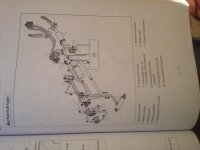
this which I assume will not be attached to (or next to) FEL valve but at a remote location. Then the remotes' valve PB port has to go to the input of the 3rd funcion valve, while the tank ports from both valves have to go to the tank.
Is the above correct?
Just for discussion & education sake . . .
Right now once the fluid leaves the loader valve there is either a hose or a hard line that goes to the rear of your tractor somewhere (mine was under the seat, I've seen some brands that went to the very rear near the top link connection). From here things will get very brand/model specific but they all follow a basic pattern. If you had rear remotes already installed, the flow will go into those next and then into the 3pt lift control last. If you have no rear remotes then there is *usually* some sort of bypass that allows the fluid to continue directly to the 3pt.
You are partially right in your thinking about the pressure on the exit side of the solenoid however there is one big difference between the solenoid and a standard valve.
A standard valve has the ability to "feather" control - or in plain terms you can split the flow of the incoming fluid and direct only a portion into the selected function while the rest continues down to the next valve in series. Whereas a solenoid valve is a basic On or Off - All or Nothing without the ability to split flow or "feather"
Therefore a standard valve will have 5 ports, they may be labeled all sorts of ways but the basic functions are Pressure In (P), Pressure Out (PB), Tank (T), and Work Ports A & B
In the "neutral" open center position fluid comes in port P, passes thru the valve body unused and out port PB thus that port is subject to full system pressure (as you know).
When you operate the valve in direction A then fluid comes in port P and is directed out work port A to one side of the hydraulic cylinder. Meanwhile the opposite side of the cylinder (work port B) is now connected to T on the valve to allow the low pressure "exhaust fluid" escaping the cylinder to flow back to the tank. If you are feathering the valve then any unused fluid in from P will still continue on out of the valve thru PB just as if the valve was in neutral.
The same thing happens when you move the valve in direction B except now P goes to work port B and work port A goes to T, any unused flow still passes thru to PB
On a solenoid valve you only have 4 Ports. You have Power In (P) and Work Ports A & B just like before but now the 4th port is Pressure Out (PB) AND Tank (T) depending on whether the valve is open or in use.
Since all 4 ports are milled into the same block of aluminum then all 4 ports are rated for the same pressure so the outlet port can function as PB.
With the solenoid in neutral fluid flow from P goes right thru to PB and on down stream just as before, however when you operate the solenoid valve to Function A then ALL flow from P goes to work port A and work port B goes to PB (and performs the same function as the T port on a regular valve). And vice versa Function B = P to work port B and work port A to PB (T)
Clear as mud right?
Now looking at the remote kit you linked . . .
I'm guessing yours does something similar to ours. The PB line comes in to the rear end of the tractor somewhere. Near that point there is a plate that's about the same size and shape as the base of that valve block and has the same bolt pattern.
That plate essentially is the bypass that sends fluid coming in from the PB line down to the 3pt control. By removing this plate and installing the valve block shown, the fluid now comes up into the valve body, thru the OC valves and out the PB port back into the tractor and on to the 3pt control.
The rest of the lines & hardware shown are what gets the A & B work ports on each valve back to the rear of the tractor.
I hope that gives you a better understanding of how things work (and not just confused you even more).