7018 use on cast iron

   / 7018 use on cast iron
  • Thread Starter
#21  
Update:

A spark test seemed to indicate that the piece is cast steel (I hope!). So I "V'ed" out the break from both sides to get a 100% weld.

Then heated it with a propane grass burner for about 10 minutes but it did not glow red. Used 3/32" 7018 at 80A for about an inch and immediately hit it with a needle scaler. Repeat, repeat, repeat.

The missing piece was filled with 1/8" 7018 at 125A but was a bit dicey (too hot). So back to 3/32" to finish.

The wear side was filled a bit with 3/32" 7018 and then topped with 5/32" Stoody 31 hardfacing at 150A (a bit cold for this rod).

The piece is currently in a bucket of sand for overnight cooling. Maybe it will come out in one piece tomorrow.

Then it will be on to grinding the critical surfaces that mate with flail mower. Since it doesn't have to be pretty the other welds may be left as is...a bit built up.

Update tomorrow. Thanks for all of the suggestions. Maybe down the line another member can benefit from this discussion as much as I have.
 
   / 7018 use on cast iron #22  
It should be fine if it's cast steel but I don't think you were paying as much attention as you should have. Cast steel doesn't really require any special technique to weld. A little preheat on a heavier section is about it. Warm to the touch is enough. No need to peen it or stick in sand to slow cool.
 
   / 7018 use on cast iron #23  
Generally cast iron will let you know with in a few minutes it's not going to play nice with you. About the time you make the second weld, the first weld will crack, and you can hear it when it does:mad:. Once it's cool, that will be the real truth.
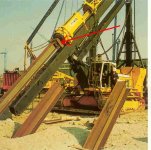
I repaired a lot of these out on a barge, where the best was preheat, and some house insulation for cool down over night. Tell me these things don't take a beaten!:eek:
(Red arrow).
 

Attachments

  • Follower.JPG
    Follower.JPG
    72.9 KB · Views: 198
   / 7018 use on cast iron
  • Thread Starter
#24  
It should be fine if it's cast steel but I don't think you were paying as much attention as you should have. Cast steel doesn't really require any special technique to weld. A little preheat on a heavier section is about it. Warm to the touch is enough. No need to peen it or stick in sand to slow cool.

Oh, I pay attention quite well, thank you. However, with a non-replaceable part for a neighbor's equipment I'll cover all the bases and take all the precautions "just in case".

A suggested earlier, a replacement could be fabricated out of 3/8" flat stock and a very short piece of pipe. A "farmer's fix" if you will. But I feel responsible for my work and if failure can be avoided then whatever it takes+ is what will be done.

Shield Arc: Thanks for the support, observations, and suggestions. I've always learned from your welding posts. I should have waited until Wednesday when my new PA300 that you forced me to buy arrives at my door.

About time to go out and dig the part, or the pieces, out of the sand.
 
   / 7018 use on cast iron #25  
Any concern the stoody hard facing rod will cause problems? I have never used hard facing rod, but hard facing rod is typically not very ductile which seems like introducing a no ductility material would be bad for a cast steel repair.

Otherwise, I have no doubt the 7018 or (your little 115 volt wire feeder if you had went that route) will hold fine. After welding the vees with 7018, then I think I would have done my hard facing build up portion with the little wire feeder as E71T-11 (or mig wire with gas). Wire feeder wire always seems much harder for me to grind than even 7018 and the wire feeder would have offered a slightly harder material for somewhat increased wear resistance yet still remained a ductile material that was introduced.

6013 is usually my rod of choice for parts build ups that I will be shaping with handheld power tools as it cuts the most like virgin mild steel with carbide burrs and grinders. However 6013 would be a bad choice for this cast steel build up since it is not mild steel. That said even lowly 6013 is harder than mild steel.
 
   / 7018 use on cast iron #26  
Did you check with Alamo or just assuming the part is non-replaceable? 10 minutes with a weed burner, it must have been over 1000 deg's. Cast steel and cast iron are two entirely different materials. A lot of people confuse the two or think they're the same thing. That's why I said it's good to know what it is. Cast steel is considered very easy to weld, cast iron not so much. Cast steel is most often used for complex shapes that would be difficult to fabricate. Backhoe swing posts are a common example of cast steel. That said, cast steel doesn't normally break but can in the right circumstances. The hard facing shouldn't affect it if it's just to stop wear and only one pass. Hard facing on cast iron would/could cause a problem because of the rapid cooling after welding and the hard material.
 
   / 7018 use on cast iron
  • Thread Starter
#27  
Never checked with Alamo. Some of the flail mower parts catalogs were checked.

Hard facing was an issue. Stoody says to expect cracking on the box but it was very evident on this piece.

Anyway, here is the finished UN-finished product. As explained in an earlier post, the areas that cracked were built up and left as is rather than to grind them flat. Hopefully, that will give the piece a bit more support.
 
   / 7018 use on cast iron #28  
What kept you from braze welding that part?

Was brass rod not suited for making up the missing piece? I've only repaired two two cast iron bits, both by braze welding, and both made use of the gas BBQ grill for preheat ;-)
Oh! And both are working today after ahh....30 years in the case of the band saw legs, and 24 years in the case of the JD dozer exhaust manifold. (IIRC)

Looks good all painted up!
 
   / 7018 use on cast iron #29  
Brazing would be fine for cast iron but not so much for cast steel. I'd grind it down so it looks better. If it's going to break again, it's going to break regardless if you left the weld ground or not. Too high of build up of weld could cause a notch effect where a new crack could start. Many hardfacing rods are designed to "check" in order to relief residual stress when cooling/shrinking. Painting it up nice and not grinding it kind of defeats the purpose of trying to make it look good. :2cents:
 
   / 7018 use on cast iron #30  
Arc

Are you using "brazing" as the same meaning as "Braze welding" I find the two quite different.

And trust the braze welding on almost any ferrous material that I can get it to flow on. Prep is the same as for welding, not like solder brazing at all.
 
   / 7018 use on cast iron #31  
Using brass/bronze filler would have similar properties to cast iron but cast steel is much easier to weld than cast iron with common welding rods and wouldn't require the heat needed for brazing.
 
   / 7018 use on cast iron
  • Thread Starter
#32  
Arc (and others), I didn't go with the brazing method partially out of inexperience with the process and partially because the piece will be subject to ground impact in the rocky soil around here. It may have been the wrong choice. We will see.

Things such as leaving the weld built up causing problems down the line is also new to me. But so is dealing with cast iron and cast steel. I'm usually more involved with welding up something like a broken disc frame or fabbing some part to make a solution for something that comes to mind while sitting on a tractor all day.

I agree that the piece came out "ugly". The welds are far from "pretty" like a pro would do. Even I can spot mistakes here and there. Thanks to all for being gentle with an old guy's attempt at a fix.

The paint was to make the piece blend in with the flail mower and not be so noticeable.
 
   / 7018 use on cast iron #33  
If you can get a weld to hold it will be much stronger than a brazed weld (using brass alloy) so I think you did the right think. I suspect that piece is cast steel rather than cast iron. Cast iron is used mostly for stuff subjected to heating and cooling like fire grates, engine blocks, manifolds etc because it doesn't expand and contract as much as steel and doesn't rust up when heated as bad as steel or cast steel. Cast iron also doesn't take to shock loading at all, so anything bolted on is likely cast iron. When broken, cast steel is a light grey color where as cast iron is more darker grey with black flecks in it.
 
   / 7018 use on cast iron #34  
If you can get a weld to hold it will be much stronger than a brazed weld (using brass alloy) so I think you did the right think. I suspect that piece is cast steel rather than cast iron. Cast iron is used mostly for stuff subjected to heating and cooling like fire grates, engine blocks, manifolds etc because it doesn't expand and contract as much as steel and doesn't rust up when heated as bad as steel or cast steel. Cast iron also doesn't take to shock loading at all, so anything bolted on is likely cast iron. When broken, cast steel is a light grey color where as cast iron is more darker grey with black flecks in it.

The good part about any repair is that it doesn't need to be "the strongest", just stronger than the parent metal next to it ;-)

(No HAZ with brass, but the part can not be welded after trying to braze it. That's a bummer)
 

Tractor & Equipment Auctions

PowerBoss Admiral Plus 38C Ride-On Floor Scrubber/Sweeper (A59228)
PowerBoss Admiral...
2004 CATERPILLAR 320C L EXCAVATOR (A60429)
2004 CATERPILLAR...
Greenworks Commercial 82V CZ60R Zero-Turn Mower-DEMO UNIT (A56438)
Greenworks...
Deere 333E (A60462)
Deere 333E (A60462)
208789 (A60430)
208789 (A60430)
JCB 220XLC-4F EXCAVATOR (A60429)
JCB 220XLC-4F...
 
Top
