Another Well Problem

   / Another Well Problem #1  

Travelover

Elite Member
Joined
Sep 9, 2002
Messages
3,502
Location
Washington
Tractor
B7100
I'm starting a new thread about the same well that had suddenly provided brown water. Thankfully the water has cleared but I have a new issue.

Currently, I'm getting the sprinkling system ready and now find that the well will not maintain more than 25-ish PSI when any zone is running. For the past 5 years, the pump would hold a steady 40 to 45 PSI while any zone was operating. The well pumps up to 60 PSI fairly quickly during normal household use. It has a 40 to PSI control switch. The sprinklers have been off since October as I live in the Pacific Northwest area.

It occurs to me that I might have slime bacteria partially blocking the well pump intake, the drop pipe might be leaking or the pump itself may be weak. The 3/4 HP pump draws 7.5 amps at 240 volts, which is unchanged.

I'm fishing for ideas / tests that I can make myself before I open my wallet for the pump to be pulled. The well guy who replaced the capacitor intimated that it was probably put in with rigid PVC pipe, as his company installed it years ago and that is their practice. I have not confirmed that, but in any case I'm not up to pulling it myself.

Thanks in advance for any advice.
 
   / Another Well Problem #2  
Can you share how the system is plumbed? I.e. well->2" 75' pipe to house-> to check valve -> to pressure tank -> 2" manifold to house and sprinklers -> 100' 3/4" pipe run to sprinklers?

Did you flush the pressure tank after the brown water episode?
Has the length of the typical house (pressure tank) cycle changed?

I'm guessing that the brown water may have been a sediment intrusion in the well and your pump may be somewhat buried in sediment. Guess! If you do pull the pump, have your well folks check out the casing with a horoscope, and if the casing is ok, clean the well out before replacing the pump.

All the best,

Peter
 
   / Another Well Problem
  • Thread Starter
#3  
Can you share how the system is plumbed? I.e. well->2" 75' pipe to house-> to check valve -> to pressure tank -> 2" manifold to house and sprinklers -> 100' 3/4" pipe run to sprinklers?

Did you flush the pressure tank after the brown water episode?
Has the length of the typical house (pressure tank) cycle changed?

I'm guessing that the brown water may have been a sediment intrusion in the well and your pump may be somewhat buried in sediment. Guess! If you do pull the pump, have your well folks check out the casing with a horoscope, and if the casing is ok, clean the well out before replacing the pump.

All the best,

Peter
The well has a T at the head and 1" rigid PVC heads into the garage with pressure tank about 50 feet away. The other discharge is to a vacuum breaker, then to 1" PVC that runs all over the property, some zones are 300 feet away. This has worked fine for the 5 years I've lived here.

I did not flush the tank after the brown water episode. The pressure tank cycle seems a little slower than previously.

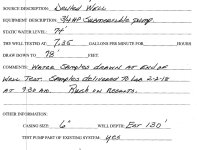
Attached is the well test from when I bought the place. Well is apparently 130 feet, not sure how to interpret the static level and draw down numbers.
 

Attachments

  • Well Test Snapshot.jpg
    Well Test Snapshot.jpg
    213.1 KB · Views: 145
   / Another Well Problem #4  
The well has a T at the head and 1" rigid PVC heads into the garage with pressure tank about 50 feet away. The other discharge is to a vacuum breaker, then to 1" PVC that runs all over the property, some zones are 300 feet away. This has worked fine for the 5 years I've lived here.

I did not flush the tank after the brown water episode. The pressure tank cycle seems a little slower than previously.

Attached is the well test from when I bought the place. Well is apparently 130 feet, not sure how to interpret the static level and draw down numbers.
As you describe the plumbing, I am missing something. If there is a vacuum breaker on the line to the sprinklers, that would leave them with no pressure, except when the pump runs. Could it be that there is a check valve after the vacuum breaker and that is where the T to the house and to the sprinklers happens?

The draw down is literally that. While pumping, usually after pumping for some number of hours at a stated gpm, the drawdown is the the depth after the pumping, in your case a 4' drop. The takeaway is that you can probably pump for awhile at 7gpm, because if the well is 130' deep, the pump is probably around 125', so you still have 47' of water over the pump at the end of the drawdown test.

I would point out that the number of hours of the drawdown test that the driller pumped is missing, as is the rate for the number of hours, as is the depth of the pump in the well. That information may be on file in your local county office, or from the folks who drilled the well.

More typically, the information is given as "pumping at 20gpm for four hours, a drawdown to X feet was observed." Sometimes the results are reported as a series of flows (gpm), and depths over time, e.g. 24hours. A lot depends on your local aquifer hydrology; if the well is in bedrock, drawdowns will tend to be large, if you are in sand, there won't be much. A relative has a 400' well straight into granite and all of the water seeps in from cracks in the bedrock, so 200' drawdowns aren't uncommon there, but the available water may only be 1,500-2,000 gallons per day.

Generally, the pumps occupy so much of the well casing the you have to pull the pump to clean the well.

Sorry.

All the best,

Peter
 
   / Another Well Problem #5  
The sprinkler pressure is low, but the well is not being pumped dry. So, the well screen and well are making plenty of water. The muck in the water could have damaged the impellers so they will not perform like they once did. Or, there could be muck in the pump screen or impellers. Or, a 20 PSI decrease in pressure could come from the water level in the well being 46' deeper than before. My guess is the impellers are damaged from the sediment as there is very little tolerance between the impeller and diffuser, and sediment makes the gap too wide. You could reduce the size of the sprinkler zones or reduce the size of nozzle in the sprinklers and get the pressure back up. A 3/4HP should max out at about 8.4 amps, which 7.5 amps makes me think the pump is worn. But the low amps could also be from a deeper water level or a blockage. If you pull the pump and don't find anything wrong, replacing with a larger pump or resizing the sprinkler zones will be needed.
 
   / Another Well Problem #6  
If you can build pressure in the house side of the T, but can't build pressure in the sprinkler system side of the T, I can only think that:

1. The pump can build pressure with the low flow of the house side but can't provide the full flow on the sprinkler side.

2. There may be an underground leak somewhere on the sprinkler side that's thwarting your attempt to build pressure.

3. The pump is worn or partially blocked and won't provide the full flow.

I'd pull the pipe past the vacuum breaker and see how much unrestricted flow you have in Gallons Per Minute. If that was satisfactory, I'd try each sprinkler zone to see if all of them fail to build pressure, or just one of them. If just one fails, it's obvious. If all of them fail, there could be a leak between the vacuum breaker and manifold for the zones, or you're back to the pump not being able to provide full flow at pressure.
 
   / Another Well Problem #7  
I'm starting a new thread about the same well that had suddenly provided brown water. Thankfully the water has cleared but I have a new issue.

Currently, I'm getting the sprinkling system ready and now find that the well will not maintain more than 25-ish PSI when any zone is running. For the past 5 years, the pump would hold a steady 40 to 45 PSI while any zone was operating. The well pumps up to 60 PSI fairly quickly during normal household use. It has a 40 to PSI control switch. The sprinklers have been off since October as I live in the Pacific Northwest area.

It occurs to me that I might have slime bacteria partially blocking the well pump intake, the drop pipe might be leaking or the pump itself may be weak. The 3/4 HP pump draws 7.5 amps at 240 volts, which is unchanged.

I'm fishing for ideas / tests that I can make myself before I open my wallet for the pump to be pulled. The well guy who replaced the capacitor intimated that it was probably put in with rigid PVC pipe, as his company installed it years ago and that is their practice. I have not confirmed that, but in any case I'm not up to pulling it myself.

Thanks in advance for any advice.
Do you have slime in your toilet tanks? If so then you could have slime on your pump and in all your pipes. Do you even chlorinate your well? I do mine about once a year because of the slime. If you have never chlorinated your well you may be surprised if you do because of all the brown water that comes out of the taps. This is a natural occurrence and is a reaction of the chlorine and the slime.
Eric
 
   / Another Well Problem
  • Thread Starter
#8  
Do you have slime in your toilet tanks? If so then you could have slime on your pump and in all your pipes. Do you even chlorinate your well? I do mine about once a year because of the slime. If you have never chlorinated your well you may be surprised if you do because of all the brown water that comes out of the taps. This is a natural occurrence and is a reaction of the chlorine and the slime.
Eric
This is a major question for me. Though I don't seem to have slime in the house, I've heard that when a well's usage is reduced (like no sprinklers for the winter) slime can accumulate on the pump's inlet screen and create a blockage. I can do the well chlorination myself, though I have not yet done it.
 
   / Another Well Problem #9  
Be careful chlorinating the well, it will make a mess of the water. Flush it from the bottom of the tank, not through the house.
I agree, the pump may be plugged, or worn. Max amps on a Franklin .75 hp motor is 8.0 amps. If it's a Pentek motor, it will be less. In my area, Franklin is the most common. 130ish' is pretty shallow for a 3/4. I'm still looking for leaks.
 
   / Another Well Problem #10  
Had some what same issue with brown water,supply line under ground had 1/2" crack,weem when pump was pushing water crack would open just enough allow ater mix with dirt...we were lucky to find problem quickly.
 
   / Another Well Problem #11  
I chlorinate my well following guidelines published online in several places plus from what my well guy says. It is best to look online so the instructions can be followed correctly. In general though this is how it should be done: The proper amount of non-scented chlorine bleach is added to the well. Then all the taps must be turned on until chlorine can be smelled. Start at the tap furthest from the well head. As soon as you smell chlorine turn off the tap. Flush toilets until you can smell chlorine. Now you must wait 24 hours without using any water. After 24 hours run water out of all the taps until you can no longer smell chlorine strongly. What I have found is that you will smell chlorine for at least a week. But running the water until it runs clear and the chlorine smell is almost gone is the best you can do. It doesn't take much bleach. I added a port to the cap on my well head for adding bleach. I put a plug in the port after I'm done adding bleach. I NEVER have any problems with coliform bacteria. This is because my well head is sealed and the water is not surface water. However, I do have the bacteria that causes slime. But then every water well anywhere in the world does. This bacteria is harmless. It uses iron in the ground to build the cell walls. If you have lots of iron in your ground water then you likely have more slime, AKA biofilm. This slime can trap small particles of whatever is in the water. When chlorinating the well the slime is destroyed which releases all these small particles. And these particles will come out of the taps. So it may look like a ton of stuff is in your water. But this stuff will cease appearing shortly.
Eric
 
   / Another Well Problem
  • Thread Starter
#12  
I chlorinate my well following guidelines published online in several places plus from what my well guy says.
Do you not run water back into the well in a continuous cycle to mix up the chlorine ? It seems like that would help in clearing slime from the pump intake screen.
 
   / Another Well Problem #13  
Do you not run water back into the well in a continuous cycle to mix up the chlorine ? It seems like that would help in clearing slime from the pump intake screen.
Yup and to wash the chlorine off the well casing, I run the hose in and let it go for 30 minutes after I pour in the chlorine.

Best,

ed
 
   / Another Well Problem #14  
Do you not run water back into the well in a continuous cycle to mix up the chlorine ? It seems like that would help in clearing slime from the pump intake screen.
You are correct. I forgot about that. That's why anybody who is going to do this needs to look online to see how to properly do it. The fitting I put in the cap on my well head is 1/2" pipe. I have a fitting that accepts a typical 3/4" hose and is 1/2" pipe at the other end. At least I think it is 3/4" hose. In any case I bought the fittings at the local hardware store so they are common. One end fits a typical garden hose and the other end is 1/2" male pipe to fit the 1/2" female pipe at the well head. I keep this adapter hanging from a wire at the well head. I totally forgot about this special adapter until Travelover mentioned running chlorinated water back down the well. The purpose of running chlorinated water down the well is, of course, to wash down the inside of well casing. If the well is sealed from contamination from the surface it really shouldn't be much of a worry, the well casing being contaminated. Still, as long as the well is being chlorinated it makes sense to wash down the casing as well. The fitting I put into the cap on my well casing does a good job of spraying water 360 degrees down the casing. Frankly, I just kinda lucked out. I bought the fitting and tapped a hole in the center of the cap on my well for adding bleach. I made up the adapter for a garden hose and screwed it into the fitting in the cap. Upon turning on the water the water sprayed out in a shallow cone. If I didn't get so lucky I would need to remove the cap to wash down the well casing to do the job properly. Which means that I probably would have neglected the job a couple times.
Eric
 
   / Another Well Problem
  • Thread Starter
#15  
OP here with an update. I chlorinated the well overnight then pumped it at 5 GPM for 3 1/2 hours to clear the well. The flow rate after all that was not enough to run the sprinklers without dropping down to about 25 PSI.
My conclusion is that the well pump inlet was not simply plugged with slime, so no joy there.
I talked to my well guy who put in the original well and pump and according to his records it is the original 1986 pump, so next step is to pull and replace the pump, drop pipe and wires for $3K-ish.
 
   / Another Well Problem #16  
Your pump is almost 40 years old? It sure doesn't owe you anything.
I woud assume the well guy will also chlorinate the well.
 
   / Another Well Problem #17  
OP here with an update. I chlorinated the well overnight then pumped it at 5 GPM for 3 1/2 hours to clear the well. The flow rate after all that was not enough to run the sprinklers without dropping down to about 25 PSI.
My conclusion is that the well pump inlet was not simply plugged with slime, so no joy there.
I talked to my well guy who put in the original well and pump and according to his records it is the original 1986 pump, so next step is to pull and replace the pump, drop pipe and wires for $3K-ish.
A well that shallow should not be too hard to do yourself. Few hundred for a new pump, reuse the wire. Save a couple thousand for sure. I did mine at 240’ new pump was $450. 20y old wire.
 
   / Another Well Problem #18  
OP here with an update. I chlorinated the well overnight then pumped it at 5 GPM for 3 1/2 hours to clear the well. The flow rate after all that was not enough to run the sprinklers without dropping down to about 25 PSI.
My conclusion is that the well pump inlet was not simply plugged with slime, so no joy there.
I talked to my well guy who put in the original well and pump and according to his records it is the original 1986 pump, so next step is to pull and replace the pump, drop pipe and wires for $3K-ish.
That's a fair price. I did my own 25+ years ago, last year I hired it out. $2,300 for pump replacement, I also replaced the piping and wire, for another $400. Mine was set at 190'.
 
   / Another Well Problem #19  
Wasn't there a thread a couple months ago about someone dropping the pipe down the well and the process of retrieving it?
 
   / Another Well Problem
  • Thread Starter
#20  
A well that shallow should not be too hard to do yourself. Few hundred for a new pump, reuse the wire. Save a couple thousand for sure. I did mine at 240’ new pump was $450. 20y old wire.
I get it. If I was 10 years younger, poorer and the well didn't have 1" galvanized drop pipe, I might consider it. I might even consider it today it if the drop pipe was flexible poly. I've watched a lot of YouTube videos and I realize it is not that hard.
 

Tractor & Equipment Auctions

2013 HAMM GRW280I-30 8 WHEEL PNEUMATIC ROLLER (A60429)
2013 HAMM...
2010 Toyota Highlander SUV (A59231)
2010 Toyota...
2009 Haybuster GP-50 Grain Processer (A55315)
2009 Haybuster...
2020 FREIGHTLINER CASCADIA TANDEM AXLE SLEEPER (A59904)
2020 FREIGHTLINER...
UNKNOWN TANK MANIFOLD (A58214)
UNKNOWN TANK...
DOOSAN G25KW GENERATOR (A58214)
DOOSAN G25KW...
 
Top