Rear Blade Anybody have a Land Pride RBT55 Grader Blade

   / Anybody have a Land Pride RBT55 Grader Blade #1  

Robert M

Member
Joined
Nov 8, 2012
Messages
28
Location
Delegate NSW
Tractor
no tractor yet
Interested in hearing if anybody has a Land Pride RBT55 grader blade and what size tractor are you pulling it with. I am looking at buying 100 HP 4wd Deutz and think it should handle this blade fine, but am not sure.
 
   / Anybody have a Land Pride RBT55 Grader Blade #2  
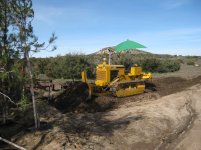
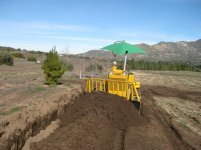
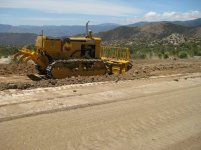
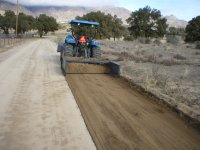
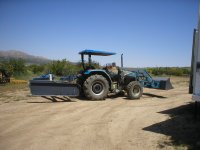
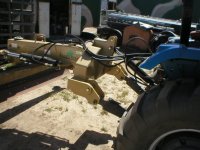
I don't have an RBT55, but I do have an RBT45108 and I run it behind a 75hp 12,000lb machine. In heavy grading, as in making new roads from virgin soil it sort of is like the tail wagging the dog. The 45 series is rated for a 125HP 15,000lb machine. The 45 has the largest offset of any of the Land Pride blades at 35". The RBT55 series only offsets to 33". The 55 series is obviously heavier duty within additional 529lbs of weight comparing the 9 foot blades. The moldboards are the same, so the difference must be in the 1/2" larger dia cylinders and how the hitch is made. From the 45 series on up all are cat 2-3 hitches. I guess it all depends on how much your new tractor is actually going to weigh and if you are trying to go with the 120" blade.

Good luck, you won't go wrong with any of the blades that I have mentioned in my opinion. ;)
 

Attachments

  • IMG_0181.jpg
    IMG_0181.jpg
    886.5 KB · Views: 408
  • IMG_0297.JPG
    IMG_0297.JPG
    136.1 KB · Views: 341
   / Anybody have a Land Pride RBT55 Grader Blade #3  
WOW! I wanted to play in this thread too but my little bitty RBT3584 just ain't big enough. ;)
 
   / Anybody have a Land Pride RBT55 Grader Blade
  • Thread Starter
#4  
What does the 15,000 rating refer to? From looking at the Land Pride catalogue 15,000 lb is the Max GVW. Is this the gross weight of the tractor and does it refer to the maximum tractor size that it is safe to use without damaging the machine or is it related to the size of tractor needed to handle the machine?

Our roads generally are not steep but there are some sections where there is a bit of an incline and I would not want the blade to be like "tail wagging the dog" so it would be important to have a good weight match of machine and blade. I will have a FEL that should help balance the blade.

Can you also tell me what the depth wheel does, I understand it is to getting a smoother road but am not sure exactly how this works.
 
   / Anybody have a Land Pride RBT55 Grader Blade #5  
What does the 15,000 rating refer to? From looking at the Land Pride catalogue 15,000 lb is the Max GVW. Is this the gross weight of the tractor and does it refer to the maximum tractor size that it is safe to use without damaging the machine or is it related to the size of tractor needed to handle the machine?

Our roads generally are not steep but there are some sections where there is a bit of an incline and I would not want the blade to be like "tail wagging the dog" so it would be important to have a good weight match of machine and blade. I will have a FEL that should help balance the blade.

Can you also tell me what the depth wheel does, I understand it is to getting a smoother road but am not sure exactly how this works.


The 15K weight rating is that the blade should not be attached to a tractor that weighs more than 15,000 lbs. An 18k tractor could do damage to the blade. I have no problem working on my 2+ miles of roads, just when I make new roads and get carried away trying to take to big of a cut. That is usually because I get lazy and should be using my dozer.

As far as the rear gauge wheel, it makes it a lot easier to control the blade, prevents the blade from digging in as the front of the tractor goes up a bump or sudden incline of any kind. Makes it more like a motor grader. Once you get good at grading though, this option is not needed in my opinion. I will say that if you do not get the gauge wheel setup, then be sure to get the skid shoes, they do make life easier. ;) What are the specs on the new machine other than 100hp? Are you considering the 9' or 10' rear blade?
 

Attachments

  • IMG_0512.jpg
    IMG_0512.jpg
    780.1 KB · Views: 273
  • IMG_0736.JPG
    IMG_0736.JPG
    780.2 KB · Views: 270
  • IMG_0516.jpg
    IMG_0516.jpg
    743.1 KB · Views: 380
  • IMG_0066.JPG
    IMG_0066.JPG
    124.3 KB · Views: 254
   / Anybody have a Land Pride RBT55 Grader Blade #6  
Brian.
That Case looks real nice, reminds me of using my old Deere 450. Every now and then I wish I had another small dozer.
 
   / Anybody have a Land Pride RBT55 Grader Blade
  • Thread Starter
#7  
Deutz Agrofarm 420 DT 4wd, 102 engine HP, max torque 380 Nm, constant torque range 1400-1700 Nm, hydraulic pump flow rate 56 l/min, total unladen weight 4010 kg, rear linkage lifting capacity 5200 kg (not sure if this is 600 mm or 24" behind the ball, I suspect it is not) here is the link to specs. Will our tractor handle the 10' blade ok? Specs | Deutz Tractors | German Engineering | Brought to you by PFG Australia.

Not sure whether to go for 8' or 10' blade. Our roads are about 4 m (12') wide + extra for drains. I would appeciate ideas on how to choose what size blade and an idea of how I work out if my tractor would be able to safely handle the 10' blade. Roads I will be grading are mostly well farmed but need to be repaired to improve drainage and fill pot holes. Soil is mostly granite, not many rocks, quite light soil that erodes easily. Our farm is undulating, mostly a gentle slope but a few spots where roads are steeper. Our tractor will also have a FEL that should help balance the weight of the blade. I had initially thought I would go for 8' blade but am now wondering if 10' would be better. Also is dual depth wheel better than single depth wheel?

cheers
Robert
 
   / Anybody have a Land Pride RBT55 Grader Blade #8  
Robert,
I think a good 8 or 9 ft blade would be a good choice if you have single rear wheels on your tractor. I had a 10ft rearblade on my old Case 1370 but it was a little wide for the narrow drives. Wish I had pictures of this blade, I set it up with hydraulic fold over caster wheels from an old combine for guage wheels, worked great.

Today I would recommend you get a good rearblade without the guage wheels and also get a good landplane setup for smoothing and finishing. With a little practice you should be happy with the results you get.
 
   / Anybody have a Land Pride RBT55 Grader Blade #9  
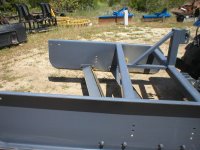
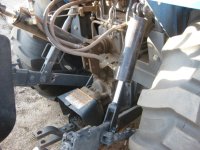
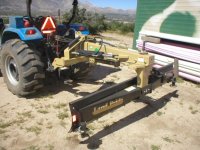
The tractor is not that heavy and DOES NOT REQUIRE a 55 series blade. Are you going to put any ballast on the tractor? Honestly this is what I would do. I would ballast the tractor front and rear, get the same rear blade that I have, an RBT45108 with skid shoes and hydraulic angle and offset. I would get top & tilt setup for the tractor and like jenkinsph said, get a good heavy land plane grader blade. You would then be pretty much set to maintain your roads.
 

Attachments

  • P4260026.JPG
    P4260026.JPG
    392 KB · Views: 259
  • PC290001.JPG
    PC290001.JPG
    388.7 KB · Views: 447
  • PC290007.JPG
    PC290007.JPG
    406.1 KB · Views: 220
  • P4260025.JPG
    P4260025.JPG
    383.2 KB · Views: 277
  • IMG_0288.JPG
    IMG_0288.JPG
    126.2 KB · Views: 207
   / Anybody have a Land Pride RBT55 Grader Blade
  • Thread Starter
#10  
I am a little confused.

Firstly by the picture of your grader blade in the picture above which looks huge compared to the size of your tractor, does the blade only weigh 1166 lbs (529 kg) as it says in the catalogue?

Secondly everybody has told me and what I have read is, you get the best grading result the heavier your blade is. That is why I was looking at the RBT55 at 1753 lbs (795 kg) although I think the consensus is that an 8' blade would be better than a 10' blade which was my original thinking as well. Wouldn't I be better with a heavier blade provided the tractor can handle it?
 
   / Anybody have a Land Pride RBT55 Grader Blade #11  
I am a little confused.

Firstly by the picture of your grader blade in the picture above which looks huge compared to the size of your tractor, does the blade only weigh 1166 lbs (529 kg) as it says in the catalogue?

Secondly everybody has told me and what I have read is, you get the best grading result the heavier your blade is. That is why I was looking at the RBT55 at 1753 lbs (795 kg) although I think the consensus is that an 8' blade would be better than a 10' blade which was my original thinking as well. Wouldn't I be better with a heavier blade provided the tractor can handle it?

At the weight that you posted, your tractor is not going to be heavy enough to warrant the 55 series blade in my opinion. Converting my 12,000lb tractor over it weighs 5454 kg. You posted that your tractor is going to weigh 4010 kg or 8822lbs. At that total weight I would not even get the 45 series blade, but the 40 series. That is why I asked you if you were going to ballast the tractor. If you are, then go with the RBT45108. Forget about the 10' blade, the tractor will not handle it well at all. The problem with an 8 footer is that it is to narrow when the blade is angled over, that is why I keep suggesting the 9 footer. Yes the weight is a good thing, but you should look at reality and the tractor just does not warrant the 55 series in my opinion. You can get the 55 series, it won't hurt other than in the wallet. There is no 8 foot 55 series blade, it is either 9' or 10'. ;)

Here's a couple of other pics, don't know if they give a better perspective or not.
 

Attachments

  • P5080001.JPG
    P5080001.JPG
    133 KB · Views: 270
  • P5080003.JPG
    P5080003.JPG
    122.7 KB · Views: 204
   / Anybody have a Land Pride RBT55 Grader Blade #12  
Robert,
Don't know anything about your area in NSW so could you post some pictures or elaborate on the soil and road bed materials? Really think for some long runs having the landplane in addition to the rearblade makes a lot of sense. Lots of wide open spaces where these tools could be used quite a bit.
 
   / Anybody have a Land Pride RBT55 Grader Blade
  • Thread Starter
#13  
Interested in what your tractor is as 12,000 lbs seems very heavy.
 
   / Anybody have a Land Pride RBT55 Grader Blade #14  
Interested in what your tractor is as 12,000 lbs seems very heavy.

It is a 2005 Mahindra 7520. Base tractor is 7300lbs, loader is 2000lbs, wheel weights total 876lbs, 1600lbs of liquid in the tires. There's 11,776lbs and then throw on the weight of whatever implement that is being used, that adds to the tractive force also. Most of my implements are 1000lbs and up. So yes it sounds heavy for what it is, but that is what I had to do to be able to get the maximum work capacity out of the tractor. ;)
 
   / Anybody have a Land Pride RBT55 Grader Blade
  • Thread Starter
#15  
It is a 2005 Mahindra 7520. Base tractor is 7300lbs, loader is 2000lbs, wheel weights total 876lbs, 1600lbs of liquid in the tires. There's 11,776lbs and then throw on the weight of whatever implement that is being used, that adds to the tractive force also. Most of my implements are 1000lbs and up. So yes it sounds heavy for what it is, but that is what I had to do to be able to get the maximum work capacity out of the tractor. ;)

Now that makes sense. The weight that I sent you was from the tractor specs is the basic tractor. My tractor will have loaderand liquid in tyres that should add a fair bit, I will have to work these out.
 
   / Anybody have a Land Pride RBT55 Grader Blade #16  
rear blade doesn't add to "tractive force" when it's down--it subtracts, if anything. Heavier blade weight merely helps the blade cut in tough surface rather than kicking up. You can always add weight by welding on a few stout upright rods and using your/somebod's old weight set. By adjusting your toplink you can make the blade more "aggressive" to cut better, if need be. If cutting action is required you can change the cutting edge to a serrated edge as used on some road graders. I actually think you will come to prefer a box blade or grader implement for repair and maintenance. I have a spiffy one and, indeed, I have a serrated cutting edge that works fine on some shale we have. (and, my grader has a hydraulic roller setup behind the box that acts much like the tail wheel you discussed, as well as packing down the material.

I have a landpride 8 footer with the hydraulic tail wheel option and, as stated by others, lengthens the "wheelbase" to smooth out minor irregularities--which is exactly what you want, I believe--so I would go for it. As for length, once you have covered your tire track width at full angle, any additional length can improve efficiency and may be useful if you have to cut ditches...although my landpride has 30" of offset and tilts, to which I can add the tilt from my Top-and-Tilt. As trick-out as my blade is, it is most useful for initial road-building and much less desirable for subsequent road maintenance.
 
   / Anybody have a Land Pride RBT55 Grader Blade #17  
rear blade doesn't add to "tractive force" when it's down--it subtracts, if anything. Heavier blade weight merely helps the blade cut in tough surface rather than kicking up. You can always add weight by welding on a few stout upright rods and using your/somebod's old weight set. By adjusting your toplink you can make the blade more "aggressive" to cut better, if need be. If cutting action is required you can change the cutting edge to a serrated edge as used on some road graders. I actually think you will come to prefer a box blade or grader implement for repair and maintenance. I have a spiffy one and, indeed, I have a serrated cutting edge that works fine on some shale we have. (and, my grader has a hydraulic roller setup behind the box that acts much like the tail wheel you discussed, as well as packing down the material.

I have a landpride 8 footer with the hydraulic tail wheel option and, as stated by others, lengthens the "wheelbase" to smooth out minor irregularities--which is exactly what you want, I believe--so I would go for it. As for length, once you have covered your tire track width at full angle, any additional length can improve efficiency and may be useful if you have to cut ditches...although my landpride has 30" of offset and tilts, to which I can add the tilt from my Top-and-Tilt. As trick-out as my blade is, it is most useful for initial road-building and much less desirable for subsequent road maintenance.

Why do you think that a rear blade lightens the load? :confused: Take off your top link and see where the blade goes when you go forward. It will pivot forward, If anything it actually puts down pressure on the rear of the tractor.

As far as the rear blade only being good for building the road, I disagree. While a land plane grader blade is easier and faster to use for maintainence and what I normally use, I anyway can get just as good if not a better finish with my rear blade. ;)
 
   / Anybody have a Land Pride RBT55 Grader Blade #18  
If the tractor is stopped with the blade on the ground and the toplink is removed (or left to float), then there is downward pressure on the 3ph and it will sink, as you say, ... if it hasn't already bottomed out ...but, then, move forward and it will want to rise. In fact, given that I have a hydraulic tail wheel, I use a swinging link to attach to my toplink. As for the "subtraction" I mentioned, consider what happens as the blade digs in, say, to an immoveable rock...wheelspin, and loss of traction. In fact wheelspin is desirable in this case rather than put undue strain on either the tractor or the blade. (for just such instances, I have cushion valves in my hydraulic angle circuit on my blade)

If, however, the blade is raised then, indeed it improves traction by weighting the rears.

As for the issue of which is better for maintenance, I merely stated my opinion given my skills. If you can get a better finish with your blade than with your grader, you are clearly a better operator than I. We do, however, seem to agree that "a land plane grader blade is easier and faster to use for maintenance" and, like you, that is what I normally use.
 
   / Anybody have a Land Pride RBT55 Grader Blade #19  
If the tractor is stopped with the blade on the ground and the toplink is removed (or left to float), then there is downward pressure on the 3ph and it will sink, as you say, ... if it hasn't already bottomed out ...but, then, move forward and it will want to rise. In fact, given that I have a hydraulic tail wheel, I use a swinging link to attach to my toplink. As for the "subtraction" I mentioned, consider what happens as the blade digs in, say, to an immoveable rock...wheelspin, and loss of traction. In fact wheelspin is desirable in this case rather than put undue strain on either the tractor or the blade. (for just such instances, I have cushion valves in my hydraulic angle circuit on my blade)

If, however, the blade is raised then, indeed it improves traction by weighting the rears.

As for the issue of which is better for maintenance, I merely stated my opinion given my skills. If you can get a better finish with your blade than with your grader, you are clearly a better operator than I. We do, however, seem to agree that "a land plane grader blade is easier and faster to use for maintenance" and, like you, that is what I normally use.

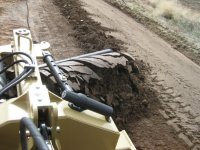
Well, I am going to be using my rear blade this weekend, so now I am going to have to check this out, and I will report back to confirm or admit that I am right or wrong. :confused2: But like you say, we do agree that a LPGB is the way to go for road maintenance. :thumbsup: ;)
 
   / Anybody have a Land Pride RBT55 Grader Blade #20  
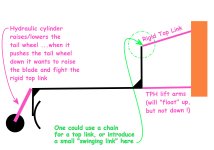
An addendum: my comment about the 3ph wanting to rise as the blade digs in as you move forward (let's say with no toplink) was based on the assumption that when the blade was resting the "strongback" was sagging ...how to say? the strongback was not level, but pitched down toward the tractor ...if it was level then the 3ph would neither want to rise nor fall. If, instead, it pitched up, then the 3ph would want to lower. That is, as you move forward with the blade digging, it wants to "straighten out" (and thereby shorten) the connection. Does that accord with your mental picture?

I have attached a picture (where the strongback is level) that I've used before to discuss some of these dynamics...and, as I look at my previous analysis, I note that although the 3ph may WANT to rise if strongback pitches down toward tractor, it can't (without lifting the tractor) because the 3ph doesn't float up, only down.

So permit me a correction ...it wants to lift (but can't) when the strongback is pitched down toward the tractor...still, the pressure is up in this case; in the other two cases it will lower or remain level, depending. This is all assuming no (no) rigid toplink; if the toplink is rigid, then the blade wants to fight the rigid toplink as described in the picture annotation ...which, in my case, I use a swinging link in the toplink connection.

but, I could be wrong. Let me know what your experiment reveals.
 

Attachments

  • toplink problem.jpg
    toplink problem.jpg
    474.9 KB · Views: 211
Last edited:
 

Marketplace Items

2013 Ford C-Max Energi Hybrid PHEV Hatchback (A59231)
2013 Ford C-Max...
1999 Thompson H3 S/A Towable Vacuum Water Pump (A59228)
1999 Thompson H3...
UNUSED FUTURE 350 HYD BREAKER HAMMER (A52706)
UNUSED FUTURE 350...
2014 Chevrolet Silverado 1500 High Country 4x4 Crew Cab Pickup Truck (A56858)
2014 Chevrolet...
2017 Jacobsen 3551 HOURS (A56859)
2017 Jacobsen 3551...
John Deere 6110M (A60462)
John Deere 6110M...
 
Top