Binding Tractor to Trailer

   / Binding Tractor to Trailer #21  
My understanding and practice is to apply the 45 degree angle from front to back of the trailer, not from the trailer deck up. The reasoning is to keep or minimize the chance the load will move sideways or forward or back which will help in keeping everything top side up. If the truck, trailer and load are turning over, I doubt I will be too concerned about whether the load stays attached to the trailer or not.
 
   / Binding Tractor to Trailer #22  
I have been hauling multiple different tractors 140 miles one way to my farm for 20 yrs. iI put 2 chains up front and one in the rear on the drawbar. never had an issue , If i have an implement on the rear i use several straps on it.
 
   / Binding Tractor to Trailer #23  
Tractor Seebee, this response is not directed at you so please don't take offense.

When I read the "trust the science" comment, my mind equated it to the "trust me" saying we all hear and avoid anyone saying it. The politicians, through this pandemic, keep using "trust the science" as a way of telling the rest of us to shut up and do as we are told, kind of like "trust me". The actual scientists are saying very little due to knowing they haven't developed enough "science" to trust.

Politician Mantra "If the facts do not support the theory, change the facts".

Ron
 
   / Binding Tractor to Trailer #24  
From an engineering standpoint:
"An equilateral triangle is structurally the most sound for obvious reasons. Equal angles and vectors naturally resist gravitational and lateral forces equally in all directions. This is true in theory and practice if one doesn't consider any other variables. Isosceles triangles always are weakest along its longest side and near its smallest or sharpest angle."

So I guess the flatter the angle in relation to the trailer bed the weaker it is. The fore and aft angle was not part of the original discussion but equally important. Again 45 degree is strongest for movement for and aft. That is why a flatter truss roof has to have larger members than a steeper truss roof. Engineers need to weigh in on this and educate all us I am a practical construction gut not an engineer.

Ron
 
   / Binding Tractor to Trailer #25  
From an engineering standpoint:
"An equilateral triangle is structurally the most sound for obvious reasons. Equal angles and vectors naturally resist gravitational and lateral forces equally in all directions. This is true in theory and practice if one doesn't consider any other variables. Isosceles triangles always are weakest along its longest side and near its smallest or sharpest angle."

So I guess the flatter the angle in relation to the trailer bed the weaker it is. The fore and aft angle was not part of the original discussion but equally important. Again 45 degree is strongest for movement for and aft. That is why a flatter truss roof has to have larger members than a steeper truss roof. Engineers need to weigh in on this and educate all us I am a practical construction gut not an engineer.

Ron
Here are a couple examples:

A tie down that is too flat and doesn't cross enough:
FlatTiedown.jpg
Very strong at preventing movement from front to back, weak at preventing moment up and down or side to side.


45 degrees up and down, left/right and front to back:
45Tiedown.jpg
Roughly equally strong in all directions.

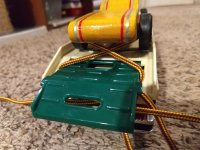
Cross tie:
XTiedown.jpg
This lets you overcome the lack of room to tie things down by tying down to the opposite side.

Aaron Z
 
   / Binding Tractor to Trailer #26  
How do you gat a 45 degree angle with the drawbar 12" or less from the trailer bed?

Ron

Buy a bigger tractor.:rolleyes:

Interesting facts......................all my equipment, the Mahindra tractor loader backhoe, the Caterpillar E70 excavator and the Lull 644D-34 telehandler all have tie down points at the lowest places on the frame. Three different machine industries, three different designed loads. Three different weights..........14,100, 15,500, and 20,160 pounds. Three (or more) engineers have their name on those hard points. What's in common............ All three have tie down mounts low.

I do know I can bind my tractor down where you can see the tires squatting. It's big enough and beefy enough to do this. Just get a longer cheater pipe. I pride myself in chaining all my loads tight enough that when I check the load, no adjustment it needed. But I still have to check.
hugs, Brandi
 
   / Binding Tractor to Trailer #27  
From an engineering standpoint:
"An equilateral triangle is structurally the most sound for obvious reasons. Equal angles and vectors naturally resist gravitational and lateral forces equally in all directions. This is true in theory and practice if one doesn't consider any other variables. Isosceles triangles always are weakest along its longest side and near its smallest or sharpest angle."

So I guess the flatter the angle in relation to the trailer bed the weaker it is. The fore and aft angle was not part of the original discussion but equally important. Again 45 degree is strongest for movement for and aft. That is why a flatter truss roof has to have larger members than a steeper truss roof. Engineers need to weigh in on this and educate all us I am a practical construction gut not an engineer.

Ron

Actually the strongest is 0 degrees but that would require 3 chains and binders for each corner (up and down, side to side and forward and back) of the load which isn't practical or necessary. 45 degrees of a sufficient sized chain holds the load front to back and side to side sufficiently. Any rubber tire load is going to bounce some so the idea is to keep it in the same place on the trailer while it is bouncing.

There are cases where tying a rubber tire load down with a vertical or close to vertical chain will actually break the chain. Picture a rubber tired loader with the big tires. There is no way you will keep it from bouncing but with a vertical chain, every time the loader bounces down it throws slack in the chain but when it comes back up it has a lot of force and momentum that can snap the chain. As Brandi stated, equipment that has tie downs has them relatively low so the chain is pivoting and has less chance of getting slack in it.
 
   / Binding Tractor to Trailer
  • Thread Starter
#28  
I also have worked in logistics, loading aircraft and other items while in the VANG. This design would be reliant on two grade hardened fasteners attached to the rear most housing of the tractor itself. I feel this design is reasonable to contain a tractor weighing under 7k (including implements in the 7k figure). If the rear housing cannot support the load via two fasteners then it痴 poorly casted or inferior materials were used to manufacture the item.

-Chris
 
   / Binding Tractor to Trailer #29  
I also have worked in logistics, loading aircraft and other items while in the VANG. This design would be reliant on two grade hardened fasteners attached to the rear most housing of the tractor itself. I feel this design is reasonable to contain a tractor weighing under 7k (including implements in the 7k figure). If the rear housing cannot support the load via two fasteners then it痴 poorly casted or inferior materials were used to manufacture the item.

-Chris
Such a load will largely be a tensile load, if it's a 3/8" fine thread grade 5 bolt on each side, the breaking strength is 7450#, thus the WLL would be 2483# per bolt.
I wouldn't trust that for a 7000# tractor.
The hitch on a tractor will generally have at least 4 bolts around the PTO housing for vertical loads, then 4 more bolts into the underside of the axle housing to handle horizontal loads.

Aaron Z
 
   / Binding Tractor to Trailer
  • Thread Starter
#30  
Such a load will largely be a tensile load, if it's a 3/8" fine thread grade 5 bolt on each side, the breaking strength is 7450#, thus the WLL would be 2483# per bolt.
I wouldn't trust that for a 7000# tractor.
The hitch on a tractor will generally have at least 4 bolts around the PTO housing for vertical loads, then 4 more bolts into the underside of the axle housing to handle horizontal loads.

Aaron Z

Thing is the tractor doesn’t weigh 7k...closer to 4K without attachments. Would you trust it now?

-Chris
 
   / Binding Tractor to Trailer #31  
Both when I was in the Navy and then worked as a civilian for Navy Public Works; we had to load test all weight handling and binding equipment/materials annually. This is a destructive test with actual weights. When the tested less than design load they became garbage, scrap, or down-graded to a lower value. Everything had a load value on a tag or stamped on in it. 50 combined years and never saw or heard of a failure when rated loads or test were applied. Every item had a load rating and a failure value.

Ron
 
   / Binding Tractor to Trailer #32  
Thing is the tractor doesn’t weigh 7k...closer to 4K without attachments. Would you trust it now?
-Chris
No, I would tie into something stronger, you are still putting the bolts into tensile load and I have seen too many pictures of people who have had bolts tear out of castings.
Yes, grade 5 bolts are good for 2400# each, but are the castings going to hold that? I doubt that the castings are grade 5.
DOT rules for rolling stock under 10,000# are "The sum of the working load limits from all tiedowns must be at least 50% of the weight of the cargo." (Driver's Handbook on Cargo Securement - Chapter 9: Automobiles, Light Trucks, and Vans | FMCSA )
I like to have it so that I meet that with any 2 of the 4 tiedowns that I use to attach the tractor to the trailer.
I will have to post a picture of what I use on the back of our L3830 which is similar in size.

Aaron Z
 
   / Binding Tractor to Trailer #33  
I go to lots of shows over here in England and sometimes I am appalled at some tractor owners turning up with their pride and joy hardly fixed to their trailer bed, I saw one last week and just had to tell the owner that if he was stopped by the police they would fine him for an "unsecured load" after explaining my experience on a motorway being pulled in to a testing station by VOSA who police the motorways lorry's etc. in England
Although I had 4 straps holding my tractor down the officer explained that if in the case the trailer came adrift that the load should stay fixed to the trailer and stated it should have 4 straps IE. one or each wheel and be positioned so no forward or reward movement should take place, the one I saw last week had only two one front and back and when I explained that if the trailer tipped over his tractor would just pivot on them and would come off, he thanked me for bringing it to his attention and I noticed when he left the show it had been strapped down with four straps plus his existing two.
As the DVLA officer explained "if it has four wheels all four must be fixed
I was trying to find out if there was any legal requirement over here in England but could not find anything definite, but I did come across this photo which proves what could happen


1629800159865.png
 
   / Binding Tractor to Trailer #34  
The tractor I used to trailer weighs about 3000# with implements. There is a front tow hook and the rear drawbar. I've been using those to chain my tractor down so that the tires have a little squish, or more recently the axle. It's my understanding that there is a weight limit in the DOT rules that when you're under that (which i think is 10k#), only 2 chains are required. The load still isn't allowed to move though. So, I'm using (2) 5400# chains on a 3000# load. Am I missing something here?
 
   / Binding Tractor to Trailer #35  
From the research I performed it appears the rear housing and two lower bolts are sufficient to withstand the forces being applied.

Thanks,

Chris
the bolts may be strong enough but is the threads and housing strong enough? I have seen many disappointed tractor owners who have broken their housings doing what they thought were bullet proof.
Personally I'd use the pin and drawbar.
 
   / Binding Tractor to Trailer #36  
The tractor I used to trailer weighs about 3000# with implements. There is a front tow hook and the rear drawbar. I've been using those to chain my tractor down so that the tires have a little squish, or more recently the axle. It's my understanding that there is a weight limit in the DOT rules that when you're under that (which i think is 10k#), only 2 chains are required. The load still isn't allowed to move though. So, I'm using (2) 5400# chains on a 3000# load. Am I missing something here?
Each attachment has to be secured also. Loaders and backhoes are always forgotten about. Or 3pt attachments. They all need to be secured to the trailer. DPS will pull you over if they see them not secured.
hugs, brandi
 
   / Binding Tractor to Trailer #37  
The tractor I used to trailer weighs about 3000# with implements. There is a front tow hook and the rear drawbar. I've been using those to chain my tractor down so that the tires have a little squish, or more recently the axle. It's my understanding that there is a weight limit in the DOT rules that when you're under that (which i think is 10k#), only 2 chains are required. The load still isn't allowed to move though. So, I'm using (2) 5400# chains on a 3000# load. Am I missing something here?
As @bindian said, you only need those two chains on your tractor but the loader bucket will need another one as well anything on the three-point or a backhoe if equipped.

Aaron Z
 

Marketplace Items

UNUSED IRANCH MINI EXCAVATOR RAKE (A60432)
UNUSED IRANCH MINI...
DEUTZ MARATHON 60KW GENERATOR (A58214)
DEUTZ MARATHON...
UNUSED 2023 VOLVO ECR25 ELECTRIC EXCAVATOR (A60429)
UNUSED 2023 VOLVO...
Cat CB24B (A60462)
Cat CB24B (A60462)
KIVEL 48" PALLET FORKS 3500 LB CAP (A60430)
KIVEL 48" PALLET...
2019 GALYEAN EQUIPMENT CO. 150BBL STEEL (A58214)
2019 GALYEAN...
 
Top