Biodiesel

   / Biodiesel #1  

MessickFarmEqu

Super Member
Joined
Feb 17, 2004
Messages
5,575
Location
Lancaster County, PA
Has anyone used biodiesel in their equipment. There seems to be a good bit of information on the internet that shoulds pretty favorable. One of my customers is investigating it because he feels that the exaust will be less irritating to him than traditional fuel. He is looking at a rather conservitive mix and I and our shop guys think it will be just fine in a Kubota BX. Any experiences?
 
   / Biodiesel #2  
Neil, do a search on this. I think Junkman was considering this a while back??? If not him, then someone on TBN, there was a discussion on it earlier this summer. Me, I'm game to try it with some of the lovely Mrs_Bob's olive oil. To me, it has too strong of a taste, but it might smell better when it is mixed with diesel and run through a tractor engine /forums/images/graemlins/grin.gif
 
   / Biodiesel #3  
We've been using biodiesel for a number of years. It is great. We haven't had any problems at all. The only thing you have to watch is in the winter. It will gel alot easier than diesel so you have to make sure you have additive in it.
 
   / Biodiesel #4  
</font><font color="blue" class="small">( Has anyone used biodiesel in their equipment)</font>
I'm still tractor shopping, so I haven't yet. But, I do use it in my diesel powered car (a VW TDI). You may want to try posting a message in the Biodiesel FAQ & Info forum over at www.biodieselnow.com. One of the frequent posters there (soypwrd) does have a Kubota tractor and is using B100 in it, so I'm sure he can provide some first hand experience.

He also has a TDI, and posts to a site similar to TBN for TDI enthusiasts. Here's a link to a recent message there concerning biodiesel usage in his Kubota.


</font><font color="blue" class="small">( Me, I'm game to try it with some of the lovely Mrs_Bob's olive oil. )</font>
I don't think you want to do this, biodiesel may be made from various vegetable oils, but its quite different than the raw vegetable oil that was the feedstock used in its production. Basically, a process called Transesterification is used produce the biodiesel, and the resulting product has the right chemical properties to be used in a diesel engine.

</font><font color="blue" class="small">( One of my customers is investigating it because he feels that the exaust will be less irritating to him than traditional fuel. He is looking at a rather conservitive mix )</font>
Sounds like he's proposing something like B5 or B20. If he's having a problem with irratating exhaust, he may want to try B100.
 
   / Biodiesel
  • Thread Starter
#5  
</font><font color="blue" class="small">(
Sounds like he's proposing something like B5 or B20. If he's having a problem with irratating exhaust, he may want to try B100. )</font>


That numbers are just the percentage mix of Bio and regular diesel right? Our local station says they have B2 and B5, why such a low concentration? Will that have much effect?
 
   / Biodiesel #6  
B2 or B5 is the Federal Mandated limit for the payment of government taxpayer funded subsidies to support the high cost of the production of BD from soybeans in this country, since it costs more to produce than what you can sell it for.

The use of B2 or B5 mixed into dino petrodiesel is basically good as it increases lubricity to the injection pump and the injection nozzles internal parts.

Use of B-100 is entirely experimental and will lead to injector coking and fouling as well as water contamination (BD is very hydroscopic) which is not good in any diesel engine.
 
   / Biodiesel #7  
Yanmar liquid cooled, 4 cylinder Direct injection diesel.

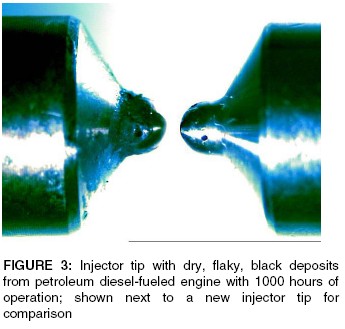
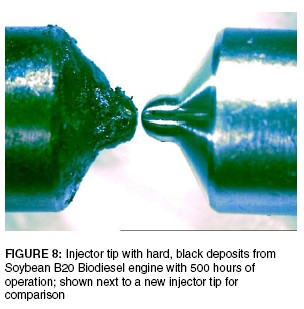
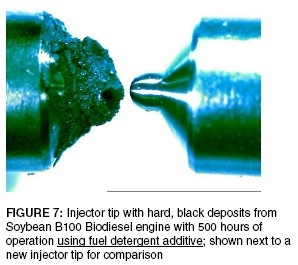
NOT GOOD.


13661000_hours_PDiesel.jpg


1366500_hours_SB20.jpg


1366500_hours_SB100.jpg


Here is the programmed cycle and loading for the engines in the test:

5 minutes at 2200 rpm and 21hp (which is 62% of rated load at 2200 rpm), then 44 minutes at 1450 rpm and 10 hp (which is 37% of rated load at 1450 rpm), then 1 minute shutdown, restart at high speed and repeat.


The photos and weight percent analysis are interesting but did not give enough clues about the deposits. The two most likely sources for these deposits are thermal decomposition of the methyl ester molecule or thermal decomposition of the glycerin molecule. At temperatures of 430ºC to 480ºC, decomposition of Soybean Biodiesel occurs [1], therefore the possibility exists for the Biodiesel to decompose during the ignition delay period, resulting in injector tip deposits.
 
   / Biodiesel #8  
Some have had very good luck on B-100, depends who is making it, what kind of quality control is going on.

I think if one is going to go B-100 you should try straight vegtable oil instead. Much easier.

</font><font color="blue" class="small">( Use of B-100 is entirely experimental and will lead to injector coking and fouling as well as water contamination (BD is very hydroscopic) which is not good in any diesel engine. )</font>
 
   / Biodiesel #9  
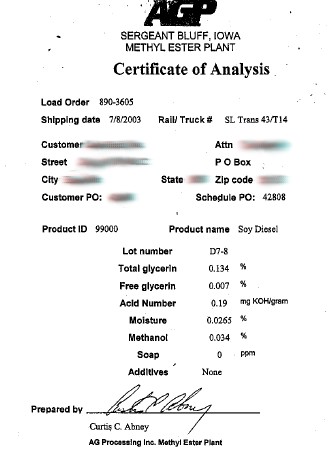
You are correct that the quality or lack thereof of the BD product is very important, however here is the BD-100 fuel quality analysis sheet for the fuel used in this test, and as you can see it is high quality BD-100 without excessive glycerin, methanol, soap, or water.


1366SB_Fuel_analysis.jpg
 
   / Biodiesel #10  
</font><font color="blue" class="small">( Has anyone used biodiesel in their equipment. )</font>

I tried it. Here's the thread.

my results

Cliff
 
   / Biodiesel #11  
</font><font color="blue" class="small">( That numbers are just the percentage mix of Bio and regular diesel right?)</font>
Yes. The term Biodiesel is often used in a confusing manner. Many times people refer to Biodiesel, when in fact they mean a biodiesel blend. Here's a definition from the Biodiesel.org FAQ:

Biodiesel is defined as mono-alkyl esters of long chain fatty acids derived from vegetable oils or animal fats which conform to ASTM D6751 specifications for use in diesel engines. Biodiesel refers to the pure fuel before blending with diesel fuel. Biodiesel blends are denoted as, "BXX" with "XX" representing the percentage of biodiesel contained in the blend (ie: B20 is 20% biodiesel, 80% petroleum diesel).

</font><font color="blue" class="small">( Our local station says they have B2 and B5, why such a low concentration? Will that have much effect? )</font>
Biodiesel in low concentrations like that will have a very positive effect on lubricity. I can't recall if a concentration that low will have much of an effect on emmissions. I doubt your customer will notice a difference in terms of exhaust irratation at this low a concentration.

As far as why so low, you would have to ask them, but the two biggest reasons are probably cost and cold weather issues. B100 is more expensive than petro diesel, so as the concentration goes up, so does the price, and B100 gels at a higher temperature so that's another issue that needs to be dealt with.
 
   / Biodiesel #12  
<font color="blue"> It will gel alot easier than diesel so you have to make sure you have additive in it. </font>
I didn't think you could use additives meant for regular diesel in biodiesel?

Neil - I used B20 in my TC25D a few summers ago. Worked fine. Since there's no local dealer, I bought 5 gallons over the Internet which made it too expensive to use on a regular basis.
 
   / Biodiesel #13  
Mike you can use any additive you like in biodiesel. Mind you we are running the 2-20% blends not 100% pure biodiesel. Every 300 gallon tank we get filled we put in a gallon of power service.
 
   / Biodiesel #14  
</font><font color="blue" class="small">( B2 or B5 is the Federal Mandated limit for the payment of government taxpayer funded subsidies to support the high cost of the production of BD from soybeans in this country, since it costs more to produce than what you can sell it for.)</font>
Please provide a reference to the federal mandate you're citing. The U.S. Department of Agriculture Commodity Credit Corporation pays a subsidy to producers who increase their production, for example by building a new plant. This subsidy covers lots of different feedstocks (not just soybeans), and its based on the amount of new capacity, not on the blend percentage used at retail.

The other federal mandate often cited is the EPAct State & Alternative Fuel Provider Rule. This mandates usage of B20 or greater.
 

Tractor & Equipment Auctions

84" HYD ROCK GRAPPLE (A52706)
84" HYD ROCK...
2018 Toro Sand Pro 5040 Bunker Rake (A59228)
2018 Toro Sand Pro...
SEMI AUTOMATIC QUICK-CHANGER FOR MINI EXCAVATOR (A58214)
SEMI AUTOMATIC...
1992 Norris Long Basket Trailer (A55973)
1992 Norris Long...
2017 FREIGHTLINER CASCADIA TANDEM AXLE SLEEPER TRUCK (A59905)
2017 FREIGHTLINER...
2006 Mercedes-Benz Unimog 405 4x4 Flatbed Truck (A56858)
2006 Mercedes-Benz...
 
Top