Bleeding the closed loop PT drive system

   / Bleeding the closed loop PT drive system #1  

KentT

Elite Member
Joined
Mar 31, 2005
Messages
2,928
Location
Sevierville, TN
Tractor
1993 Power Trac 1430 w/Kubota diesel engine
I'm thinking about my upcoming wheel motor upgrade and have a couple of questions...

1. To bleed the drive system after it has been opened up at each wheel, do I just bleed it at the charge pump the same way I would when changing the filter?

2. Should I also push the treadle in, while cranking with the spark-plug wires removed, to allow the tram pump to push the air out of the lines? If so, how would I know how long to crank it? When bleeding after changing the filter, you crank long enough to make sure the charge pump is fully primed and pumping a steady flow. Since the air introduced into the system would be on the other, output side of the tram pump, would this still be a good indicator?

3. Given the fact that it is a closed-loop system where the oil stays in there all the time (not going back to the reservoir) and only replenished by the charge pump as needed to overcome "leakage" -- do you think it would be beneficial to try draining ALL the oil out of the lines that run to the wheel motors, just to get rid of any possible contaminents in those lines?

Thanks -- I look forward to the insight...
 
   / Bleeding the closed loop PT drive system #2  
KentT said:
I'm thinking about my upcoming wheel motor upgrade and have a couple of questions...

1. To bleed the drive system after it has been opened up at each wheel, do I just bleed it at the charge pump the same way I would when changing the filter?

2. Should I also push the treadle in, while cranking with the spark-plug wires removed, to allow the tram pump to push the air out of the lines? If so, how would I know how long to crank it? When bleeding after changing the filter, you crank long enough to make sure the charge pump is fully primed and pumping a steady flow. Since the air introduced into the system would be on the other, output side of the tram pump, would this still be a good indicator?

3. Given the fact that it is a closed-loop system where the oil stays in there all the time (not going back to the reservoir) and only replenished by the charge pump as needed to overcome "leakage" -- do you think it would be beneficial to try draining ALL the oil out of the lines that run to the wheel motors, just to get rid of any possible contaminents in those lines?

Thanks -- I look forward to the insight...

Kent

I am assuming the machine is up on blocks. I think you should use plugs in the lines when you remove the wheel motors, When you have them all hooked up, remove the bleed plug, and crank until there is no air coming out of the system . Do you have a case drain going from the tram pump to the hydraulic cooler? I think any air left in the system, will be compressed and forced out the case drain. The charge pump is always at standby to keep the system pressurized. I wouldn't crank the starter very long, give the starter a rest , and crank some more. Just my opinion.
 
   / Bleeding the closed loop PT drive system
  • Thread Starter
#3  
JJ,

My PT doesn't have case drains at all, as far as I know. I should've mentioned that.

That's one of the reasons why I asked about draining the lines while I had it open. Otherwise, any contaminants there may be are "trapped" in the drive system until they happen to get out as "leakage."

Char-Lynn also cautions to fill the motors with fluid when replacing them, and to not run them without oil. That's why I was thinking of cranking it with the treadle mashed down -- to get some oil back to the wheel motors as soon as possible.
 
   / Bleeding the closed loop PT drive system #4  
This is an excellent question. I plan on replacing my “hydraulic fluid” with real hydraulic fluid at some point. However, if the wheel circuit is closed, how do I replace the fluid in this critical circuit? Also, what is filtering this circuit? If a wheel motor starts to suffer a catastrophic failure, does this mean it potentially damages every other motor (and the pump) in the circuit? It think I’m missing something.
 
   / Bleeding the closed loop PT drive system #5  
Kent.

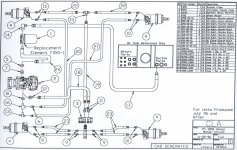
Do you have a hydraulic circuit schematic for the 425? Please post one if you have one.
 
   / Bleeding the closed loop PT drive system #6  
KentT said:
JJ,

My PT doesn't have case drains at all, as far as I know. I should've mentioned that.

That's one of the reasons why I asked about draining the lines while I had it open. Otherwise, any contaminants there may be are "trapped" in the drive system until they happen to get out as "leakage."

Char-Lynn also cautions to fill the motors with fluid when replacing them, and to not run them without oil. That's why I was thinking of cranking it with the treadle mashed down -- to get some oil back to the wheel motors as soon as possible.

Kent,

You can partially fill the wheel motor by removing the pressure fitting at the tram pump. I would think that if you just replaced the wheel motors, and started the engine and let it idle, and then press on the treadle to get the pump pumping, it will fill the wheel motors all by itself. The motors are not going to turn until they receive the fluid. The wheel motors will start turning, and the first motor that is closer to the pump will turn first. After they have turned for a few minutes, they should be ready to go.
 
   / Bleeding the closed loop PT drive system #7  
J_J said:
Kent.

Do you have a hydraulic circuit schematic for the 425? Please post one if you have one.

I think so...take a look at the attached image.
 

Attachments

  • 1845circuit.jpg
    1845circuit.jpg
    199.7 KB · Views: 190
   / Bleeding the closed loop PT drive system #8  
marrt said:
I think so...take a look at the attached image.

Actually, I mis-read your post. Obviously, that image is for my 1845...not the 425.
 
   / Bleeding the closed loop PT drive system #9  
KentT said:
JJ,

My PT doesn't have case drains at all, as far as I know. I should've mentioned that.

That's one of the reasons why I asked about draining the lines while I had it open. Otherwise, any contaminants there may be are "trapped" in the drive system until they happen to get out as "leakage."

Char-Lynn also cautions to fill the motors with fluid when replacing them, and to not run them without oil. That's why I was thinking of cranking it with the treadle mashed down -- to get some oil back to the wheel motors as soon as possible.
When you get the new wheel motors they will probably have plastic plugs where the hoses fit inorder to keep contaminents out. If you take the plugs out when you are installing the wheel [which you will have to do anyway ], with the plastic plugs out if you pour oil into one of the holes as you are turning the shaft of the motor by hand that will fill the motor for you so that the motor will have oil in it when you first apply tram pressure . It might be possible to take the hoses off closer to the pump and fill them at the same timeas you are filling the wheel motor. Anotoher thing as you are getting ready to install the new wheel motors already have the proper fittings in the wheel motors to hook the hoses up to, already having this done will cut down on the time from the time you take the hoses of the old wheel motors and hooking them up to the new wheel motors. Another thing you might want to do is have some rags already handy to stuff into the end of the hoses that you take off or some other means to plug the end of the hoses to keep from loosing too much or all of your oil in the system. Plan your project out ahead of time say forinstance if you can pull the hoses up above the oil level you won't loose very much oil that way . After saying all this seems like projects seldom go the way you plan but that way you will be thinking and planning ahead. Good luck with your change over. Oh yes have some screw drivers handy within reach and also any other tool that you think you might need that way you won't be having to hunt them while the oil is a flowing. Oh yea don't leave the rags in the hoses when you reconnect them and I know some might say that fragments from the rags will contaiminate the system that might be true but I also know that sometimes all things that you wouldn't do goes out the window when you are actually doing the job. I hope some of this is a help to you . Another thing take the plugs that you took out of the new wheel motor and put them in the old wheel motor to help protect them.
 
   / Bleeding the closed loop PT drive system
  • Thread Starter
#10  
JJ,

I don't have the hydraulic diagram handy -- the Owner's Manual is with the PT down in Tennessee.

toy,

Thanks for the tips. I'm leaning toward draining the lines to the wheel motors, to try getting rid of any metal particles that may be in there. Hopefully this is a "one time" opportunity to clean any contaminents out.
 
   / Bleeding the closed loop PT drive system #11  
Kent,
Don't bother about your Manual being inTennesee, in all probability it is of little use to you. I have one more circuit to trace and redraw, to complete MY CIRCUITS FOR MY 422, other peoples may be different. The ones I have in my Manual will be trash pretty soon.
I have taken as much time as it needs to find out exactly where each hose originates, and terminates. You could be in for some surprises.
I already apologized to JJ for giving him a copy of a system from my manual. I have not yet posted all my corrected drawings. There is apparently no
set procedure for installing the hoses.
I have four circuits in my manual, so I am drawing four new ones. ALL circuits finish up at the return ports of the tank. The last one ( part of the tilt/lift circuit )comes from the Sauer-Danfoss valve bank, goes to the cooler, and then to the return port on the tank.
I call it "trying to do things right", as one of our other auto mechanic colleagues will confer, it's just something we do, so that nobody gets killed or injured.
You will enjoy tracing the hoses, it's tough but well worth the effort.
 
   / Bleeding the closed loop PT drive system #12  
NJBill said:
Kent,
Don't bother about your Manual being inTennesee, in all probability it is of little use to you. I have one more circuit to trace and redraw, to complete MY CIRCUITS FOR MY 422, other peoples may be different. The ones I have in my Manual will be trash pretty soon.
I have taken as much time as it needs to find out exactly where each hose originates, and terminates. You could be in for some surprises.
I already apologized to JJ for giving him a copy of a system from my manual. I have not yet posted all my corrected drawings. There is apparently no
set procedure for installing the hoses.
I have four circuits in my manual, so I am drawing four new ones. ALL circuits finish up at the return ports of the tank. The last one ( part of the tilt/lift circuit )comes from the Sauer-Danfoss valve bank, goes to the cooler, and then to the return port on the tank.
I call it "trying to do things right", as one of our other auto mechanic colleagues will confer, it's just something we do, so that nobody gets killed or injured.
You will enjoy tracing the hoses, it's tough but well worth the effort.

NJBILL,

MARRT sent me a copy of the hyd circuit for an 1850. It only had a basic circuit, and left out many details. If you sent me something on your 422, I did not receive it. Pt is about the worst I have ever seen on letting the owners know how the Pt machines work. It should have a good theory of operation, and complete wiring and hydraulic schematics. It's a stinking shame, that if we can't figure things out, we have to call Terry. They must think that most of us are stupid , and that we can't read a schematic. Their motto seems to , sell it, forget it, and if you need parts, only call us if you have a min $50.00 order. They would never get a contract with the military. because they would have to supply to many details, and write very detailed manuals. Pictures, forget it . They have no idea that we live in a digital age and pictures are every where. They say that a picture speaks a thousand words, but PT doesn't believe that , so they say very little. What is it that we get, a third generation copy of a Zerox copy, done on a machine that has not been cleaned in a very long while. They get a failing grade and absolutely no gold stars or smiley faces for documentation.
 
   / Bleeding the closed loop PT drive system #13  
KentT said:
JJ,

I don't have the hydraulic diagram handy -- the Owner's Manual is with the PT down in Tennessee.

toy,

Thanks for the tips. I'm leaning toward draining the lines to the wheel motors, to try getting rid of any metal particles that may be in there. Hopefully this is a "one time" opportunity to clean any contaminents out.
If in this motor change out you do loose a good portion of the hydroulic oil in the tank it might be a good time to cansider completly changing the oil and doing a good clean up of the hydroulic tank.
 
   / Bleeding the closed loop PT drive system #14  
toy said:
If in this motor change out you do loose a good portion of the hydroulic oil in the tank it might be a good time to cansider completly changing the oil and doing a good clean up of the hydroulic tank.


I just changed out the left rear wheel motor and was surprised that very little fluid was lost, even though I didn't plug the hoses and they were disconnected for two or three days. I just tied them facing up the best I could. Also I didn't bleed the system when done installing the new motor. I haven't noticed any ill effects yet after a couple hours of loader work. I'm not giving any recommendations here, just info.
 
   / Bleeding the closed loop PT drive system
  • Thread Starter
#15  
toy said:
If in this motor change out you do loose a good portion of the hydroulic oil in the tank it might be a good time to cansider completly changing the oil and doing a good clean up of the hydroulic tank.
I just changed the oil, going to Amsoil 20W50 synthetic, about 100 hours ago -- perhaps a bit more. Don't really want to repeat that $200+ expense if it isn't necessary.
 
   / Bleeding the closed loop PT drive system #16  
RegL said:
I just changed out the left rear wheel motor and was surprised that very little fluid was lost, even though I didn't plug the hoses and they were disconnected for two or three days. I just tied them facing up the best I could. Also I didn't bleed the system when done installing the new motor. I haven't noticed any ill effects yet after a couple hours of loader work. I'm not giving any recommendations here, just info.
I have not had any problems with my machine that would require changing out any parts such as a wheel motor [knock on wood] so to give first hand knowledge on that particular change out I couldn't , but on other machines when taking hoses loose I've seen oil gush out and everyone trying to find something to plug the hose or get the hose tightened back up in a hurry. Tying up the hoses is a good idea to raise up the hose ends above oil level, but not looking at it at the time I wrote the response I couldn't remember if there was enough slack to do that. This is what I like about this forum when we are faced with a major repair we can get good general advice and if anyone has done the job first hand they can give an accurate idea of what to expect and things that they would have done different if doing it again. That way we can get ready to do the job with general suggestions in case something goes wrong and a more precise description of how a job was done successfully. This way when we start a job we will be more prepared more alert and can work more productively to complete job with success.
 
   / Bleeding the closed loop PT drive system #17  
RegL said:
I just changed out the left rear wheel motor and was surprised that very little fluid was lost, even though I didn't plug the hoses and they were disconnected for two or three days. I just tied them facing up the best I could. Also I didn't bleed the system when done installing the new motor. I haven't noticed any ill effects yet after a couple hours of loader work. I'm not giving any recommendations here, just info.
In my first post in this thread I thought I had neglected to mention tying up the hoses above the oil level but in rereading it I did mention it. I knew that I had thought of that but I didn't know for sure if I mentioned it , sometimes my body is present but my mind is lost in space. Scotty you can beam me back up now.
 

Tractor & Equipment Auctions

2024 PRO FABRICATION RTM-5.2K-Y REEL TRAILER (A59905)
2024 PRO...
NEW Thiessen Track Closer Disk (A56438)
NEW Thiessen Track...
2004 John Deere 4720 (A60462)
2004 John Deere...
2024 YANMAR TL100VS SKID STEER (A60429)
2024 YANMAR...
iDrive TDS-2010H ProJack M2 Electric Trailer Dolly (A59228)
iDrive TDS-2010H...
2016 PETERBILT 365 (A58214)
2016 PETERBILT 365...
 
Top