Branson Front Wheel Axle Failures

   / Branson Front Wheel Axle Failures #1  

CliffNeudorf

New member
Joined
Feb 7, 2017
Messages
18
Location
Lanark, Ontario
Tractor
Branson 3510H
Hello

I am in need of help and advice from Branson operators.

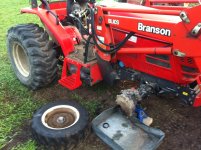
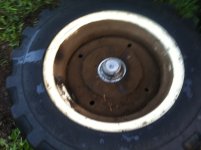
Similar to BumpandNan on the "Branson Warranty Troubles" thread I have experienced a front axle break failure this past fall. The difference is that this is an out of warranty failure, my tractor is a 2009 3510H model. With it, the wheel assembly came clean off with no warning. Please see pictures attached. While I am not seeking warranty I am quite concerned that this type of failure represents a safety issue which should be the subject of a competent investigation and corrective action as found necessary. I would appreciate hearing from anybody who has experienced such a failure. Please share with me your experiences and concerns in this thread or by private email.

I believe this investigation should look into the manufacturing process of the axle, is it made of two pieces welded together? or, is it a single piece construction? I have concerns that this may have been a bad friction weld that has failed. So far Branson Tractor considers this failure closed because it is out of warranty.

I think that a failure investigation of this nature should be led by Kukje Machinery who are the designers and manufacturers of the product. They are the experts who would have the most knowledge and understanding of the axle manufacturing processes and the corresponding failure modes of the axle.

My tractor, as indeed are many tractors of this type, is often used on a public highway and on roadways, failure at such a time could lead to catastrophic results or on a side hill turn for that matter. In my case the wheel came off while turning over a compost pile. Hardly an excessive load. This leaves me with an uncertainty considering the LH front wheel axle which had not failed but which is of the same age in hours and calendar time as the axle that failed.

For those that are interested, I have attached some pictures of the tractor and wheel axle as failed. The wheel lies on the ground as it came to rest after departing the tractor.
Branson failure #1.jpgBranson failure #2.JPGBranson failure #3.JPGBranson failure #4.JPGBranson failure #5.JPG
 
   / Branson Front Wheel Axle Failures #2  
Just for reference, i have broke a couple of axles over the years in a very similar manner. Once on a Ford 8N and again on a Ferguson TO35. They were 2wd and much easier to fix though. Replacements were readily available at tractor salvage yards. You won't be so lucky probably. Let us know how the repair goes.
 
   / Branson Front Wheel Axle Failures #3  
What is the primary use of the tractor? Hard surface (gravel/concrete/asphalt)? Is the 4 wheel assist engaged all the time? I only use the 4wd when it is absolutely needed. Constant use of 4wd, especially on hard surfaces when turning, puts a lot of pressure on the axel stubs. To get a feel of what is happening, if you have a 4wd truck/suv, engage the 4wd and drive it slowly on a hard surface and go in a circle. It will turn but you can feel the resistance as the tires do not slip on the road surface.

Seeing that you have industrial tires puts a lot more tire surface in contact with the ground. The front tires need to be able to slip a bit in order to relieve the pressure.

My .04 worth on the subject.
 
   / Branson Front Wheel Axle Failures #4  
Hello

I am in need of help and advice from Branson operators.

Similar to BumpandNan on the "Branson Warranty Troubles" thread I have experienced a front axle break failure this past fall. The difference is that this is an out of warranty failure, my tractor is a 2009 3510H model. With it, the wheel assembly came clean off with no warning. Please see pictures attached. While I am not seeking warranty I am quite concerned that this type of failure represents a safety issue which should be the subject of a competent investigation and corrective action as found necessary. I would appreciate hearing from anybody who has experienced such a failure. Please share with me your experiences and concerns in this thread or by private email.

I believe this investigation should look into the manufacturing process of the axle, is it made of two pieces welded together? or, is it a single piece construction? I have concerns that this may have been a bad friction weld that has failed. So far Branson Tractor considers this failure closed because it is out of warranty.

I think that a failure investigation of this nature should be led by Kukje Machinery who are the designers and manufacturers of the product. They are the experts who would have the most knowledge and understanding of the axle manufacturing processes and the corresponding failure modes of the axle.

My tractor, as indeed are many tractors of this type, is often used on a public highway and on roadways, failure at such a time could lead to catastrophic results or on a side hill turn for that matter. In my case the wheel came off while turning over a compost pile. Hardly an excessive load. This leaves me with an uncertainty considering the LH front wheel axle which had not failed but which is of the same age in hours and calendar time as the axle that failed.

For those that are interested, I have attached some pictures of the tractor and wheel axle as failed. The wheel lies on the ground as it came to rest after departing the tractor.
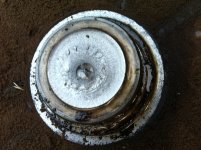
View attachment 498382View attachment 498383View attachment 498384View attachment 498385View attachment 498386

IF you can find them, I think I would replace BOTH front axles!
It will very likely be far more difficult to find one later,...when/if the other side fails.
Then too: If they are both new, you will have eliminated the worry factor.
 
   / Branson Front Wheel Axle Failures
  • Thread Starter
#5  
Just for reference, i have broke a couple of axles over the years in a very similar manner. Once on a Ford 8N and again on a Ferguson TO35. They were 2wd and much easier to fix though. Replacements were readily available at tractor salvage yards. You won't be so lucky probably. Let us know how the repair goes.

Hello Cougsfan, thanks for the comments.

My dealer very quickly repaired the tractor and returned the tractor to me. They recognized that I was starting to plant my garlic and needed the tractor. It has great super slow cruse capability. Kudos to them for getting it back to me as quickly as they did.

Crap does happen and I can accept that however this to me is a significant safety issue. Also the failure is eerily similar to another failure I had once been exposed to. It was a friction weld failure where a turbine rotor was welded to a turbine shaft. Kukje and Branson need to be transparent on this issue. Are they using friction welding or aren't they? If they are using friction welds on these axles, some serious review of this failure leading to a more in-depth look at their manufacturing processes and quality control needs be undertaken. In the best of companies quality escapes can and do occur. I still have not heard from Branson Tractor outside of the fact that their service rep has declared the case is closed because the tractor is out of warranty.

Cheers Cliff
 
   / Branson Front Wheel Axle Failures
  • Thread Starter
#6  
What is the primary use of the tractor? Hard surface (gravel/concrete/asphalt)? Is the 4 wheel assist engaged all the time? I only use the 4wd when it is absolutely needed. Constant use of 4wd, especially on hard surfaces when turning, puts a lot of pressure on the axel stubs. To get a feel of what is happening, if you have a 4wd truck/suv, engage the 4wd and drive it slowly on a hard surface and go in a circle. It will turn but you can feel the resistance as the tires do not slip on the road surface.

Seeing that you have industrial tires puts a lot more tire surface in contact with the ground. The front tires need to be able to slip a bit in order to relieve the pressure.

My .04 worth on the subject.

Hi Coralhead, thank you very much for your comments and interest. We normally do not use the 4wd feature unless we need to, for instance in soft ground or snow where we have traction issues. In my view if one accepts that the times we have used the tractor in 4wd are sufficient to lead to this failure I personally feel that the tractor drive system is under designed. I do however believe the tractor has designed into it the capability to handle average driving that respects the conditions set in the operators handbook. I personally believe that Kukje has experienced some quality escapes which they may or may not be aware.

It would be quite helpful if Branson Tractor as the front line responder to the operator could be more transparent in their approach to these type of problems. I.E. what have they (Kukje) seen in terms of failure reports?, how deep of an investigation have they (Kukje) conducted in each of the failures that have been reported? have they (Kukje) requested and tested the broken bits through metallurgical analysis to see what the failure mode was and determined what is needed to correct possible future failures? Does Kukje have a process whereby their distributors collect evidence of failures and forward those collections to Kukje for analysis? Coralhead, this is where my head is at this at, I am not used to manufacturers and distributors going dark at a time that they are needed.
 
   / Branson Front Wheel Axle Failures
  • Thread Starter
#7  
IF you can find them, I think I would replace BOTH front axles!
It will very likely be far more difficult to find one later,...when/if the other side fails.
Then too: If they are both new, you will have eliminated the worry factor.

Fried, I really appreciate your input, I actually am thinking of doing that. I have learned enough in researching this issue that I feel quite confident that I could easily do this work should the need arise in future.
 
   / Branson Front Wheel Axle Failures #8  
Not trying to be critical,,, but,,, these tractors require some minimum ballast on the rear when using the loader.

Your pic does not show any ballast,, although, it may be hidden.
Do you use rear ballast?
 
   / Branson Front Wheel Axle Failures #9  
Not trying to be critical,,, but,,, these tractors require some minimum ballast on the rear when using the loader.

Your pic does not show any ballast,, although, it may be hidden.
Do you use rear ballast?
We had a tractor at work that had almost the same failure from overloading the front axle.
The dealer said that it didn't need ballast, but without ballast it was over the front axle rating with the loader/blade off the ground. Adding 2000# on the 3 point took enough weight off of the front axle to get it under the rating.

Aaron Z
 
   / Branson Front Wheel Axle Failures #10  
Not trying to be critical,,, but,,, these tractors require some minimum ballast on the rear when using the loader.

Your pic does not show any ballast,, although, it may be hidden.
Do you use rear ballast?

I agree.... and although you were just moving compost that day,
It was probably a hard shock a while back that started this path in motion.

9 years old, 1558 hours, unknown history, not a regular occurrence
= Kukje won't investigate unless it becomes a COMMON problem, (which it isn't)
 
   / Branson Front Wheel Axle Failures
  • Thread Starter
#11  
Not trying to be critical,,, but,,, these tractors require some minimum ballast on the rear when using the loader.

Your pic does not show any ballast,, although, it may be hidden.
Do you use rear ballast?


Cadplans, your observation is correct, I do not use balance weights or ballast as mentioned in the operators manual. For stability and control issues I have fluid in the wheels (supplied by the dealer), half full as the frost line showed me this morning.

Are you implying that weights are necessary to protect the axle from overload and failure? In reviewing the operators manual and the service manual for current versions of the tractor I can see no mention that the weights must be installed to protect the health of the axle. The only technical guidance or requirements that I see is that the operator is informed to increase the front wheel tire pressures by approx 50% when installing the loader. I do understand very well how aft applied weight will pull load from the front in operation but have never viewed it as a requirement to protect against functional failure of the axle. I would expect Kukje engineering to have designed into the axle strength the necessary contingency margins to address the operational loads developed using their loaders in typical farm operations. That axles are breaking remains a safety concern with me that has not been addressed by Kukje.

Again, thank you very much for you points they certainly causing me to more fully appreciate this issue.

.
 
   / Branson Front Wheel Axle Failures #12  
Cadplans, your observation is correct, I do not use balance weights or ballast as mentioned in the operators manual. For stability and control issues I have fluid in the wheels (supplied by the dealer), half full as the frost line showed me this morning.

Are you implying that weights are necessary to protect the axle from overload and failure?
In reviewing the operators manual and the service manual for current versions of the tractor I can see no mention that the weights must be installed to protect the health of the axle.
.

Actually,, I do not own a tractor like yours,, but, I am trying to help.
With JD tractors. the specs for the needed weight on the 3 point hitch is detailed in the loader manual.

I dug a little,, and found an example for a tractor smaller than yours.
That tractor (a JD 1023E), is expecting the 3 point ballast to be about 600 pounds, plus fluid filled tires.

Whether this weight is recommended for stability, or axle survival,, I do not know,,,:confused:
 
   / Branson Front Wheel Axle Failures
  • Thread Starter
#13  
We had a tractor at work that had almost the same failure from overloading the front axle.
The dealer said that it didn't need ballast, but without ballast it was over the front axle rating with the loader/blade off the ground. Adding 2000# on the 3 point took enough weight off of the front axle to get it under the rating.

Aaron Z

Aaron, could you advise the make/model of the tractor and loader combination you refer to? I would really appreciate that. Did you have factory supplied guidance for making the necessary calculations or were you left to develop this information on your own? if you do not wish to publicly divulge this info could you privately send it to me? Thanks.

Also, your comment suggests to me that the use of weights to ensure respect of the front axle rating may not be well understood nor properly addressed in the guidance information and manuals issued by the manufacturer/distributor to the dealer and the operator. 2000 pound extra on the 3 point is a lot of weight to be lugging around.
 
   / Branson Front Wheel Axle Failures #14  
Aaron, could you advise the make/model of the tractor and loader combination you refer to? I would really appreciate that. Did you have factory supplied guidance for making the necessary calculations or were you left to develop this information on your own? if you do not wish to publicly divulge this info could you privately send it to me? Thanks.
Also, your comment suggests to me that the use of weights to ensure respect of the front axle rating may not be well understood nor properly addressed in the guidance information and manuals issued by the manufacturer/distributor to the dealer and the operator. 2000 pound extra on the 3 point is a lot of weight to be lugging around.
It was a LS tractor, the dealer sold us the tractor with a 14' Horst Snow Wing (I think it is a SB3200W914) on the front and wheel weights on the back wheels as a package.
We assumed that they made sure that it was within spec, but after the second front axle failure, we weighed the front and rear axles with the blade on/off the ground. I don't remember where we found the front axle weight rating, but we were over it by at least 1000# (IIRC) with the blade in the air and no weight on the back.
We put a 2000#(ish) weight on the 3 point hitch and the front axle weight was within the weight rating. No issues with the front axle since (to date).

Aaron Z
 
   / Branson Front Wheel Axle Failures
  • Thread Starter
#15  
It was a LS tractor, the dealer sold us the tractor with a 14' Horst Snow Wing (I think it is a SB3200W914) on the front and wheel weights on the back wheels as a package.
We assumed that they made sure that it was within spec, but after the second front axle failure, we weighed the front and rear axles with the blade on/off the ground. I don't remember where we found the front axle weight rating, but we were over it by at least 1000# (IIRC) with the blade in the air and no weight on the back.
We put a 2000#(ish) weight on the 3 point hitch and the front axle weight was within the weight rating. No issues with the front axle since (to date).

Aaron Z

Thanks for the quick reply. Certainly shows that a mismatch can and does take place.
 
   / Branson Front Wheel Axle Failures #16  
Thanks for the quick reply. Certainly shows that a mismatch can and does take place.
Yes, this machine is mainly used to push snow around in the winter and pull a 10' rotary mower a few times in the summer (to mow a rough field).

Aaron Z
 
   / Branson Front Wheel Axle Failures
  • Thread Starter
#17  
Actually,, I do not own a tractor like yours,, but, I am trying to help.
With JD tractors. the specs for the needed weight on the 3 point hitch is detailed in the loader manual.

I dug a little,, and found an example for a tractor smaller than yours.
That tractor (a JD 1023E), is expecting the 3 point ballast to be about 600 pounds, plus fluid filled tires.

Whether this weight is recommended for stability, or axle survival,, I do not know,,,:confused:


Thanks for this, I did look at the Branson BL25R loader manual.

I have excerpted the following "Fluid and/or weights for rear tires is recommended for added stability. See tractor operator's manual. Three point hitch mounted weights are available from your Branson dealer. ...and that's all they wrote.

Between you and Aaron and Linc Tex you have provided some good insight. I have two requests in to Branson for them to provide me with a contact in the Kukje maintenance engineering/ product support area. Branson has not responded as yet. If any one has contacts with Kukje I would appreciate if you pass on to me their coordinates.
 
   / Branson Front Wheel Axle Failures #18  
Even though it may not specifically say it anywhere in any manual, practical experience shows and common sense says that ballast in the back will reduce stress on the front axle. Another thing that stresses axles tremendously is power steering. You can now turn the front wheels with a full load in the FEL easily while standing still. Pre-power steering days you couldn't budge the steering wheel with a load while standing still. These conditions that create stress on a front end haven't changed. It reduces front end stress tremendously if you only turn the wheels while you are moving if you have a heavy load on the front. Sure, you can "engineer" around all those problems, and manufacturers have done that.... but little things like using ballast and turning only when moving still make sense when using a tractor.
 
   / Branson Front Wheel Axle Failures #19  
Even though it may not specifically say it anywhere in any manual, practical experience shows and common sense says that ballast in the back will reduce stress on the front axle.

Yep. We have a 2000# 7' frame mounted snowblower on the front of our L3830. You can really tell if you forget to lift the weight barrel on the 3 point before you lift the snowblower. The first time I did that, I popped one of the front tires off of the bead...

Aaron Z
 
   / Branson Front Wheel Axle Failures #20  
We sell Branson, Mahindra and Deutz, and we work on all brands. There is not a single brand of compact tractor that does not deal with an occasional front axle failure. We have repaired broken front axles on what would be considered the very best most expensive brands. (Trying to not pick on any particular brand...but rest assured, it crosses all brands).

I can brake any compact front tractor axle if you give me a half hour or so. There are several methods. The common one we see is folks driving down a bank, like towards a creek, where they load the front bucket heavily and then aggressively try to back up the bank. Front tires have exceptional traction in this circumstance, rear tires have almost no traction, and a lot of tractive force is needed to get back up the hill. Now the front axle, which is designed to just assist traction, is trying to do much more than it's design spec. If you get a bit aggressive and the tires do not spin and the engine does not bog and the clutch does not slip...then you either are successful in the maneuver or you break a front axle, or side gear or ring and pinion.

There is another carnage method - if you use the front loader as a dozer or digger instead of as a loader, you can load the bucket up heavy and then lift the loader some (but remaining in the pile) and then drive forward and you are again putting huge loads on the front axle and nothing on the rear axle. The rear end is light, front traction is exceptional, all the work is being done by relative tiny front axles. This also happens pushing over trees or using the front bucket to lift a huge boulder out of a hole. Rest assured, there are many ways to break a tractor!

The front axle is tiny compared to the rear axle. It ought to just assist, not do all the work. It is my opinion that this is the cause of most front axle failures. Now if we go to a full size Cat tractor-loader, either a skip loader or a TLB, they use a pretty massive front axle, and you can get away with digging. Same with a skid-steer. But not a compact farm tractor that happens to have a loader installed.

Filling the rear tires to 75% with heavy liquid ballast and hanging a good size implement off the three-point will go a long ways toward saving a front axle, because it keeps the rear axle in the game as far as tractive force. That gives the front axle much less to do. And also, consider how you are using the tractor and if you are asking for more work from the tractor than for which it is designed - then do it seldom and do it gently.

I am sure there are other reasons front axles break, it isn't always due to what I described above. There can be faulty parts, or a leaky seal that drains away lubrication, or a failed bearing. These things happen, but far and away what I described above is the cause of the failure, and frankly an operator needs to understand the physics of it all well enough to be careful in certain situations. Repeat failures on a single tractor are generally more telling that the operator is repeating the same type of carnage inducing usage than is it telling us that the axle has issues. I am sure there are exceptions, I am speaking in general terms here.

Branson uses a good solid front axle, not any more prone to breakage than any of the better known brands. But it is not a $100k commercial skip loader with massive planetary front axles.

Those are my thoughts, and I hope I have not offended anyone.
 

Tractor & Equipment Auctions

1611 (A57192)
1611 (A57192)
Dvorak Model 3072A Hydraulic Ironworker S/A Towable Trailer (A59228)
Dvorak Model 3072A...
2021 KOMATSU WA380-8 WHEEL LOADER (A60429)
2021 KOMATSU...
2018 JOHN DEERE 333G SKID STEER (A60429)
2018 JOHN DEERE...
2000 FORD F550 SUPER DUTY SERVICE TRUCK (A60430)
2000 FORD F550...
2017 JOHN DEERE 323E SKID STEER (A60429)
2017 JOHN DEERE...
 
Top