Building a road... whoulda thunk it'd be this hard?

   / Building a road... whoulda thunk it'd be this hard? #21  
Springs are a pain in the butt when building a road, house or what have you.

Culverts where the springs are tricky. My old place we had a single wide and we had a spring that ran directly under where we set it up. The equipment operator suggested what has worked before in our area. He found a spot where the spring was obvious (poked his finger in the ground and up bubbled water and it went from muddy to clean in seconds) and dug a nice sized hole with his excavator (so, you'd do this upstream, spring, from where the roads begins, and filled it with limestone (#2 I believe was the size). After he got 3-4' of limestone in the ground he had me get a 100' roll of perforated pipe and dug a ditch about 42" wide and 4' deep for 40-45'. We put down 1-2' of limestone in the ditch and then the TWO runs of the 4' pipe, the covered with the rest of the limestone, then the dirt and we never had a problem with the spring again. I'm guessing where the hole was dug to where it ended had dirt from 6' to 3' to the end of the slope, maybe more. BTW he had a big excavator digging then a dozer etc running all over the place and never an issue in 4-5 years.

I ain't gonna say it'll work in your case, but it worked for us. LOTS of clay and sandstone where we had this done.
 
   / Building a road... whoulda thunk it'd be this hard? #22  
Given that you are building what I call a tractor trail or hiking trail this is a cheap trick that works in muddy clay. In your areas that will not dry out cut 6" +/- trees into 8' lengths and lay them side by side perpendicular to the trail. When covered with soil they will distribute the weight and keep you from sinking into the mud. Loggers have built logging roads this way for many years. Because the wood is covered with soil it does not rot away, no oxygen, the way you might think. Also for the little amount of water the springs are weeping you can use 6 or 8" PVC as culverts in with your wood matting. Much cheaper than 12" culvert pipe. Stone, unless you have it on the property, and geotex fabric is to expensive for a tractor trail.

MarkV
 
   / Building a road... whoulda thunk it'd be this hard? #23  
Given that you are building what I call a tractor trail or hiking trail this is a cheap trick that works in muddy clay. In your areas that will not dry out cut 6" +/- trees into 8' lengths and lay them side by side perpendicular to the trail. When covered with soil they will distribute the weight and keep you from sinking into the mud. Loggers have built logging roads this way for many years. Because the wood is covered with soil it does not rot away, no oxygen, the way you might think. Also for the little amount of water the springs are weeping you can use 6 or 8" PVC as culverts in with your wood matting. Much cheaper than 12" culvert pipe. Stone, unless you have it on the property, and geotex fabric is to expensive for a tractor trail.

MarkV

MarkV:
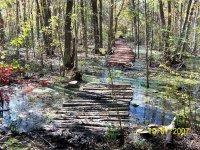
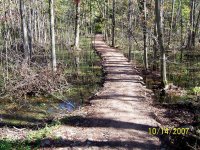
This road is built similar to your description. It's about 80 yards across a swamp. I put the logs in, covered with field stone, then covered the stone with dirt.

I also have some shorter sections of road where I used just logs, as you described. The log roads (we call them corduroy) will last for generations, but they would be tough to ride a bicycle over.
 

Attachments

  • corduroy.JPG
    corduroy.JPG
    261 KB · Views: 896
  • stone and gravel.JPG
    stone and gravel.JPG
    245.3 KB · Views: 1,041
   / Building a road... whoulda thunk it'd be this hard? #24  
chipsndust. I love what you have done. It seems like a great idea with the logs. The only thing I would suggest for OP if he wants to follow that idea is after the logs are laid down and there is at least 2 inches of dirt on top of logs, he should add throwaway carpet on top. then add more dirt to cover the carpet to the final desired height. Perhaps this would give a more stable way to hold the dry dirt on top.
 
   / Building a road... whoulda thunk it'd be this hard? #26  
MarkV:
This road is built similar to your description. It's about 80 yards across a swamp. I put the logs in, covered with field stone, then covered the stone with dirt.

I also have some shorter sections of road where I used just logs, as you described. The log roads (we call them corduroy) will last for generations, but they would be tough to ride a bicycle over.

Chipndust shows a perfect example of what I was talking about. Great job by the way. In my case I wasn't near as wet as his swamp, just clay mud like the OP's that would not dry out. The logs plus 8-12" of soil and it is as smooth as any of the other trails on the property, also stays dry.

MarkV
 
   / Building a road... whoulda thunk it'd be this hard? #27  
You have already put down so much gravel but I have put in two roads on my farm through woods such as yours and on both I ran into water problems, I too finally had to lose all of the #4 gravel ( big as your fist as you say) I had a friend who had a friend who built roads and he came out and said...you need dirt and he told me to build up the low lying areas of the road with dirt and put a crown on the road ( higher in the middle - sloping to the sides ) and then put the gravel back down. I did just that and it worked fine in both cases. The bottom line is I had to build the road up higher than the rest of the property after I put in the culverts like you did.
 
   / Building a road... whoulda thunk it'd be this hard? #28  
My land was soggy in areas until we cut down some of the trees and opened it up some. This seemed to help dry it up some. If you have running water, you will have to direct it. The middle to last part of your trail didn't look too bad. It looks like you really have only the first half which is the real problem. You already made great progress!

The trail construction manual that Charlz posted was pretty interesting (thanks Charlz!). Maybe you could use a combination of the corduroy and turnpike construction methods. Digging drainage ditches down the sides of your path will channel the water away from your trail and connect into your culverts/drainage that you've already installed. Use trees that you cut down to use as treads on the path. You might need to rent the small excavator again to dig the ditches, but if you gather up a supply of logs and plan the routing of the ditches you might be able to get it done with a weekend rental.
 
   / Building a road... whoulda thunk it'd be this hard? #29  
Neat pics and explination of what you are working with. :)

Will you allow me a bit of soapbox? Where I farm, you need all sorts of permits to put in any drainage, and would _never_ be allowed to put in drainage in the wetlands you show. I'd be required to buy 2x as much reconstructed wetlands, or return the stuff I changed back to what it was. I'd about be thrown in jail for that sort of work.

I'm trying to feed the world, and you are building a bike trail. Guess we see what is important to the world.... :(

You mention you are connecting to a 'farm road' behind your property. For the kids to bike on.... Who owns that road, is it public? Do farmers use it a lot with big ag machinery? Is it hilly or winding? I'd hate to see you setting up a tradgedy in the making. Farm implements don't have the best visibility, and kids don't make the best choices for how to behave on public roads sometimes.... As a farmer, you are setting up something I always cringe about - town folk don't quite understand farming & how machines work & how we need to travel and how poor the visibility really is on those machines..... And you really shouldn't be hooking up to a provate road without permission, if that is what it is. Just saying.....


Road building in clay wet soils is a challenge. You need to build up - get a foot higher than the ground around the road bed. Your dozer blade made more of a trench. You eed to go the other way, build a road bed up, with a crown. Any low spots, you need to get the water to cross under the road with culverts as you did. Will take a little time for the mounded clay to dry out, but then it will be an ok roadbed. Put some gravel on top of that, & it will be good for what you are doing. But you need to build up.

Wet pockets might not be springs, but just small tiny ponds - where the soil moisture meets the surface of the soil. Hard to drain those, is ther is no fall. You could trench in 4 inch perferated tile, and run it downhill towards the pond to get the water to drain away - but that is a very severe offence in my state to drain a wetland. Thought Ohio was also pretty harsh on that sort of thing. I just put in 4000 feet of tile in a 15 acre field - was lucky & got the permit. I know a little about clay & lot of rainfall & wetter areas. :)

You need to build your roadbed up taller. Then the water will stay down out of it, and the dry layer will carry the load. In real wet areas, you need to get higher, so the dry layer can set up better, stay drier. In some areas you can build road ditches down both sides. But you need to create an elevation difference, for the water to stay lower, for the roadbed to be up higher and dry out.

--->Paul
 
   / Building a road... whoulda thunk it'd be this hard? #30  
You know Paul..I just can't help myself - I have to respond...People buy land not just to farm but to enjoy - ride horses, walk in the woods, hunt, ride ATV's with their kids - not everyone buys land just to farm and further I have to say that I would sell my farm before I ever let the government tell me where I could build a road on my own property...don't you think the government especially lately is sticking their nose a little too far up our skirts? Just saying.............
 
   / Building a road... whoulda thunk it'd be this hard? #31  
Another idea that I did at my current house. It did cost some but has done well for 3 years now. You could do on a smaller scale (mine has held with cement trucks and 20 ton gravel loads). My drive crosses about 300 feet of true muck soil (think peat bog). It is the black stuff you but for $3 a bag for "potting soil." We dug the soft areas out about 4-5 feet deep, then layed geogrid/textile. Then large pieces of broken concrete. I got the concrete for free for a local plant that had a dump pile. It was all 2-6 foot pads of rebar free stuff. I got it at a plant next to LaFarge in Alliance ohio. (not sure if near you). I did have to pay the trucking though.

We layed the large concrete, then smaller broken concrete chunks. Then another layer of geogrid followed by #1 and 2s then 411 I believe (2" down to fines). When I drive over it with the dozer you see the ground bounce and vibrate 10-15 feet to the side of the drive and the drive itself. But it does seem to hold so far.

Maybe skip the first geogrid and just lay some big broken concrete--sort of disperses any load on top of it. Then go with coarse stone and maybe finer if it stays put. You may be able to find a concrete pouring/finishing company willing to deliver their tear out material to you for free...keep calling and I bet they will bite! I bet if you have time you can get a lot for free. Just trying to help. Have you called your township/county? I know around here you can register with them for dumping material from jobs. Good luck and thanks for the pics...looks likel a beautiful place...and nice for bow hunting too!
Peter
 
   / Building a road... whoulda thunk it'd be this hard? #32  
Oh my God,

This whole thread brings back nightmarish memories of spending ridiculous money on DES surveys, plans and fees, waiting for approvals , then watching 5,000 yards of blast rock and countless truckloads of gravel disappear in a swamp.

Two years an a few loads of ledge pack my 1,400 ft. driveway stands up better than the town's dirt road to my place.

Keep on plugging away at it and your road will get done.

Mike
 
   / Building a road... whoulda thunk it'd be this hard? #33  
You know Paul..I just can't help myself - I have to respond...People buy land not just to farm but to enjoy - ride horses, walk in the woods, hunt, ride ATV's with their kids - not everyone buys land just to farm and further I have to say that I would sell my farm before I ever let the government tell me where I could build a road on my own property...don't you think the government especially lately is sticking their nose a little too far up our skirts? Just saying.............
Amen to that, BRIN.
 
   / Building a road... whoulda thunk it'd be this hard? #34  
If I could think outside the ditch here, and maybe I missed it somewhere in the thread - but did you consider a pond?

If allowed, and looking at the vegetation in the pics I think it might be, you get the pond and all the dirt you need.

Before hand, you would need to find the depth of the clay to bedrock (ledge) to see if you have enough depth to work with.

Dave.
 
   / Building a road... whoulda thunk it'd be this hard? #35  
If I could think outside the ditch here, and maybe I missed it somewhere in the thread - but did you consider a pond?

If allowed, and looking at the vegetation in the pics I think it might be, you get the pond and all the dirt you need.

Before hand, you would need to find the depth of the clay to bedrock (ledge) to see if you have enough depth to work with.

Dave.

Clay does not make for a good road bed. Hard as a rock when dry, but a greasy muddy mess when wet. Clay can be used as fill but would need about 18" of rock then 6" of gravel on top. You can get away with less topping with fabric.

I'm using the clay from my ponds to build a senic overlook toward the mountains on my property.
 
   / Building a road... whoulda thunk it'd be this hard? #36  
If I could think outside the ditch here, and maybe I missed it somewhere in the thread - but did you consider a pond?

If allowed, and looking at the vegetation in the pics I think it might be, you get the pond and all the dirt you need.

Before hand, you would need to find the depth of the clay to bedrock (ledge) to see if you have enough depth to work with.

Dave.

Clay does not make for a good road bed. Hard as a rock when dry, but a greasy muddy mess when wet. Clay can be used as fill but would need about 18" of rock then 6" of gravel on top. You can get away with less topping with fabric.

I'm using the clay from my ponds as backfill to build a senic overlook toward the mountains on my property.
 
Last edited:
   / Building a road... whoulda thunk it'd be this hard? #37  
Clay doesn't make a good foundation for about anything - it is a great natural pond liner however :D

If you go with even a modest size pond and some french drains leading to it from wet areas, you could dry your lot up considerably I'm thinking.
 
   / Building a road... whoulda thunk it'd be this hard?
  • Thread Starter
#38  
Wow, thanks everyone for the replies! I have a few days off the computer and come back to a ton of good info and suggestions.

The good news: It rained almost all last week, sometimes quite heavily, but so far the ditches at the front, sides and back are actually working! At the front part of the road the water is draining down the sides, through the culvert and into the pond. At the middle, where I placed the two culverts, water is flowing well to the spring cap and then into the pond. The other great news is all that muck that I pulled up from the spring and while digging for the two culverts has dried out - even with the rain - and it's actually walkable now. My oldest boy and I went back there at dusk. There's a ~10 acre field completely enclosed by trees at the back of my property and we saw 7 deer in different places around the low brush and treeline. I don't own a bow but I sure could use one here :)

The bad news: I haven't been all the way to the back in almost a month, and I have just found out that having this road will take maintenance to keep clear, or the woods will take it back over. There were limbs down and growing back over it in that short time. Probly a good chore for the kids.

I have decided on a plan - I will use the corduroy log road described by MarkV and chipsndust in posts 22 and 23 to cross the last muddy spot over the two culverts. I have tons of trees and they are all free. I scoured the net looking for info on something like that before I started but I guess I didn't look hard enough! And I have resigned myself to having to buy one more load of gravel to connect the front road to where the logs will go. Once that's done I think we will have a functional road! The logs may not last forever but at this point I would be happy with 10 years.

If I could I would have a "do-over" and get the big chunks of concrete, pull everything off and lay them down, then build the road up 6-12" on top of that, but because of the access issues and time I just can't do it. Hopefully the way I did it will last for a while.

Oh, one other thing, about the farm road at the back: It is actually 20' into our property and runs parallel with the back line. The only traffic it gets are horses from all the stables in the area. There may be an ATV from time to time but those get chased off pretty quick. So the kids will be safe. The farmer keeps all his toys in the field and not on the lane. He does come and brush hog it twice a year to keep it clear though, nice guy.

I'll post back when I start doing the corduroy road with some more pics! Thanks again all.

Patrick
 

Tractor & Equipment Auctions

MARATHON 20KW GENERATOR (A55745)
MARATHON 20KW...
2018 GENIE GTH1056 TELESCOPIC FORKLIFT (A60429)
2018 GENIE GTH1056...
Schulte XH1500 Series 4 15ft Pull-Behind Batwing Rotary Brush Cutter Tractor Attachment (A59228)
Schulte XH1500...
2014 Ford Explorer AWD SUV (A59231)
2014 Ford Explorer...
FORD 8630 TRACTOR (A60430)
FORD 8630 TRACTOR...
TANK MANIFOLD (A58216)
 
Top