Calling All Plumbers

/ Calling All Plumbers #1  

Transit

Veteran Member
Joined
May 13, 2009
Messages
1,551
I have a problem with my base board heating system that has driven me nuts for years. During the heating season I have to bleed air out of the system three or four times or the banging and grueling will have me go Postal. The system is a closed loop, boiler > pipes > radiators > pipes > circulation pump > boiler. I have pressure checked the system several times, no leaks. At the highest point in the system there is positive pressure above atmospheric, hence no way air can leak in. So where is the air coming from?

My thinking has evolved to the point that air is being drawn in at the suction side of the pump. The water is not in motion, weighing maybe 100 -150 pounds. When the circulator pump starts, the water is at rest and its at-rest inertia will not allow it to accelerate instantly causing the suction side of the pump to briefly fall below atmospheric pressure.
For this brief time, a wee amount of air is drawn in around the pump drive shaft seals and eventually gets larger. Now you would expect that the expansion tank would compensate for the pressure drop, but the expansion tank is on the output side of the boiler under pressure. I would think that a second tank on the input/suction side of the water pump would compensate, acting as a shock absorber for the sudden pressure drop in the suction line? Or only one expansion tank is needed at the suction side of the pump?

Every hydronic heating system I have seen has the expansion tank on the output side of the boiler, why?
 
/ Calling All Plumbers #3  
I watched this on one of the home fixit tv programs and how it was repaired. An fairly easy repair if i remember correctly, had 4 different people on the show that explained alot of small repairs, but darned, I can't think of the name of it. Maybe someone else on here saw it too. Ended up not really being air in the system from what I remember.
 
/ Calling All Plumbers #4  
Nice article Mace. The expansion tank location isn't important, but what makes a big difference in air in the system & air bound systems is where the circulator is located. Most older systems (and too many new) have the pump on the return line, sucking water through the radiators. It should be on the supply line, pushing the water through. Why was this done? A long time ago the pump was placed there because the pump was kept out of the hottest water and the seals would last longer. It stayed that way for a long time because "that's the way we always did it", and it was easier to package the boiler for shipping. A great book on this subject is Pumping Away, by Dan Holohan. It should be a required read for everyone in the trade. It's better to know why something works, than how to put it together. If you put a pressure gauge upstream from the pump, you won't see a drop in pressure when it starts, so you are probably not sucking in air anywhere. As Mace's article implies,the air will probably clear up after a couple of bleedings. If your system uses a purge setup to get the air out, you are adding fresh water to the system when it is purged, bringing in more air, adding to the problem.
These things can be a real pain to clear up. I have been away from the trade for many years, there may be additives out there that can help you.
 
/ Calling All Plumbers #5  
Have you thought about adding auto bleaders on each radiator? I know they are cheap and work for years.
 
/ Calling All Plumbers #6  
If it IS air in the system, it may be caused by cavitation at the pump impeller. Essentially what happens is the dissolved oxygen in the water comes out of solution as it passes by the end of the impeller blades. Same thing with submarine props turning at high speed in shallow depth (low pressure), air bubbles are formed at the trailing edge of the blade because the water pressure isn't high enough to keep them in solution.

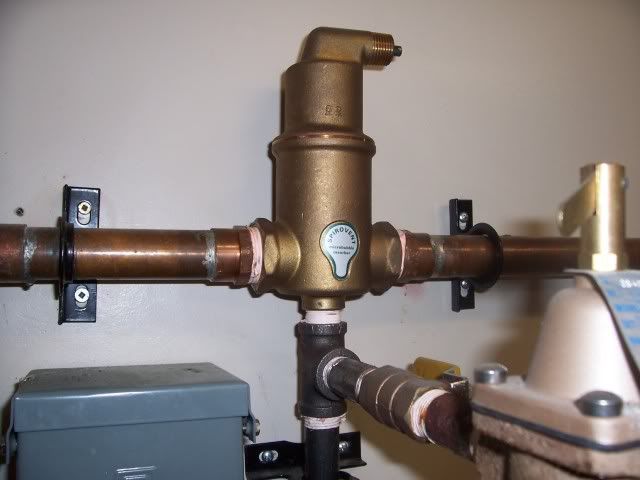
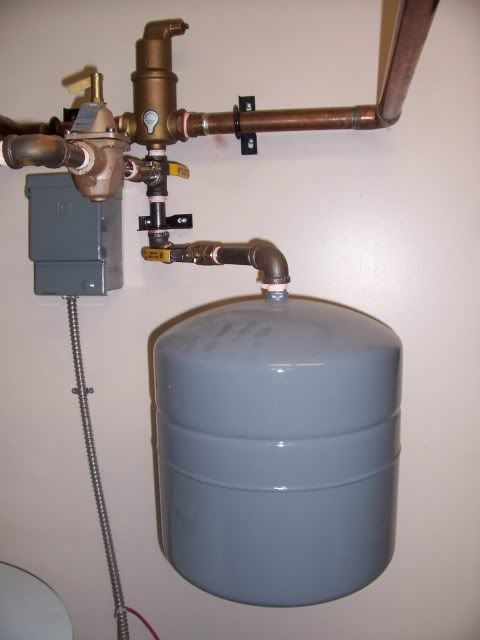
You may want to install a de-aerating valve, called a Spirovent microbubble resorber

100_3484.jpg


100_3485.jpg


Mine is installed at the top of the system, just after the pressure reducing valve and before the expansion tank as in the second pic.

Sean
 
/ Calling All Plumbers #7  
There is probably a very simple fix for this. If your system pressure is 10 psi or more below the relief valve setting, turn the regulator for the make up water up by 2 psi.

E/S
 
/ Calling All Plumbers
  • Thread Starter
#8  
Reading through all the replies, I have done 99% of what has been suggested. That 1% undone is to install an inline air-water purge valve.
 
/ Calling All Plumbers #9  
If it IS air in the system, it may be caused by cavitation at the pump impeller. Essentially what happens is the dissolved oxygen in the water comes out of solution as it passes by the end of the impeller blades.

Sean

Another possible solution is a vortex breaker installed on the pump inlet side if one is available for the OP's pump. It's essentially an "X" in the line to break up the swirling motion.
 
/ Calling All Plumbers #10  
This is a common problem because in fin type baseboards there is no space for air to accumulate and be vented in one shot. You have a tube with slugs of air every few feet. You bleed one slug, but ten ,feet down the line there's another and another etc. I installed these systems by running continueous loops .In one rad out the rad and into another.I put shut offs and boiler drains at each end of the loop. Now I could shut the valves, connect a hose from the house water supply to one drain, connect the other boiler drain to the sewer or run it outside, and flush ,purge the system. Zero problems this way. If your system has a main feed and branches off the main ,you will never solve this problem. Air valves on the baseboard will do nothing but frustrate you. An auto vent at the boiler will help but not solve this problem
 
/ Calling All Plumbers #11  
It's very early, I can't sleep because my back is killing me and I'm exhausted...plus it's been a while since I even thought about this stuff. I've owned a few boilers w/ baseboards but mostly just learned about low pressure hot water boilers while studying for stationary fireman and engineers license.....just hit the high points on these systems. anyway, you know what they say about opinions, everyone's got one...fill in the blank,etc.

I don't know if you have a diaphragm type expansion tank or the old style but if either hasn't been serviced and not working correctly, maybe you're PRV is occasionally opening and you're adding make up water to the system, which as Ken_CT mentioned will have higher O2 content and add to possible problems. Does the system have an automatic air vent or an air separator and is it working correctly? Also, as Chilly mentioned, the microbubble resorbers are a common solution and supposedly very efficient at removing even dissolved O2. I would be surprised if the air is coming from the pump seal, but I'm no expert. There are chemicals that can be added to system water to aid in removing dissolved O2, they're really for corrosion inhibitors and while healthy for some systems, probably won't help your issue. Don't know if I've helped, hurt or confused, but check and make sure that your system components are working correctly.

As far as why the expansion tank is on the output side, they are designed to compensate for thermal expansion which is going to be highest at this point. The water returning to the boiler has cooled significantly in comparison by the time it has returned to the other side of the circuit so a tank there would not be needed.

On Edit: Hey, I just remembered something.....I made a set of front weights for the tractor out of an old cast iron sectional boiler I took out of a property I bought one time....worked great. Just something to ponder if the frustration level drives you over the edge. :)
 
Last edited:
/ Calling All Plumbers #12  
This is a common problem because in fin type baseboards there is no space for air to accumulate and be vented in one shot. You have a tube with slugs of air every few feet. You bleed one slug, but ten ,feet down the line there's another and another etc. I installed these systems by running continueous loops .In one rad out the rad and into another.I put shut offs and boiler drains at each end of the loop. Now I could shut the valves, connect a hose from the house water supply to one drain, connect the other boiler drain to the sewer or run it outside, and flush ,purge the system. Zero problems this way. If your system has a main feed and branches off the main ,you will never solve this problem. Air valves on the baseboard will do nothing but frustrate you. An auto vent at the boiler will help but not solve this problem

Sorry I should have added that it could be fixed but with major repiping. You know maybe you have this purge system in place and don't know it. Why not get a heating specialist in for a consult? A couple of bucks might solve your problem very easily.
 
/ Calling All Plumbers #13  
I had a similar situation with my in-floor hydronic, for the first five years I ran it. Finally cured the problem by doubling the size of the expansion tank. Now its been at least five years with NO bleeding and no re-filling and no los of pressure (12lbs).
 
/ Calling All Plumbers
  • Thread Starter
#14  
Thanks for the replies; i have auto air bleed valves on the down stream side of each cast iron radiator. Cast iron or copper fin tube should make no difference.

Lets assume that there is a leek somewhere in the system and the air is from the make-up water, what kind of sealer can be used?
 
/ Calling All Plumbers #15  
Nice article Mace. The expansion tank location isn't important, but what makes a big difference in air in the system & air bound systems is where the circulator is located. Most older systems (and too many new) have the pump on the return line, sucking water through the radiators. It should be on the supply line, pushing the water through. Why was this done? A long time ago the pump was placed there because the pump was kept out of the hottest water and the seals would last longer. It stayed that way for a long time because "that's the way we always did it", and it was easier to package the boiler for shipping. A great book on this subject is Pumping Away, by Dan Holohan. It should be a required read for everyone in the trade. It's better to know why something works, than how to put it together. If you put a pressure gauge upstream from the pump, you won't see a drop in pressure when it starts, so you are probably not sucking in air anywhere. As Mace's article implies,the air will probably clear up after a couple of bleedings. If your system uses a purge setup to get the air out, you are adding fresh water to the system when it is purged, bringing in more air, adding to the problem.
These things can be a real pain to clear up. I have been away from the trade for many years, there may be additives out there that can help you.

Ken, that answer is just chock full of information. My own hydronic system is propylene glycol in pex pipes buried in the concrete floor and heated by a hot water heater. It works a treat, but I wonder about that expansion tank. As far as I can see, the expansion tank and piping to it are the only parts of the whole system made out of metal that can rust and corrode. I'm curious what you might think about that. I've always wondered if anyone makes a non-corrodable expansion tank.
Thanks, rScotty,
A JD, a Kubota, and a couple of Yanmars - all of them have their job to do. An equal opportunity hobbyist.
 
Last edited:
/ Calling All Plumbers #16  
Thanks for the replies; i have auto air bleed valves on the down stream side of each cast iron radiator. Cast iron or copper fin tube should make no difference.

Lets assume that there is a leek somewhere in the system and the air is from the make-up water, what kind of sealer can be used?

The bleaders do get stuck and need replacing or a good cleaning (if you can). How old are they?
 
/ Calling All Plumbers #17  
Thanks for the replies; i have auto air bleed valves on the down stream side of each cast iron radiator. Cast iron or copper fin tube should make no difference.

Lets assume that there is a leek somewhere in the system and the air is from the make-up water, what kind of sealer can be used?

Do you know for sure that the auto valves are functioning? If there is a leak, it should be able to be seen, you'll see obviouse signs of water and the only way I know to deal with that are the typical methods ( isolate trouble spot and repair---sweat in new fitting, valve ,etc) There doesn't necessarily have to be a leak, per se...I was referring to an expansion tank that wasn't functioning correctly. If the old style expansion tank is full of water then there is no air to absorb the thermal expansion- the prv opens and the air rich make up water comes into your system. From what I remember, if a diaphragm type has an over or under charged bladder, it can cause similar problems. Where does your PRV drain to, i.e.....if it was opening intermittently would you see obvious signs of water or would it be going into a floor drain, etc where you may not be noticing it?

I again want to remind that I'm certainly no expert...just throwing some ideas out there and trying to help. I can tell that there are some members here that are far better versed with these systems than me. I actually had a problem with an expansion tank one time years ago ( PRV was opening) and found the tank was full of water and was the culprit. I also think kidr has some good advice. Both systems I've owned were designed the way he described and allowed for easy flushing/purging and yours might be too...have you checked this out?
 
/ Calling All Plumbers #18  
Thanks for the replies; i have auto air bleed valves on the down stream side of each cast iron radiator. Cast iron or copper fin tube should make no difference.

Lets assume that there is a leek somewhere in the system and the air is from the make-up water, what kind of sealer can be used?

The difference is that fin tubes are only tubes . No place to accumulate air. The cast iron baseboard is 6 to 10 inches high. Plenty of room to store air and still allow circulation . Big difference in they they should be piped. Your system is not sucking air.If it was you would have leaks when the pump was off.The pump is just a small paddle wheel I don't think it could create suction in a closed pressurized system. It's not designed to do that So what do you have cast iron or fin tube or mixed? Does your system feed water a lot? It should almost never feed water. Are you maintaining at least 12psi on the boiler?
 
/ Calling All Plumbers #19  
Transit,
Put in the Spirovent! It will automatically bleed your whole system whenever gas gets in there. Dissolved air and gasses eventually come out. It's not a true closed system or you wouldn't need an auto filling valve for make up water. Cavitation at startup of the pumps can keep things banging around forever too.
The spirovent works really well. :thumbsup:
 
/ Calling All Plumbers #20  
If you're losing water the makeup water will bring dissolved air in with it. I would turn off the makeup water and monitor the boiler closely for a couple of days. If you are using significant makeup water you have bigger problems then air in your pipes. The makeup water brings in oxygen which will corrode your boiler away.

If you are losing water I can think of two scenarios that wouldn't result in visible leakage. One is that your expansion tank is too small and your pressure valve is releasing. The water spills around the boiler and the heat of the boiler makes it evaporate quickly. The other is that the boiler is leaking internally and the water is going up the chimney.
 
 
Top