Chain and binders

/ Chain and binders #1  

Roger2561

Silver Member
Joined
Apr 17, 2005
Messages
135
Location
New Hampshire, USA
Tractor
JD 4500
I'm not sure if this is the correct place to ask this question, but in my mind it's a safety issue. I have a JD4500, loaded rear tires, FEL, 4X4, the heaviest 3pth piece I have is nearly 900Lbs. I need recommendations regarding chains and binders for trailering; Grade, number of chains and binders, optimum anchoring points, etc...

Thanks in advance for your assistance.

Roger
 
/ Chain and binders #2  
Roger,
There have been many discussions and disagreements on securing the load on a trailer and many opinions re: grade 43 vs. grade 70 chain vs. ratchet straps. Without starting a whole new discussion, the general concensus seems to be as follows:
1) Use grade 70 chain or better. Chain load weight capacity varies depending on size of chain (1/4",5/16",3/8" etc.) so pick a chain size rated high enough to handle your load. (Most would probably use 3/8"). Use 1 chain at each corner of the tractor secured with ratchet binders.
2) Attachments such as bucket, rotary cutter, backhoe etc. should also be secured with separate chains and binders.
3) Chains should be positioned as to not allow forward, rearward, or side motion on the trailer.
4) Wheels should be blocked or chocked as well.
5) Brakes on tractor should be set and vehicle placed in gear in low range.
There are Dept. of Transportation laws for each state that apply for securing loads rated above and below 10,000 lbs. The laws vary per state but I think you'll be safe and legal securing as described above.

George
 
/ Chain and binders #3  
What size, brand, or grade ratcheting chain binders should be used? Also does anyone have anymore information about where to hook the chains at each corner (axle?) and where to put the chain binder? Maybe even some pictures. I assume that you wrap the chain around the axle and then around a corner of the trailer (mine has chain pipes in the rub rail just for this). Then use the binder to grab two pieces in the middle of the chain and pull them tighter. This is how I've used regular chain binders before. Thanks in advance for the help!
 
/ Chain and binders #4  
What size, brand, or grade ratcheting chain binders should be used? Also does anyone have anymore information about where to hook the chains at each corner (axle?) and where to put the chain binder? Maybe even some pictures. I assume that you wrap the chain around the axle and then around a corner of the trailer (mine has chain pipes in the rub rail just for this). Then use the binder to grab two pieces in the middle of the chain and pull them tighter. This is how I've used regular chain binders before. Thanks in advance for the help!
 
/ Chain and binders #5  
I would agree completely with what George said. As far as brands, I'm sure that some are certainly better than others and the concensus is that U.S., Canadian, or Japanese made chain is better than Chinese or Koren. I personally have all U.S. made grade 70 chain and binders, but I would not be afraid of using all Chinese made grade 70 chains and binders. I am not a metalurgist, and don't care to be, but you can find several sites on the internet that go into great detail of the steel making processes, but they also say that some metal made in China meets even the highest standards and some is junk. So, since I've spent so much money on my tractor and equipment, I went ahead and spent the extra $100 or so to buy all U.S. made stuff simply for piece of mind. The only thing I know for sure, since I personally experienced it, is that you can snap two "10,000" straps going down a highway dip with a 7500 pound trailer. I was in the 'straps are fine and are much easier to use' camp before that.
 
/ Chain and binders #6  
I would agree completely with what George said. As far as brands, I'm sure that some are certainly better than others and the concensus is that U.S., Canadian, or Japanese made chain is better than Chinese or Koren. I personally have all U.S. made grade 70 chain and binders, but I would not be afraid of using all Chinese made grade 70 chains and binders. I am not a metalurgist, and don't care to be, but you can find several sites on the internet that go into great detail of the steel making processes, but they also say that some metal made in China meets even the highest standards and some is junk. So, since I've spent so much money on my tractor and equipment, I went ahead and spent the extra $100 or so to buy all U.S. made stuff simply for piece of mind. The only thing I know for sure, since I personally experienced it, is that you can snap two "10,000" straps going down a highway dip with a 7500 pound trailer. I was in the 'straps are fine and are much easier to use' camp before that.
 
/ Chain and binders #7  
</font><font color="blue" class="small">( about where to hook the chains at each corner (axle?) and where to put the chain binder? Maybe even some pictures. I assume that you wrap the chain around the axle and then around a corner of the trailer (mine has chain pipes in the rub rail just for this). )</font>

You can wrap the chain around the axle. If you are concerned about the chain scratching up the paint, you can get axle straps at TSC. They are a short nylon webbing that you wrap around the axle and you hook your chain to the ends of the strap.
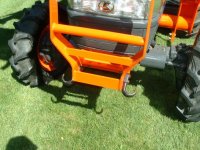
On my Kubota I bolted hooks on the front to attach the chains to. (see picture)
 

Attachments

  • 896923-4330 Kubota hooks.JPG
    896923-4330 Kubota hooks.JPG
    59.4 KB · Views: 413
/ Chain and binders #8  
</font><font color="blue" class="small">( about where to hook the chains at each corner (axle?) and where to put the chain binder? Maybe even some pictures. I assume that you wrap the chain around the axle and then around a corner of the trailer (mine has chain pipes in the rub rail just for this). )</font>

You can wrap the chain around the axle. If you are concerned about the chain scratching up the paint, you can get axle straps at TSC. They are a short nylon webbing that you wrap around the axle and you hook your chain to the ends of the strap.
On my Kubota I bolted hooks on the front to attach the chains to. (see picture)
 
/ Chain and binders #9  
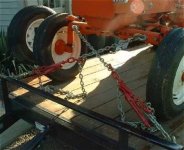
On one of my antique tractors I bolted lifting rings to the front axle to attach my chains to. Many tractors have holes or bolts through the front axle that can be utilized. I will attach a picture.
 

Attachments

  • 896926-untitled (Small) (Small).JPG
    896926-untitled (Small) (Small).JPG
    45.3 KB · Views: 709
/ Chain and binders #10  
On one of my antique tractors I bolted lifting rings to the front axle to attach my chains to. Many tractors have holes or bolts through the front axle that can be utilized. I will attach a picture.
 
/ Chain and binders #11  
I'll take a stab too.

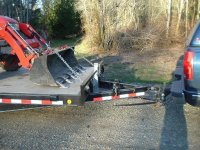
1) Grade 70 is ideal, grade 43 is second choice. Country of origin is not important unless you are older. Us young folks have been using foreign merchandise all our lives, note the Korean tractor. Other grades of chain, especially higher ones, have some funky metal characteristics that are not desirable like being extra stretchy. The vast majority of folks that should know use G70 for binding rolling loads. I use 3/8" chain for my 4000 lb tractor.

2) The binders are not graded like chain. They are only labeled with a working load limit or WLL. Be sure that the WLL of the binder is at least as high as the WLL of the chain you choose. I prefer ratchet binders.

3) I use and recommend 4 separate chains and 4 separate binders. Each pair leading from a corner of the tractor to the trailer to make an "X" shape. I am not real big on independently chaining down implements or the loader though I recognize that the rules require it. If you are trailering interstate or a long ways then I would add an independent chain and binder to the FEL and the rear implement. What I do is arrange my X so that the implements are being squeezed if it is possible.

3) I anchor on the tractor to the tractors drawbar hitch assembly in the rear and around the tractor frame in front. Then I go to the best stakepockets on the trailer.

4) The chain you buy for binding has hooks on each end. They are not slip hooks so the hooks stay with the link you put them on. Make a short loop around the anchor point on each end and then place the binder between the two loops. All the extra slack will now be between the two binder hooks and should be wrapped around something to prevent the chain from dragging on the road.

5) The consensus is a strange way to think of it, there are some dang smart folks who think the consensus is bunk. Whatever you do, don't use straps.
 

Attachments

  • 896927-towin.JPG
    896927-towin.JPG
    61.4 KB · Views: 353
/ Chain and binders #12  
I'll take a stab too.

1) Grade 70 is ideal, grade 43 is second choice. Country of origin is not important unless you are older. Us young folks have been using foreign merchandise all our lives, note the Korean tractor. Other grades of chain, especially higher ones, have some funky metal characteristics that are not desirable like being extra stretchy. The vast majority of folks that should know use G70 for binding rolling loads. I use 3/8" chain for my 4000 lb tractor.

2) The binders are not graded like chain. They are only labeled with a working load limit or WLL. Be sure that the WLL of the binder is at least as high as the WLL of the chain you choose. I prefer ratchet binders.

3) I use and recommend 4 separate chains and 4 separate binders. Each pair leading from a corner of the tractor to the trailer to make an "X" shape. I am not real big on independently chaining down implements or the loader though I recognize that the rules require it. If you are trailering interstate or a long ways then I would add an independent chain and binder to the FEL and the rear implement. What I do is arrange my X so that the implements are being squeezed if it is possible.

3) I anchor on the tractor to the tractors drawbar hitch assembly in the rear and around the tractor frame in front. Then I go to the best stakepockets on the trailer.

4) The chain you buy for binding has hooks on each end. They are not slip hooks so the hooks stay with the link you put them on. Make a short loop around the anchor point on each end and then place the binder between the two loops. All the extra slack will now be between the two binder hooks and should be wrapped around something to prevent the chain from dragging on the road.

5) The consensus is a strange way to think of it, there are some dang smart folks who think the consensus is bunk. Whatever you do, don't use straps.
 
/ Chain and binders #13  
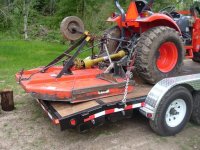
Here's the tractor butt. Note how in both photos the chains also squeeze the implements.
 

Attachments

  • 896931-tractor butt.JPG
    896931-tractor butt.JPG
    52.1 KB · Views: 342
/ Chain and binders #14  
Here's the tractor butt. Note how in both photos the chains also squeeze the implements.
 
/ Chain and binders #15  
On those Kubota hooks, do you chain using the criss cross method as your antique tractor picture shows?
 
/ Chain and binders #16  
On those Kubota hooks, do you chain using the criss cross method as your antique tractor picture shows?
 
/ Chain and binders #17  
</font><font color="blue" class="small">( 3) I use and recommend 4 separate chains and 4 separate binders. Each pair leading from a corner of the tractor to the trailer to make an "X" shape. )</font>

I know that sounds like overkill but it really isn't if you have to stop quick. I buy my transport chain in 20' lengths. It already comes with a hook on each end. I cut them into two 10' lengths and add 1 hook to the cut end on each chain. That is about the cheapest way that I've found to get enough chain to safely transport a tractor. 10' lengths are more than long enough if you use 4 chains (one one each corner). I also tie down the loader and any implement on the 3 pt.
 
/ Chain and binders #18  
</font><font color="blue" class="small">( 3) I use and recommend 4 separate chains and 4 separate binders. Each pair leading from a corner of the tractor to the trailer to make an "X" shape. )</font>

I know that sounds like overkill but it really isn't if you have to stop quick. I buy my transport chain in 20' lengths. It already comes with a hook on each end. I cut them into two 10' lengths and add 1 hook to the cut end on each chain. That is about the cheapest way that I've found to get enough chain to safely transport a tractor. 10' lengths are more than long enough if you use 4 chains (one one each corner). I also tie down the loader and any implement on the 3 pt.
 
/ Chain and binders #19  
</font><font color="blue" class="small">( On those Kubota hooks, do you chain using the criss cross method as your antique tractor picture shows?
)</font>
Yes. By the way the hooks are rated at 11,000 lbs each so I have a margin of safety.
 
/ Chain and binders #20  
</font><font color="blue" class="small">( On those Kubota hooks, do you chain using the criss cross method as your antique tractor picture shows?
)</font>
Yes. By the way the hooks are rated at 11,000 lbs each so I have a margin of safety.
 

Marketplace Items

2012 Peterbilt 386 T/A Day Cab Truck Tractor (A60352)
2012 Peterbilt 386...
2019 CATERPILLAR 326FL EXCAVATOR (A62129)
2019 CATERPILLAR...
IRET13 ELECTRIC TRICYCLE (A58214)
IRET13 ELECTRIC...
Oxy-acetylene Torch and Regulator Rig (A61307)
Oxy-acetylene...
500 BBL FRAC TANK (A58214)
500 BBL FRAC TANK...
2020 MACK GRANITE (A58214)
2020 MACK GRANITE...
 
Top