2manyrocks
Super Member
- Joined
- Jul 28, 2007
- Messages
- 9,520
Must be talking about a giant chubby pencil from kindergarten. Still waiting to see someone pick up a standard No. 2 pencil with a grapple.


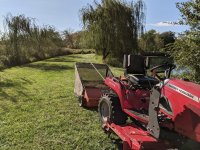
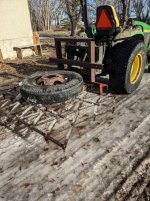
Excellent. Do you have float wheels on this, so you can just drop it and let it follow a lumpy lawn, or do you float it with adjusting your 3-point height? Also, are you using a hydraulic angle, or just manually setting it?Over some 40+ years of attempting to learn how to farm, I scoffed at 6', 3 pt mounted rakes that can be multi positioned and 360 degree rotated to pull or push debris, as I felt they were essentially useless (dumbass thought). This neighbor that cleaned up his Locust trees had tree parts everywhere as he had a tree stripper come out .....skid steer mounted device that just ripped the branches off the tree and made a big mess.
I thought about it and decided I'd try such implement so I bought one. Ha! Now one of my favorite implements. I use it for many things, including fall leaf raking and find that it's better at doing jobs (like putting rock back on and leveling driveways with loose rock, which were done with my blade or box scraper in the past. Give it some thought.


I use a chain in place of the top link. Allows me to raise when needed, but when I let it down, it follows (floats) the terrain.Excellent. Do you have float wheels on this, so you can just drop it and let it follow a lumpy lawn, or do you float it with adjusting your 3-point height? Also, are you using a hydraulic angle, or just manually setting it?
Looks like an excellent way to de-thatch a lawn, if it doesn't dig in too much.Rowse makes rakes for haying that are essentially a modern version of the dump rake.
Sounds like the easiest way to go for fields bordering woods, but this is a finished lawn space around the house, so this is not an area for flail mower.Maybe I'm lazy but if the branches weren't too thick that would be a mulching job for my flail mower during a mowing pass. Any big chunks that were left after being pummeled with the flail hammers I'd pick up
On my front and back lawn I do not like the little wood chunks to walk on barefoot - and I enjoy my barefoot time in the summer as I go in and out of the lake.Maybe I'm lazy but if the branches weren't too thick that would be a mulching job for my flail mower during a mowing pass. Any big chunks that were left after being pummeled with the flail hammers I'd pick up
You could set them to do that but normally the end of the tooth is more tangent to the ground and doesn't dig.Looks like an excellent way to de-thatch a lawn, if it doesn't dig in too much.
The full auto method is to hire someone to clean up for you. If you can afford to mow 4 acres you can afford to hire a contractor.Every spring, I spend at least a full afternoon cleaning up downed branches from my ~4 acres of lawn, mostly from the more mature walnut and maple trees. I get to repeat this exercise after each major storm, all summer long, and I'm getting awful tired of the routine. Presently, I drive the FEL to an area with a bunch of downed branches, pick up each larger one and put them into the bucket. Then I rake up all of the smaller bits, and scoop them into the bucket. Very tedious.
I'm wondering what automated options might be possible. A landscape rake with float (anti-scalp) wheels would do half the job, at least gathering them together. Although driving over them in the process is just going to make them harder to pick up, in the end. Perhaps a tooth bar on my bucket, fitted with large swivel caster mounts on either side, so that I can drive around gathering branches with the bucket floating just an inch off the lawn.
Ideas? I can't be the only one hating this chore.


This is true, for the single spring clean-up, but more difficult to schedule for the repeat of this task required after each and every major summer storm.The full auto method is to hire someone to clean up for you. If you can afford to mow 4 acres you can afford to hire a contractor.
I've been doing a lot of this, lately. Works, to a point, when the stuff is small enough to fit in the bucket, but large enough to still stay together in a bundle. I still end up bending and picking up a lot, though.I take a hay or pitch fork and run it along the ground, pushing the branches into a pile. Once I get a bushel or so of branches, I then use the fork at a downward angle, “stabbing” the pile to kind of compact them together. In one motion, I then lift the branches up almost vertically, so they sit against one another in the back support of the fork tines and carry them to the pile.
Not a way of using the tractor, but its inexpensive and effective.