Commuting

   / Commuting #61  
I had a minivan for a short time, one of my rare used vehicle purchases. Hated it. Had nothing to do with image. Then the transmission went out at 70k miles. Never had that happen on any honda, so i got rid of it and bought my first of 2 SUV pilots. Just a much better and more practical vehicle. Dont know why anyone would have a minivan instead of an SUV.

Now i wont be caught in a prius.
 
   / Commuting #62  
I had a minivan for a short time, one of my rare used vehicle purchases. Hated it. Had nothing to do with image. Then the transmission went out at 70k miles. Never had that happen on any honda, so i got rid of it and bought my first of 2 SUV pilots. Just a much better and more practical vehicle. Dont know why anyone would have a minivan instead of an SUV.
Now i wont be caught in a prius.
We had a 2002 Caravan that we bought in 2009 and replaced with a 2005 Yukon XL in 2014 as the Caravan had softball sized holes in the rocker panels.
More room, better ride, can tow anything we need to without any worry about the transmission (the Caravan had an odd shift "clunk" from time to time), a ceiling mounted DVD player (usually gets broken out at hour 3-4 of a car ride when the kids get tired of their coloring books), the wife loves it and the difference in fuel is about $400/year (14.5MPG vs 19ish MPG over 10,000 miles).
The only downside is that we miss having sliding doors when parking is tight, but we can live with that.

Aaron Z
 
   / Commuting #63  
I couldn't get my wife to touch a minivan when we were shopping earlier this year, but she did admit the access to the rear seat, and the overall seating capacity, was far better than any SUVs we shopped. Even among the Honda lineup where the Pilot SUV and Odyssey minivan share much of the same underpinnings (and Honda Ridgeline as well), the minivan version is so much more space efficient. That should be obvious to anyone who takes a careful look. If you can ignore the image, the minivan is king in many ways.

The interesting thing we found with SUVs is that the big ones didn't really have much more interior or cargo space than the midsize ones. In fact, the Yukon that I liked had a rather pathetic rear cargo area with a raised floor that was very unwieldy to use (was at mid stomach height for me, and I'm 6'1" tall). Apparently GM couldn't figure out how to hide a folding third row back there without a raised Mickey-mouse false floor. Really dumb. I am sure that is an artifact of the body-on-frame design that originates from pickup trucks.

In the end, the only thing compelling about the Yukon over smaller SUVs was the towing capacity. As I already have a full size crew cab pickup that can do even better, that wasn't real important on our shopping list. Of course the other problem was that GMC wants $70K-80K for Yukons, and that is past the line of delusional for me. It's nice but not that nice.
 
   / Commuting #64  
Of course the other problem was that GMC wants $70K-80K for Yukons, and that is past the line of delusional for me. It's nice but not that nice.
I have a family member who had a Yukon XL for years and just switched to a loaded GMC Crew Cab pickup as she couldn't see paying that much for a new Yukon.

Aaron Z
 
   / Commuting #65  
It's irrational to believe that people make rational decisions. Most people make decisions based on emotion, and most people I know wouldn't be caught dead in a mini-van because of their image.

Driving a mini van says "look at me, I'm a doting parent with three kids and a box of poopy diapers in the back." Mini vans are practical family hauling vehicles and that's the image they convey.

Driving a Prius has a different image, one with virtuosity wafting off it as it drives down the road, it's only purpose to save gas and make their drivers feel good about themselves.

Aside from using more fuel, trucks and SUV's can do pretty much everything. They're big and comfortable, powerful, durable, can drive through anything, tow heavy trailers, carry all kinds of stuff for rural living, and let's face it...they're cool.
We have a 2016 Tahoe, which we bought, reluctantly, to tow a sailboat. It’s the LT (middle) trim with Max Towing Package, MSRP was only $62,000.....

Other than being expensive, thirsty, hard to get in and out of, surprisingly little room because it has a beam rear axle, and the handling of the pickup it逞エ based on, no one is fooled: there are kids rolling around back there just like a minivan. It is only cool to parents in denial.

Kind of funny but we bought a new snow thrower, which would fit in the minivan. But with the Tahoe, had to drive back and get the trailer: not enough height, load floor is too high. It does tow well, and we needed 6,000+ towing and the ability to carry passengers and a dog, so giant, sluggish, ill-handling, expensive, gas guzzling SUV it is....
 
   / Commuting #66  
I couldn't get my wife to touch a minivan when we were shopping earlier this year, but she did admit the access to the rear seat, and the overall seating capacity, was far better than any SUVs we shopped. Even among the Honda lineup where the Pilot SUV and Odyssey minivan share much of the same underpinnings (and Honda Ridgeline as well), the minivan version is so much more space efficient. That should be obvious to anyone who takes a careful look. If you can ignore the image, the minivan is king in many ways.
The auto manufacturers do psychological profiling of buyers when designing their vehicles. The profile of parents who buy SUV’s instead of minivans is not very flattering....

''We have a basic resistance in our society to admitting that we are parents, and no longer able to go out and find another mate,'' Mr. Bostwick said. ''If you have a sport utility, you can have the smoked windows, put the children in the back and pretend you're still single.''

Minivan buyers are also less likely than sport utility buyers to have reservations about being parents. ''Sport utility people say, 'I already have two kids, I don't need 20,' '' Mr. Bostwick said. ''Then we talk to the people who have minivans and they say, 'I don't have two kids, I have 20 -- all the kids in the neighborhood.' ''

Such psychological factors play a bigger role in the dividing line between minivan and sport utility customers than in the division between any other segments of the auto market, he added.

....'Minivan people want to be in control in terms of safety, being able to park and maneuver in traffic, being able to get elderly people in and out,'' Mr. Schaafsma said. ''S.U.V. owners want to be more like, 'I'm in control of the people around me.' '' This is an important reason why seats are mounted higher in sport utilities than in minivans, he said.

Sport utility buyers are much more concerned with their vehicles' external appearance, while minivan buyers are more interested in the vehicles' interiors and practicality, said Thomas Elliott, Honda's executive vice president for North American auto operations. ''The people who buy S.U.V.'s are in many cases buying the outside first and then the inside,'' he said. ''They are buying the image of the S.U.V. first, and then the functionality.''

Strategic Vision, a market research company in San Diego that does a lot of work for the auto industry, has found that a greater percentage of minivan buyers than sport utility buyers are involved in their communities and families. Minivan buyers are more likely than buyers of any other kind of vehicle to attend religious services and to do volunteer work, while sport utility buyers rank with pickup truck buyers and sports car buyers as the least likely to do either,
Passenger fatality rates in cars and SUV’s are about the same. Minivans are lower.....Sorry, Suburban drivers.
 
   / Commuting #67  
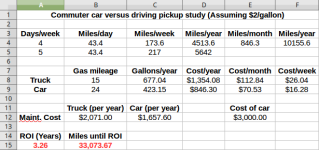
Car vs truck_commuting.png

I used the initial 5 year estimated cost of maintenance and repair; there's not much else available for vehicles past that (that I know of.) I assumed $3,000 to buy an 80-100k miles 2005-2008 Ford Focus, used $2/gallon for fuel, the EPA rating of my truck/car, having every other Friday off, and my mileage per day for work. A 3 year ROI isn't bad, but we already have 3 cars. My wife uses her Accord for commuting to work so that's out. My Mustang is a twin turbo'd toy, so that's out. I don't particularly want another car floating around and with a 3+ year ROI, it's not worth it to me to deal with the annoyance of more junk in the way. Between the sheep, horses, dogs, chickens, and travel for cycling, we use my truck so often that it doesn't make sense in my situation to have another car.

As someone said earlier, people have to decide if it makes sense for them. If you have the money for fuel, savings/retirement is taken care of each paycheck, and don't want a commuter car, don't get a commuter car.
 
   / Commuting #68  
I haven't done the numbers in awhile but it doesn't make sense for me to drive my truck every day. My commute is about 120mi round trip, 5-7 days a week (more 6 and 7 day weeks the last few months). I drive an 04 Corolla with 248k on it, gets about 30-35 mpg and maintenance is relatively low and inexpensive.

My truck is a 07 Ram 2500 4x4 Cummins, I need the 3/4t and 4x4 for what I do with it and where I live. I plan on keeping the truck as long as possible.

Between fuel cost and maintenence it isn't feasible to drive it to work everyday, not to mention trying to part a full size crew cab truck that you care about in the city.

I wish i could drive my truck every day but it just doesn't make financial sense.
 
   / Commuting #69  
I haven't done the numbers in awhile but it doesn't make sense for me to drive my truck every day. My commute is about 120mi round trip, 5-7 days a week (more 6 and 7 day weeks the last few months). I drive an 04 Corolla with 248k on it, gets about 30-35 mpg and maintenance is relatively low and inexpensive.

My truck is a 07 Ram 2500 4x4 Cummins, I need the 3/4t and 4x4 for what I do with it and where I live. I plan on keeping the truck as long as possible.

Between fuel cost and maintenence it isn't feasible to drive it to work everyday, not to mention trying to part a full size crew cab truck that you care about in the city.

I wish i could drive my truck every day but it just doesn't make financial sense.

I hear you. I had a commuter car several years ago when I was driving 160 miles/day for work, 4 days/week. It would have cost me a fortune in the 7.5L powered F250 I had at the time.
 
   / Commuting #71  
We have had SUV's since 2003, and cargo space has always neen a priority. I agree that a lot of the SUVs are not very well designed for cargo space. The one we really like is the Honda Pilot, which we bought in 2010. It is the roomiest of all that we checked out in the mid size category. Unfortunately, I think it was last year that Honda redesigned the pilot, and now it is smaller and looks like a jellybean. Do not like it. So we are sticking with our 2010 for now.
 
   / Commuting #72  
From what I can see, most people drive pickups to transport air back and forth from work. :laughing: We have a 4x8 utility trailer that does most of what they do with them.

Except if it rolls over, which accounts for 35% of traffic fatalities..And just hope you don’t meet the dump truck driver who feels the same way you do.

And when it comes to active safety - the ability to avoid an accident by turning and or braking - his smaller and much more agile car will avoid the accident altogether, rather than plowing into it like most trucks and their drivers will do.

We have a 2016 Tahoe and I do not understand why anyone drives these things unless they have to tow something heavy. Our Honda Odyssey minivan is much easier to get in and out of, has much more room, is faster, rides better, handles better, is faster, and gets 50% better mpg. But my wife wanted a sailboat that weighs 6,000 lbs on the trailer so she gets to drive the penalty box. SUV’s prove Americans have no driving skill.

Fatals in roll over accidents is due to people not being seat belted 99.9% of the time.
 
   / Commuting #73  
Fatals in roll over accidents is due to people not being seat belted 99.9% of the time.
True enough , for all vehicles.

If you look at the government projections for safety mandates, we should have about -20,000 highway deaths a year. Airbags are pretty much there to protect the knotheads who don’t wear seatbelts.
 
   / Commuting #74  
With fuel at $2.54/gallon and driving 10,000 miles per year, if you spend more than $2032/year on insurance and maintenance for your "commuter car", you are losing money driving a car that gets 50MPG vs one that gets 10MPG.
With fuel at $2.54/gallon and driving 20,000 miles per year, if you spend more than $1524/year on insurance and maintenance for your "commuter car", you are losing money driving a car that gets 50MPG vs one that gets 20MPG.
MPGMiles/year Gallons/year $/Gallon $/year
1010000 1,000 $ 2.54 $ 2,540
1510000 667 $ 2.54 $ 1,693
2010000 500 $ 2.54 $ 1,270
2510000 400 $ 2.54 $ 1,016
3010000 333 $ 2.54 $ 847
3510000 286 $ 2.54 $ 726
4010000 250 $ 2.54 $ 635
4510000 222 $ 2.54 $ 564
5010000 200 $ 2.54 $ 508

Aaron Z

I need a table set at 36,000 miles per year. Then add depreciation, as it can be the hidden, most expensive factor.

Nice table but it's missing the increased depreciation and added maintenance of the more expensive vehicle.

Insurance on the Accent is about $150 per year, I only carry liability/comprehensive. When I added it to the policy the truck insurance went down (multi-car), so it's actually less than that.

I average 19,000 miles per year on the Accent. It cost $12,500 new + $1000 tax/title so $13,500 in 2008. I don't have every sales receipt for gas that I've run through it but I would guess it averages out to close to $3 per gallon. 191,000/33mpg = 5788 gallons x 3 = $17363 in gas. Truck gets less than 18 mpg these days. 10,611 gallons x 3 = $31,833 minus $17,363 = $14,470 gasoline savings.

Maintenance on the Accent has been very inexpensive. 2 timing belts, 2 wheel bearings, plugs, tires, oil changes, and a couple other minor things. I figure I'm doing far less maintenance on the F150 driving @ about 1000 miles per year so anything I didn't have to spend on the truck because of mileage savings should be subtracted from the car maintenance.

I still think I'm ahead. Even tires are way less expensive.


I completely understand people like to drive trucks. To each their own, it's America after all.

Kevin

Lot of good info here. To each their own. Price of gas has been cheeeeep for the last couple of years. If it gets back to $3.50/gallon, there will be more small cars if it stays high for a year or two.
 
   / Commuting #75  
I need a table set at 36,000 miles per year. Then add depreciation, as it can be the hidden, most expensive factor.
Here is the table with 36k miles/year. Deprecation will vary based on the car make/model/year/options, etc.
MPG
Miles/year Gallons/year $/Gallon $/year
10
3600036002.549144
15
3600024002.546096
203600018002.544572
253600014402.543657
303600012002.543048
35360001028
2.542612
40360009002.542286
45360008002.54
2032
50360007202.541828

Aaron Z
 
   / Commuting #76  
Here is the table with 36k miles/year. Deprecation will vary based on the car make/model/year/options, etc.
MPG
Miles/year Gallons/year $/Gallon $/year
10
3600036002.549144
15
3600024002.546096
203600018002.544572
253600014402.543657
303600012002.543048
35360001028
2.542612
40360009002.542286
45360008002.54
2032
50360007202.541828

Aaron Z

Thanks.

I recommend buying a common car with about 80-100K miles on it, for as cheap as you can, thus reducing your depreciation. 36,000 miles a year, after 4-5 years, will totally kill the value of anything. Especially a new car.
 
   / Commuting #77  
I will stick with my truck thanks....That said, its only about 4 miles to work.
 
   / Commuting #78  
I will stick with my truck thanks....That said, its only about 4 miles to work.

I would do exactly the same. I dream of being that close to work, but I love where I live and not many opportunities here.
 
   / Commuting #79  
Places like Edmunds.com will give you the value adjustment for high mileage. For our 2014 outback, 12-15,000 miles/year is “normal.” 144,000 miles decreased the value $4,607.
 
   / Commuting #80  
Timely thread. I just switched jobs and traded a company car for a long commute in my own vehicle. 75 miles each way. The F450 is not a commuter in any way and neither is my 2500. So I bought a 2006 CRV. I've done the math and the commuter car almost always pays out for me.

Beyond that, i always hated bringing my nice truck onto job sites or worse, parking in Boston. Had to do both a few years ago with my POS Malibu. Best "Boston" car i owned. Of course it had some battle scars from that job, but thats what it was for.
 

Tractor & Equipment Auctions

2270 (A60432)
2270 (A60432)
John Deere 2640 2WD Tractor with 146 Front Loader (A57024)
John Deere 2640...
2003 Big Tex 10PI 16ft. T/A Pipe Top Utility Trailer (A55973)
2003 Big Tex 10PI...
2025 MACK GRANITE GR64F DUMP TRUCK (A59823)
2025 MACK GRANITE...
2014 Chevrolet Silverado 1500 High Country 4x4 Crew Cab Pickup Truck (A56858)
2014 Chevrolet...
2021 MULTIQUIP 25 WHISPERWATT AC GENERATOR (A59823)
2021 MULTIQUIP 25...
 
Top